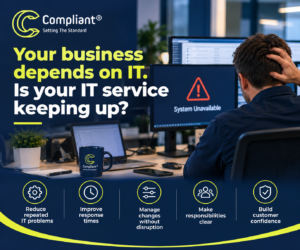
Your Business Depends on IT. Is Your IT Service Keeping Up?

 Your Business Cannot Afford IT That Keeps Letting You Down
It is Monday morning.
Your team is ready to start work. Customers are waiting, orders need processing, and there are deadlines to meet.
Then the system stops working.
Nobody can access the files they need. Emails are not coming through. Your customer service team cannot see important information, and employees are waiting for someone to fix the problem.
The IT team is already busy dealing with another issue.
An hour passes.
Then another.
Work is falling behind, customers are becoming frustrated, and your business is losing valuable time.
Eventually, the problem is fixed.
Everyone gets back to work.
But two weeks later, the same thing happens again.
How much is unreliable IT really costing your business?
For many organisations, IT problems have become an accepted part of the working day.
People expect systems to be slow sometimes. They accept that certain problems will keep returning. They learn to work around things that do not function properly.
But those small issues can have a much bigger effect than you might think.
When IT services fail, your employees cannot always do their jobs. Customers may not receive the service they expect, and managers can spend hours dealing with problems that should have been prevented.
Your business may also face extra costs from urgent repairs, missed deadlines and lost work.
This is where ISO 20000-1 IT Service Management can make a difference.
ISO/IEC 20000-1 is an internationally recognised standard that helps organisations manage and improve the IT services they provide.
It encourages businesses to plan their services, understand what customers need, deal with problems properly and keep looking for ways to improve.
The aim is simple.
Make sure IT services support your business rather than hold it back.
And when your business depends on technology every day, that is something worth taking seriously.
The Hidden Cost of Poor IT Service
When an IT system fails, most businesses focus on getting it working again.
That is understandable.
Employees need access to their systems, customers need answers, and work needs to continue.
But fixing the immediate problem does not always deal with the full cost.
Think about what happens when 20 employees cannot work properly because a key system is unavailable.
They may still be getting paid, but they cannot complete their normal tasks.
If each employee costs the business an average of £20 per hour, two hours of lost work could represent £800 in staff time.
And that is before you consider the cost of IT support, delayed orders or unhappy customers.
Not every minute of disruption will be completely unproductive, but even a short failure can have a serious effect.
Lost time across the business
IT problems rarely affect just one person.
A slow system can hold up an entire department.
A failed connection may prevent employees from accessing shared files.
An issue with customer records could stop your sales team from answering enquiries.
When systems are not working, people often find other tasks to complete.
But those tasks may not be the ones that matter most.
Important work gets pushed back.
Deadlines become harder to meet.
And when the system finally returns, employees may need to work harder to catch up.
Rising support costs
Repeated IT problems can also increase the cost of support.
Your IT team may spend hours fixing the same issues.
If you use an outside provider, you may face additional charges for urgent assistance.
Sometimes businesses buy new equipment or software without fully understanding what caused the problem.
That can lead to money being spent on solutions that do not address the real issue.
Unhappy customers
Customers do not usually care why your systems are not working.
They want the service they were promised.
If they cannot place an order, access an online service or receive an answer to a simple question, their confidence may begin to fall.
One delay might be forgiven.
Repeated problems can make customers question whether your business is reliable.
And when customers lose trust, they may start looking elsewhere.
Pressure on employees
Poor IT service does not just affect money.
It affects people.
Employees become frustrated when systems repeatedly fail.
They may feel embarrassed when they cannot help customers or complete their work on time.
Your IT team can also face growing pressure as more problems are reported.
If every day feels like an emergency, there is little time left to improve the service.
That is not a good way for any business to operate.
What Is ISO/IEC 20000-1?
ISO/IEC 20000-1 is an international standard for service management.
It sets out requirements for a service management system.
That might sound complicated, but the idea is straightforward.
A service management system is the way an organisation plans, delivers, checks and improves its services.
In an IT setting, this could include making sure systems are available, support requests are handled, changes are managed and problems are investigated.
ISO/IEC 20000-1 helps businesses bring these activities together.
Instead of dealing with every problem separately, the organisation develops a clear way to manage its services.
The standard can be used by internal IT teams and by businesses that provide IT services to other organisations.
It is not limited to large technology companies.
A smaller IT provider may benefit just as much as a large organisation, provided the system is designed to suit its needs.
It is about service, not just technology
One of the most important things to understand about ISO 20000-1 IT Service Management is that it is not simply about computers.
It is about the service people receive.
A business could have modern equipment, expensive software and skilled IT employees.
But if customers cannot get help when they need it, the service may still be poor.
Good IT service management looks at the whole experience.
Can people access the services they need?
Are problems handled within agreed times?
Do employees know who is responsible for each task?
Are changes planned carefully?
Does the organisation learn when something goes wrong?
These are the kinds of questions ISO/IEC 20000-1 helps businesses address.
Why Fixing IT Problems Is Not Enough
Imagine your business receives 30 IT support requests every week.
Most are dealt with quickly.
Your team is working hard, and customers generally receive a response.
On paper, everything may look fine.
But what if 10 of those requests relate to the same problem?
Perhaps employees regularly lose access to a shared system.
Each time, the IT team restores access.
The person can work again, and the request is closed.
But nobody investigates why the issue keeps happening.
The following week, another employee reports the same problem.
And the cycle continues.
Fixing a problem is not the same as preventing it from happening again.
ISO/IEC 20000-1 encourages organisations to look at repeated issues and understand their causes.
That means asking questions.
Why does the problem keep returning?
Is the system being used correctly?
Does something need updating?
Are employees receiving the right guidance?
Could a change prevent future failures?
The answers will vary.
But the aim is to stop wasting time on the same problems.
Move away from constant emergencies
When IT teams spend most of their time responding to urgent problems, they have little opportunity to plan ahead.
This can become a difficult cycle.
There is no time to improve systems because the team is too busy fixing them.
And because the systems are not improving, the problems keep returning.
A clear service management system can help break that cycle.
It gives the organisation a better way to identify risks, plan work and review what needs improving.
Not every problem can be prevented.
But businesses can reduce avoidable disruption by understanding their services and managing them more carefully.
How ISO 20000-1 Can Improve Your IT Services
A well-managed IT service should help employees work, support customers and meet business needs.
ISO/IEC 20000-1 provides a clear framework for achieving this.
Here are some of the ways it can help.
1. Make responsibilities clear
When an IT problem occurs, people need to know who should deal with it.
If nobody is sure, valuable time can be lost.
A support request might be passed between several employees before someone takes responsibility.
The customer becomes frustrated, and the problem takes longer to resolve.
ISO/IEC 20000-1 encourages organisations to define responsibilities.
Employees should understand what they need to do, who makes decisions and when a problem needs further attention.
This can make support more organised and reduce confusion.
2. Improve response times
When someone reports an IT problem, they want to know what will happen next.
Will they receive a response within an hour?
Will the issue be fixed today?
What happens if it cannot be resolved quickly?
A service management system helps organisations set clear expectations.
These should be based on what the business needs and what the service provider can realistically deliver.
It is also important to measure whether those expectations are being met.
If response times are regularly missed, the organisation needs to understand why.
Perhaps the team needs more support.
Maybe certain problems take longer than expected.
Or the process for handling requests needs improving.
Without reviewing performance, these issues can continue unnoticed.
3. Reduce repeated problems
Repeated IT issues waste time.
They also make customers less confident in the service.
ISO/IEC 20000-1 supports a more organised approach to finding and managing the causes of problems.
Instead of only recording that a system failed, the business can look at why it failed and whether action is needed to prevent it happening again.
Over time, this can help reduce unnecessary support requests and allow employees to focus on more valuable work.
4. Manage changes more carefully
Technology changes all the time.
Software needs updating.
New systems are introduced.
Equipment is replaced.
Businesses also change the way they work.
But poorly planned changes can create new problems.
Imagine an important software update is installed during a busy working day.
The update causes another system to stop working.
Employees cannot complete their tasks, and customers experience delays.
The change may have been necessary, but the timing and preparation were poor.
ISO/IEC 20000-1 requires organisations to manage changes in a controlled way.
That includes understanding the possible effects, planning the work and checking that changes achieve the intended result.
A little preparation can help avoid a great deal of disruption.
5. Improve communication
Communication is often one of the biggest sources of frustration when IT services fail.
Employees report a problem but hear nothing back.
Customers do not know when their service will return.
Managers receive different information from different people.
Even when the IT team is working hard, poor communication can make the situation feel worse.
A good service management system helps businesses decide what information needs to be shared, who needs to receive it and when updates should be provided.
People may be more understanding of a delay when they know what is happening.
Silence often creates more frustration than the problem itself.
What Happens When IT Services Grow Faster Than the Business Can Manage?
Growth is something most businesses want.
More customers.
More employees.
More contracts.
But growth can put pressure on IT services.
A system that worked well for 10 employees may struggle when the business reaches 50.
An informal support process might be manageable when there are only a few customer requests each week.
But what happens when there are hundreds?
Without clear processes, growing businesses can find themselves dealing with increasing numbers of problems.
Employees may begin working in different ways.
Support requests can be missed.
Important information may not be recorded.
And managers may struggle to understand whether the service is performing well.
Build a service that can grow
ISO 20000-1 IT Service Management helps organisations plan for their needs.
That includes understanding what services are provided, who uses them and what is required to deliver them properly.
As the business changes, those needs can be reviewed.
For example, a company planning to take on a large new customer may need to consider whether its current IT support arrangements can manage the additional work.
Will more employees be needed?
Can existing systems handle the demand?
Are suppliers able to provide the required support?
What happens if something goes wrong?
Thinking about these questions before growth takes place can help reduce problems later.
A well-managed service is not just about coping with today’s workload.
It should also support the business as its needs change.
Why Your IT Team Should Not Have to Carry Everything Alone
In some organisations, one or two employees hold most of the knowledge about how IT services work.
They know which systems need special attention.
They remember how previous problems were fixed.
They understand which suppliers to contact.
And when something goes wrong, everyone turns to them.
This may work for a while.
But what happens when those employees are on holiday, off sick or leave the business?
Important knowledge can disappear.
Problems may take longer to resolve.
Other employees may struggle because they do not know what to do.
A service management system helps organisations reduce this risk.
Important information can be recorded and made available to the people who need it.
Responsibilities can be shared.
Processes can be explained clearly.
Training can also help employees understand their roles.
The aim is not to remove the value of experienced people.
It is to make sure the business can continue providing a reliable service without depending entirely on one person.
How Do You Know Whether Your IT Service Is Performing Well?
Many businesses only review their IT service when something goes wrong.
If customers are not complaining, managers may assume everything is working.
But the absence of complaints does not always mean the service is performing well.
Employees may have stopped reporting small problems because they do not expect anything to change.
Customers might be putting up with slow responses.
Your IT team may be working extra hours to keep services running.
Without useful information, these problems can remain hidden.
Measure what matters
ISO/IEC 20000-1 encourages organisations to review how well their services are performing.
That does not mean producing large reports full of figures nobody understands.
It means choosing information that helps the business make better decisions.
For example, you might look at:
-
How many IT problems are reported each month.
-
How quickly support requests are answered.
-
How long important systems are unavailable.
-
How often the same problems return.
-
Whether customers are satisfied with the service.
-
How many planned changes cause unexpected problems.
These measures can help managers understand what is working and what needs attention.
Turn information into action
Collecting figures is not enough.
The information needs to be used.
If the same problem is reported every week, someone should investigate.
If customers are unhappy with response times, the business should look at what can be improved.
If a change causes a major failure, the team should review what happened.
Small improvements made regularly can lead to a more reliable service over time.
That is one of the key aims of ISO 20000-1 IT Service Management.
Could Better IT Service Management Save Your Business Money?
When business owners consider improving IT services, cost is often one of their first concerns.
They may worry about spending money on new systems, staff training or consultancy support.
Those costs need to be considered carefully.
But it is also worth looking at what poor IT service already costs the business.
Consider a simple example.
An organisation experiences four hours of avoidable IT disruption each month.
During that time, 15 employees are unable to complete their normal work.
If the average staff cost is £20 per hour, the potential cost of that lost working time is:
Illustrative cost of IT disruption
Monthly cost
£1,200
Annual cost
£14,400
Based on 15 employees, four hours of disruption each month and £20 per hour. Actual costs will vary.
That does not include lost sales, customer complaints or the cost of fixing the problem.
Now imagine reducing the amount of disruption.
Even a modest improvement could free up valuable time and reduce avoidable costs.
ISO/IEC 20000-1 does not guarantee savings.
However, it gives businesses a structured way to identify problems, improve services and review whether changes are delivering value.
For organisations that depend heavily on IT, this can be an important part of managing costs.
The Benefits of an ISO Consultant’s Support
Understanding the value of better IT service management is one thing.
Finding the time to improve it can be another.
Your IT team may already be busy handling support requests, managing systems and helping employees.
Managers may know that processes need improving but struggle to decide where to begin.
There may also be uncertainty about what ISO/IEC 20000-1 requires.
This is where the benefits of an ISO consultant’s support can become clear.
An experienced consultant can help your organisation understand the standard and develop a service management system that suits the way you work.
Understand where you are now
Before making changes, it is important to understand what is already in place.
Your business may have effective processes that do not need replacing.
There may also be areas where responsibilities are unclear or important information is missing.
An ISO consultant can help review your existing arrangements and identify gaps.
This provides a starting point for improvement.
Avoid unnecessary work
One concern businesses often have about ISO certification is the amount of paperwork involved.
Nobody wants to spend hours creating documents that do not help employees or customers.
A good consultant should help you understand which processes and records are needed.
The aim is to build a practical system that meets the standard and supports the business.
Not to create extra work simply for the sake of certification.
Help your team understand the requirements
ISO standards can seem difficult when you first read them.
Some requirements may be unfamiliar.
Others may need explaining in the context of your business.
A consultant can help turn those requirements into clear actions.
This can make the process easier for managers and employees to understand.
It can also help people see how their daily work supports the service management system.
Prepare for certification
If your organisation is working towards ISO/IEC 20000-1 certification, there will be a number of steps to complete.
These may include reviewing current processes, making improvements, checking that the system works and preparing for an external audit.
An ISO consultant can provide guidance throughout that journey.
The consultant does not award certification. That decision is made by the certification body.
But practical support can help your team understand what to expect and prepare more confidently.
Keep improving after certification
Certification should not be the end of the journey.
Your IT services will continue to change.
New customers may have different needs.
Technology will develop.
Your business may grow.
An ISO consultant can provide ongoing support to help you review your system and keep it useful.
At Compliant Ltd, we focus on helping businesses understand their responsibilities and build management systems that support their day-to-day work.
The aim is to make compliance easier to manage while helping businesses improve the services they provide.
Can ISO/IEC 20000-1 Help You Win More Business?
For organisations that provide IT services to customers, trust is essential.
Customers want to know that their systems and services are being managed properly.
They need confidence that support will be available when problems occur.
They also want to know that changes will be handled carefully and that the provider is committed to improving.
ISO/IEC 20000-1 certification can help demonstrate that an organisation has a recognised service management system in place.
This may be useful when responding to tenders or completing supplier checks.
Some customers may specifically request evidence of service management arrangements.
Others may view certification as a sign that the provider takes service quality seriously.
Of course, certification does not guarantee new contracts.
Price, experience, technical ability and customer service will still matter.
But a recognised standard can provide useful evidence of how your organisation manages its services.
For businesses looking to grow, that can support conversations with potential customers.
Make IT Service Management Part of Everyday Work
One of the biggest mistakes an organisation can make is treating ISO/IEC 20000-1 as something that only matters during an audit.
Documents are updated.
Records are checked.
Employees are reminded of their responsibilities.
Everyone works hard to prepare.
Then the audit finishes, and the system receives little attention until the next assessment.
That approach misses much of the value.
A service management system should help your business every day.
It should make it easier to deal with problems, plan changes and understand whether services are meeting customer needs.
Managers should use the information it provides.
Employees should understand how the processes support their work.
And leaders should see reliable IT services as an important part of business performance.
Start with the problems that matter most
You do not need to improve everything at once.
Begin by looking at the problems causing the greatest disruption.
Perhaps your customers are unhappy with response times.
Maybe the same technical issue keeps returning.
Or your team is struggling to manage changes without affecting other services.
Identify the problem.
Understand what is causing it.
Decide what needs to change.
Then check whether the improvement has worked.
This approach can help you make progress without overwhelming your team.
It also supports the wider aim of ISO 20000-1 IT Service Management: delivering services that meet needs and improve over time.
Your Business Depends on IT. Make Sure IT Can Support Your Business.
Technology is now part of almost every business activity.
It helps employees communicate, manage information, serve customers and complete their work.
When IT services are reliable, people may barely notice them.
Work gets done.
Customers receive the support they need.
The business can focus on its goals.
But when IT services repeatedly fail, the effects can spread quickly.
Employees lose time.
Customers become frustrated.
Costs increase.
And managers are left dealing with problems that take attention away from running the business.
The question is not whether your IT service will ever experience a problem.
Problems will happen.
The question is whether your organisation has the right arrangements in place to manage them, learn from them and reduce the chance of them happening again.
ISO/IEC 20000-1 provides a recognised framework for doing exactly that.
It can help businesses improve how services are planned, delivered, checked and improved.
It can support clearer responsibilities, better communication and more reliable service.
And with the right approach, it can become a valuable part of how your business operates.
The benefits of an ISO consultant’s support can make that journey easier, particularly when your team is already managing a busy workload.
At Compliant Ltd, we understand that businesses need practical advice.
You want to know what the standard requires.
You want to understand what needs improving.
And you want a service management system that supports your business rather than creating unnecessary work.
Ready to Improve Your IT Service Management?
If your organisation is dealing with repeated IT problems, slow support, service delays or growing customer expectations, it may be time to review how your services are managed.
Whether you are considering ISO/IEC 20000-1 for the first time, preparing for certification or looking to improve an existing management system, Compliant Ltd can help.
We provide practical ISO consultancy support to help businesses understand the requirements, identify areas for improvement and prepare for certification.
Our aim is to help you build a management system that works for your organisation and supports the services your customers depend on.
Speak to Compliant Ltd about your certification plans.
Visit compliantltd.com to learn more about our ISO consultancy and certification support.
Supporting businesses through compliance with confidence.