Skip to main content
Skip to footer
Skip to main content
Skip to footer

ISO 14001: Are Environmental Risks Hiding in Your Everyday Operations?
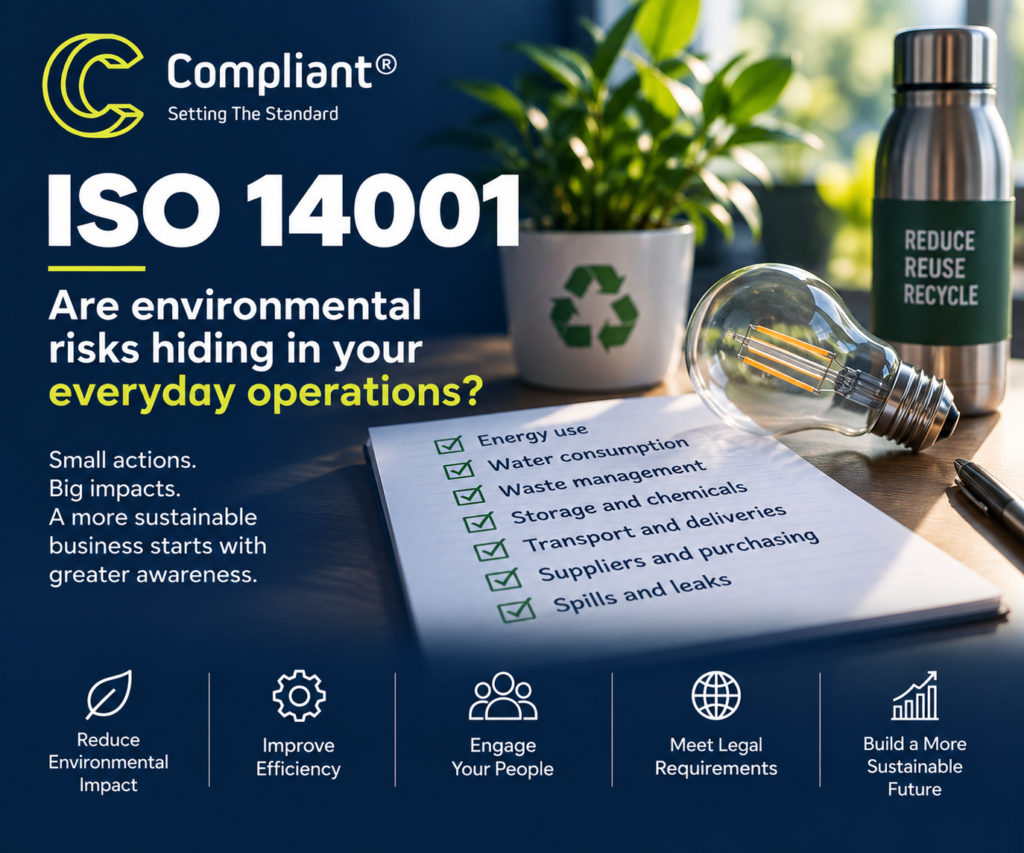
ISO 14001: Are Environmental Risks Hiding in Your Everyday Operations?
Environmental problems do not always begin with a major spill, a serious incident or something dramatic enough to make everyone stop and take notice.
Sometimes they begin with a dripping tap.
A waste container that is not labelled properly.
Equipment left running overnight.
Chemicals stored in the wrong place.
A delivery vehicle making unnecessary journeys.
A member of staff putting something into the wrong bin.
A supplier using far more packaging than necessary.
Individually, these things may seem small.
But when they happen every day, across different parts of a business, the impact can grow.
That is where ISO 14001 can make a real difference.
It encourages businesses to look closely at their everyday activities and understand how they affect the environment. More importantly, it helps organisations move away from simply reacting to environmental problems and start managing them before they become bigger issues.
Because some of your greatest environmental risks may not be hiding in unusual situations.
They could be part of the way you work every single day.
When Something Becomes Normal, We Stop Seeing It
Walk through your workplace tomorrow and look at it as though you have never been there before.
What would you notice?
Lights on in empty rooms?
Equipment running when nobody is using it?
Waste bins containing items that could have been recycled?
Products stored somewhere they could leak?
Doors left open while heating or air conditioning is running?
Large amounts of unnecessary packaging?
Water being used when it does not need to be?
Your employees may walk past these things every day.
That does not mean they do not care.
They may simply have become normal.
This happens in almost every area of business.
When we see something repeatedly, we stop noticing it.
That is one reason environmental risk management needs structure.
ISO 14001 encourages businesses to stop, look and question.
What are we doing?
How could it affect the environment?
Are we controlling that impact?
Could we do something better?
Those questions can uncover risks and opportunities that have been sitting in plain sight.
What Does ISO 14001 Actually Help You Do?
ISO 14001 is an international standard for environmental management systems.
That sounds complicated.
In practice, the idea behind it is straightforward.
Your organisation needs to understand how its activities interact with the environment and then manage the important effects.
This can include the resources you use.
The waste you create.
The energy you consume.
The emissions associated with your activities.
The products you purchase.
The materials you store.
The journeys you make.
The suppliers you use.
The possibility of spills or leaks.
The way products are eventually disposed of.
ISO 14001 helps bring these different areas together within one management system.
Rather than environmental responsibility being a collection of separate actions, it becomes part of how the business operates.
Environmental Risk Is Different for Every Business
There is no single environmental checklist that works for every organisation.
A manufacturing company may need to think carefully about chemicals, machinery, emissions and waste materials.
A construction business may need to consider fuel, dust, noise, waste and the impact of work on local areas.
An office-based organisation may have fewer obvious environmental risks, but it still uses electricity, purchases equipment, produces waste and relies on transport and suppliers.
A logistics company will have another set of considerations.
That is why copying another company’s environmental management system rarely works well.
ISO 14001 should reflect your organisation.
Your activities.
Your environmental impacts.
Your risks.
Your opportunities.
Your legal and other requirements.
Your priorities.
The starting point is understanding what actually happens within your business.
Waste Is an Obvious Place to Look
Waste is one of the easiest environmental impacts to see.
But businesses can still underestimate it.
Look at what goes into your bins over a normal week.
How much of it needed to become waste?
Could something have been reused?
Could it have been recycled?
Was too much ordered?
Did packaging create unnecessary waste?
Did a mistake mean materials had to be thrown away?
Waste is not only an environmental issue.
It can also represent wasted money.
You paid for the material.
You may have paid for it to be delivered.
Employees may have spent time handling it.
Then you may pay again to have it taken away.
Reducing waste can therefore have more than one benefit.
ISO 14001 encourages businesses to understand where waste comes from and consider whether it can be prevented or reduced.
That is far more useful than simply finding another bin to put it in.
Look Beyond the Recycling Bin
Recycling is useful.
But good environmental management should go further.
The better question is often:
Could we avoid creating this waste in the first place?
Perhaps suppliers could use less packaging.
Maybe materials could be ordered in different quantities.
A process could be changed to reduce offcuts.
Reusable items could replace disposable ones.
Documents could be shared electronically instead of printed.
Products could be repaired rather than immediately replaced.
The answer will depend on the business.
The important part is asking the question.
Recycling deals with something after it has become waste.
Prevention looks at why the waste existed at all.
Energy Use Can Hide in Plain Sight
How much energy does your organisation use when nobody is doing any work?
That is worth investigating.
Lights.
Computers.
Machinery.
Heating.
Cooling.
Chargers.
Kitchen equipment.
Ventilation.
Some equipment needs to remain on.
Some does not.
The problem is that habits develop.
The last person leaves the room and nobody switches the light off.
A computer stays on all night because it always has.
Heating operates at the weekend even when the building is empty.
Machinery runs during breaks.
Individually, each example may appear insignificant.
Across a year, the numbers can look very different.
ISO 14001 encourages organisations to understand resource use and identify opportunities to reduce unnecessary consumption.
That can help reduce environmental impact.
It may also reduce costs.
Water Deserves Attention Too
Water can easily be overlooked, particularly in businesses where it is not part of the main product or service.
But everyday waste adds up.
A leaking tap.
A faulty toilet.
Equipment using more water than necessary.
Cleaning processes that could be improved.
Leaks that remain unnoticed.
Businesses should understand where water is being used and whether there are opportunities to reduce waste.
Again, this does not need to become complicated.
Sometimes improvement begins because somebody notices a problem and reports it.
The management system then needs to make sure something happens as a result.
What Are You Storing?
Storage areas can contain environmental risks that people stop noticing.
Oils.
Fuels.
Cleaning products.
Paints.
Chemicals.
Waste materials.
Batteries.
Containers.
Ask some basic questions.
What is being stored?
Does it need to be there?
Is it stored correctly?
What would happen if the container leaked?
Could the substance reach a drain?
Is suitable spill equipment available?
Do employees know what to do?
Are containers clearly identified?
A container sitting safely on a shelf today may not feel like an environmental risk.
But risk management considers what could happen.
That is an important difference.
You do not wait for the leak before deciding how it should have been stored.
Small Spills Can Become Bigger Problems
A spill does not need to involve thousands of litres to matter.
Even a smaller incident can create problems if the substance reaches soil, water or drainage systems.
The response matters.
Would employees know what to do?
Where are spill kits located?
Are they suitable for the materials being used?
Who needs to be told?
How should contaminated materials be disposed of?
When was the response last tested?
Having a spill kit in a cupboard is not the same as being prepared.
People need to know it exists.
They need to know when and how to use it.
Environmental emergency planning under ISO 14001 helps businesses think about these situations before they happen.
Transport Is Part of the Picture
Environmental impacts do not stop at the front door.
Think about the journeys connected to your organisation.
Deliveries.
Business travel.
Company vehicles.
Employee travel.
Collections.
Supplier journeys.
Could deliveries be combined?
Could some meetings take place without travel?
Are routes planned efficiently?
Are vehicles maintained properly?
Could purchasing decisions reduce unnecessary transport?
Not every journey can be removed.
That is not the point.
The goal is to understand where environmental impacts occur and look for sensible opportunities to reduce them.
Your Purchasing Decisions Matter
Environmental management starts before a product arrives at your premises.
What you buy matters.
Where it comes from matters.
How it is packaged matters.
How long it lasts matters.
What happens when you no longer need it matters.
Consider two products that perform the same job.
One lasts significantly longer.
One uses less energy.
One arrives in reusable packaging.
One can be repaired.
One can be recycled more easily at the end of its life.
The cheapest purchase price does not always tell the whole story.
ISO 14001 encourages businesses to consider environmental issues when making relevant purchasing decisions.
This can help environmental thinking move beyond one department and become part of wider business decisions.
Your Suppliers Can Affect Your Environmental Performance
Your organisation may be working hard to reduce its environmental impact.
But what about the businesses supplying you?
Perhaps a supplier sends every small item in a large box filled with plastic.
Maybe deliveries arrive separately when they could be combined.
A contractor may not understand your environmental rules.
A waste provider might not be managing materials in the way you expect.
You cannot control every action another organisation takes.
But you can consider environmental requirements when choosing and managing suppliers.
You can ask questions.
You can set expectations.
You can review performance.
You can look for better options.
Supply chains can create environmental risks.
They can also create opportunities for improvement.
What Happens to Your Waste After It Leaves?
A waste collection vehicle arrives.
Your waste disappears.
Problem solved?
Not necessarily.
Businesses need to understand their responsibilities.
Simply handing waste to somebody else does not mean you should stop thinking about it.
Who is collecting it?
Where is it going?
Is it being handled correctly?
Do you have the records you need?
Are different types of waste being separated where required?
Environmental management needs to follow the process beyond your own bin.
This is an area where assumptions can create problems.
“We thought the contractor dealt with that” is not a strong environmental control.
Know what is happening.
Environmental Law Cannot Be Ignored
Businesses may have environmental legal requirements that apply to their activities.
The exact requirements depend on what the organisation does, where it operates and the environmental impacts involved.
One challenge is that businesses do not always know which requirements apply.
Another is keeping that information current.
ISO 14001 requires organisations to understand relevant compliance obligations and consider how they apply.
This matters.
Environmental management is not only about voluntary improvements such as reducing electricity use.
Some requirements are legal duties.
Businesses need a process for identifying them, understanding them and checking whether they are meeting them.
Your Employees Will See Things Management Does Not
Senior managers cannot be everywhere.
Employees working within processes every day will often see environmental issues first.
They notice the leaking equipment.
They see which materials are regularly thrown away.
They know when a waste container is constantly becoming full.
They know which machine is left running.
They see where packaging is excessive.
They know which process creates unnecessary waste.
Ask them.
A strong environmental management system should give employees a way to raise concerns and suggest improvements.
Some of the best environmental improvements may come from people who do not have the word “environmental” anywhere in their job title.
They simply understand the work.
Training Should Relate to the Person’s Job
Environmental training should not mean giving every employee the same presentation and expecting that to solve everything.
People need information that relates to what they do.
Someone handling chemicals needs to understand safe storage and what to do during a spill.
An employee responsible for purchasing may need to understand environmental considerations when choosing suppliers or products.
Someone managing waste needs to understand how it should be separated and stored.
Office employees may need simple guidance about energy, waste and reporting problems.
Make it relevant.
People are more likely to remember information when they understand how it connects to their everyday work.
Environmental Incidents Should Teach You Something
If something goes wrong, correcting the immediate problem is important.
But do not stop there.
Suppose a container leaks.
Clean it up.
Then ask why it happened.
Was the container damaged?
Was it stored incorrectly?
Had nobody checked it?
Was the storage area unsuitable?
Had employees been trained?
Could the same thing happen somewhere else?
This is where an environmental management system creates value.
The aim is not simply to deal with today’s problem.
It is to reduce the chance of having tomorrow’s version of the same problem.
Near Misses Matter Too
Sometimes something nearly goes wrong.
A container almost falls.
A spill is caught before it reaches a drain.
Waste is nearly put into the wrong container.
An employee notices damaged storage before anything leaks.
These events can be extremely useful.
Nothing serious happened.
Great.
But ask what the event is telling you.
A near miss can expose a weakness without causing the damage that a full incident might create.
Use that opportunity.
Fix the weakness while you still have the chance.
Internal Audits Should Look at What Really Happens
An environmental internal audit should not simply involve sitting at a desk checking documents.
Go and look.
Walk around.
Talk to people.
Look at waste areas.
Check storage.
Look at energy use.
Ask employees what they would do during a spill.
Check whether environmental procedures match actual practice.
Look at previous problems.
See whether improvements were completed.
The purpose is not to catch people doing something wrong.
It is to understand whether your environmental management system is working.
If there is a weakness, finding it internally is valuable.
You have an opportunity to improve it.
Environmental Objectives Need to Mean Something
“We want to be greener.”
It sounds positive.
But what does it actually mean?
A useful environmental objective should give the business something clear to work towards.
Reduce a particular type of waste.
Lower electricity use.
Reduce water consumption.
Improve recycling.
Reduce unnecessary travel.
Cut the amount of packaging purchased.
The objective needs to make sense for your organisation.
Then monitor progress.
If you want to reduce waste, understand how much you currently create.
Make changes.
Measure again.
Did it work?
If not, why?
This is how ISO 14001 turns good intentions into action.
Small Changes Can Create Bigger Benefits
Environmental improvement does not always require a huge project.
A simple change to ordering may reduce waste.
Changing a delivery schedule could reduce journeys.
Fixing a water leak reduces unnecessary consumption.
Clearer labels could improve waste separation.
Better training could reduce spills.
Switching equipment off could reduce energy use.
One improvement may seem small.
But multiply it across employees, sites and months.
The impact can become much larger.
Small improvements also help build a culture where people regularly think about environmental performance.
That can be just as valuable as the individual saving.
Why ISO Consultant Support Can Help
One of the hardest things about environmental risk is recognising something that has become normal.
Your team sees the same workplace every day.
They know the processes.
They understand the shortcuts.
They know which bin always becomes too full.
They know that particular container has “always been stored there”.
Familiarity can make risks harder to see.
An experienced ISO consultant can bring an outside perspective.
They can walk through a process and ask:
Why is this stored here?
What happens to this waste?
Who checks this?
What would happen if this leaked?
Why is this equipment running?
Where does this material go next?
How do you know your waste contractor is suitable?
What environmental requirements apply here?
When was this last reviewed?
These are not complicated questions.
But they can reveal gaps.
Consultant Support Can Make ISO 14001 Practical
ISO standards can sometimes feel overwhelming when a business first approaches them.
The danger is that organisations become focused on documents rather than environmental performance.
A procedure gets written.
A form gets created.
A policy goes on the wall.
Everyone prepares for the audit.
But what changed?
A good ISO consultant can help keep the focus on practical improvement.
What environmental impacts actually matter?
What controls do you need?
What are you already doing well?
Where are the gaps?
What evidence is useful?
What can be simplified?
Your environmental management system should help you manage environmental performance.
It should not exist simply to produce paperwork.
A Fresh Pair of Eyes Can Challenge Assumptions
“We’ve never had a spill.”
“We’ve always stored it there.”
“Our waste company handles everything.”
“That machine has always stayed on.”
“We don’t use enough water for it to matter.”
“We’re only an office.”
These statements might be completely reasonable.
But they are worth questioning.
An ISO consultant can help challenge assumptions without losing sight of how the business actually operates.
The goal is not to find problems for the sake of finding problems.
It is to make sure important environmental risks are understood rather than assumed to be under control.
Leadership Has to Be Involved
ISO 14001 cannot sit with one environmental manager while everyone else carries on as normal.
Leadership matters.
Managers decide priorities.
They approve resources.
They influence purchasing.
They set expectations.
Most importantly, employees watch what leaders do.
If managers talk about reducing waste but regularly ignore the waste rules themselves, people notice.
If environmental improvement is only discussed before an audit, employees notice that too.
Environmental responsibility becomes stronger when leadership treats it as part of running the business.
Not an extra job.
Not an audit exercise.
Part of normal decision-making.
Look at Your Business Differently Tomorrow
When you arrive at work tomorrow, try something simple.
Do not immediately start your normal routine.
Look around.
What is being wasted?
What is running?
What is being thrown away?
What is being stored?
What could leak?
What journeys are happening?
What are you buying?
What happens to the things you no longer need?
What would happen if something went wrong?
Then ask your employees what they notice.
You might be surprised by the answers.
Environmental risks do not always announce themselves.
Often, they become part of the background.
Are Environmental Risks Hiding in Your Everyday Operations?
ISO 14001 is not simply about having an environmental policy or achieving another certificate.
Its real value comes from understanding the relationship between your organisation and the environment.
That starts with everyday operations.
The waste you produce.
The energy and water you use.
The materials you buy.
The substances you store.
The suppliers you choose.
The journeys you make.
The decisions your employees make.
The incidents you learn from.
The improvements you introduce.
An experienced ISO consultant can support that process by helping you understand ISO 14001, identify environmental risks, challenge assumptions and create a management system that reflects the way your organisation actually works.
But improvement begins with looking.
So choose one part of your organisation today.
Walk through the process from beginning to end.
Do not only ask whether it works.
Ask:
What environmental impact does this have?
What could go wrong?
Are we doing anything we don’t need to do?
Could we use less?
Could we waste less?
Could we do this differently?
You may discover that your biggest opportunity is not hidden inside a complicated environmental report.
It may be something your employees walk past every morning.
Because environmental risks do not have to be dramatic to matter.
And when small risks become everyday habits, their impact can grow quietly over time.
ISO 14001 helps you notice them before “that’s just how we do it” becomes an expensive environmental problem