 Your Business Might Be Secure. But What About the Companies You Trust With Your Data?
You have invested time and money into protecting your business.
Your employees use passwords. Important files are stored securely. Your systems are updated, and your team understands the importance of keeping information safe.
You feel confident that your business is taking security seriously.
But there is one question you may not have considered.
How secure are the companies that have access to your information?
Think about the suppliers your business uses every day.
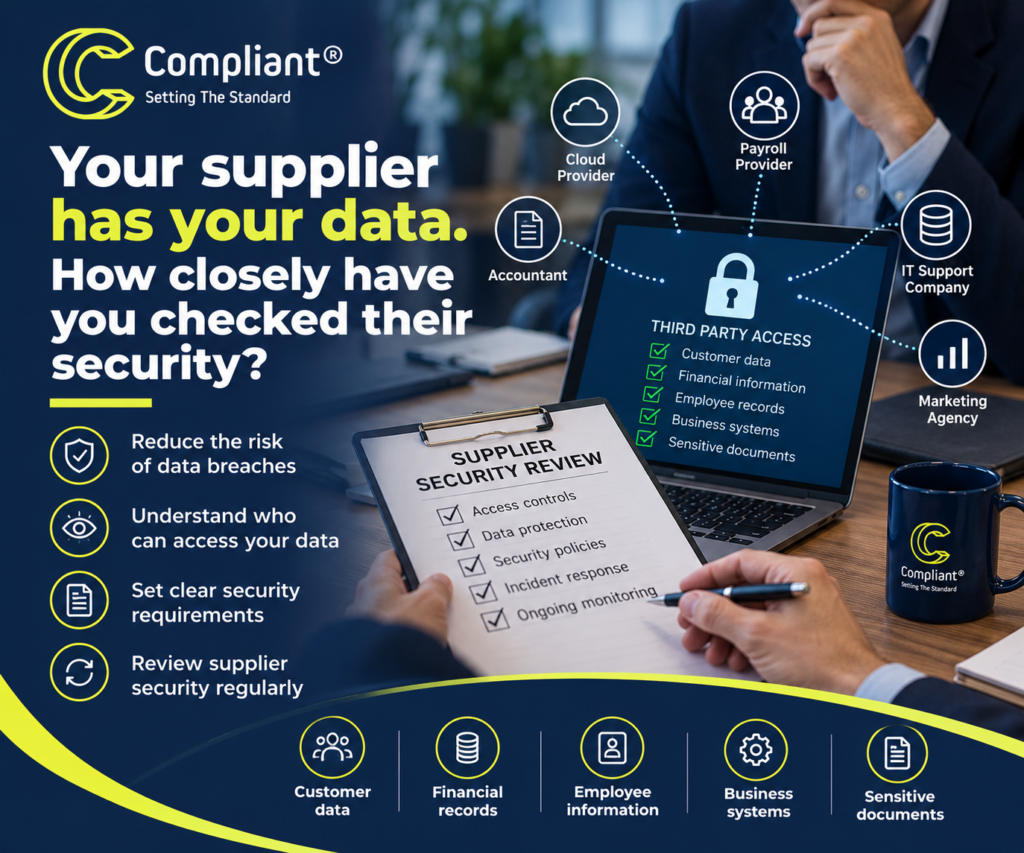
Your accountant may have access to financial records.
Your payroll provider holds employee information.
Your IT support company may have access to your systems.
Your cloud storage provider could be holding thousands of important documents.
And your marketing agency might have access to customer information or online accounts.
You trust these companies to look after your information.
But have you checked how they protect it?
What would happen if one of their systems was attacked?
What if an employee at a supplier accidentally shared your customer information?
Or what if a company you work with suffered a serious data breach and your business information was exposed?
The problem is that your business can have strong security measures and still be affected by poor security at a supplier.
That is a risk many businesses do not fully understand until something goes wrong.
And by then, the damage may already have been done.
This is where ISO 27001 supplier security becomes important.
ISO/IEC 27001 is an internationally recognised standard for managing information security.
It helps organisations understand the risks to their information and put suitable measures in place to protect it.
An important part of this is understanding the risks linked to suppliers.
Because protecting your business information should not stop when that information leaves your office.
How Much Information Are You Sharing With Suppliers?
Most businesses rely on outside companies to provide important services.
It would be difficult to operate without them.
Accountants help manage finances.
IT providers keep systems working.
Payroll companies process wages.
Software providers help employees complete everyday tasks.
These services can save time, reduce costs and allow businesses to focus on what they do best.
But they also create another responsibility.
You need to understand what information those suppliers can access and how it is being protected.
Your suppliers may hold more information than you realise
Consider a small business with 30 employees.
It uses an outside payroll company, an IT support provider, an online customer management system and a cloud storage service.
Each supplier may hold or access different information.
The payroll company could have employee names, addresses, bank details and salary information.
The IT provider may have access to company systems, email accounts and important files.
The customer management system could contain contact details, sales records and information about ongoing work.
The cloud storage provider may hold business documents, contracts and financial records.
That is a lot of information being handled outside the business.
And every supplier relationship creates questions that need answering.
Who can access the information?
Where is it stored?
How is it protected?
What happens if something goes wrong?
And what happens to the information when the supplier relationship ends?
If you cannot answer these questions, you may not fully understand the risks your business is facing.
Sharing information does not remove your responsibility
Some businesses assume that once information has been passed to a supplier, protecting it becomes entirely the supplier’s problem.
That is not always the case.
For example, under UK data protection law, a business that decides why and how personal information is used will often remain responsible for meeting its duties, even when another company processes that information on its behalf.
This means choosing suppliers carefully and putting suitable arrangements in place.
Not every supplier has the same legal role, and the requirements will depend on the information and services involved.
But one thing is clear.
You should not assume that handing information to another company means you no longer need to think about its security.
The Hidden Cost of Poor Supplier Security
When people think about a data breach, they often imagine someone breaking into their own company’s computer systems.
But a security problem can also begin with a supplier.
And the effects can reach far beyond the company where the problem started.
Financial losses
A supplier security failure could leave your business facing unexpected costs.
You may need help investigating what happened.
Systems might need to be checked or repaired.
Customers may need to be contacted.
Legal advice could be required.
Depending on the circumstances, there may also be costs linked to lost work, recovery and possible claims.
For some businesses, these costs can be difficult to manage.
Lost customer trust
Customers share information with businesses because they expect it to be handled responsibly.
They may not know which outside companies help you deliver your services.
If their information is exposed through a supplier, they may still question why your business shared it and whether enough care was taken.
Trust can take years to build.
A serious security failure can damage it very quickly.
Business disruption
Imagine your business relies on an outside IT provider to manage an important system.
That provider suffers a security incident and the service becomes unavailable.
Your employees cannot access the information they need.
Customers cannot receive the service they expect.
Orders may be delayed, and important deadlines could be missed.
Even if your own systems were not directly attacked, your business may still be affected.
Damage to your reputation
A supplier security incident can also affect how customers, partners and potential clients view your business.
They may ask whether you carried out suitable checks before sharing information.
They may want evidence that you understand the risks linked to your suppliers.
And if you cannot provide clear answers, it could affect their confidence in working with you.
This is why supplier security should be treated as a business issue, not simply an IT problem.
Why Trusting a Supplier Is Not the Same as Checking Their Security
You may have worked with the same supplier for years.
They answer your calls.
They deliver their service on time.
Their employees are friendly and helpful.
You have never had a reason to complain.
That is positive.
But it does not automatically mean their information security is strong.
A company can provide excellent customer service while still having weaknesses in the way it protects information.
Perhaps employees have access to more information than they need.
Maybe important systems are not updated regularly.
Or the company has no clear plan for dealing with a security incident.
You may never know unless you ask.
Familiarity can create a false sense of security
Long-standing supplier relationships can sometimes lead businesses to stop asking questions.
The supplier has always been reliable, so there seems little reason to review the arrangement.
But businesses change.
They introduce new systems.
They employ new people.
They may use other companies to help deliver their services.
And the amount of information they hold can increase over time.
A supplier that was suitable five years ago may need reviewing against your current needs.
This does not mean you should distrust every company you work with.
It means recognising that good relationships still need sensible checks.
A contract alone may not be enough
Having a signed agreement is important.
But a contract does not prove that security measures are working.
You may have agreed that a supplier will protect your information.
Have you checked how they plan to do that?
Do they understand what to do if information is lost?
Will they tell you quickly if a security incident affects your data?
Can they explain who has access to your information?
These questions help turn written promises into something your business can assess.
What Is ISO 27001 Supplier Security?
ISO/IEC 27001 helps businesses create and maintain an information security management system.
This is a structured way of identifying information security risks, deciding how to manage them and checking that the chosen measures are working.
Supplier relationships are an important part of this.
ISO/IEC 27001:2022 includes security controls covering supplier relationships, supplier agreements, information and communication technology supply chains, and the monitoring and review of supplier services.
There is also a specific control covering security when using cloud services.
The controls an organisation uses should reflect its risks and needs.
The aim is not to make every supplier complete the same lengthy form.
It is to understand the risks and apply suitable checks.
Start by understanding the supplier relationship
Before deciding what checks are needed, businesses should understand what the supplier does.
Does the supplier simply provide office equipment?
Or does it have access to sensitive customer records?
Does it maintain important computer systems?
Could a failure in its service stop your business from operating?
Different suppliers create different levels of risk.
A company delivering stationery will usually need a different level of security review from an IT provider with access to your network.
ISO 27001 supplier security encourages businesses to consider these differences.
Decide what protection is needed
Once you understand the risks, you can decide what measures are suitable.
This might involve checking a supplier’s security policies, reviewing relevant certificates, agreeing how information will be handled or confirming what happens if there is a problem.
The important thing is to make decisions based on the information and services involved.
A practical approach can help businesses protect important information without creating unnecessary work.
Seven Questions Every Business Should Ask Its Suppliers
You do not need to be a computer expert to begin asking better security questions.
Start with the companies that have access to your most important information.
Then consider the following.
1. What information can the supplier access?
You should understand exactly what information is being shared.
Does the supplier need access to customer records?
Can it view financial information?
Does it have access to your systems?
Could employees at the supplier see information that is not needed for their work?
The less unnecessary access a supplier has, the fewer opportunities there may be for information to be exposed.
2. How does the supplier protect your information?
Ask what measures are in place to keep information secure.
For example, does the supplier control who can access important records?
Does it use additional checks when people sign in to sensitive systems?
Are systems kept up to date?
Is important information protected when it is stored or shared?
The answers should make sense for the type of service being provided.
3. Who else can access your data?
Your supplier may use other companies to help deliver its services.
For example, an IT provider might use an outside cloud storage company.
A payroll provider may use specialist software hosted by another business.
This means your information could be handled by more companies than you originally expected.
Ask whether other organisations are involved and what protection is in place.
Where personal data is involved, there may also be legal requirements around the use of further service providers.
4. What happens if there is a security incident?
Every supplier should understand how to respond if something goes wrong.
Ask whether they have a clear plan.
Who will investigate?
How will they limit the damage?
When will they tell your business?
What information will they provide?
For some personal data incidents, legal reporting deadlines can be short. Under UK GDPR, a controller may need to report a qualifying personal data breach to the Information Commissioner’s Office within 72 hours of becoming aware of it, where feasible.
That makes timely communication from suppliers especially important.
5. Does the supplier review its security?
Security is not something that can be checked once and forgotten.
New risks appear.
Technology changes.
Employees join and leave.
Ask whether the supplier reviews its arrangements and checks that its security measures continue to work.
You may also want to know whether it carries out independent security assessments.
6. Does the supplier hold ISO 27001 certification?
ISO 27001 certification can provide useful evidence that a supplier has an information security management system assessed against the standard.
However, it is important to understand what the certification covers.
A certificate may apply to certain services, locations or parts of the organisation rather than everything the company does.
You should check the scope and whether the certificate is current.
Certification can support your review, but it does not remove the need to consider the risks linked to your particular relationship.
7. What happens when the contract ends?
Supplier security does not stop when you decide to work with another company.
You need to understand what will happen to your information.
Will it be returned?
Will copies be deleted?
Are there records the supplier must keep for legal reasons?
How will access to your systems be removed?
These questions should be considered before the relationship ends, not after.
Not Every Supplier Needs the Same Level of Review
One concern businesses often have about supplier security is the amount of work involved.
If you use 50 suppliers, do you need to carry out a full security review of every one?
Not necessarily.
A sensible approach is to focus on the level of risk.
This is often called a risk-based approach.
It simply means giving more attention to the relationships that could cause the greatest harm if something went wrong.
Higher-risk suppliers
These might include companies that:
-
Store sensitive customer or employee information.
-
Have access to important business systems.
-
Provide services your business cannot easily operate without.
-
Handle large amounts of personal or financial information.
-
Use other companies to process your information.
These suppliers may need more detailed checks and regular reviews.
Lower-risk suppliers
Other suppliers may have little or no access to sensitive information.
Their services may also have a limited effect on your business if something goes wrong.
A simpler review may be suitable.
The important thing is to make a reasoned decision.
You should understand why one supplier needs more attention than another.
ISO 27001 supplier security supports this approach by helping businesses assess risks and choose suitable measures.
Why Supplier Reviews Should Not Be a One-Time Exercise
Imagine you carry out a detailed security review before signing a contract.
The supplier provides good answers.
You are satisfied with the arrangements, and the relationship begins.
Three years pass.
During that time, the supplier changes its systems, opens another office and begins using a new cloud provider.
But your business has not reviewed its security since the original agreement.
Are the original checks still enough?
Possibly not.
Supplier relationships change, and security arrangements need to be reviewed when appropriate.
Changes can create new risks
A supplier may begin handling more information.
It might introduce a new service.
It may change the way information is stored.
Or your own business could start using the supplier for more important work.
Each change may affect the level of risk.
Regular reviews can help businesses understand whether existing arrangements remain suitable.
Use information you already have
Supplier reviews do not always need to be complicated.
You might review current certification, discuss service performance, check agreed security requirements or ask about important changes.
You can also consider whether the supplier has experienced incidents that affect your relationship.
The aim is to make sure the business continues to understand the risks.
A review should lead to action when something needs improving.
Simply collecting documents without looking at what they mean offers little value.
What Should Happen When a Supplier Fails a Security Review?
Discovering a weakness does not always mean you need to end the relationship.
Sometimes the supplier may be willing and able to make improvements.
For example, you might discover that too many employees can access your information.
The supplier may agree to reduce access and provide evidence that the change has been made.
Or you may find that its incident reporting arrangements are unclear.
A clearer agreement could help address the problem.
The right response will depend on how serious the risk is.
Agree what needs to change
When a problem is identified, be clear about the action required.
Who is responsible?
When should it be completed?
How will you know it has been done?
If the issue is serious, you may need to limit access or take other steps while improvements are being made.
Check that the action worked
Do not assume a problem has been resolved simply because someone says it has.
Ask for suitable evidence where needed.
Review whether the risk has been reduced to an acceptable level.
If the supplier cannot meet your security needs, you may have to consider other options.
This can be a difficult business decision, especially when the supplier provides an important service.
But ignoring a known weakness could create a much bigger problem later.
How ISO 27001 Can Help Protect Customer Trust
Customers are becoming more aware of how businesses handle their information.
They may ask questions before signing contracts.
They may want to understand where their data is stored.
Some will request evidence of information security arrangements.
Others may require suppliers to meet certain security standards before they can work together.
ISO/IEC 27001 can help businesses provide clearer answers.
It shows that information security is being managed through a recognised system.
That includes understanding risks linked to suppliers.
Security can support business growth
For organisations hoping to win larger contracts, information security may form part of the buying decision.
Potential customers may want evidence that their information will be protected.
Having an effective information security management system can support those discussions.
ISO 27001 certification may also help demonstrate that your organisation takes information security seriously.
It does not guarantee that you will win new business.
And it cannot guarantee that a security incident will never happen.
But it can provide useful evidence of a structured approach to protecting information.
That can help build confidence with customers and business partners.
The Benefits of an ISO Consultant’s Support
Supplier security reviews can feel difficult when you are already managing a busy business.
You may have dozens of suppliers.
Some may provide simple services.
Others may have access to sensitive information or important systems.
Your IT team may understand the technical risks, but managers may be unsure how to turn that knowledge into clear supplier requirements.
You might also be preparing for ISO 27001 certification and need to understand what evidence is expected.
This is where the benefits of an ISO consultant’s support can become valuable.
Understand what ISO 27001 requires
An experienced ISO consultant can explain the requirements of the standard in plain English.
They can help you understand how supplier security fits into your wider information security management system.
This can make the process easier for managers and employees who do not have a technical background.
Identify your most important supplier risks
Not every supplier needs the same level of attention.
A consultant can help your business develop a practical way to assess suppliers based on the information they access and the services they provide.
This helps you focus your time on the areas that matter most.
Develop clear supplier review processes
A business needs a consistent way to review supplier security.
Without one, different employees may ask different questions or make decisions without recording why.
An ISO consultant can help you develop suitable processes for reviewing suppliers, recording findings and following up on concerns.
The aim should be to create something your team can use.
Not a complicated system that gets ignored.
Prepare for certification
If your business is working towards ISO 27001 certification, supplier security may form part of the audit.
You may need to explain how supplier risks are assessed and how suitable controls are selected and managed.
A consultant can help you understand the requirements, identify gaps and prepare for the assessment.
The independent certification body remains responsible for deciding whether certification is awarded.
Support ongoing improvement
Supplier security is not something you complete once.
Relationships change, new suppliers are introduced and risks develop over time.
An ISO consultant can provide ongoing support to help your business review its arrangements and keep its management system useful.
At Compliant Ltd, we help organisations understand ISO requirements and develop practical management systems that support everyday business activities.
Our focus is on clear advice, sensible processes and helping businesses feel confident about their next steps.
Five Steps You Can Take to Improve Supplier Security Today
You do not need to wait until your next audit to begin improving how supplier security is managed.
There are practical steps you can take now.
Step 1: Create a list of your suppliers
Start by identifying the companies your business relies on.
Include suppliers that store information, access systems or provide important services.
You may find that more organisations have access to your information than you expected.
Step 2: Identify what information they hold
For each relevant supplier, consider what information is being shared.
Is it public information?
Does it include customer details?
Could it contain financial records or other sensitive information?
This will help you understand which relationships need closer attention.
Step 3: Decide which suppliers present the greatest risk
Look at the possible effect of a security failure.
Could it expose personal information?
Would it stop your business from operating?
Could it damage customer trust?
Use the answers to decide which suppliers should be reviewed first.
Step 4: Ask questions and review the answers
Contact the suppliers that present the greatest risks.
Ask about their security arrangements, incident reporting and any relevant certification.
Where appropriate, request supporting evidence.
Do not collect information simply to file it away.
Use it to decide whether the supplier’s arrangements meet your needs.
Step 5: Keep reviewing
Set suitable review periods based on the risks involved.
You should also consider carrying out a review when something important changes.
This could include a new service, a serious security incident or a change in how your information is handled.
Make sure someone in your business is responsible for keeping these reviews on track.
These steps will not remove every risk.
But they can help you make better decisions about the companies you trust with your information.
Your Security Is Only Part of the Picture
It is easy to focus on the security measures within your own business.
You can see your systems.
You know your employees.
You understand the processes you have put in place.
But the moment you share important information with another company, you become dependent on how that company manages security too.
That does not mean you should stop using suppliers.
Outside providers play an important role in helping businesses operate, grow and deliver services.
It means you need to understand the risks involved.
A supplier should not receive access to sensitive information simply because you have always worked with them.
There should be a clear reason for sharing that information.
You should understand how it will be protected.
And you should know what will happen if something goes wrong.
ISO 27001 supplier security helps businesses take a more organised approach to these responsibilities.
It encourages you to identify risks, agree suitable security measures, review supplier relationships and take action when improvements are needed.
The result can be better protection for your information and greater confidence in the businesses you depend on.
It can also help you provide reassurance to customers who want to know their information is being handled responsibly.
The aim is not to create unnecessary paperwork.
It is to make sure important security decisions are being made with care.
Do You Really Know How Secure Your Suppliers Are?
Think about the companies that currently have access to your business information.
Could you explain what each one can see?
Do you know how they protect it?
Have you checked whether their security arrangements are still suitable?
Would they tell you quickly if something went wrong?
And could you show a customer or auditor how you manage these risks?
If you are unsure about the answers, it may be time to review your approach.
A supplier security review can help identify weaknesses before they become serious problems.
It can also help your business make more informed decisions about the organisations you work with.
ISO/IEC 27001 provides a recognised framework for managing these risks as part of your wider information security arrangements.
And with the right support, the process does not need to become overwhelming.
Speak to Compliant Ltd About Your ISO 27001 Certification Plans
Protecting business information is not just about passwords, software and computer systems.
It is also about understanding who you share information with and making sure suitable protection is in place.
If your organisation relies on outside suppliers to store information, manage systems or deliver important services, now is a good time to ask whether your supplier security arrangements are strong enough.
At Compliant Ltd, we help businesses understand ISO/IEC 27001 and develop practical information security management systems.
Whether you are starting your certification journey, reviewing your existing arrangements or preparing for an audit, our team can help you understand what needs to be done.
We can support you in identifying information security risks, developing suitable supplier review processes and preparing your management system for certification.
Your suppliers may have access to your data. Make sure you understand how they are protecting it.
Speak to Compliant Ltd about your certification plans and find out how ISO 27001 could help strengthen your supplier security arrangements.
Visit compliantltd.com to learn more about our ISO consultancy and certification support.
Supporting businesses through compliance with confidence.