Skip to main content
Skip to footer
Skip to main content
Skip to footer

AI is moving faster than many businesses can control
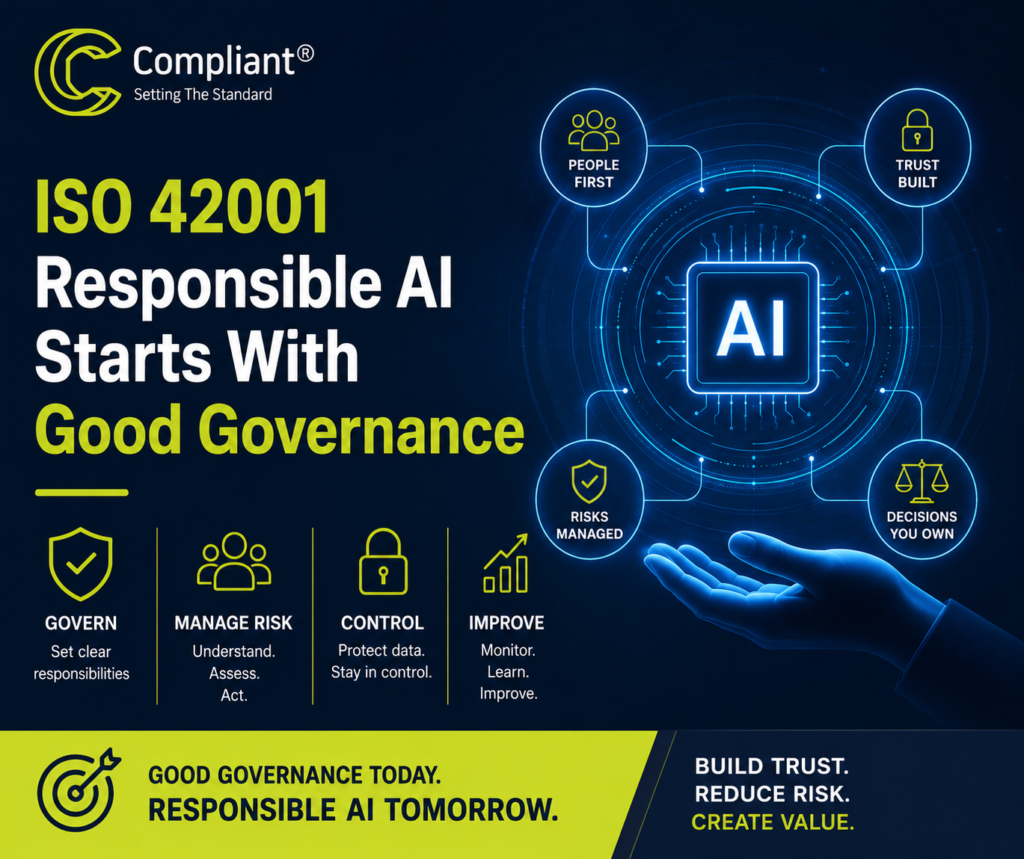
AI is moving faster than many businesses can control
Someone in your business is probably using AI.
The question is, do you know how?
They may be using it to write emails.
Create reports.
Analyse information.
Answer customer questions.
Review documents.
Generate images.
Summarise meetings.
Help make decisions.
Or complete work that once took several hours in a matter of minutes.
That can bring real benefits.
But there is another side to the story.
What information are your employees putting into AI tools?
Who checks whether the answers are correct?
Could confidential information be shared without anyone realising?
Are customers being told when AI is involved?
Who is responsible if an AI system makes a poor decision?
What happens if different teams start using different AI tools without approval?
And perhaps the biggest question of all:
Does anyone in your organisation actually have control of this?
AI can move quickly.
Good governance makes sure your organisation does not lose control while trying to keep up.
That is where ISO 42001 becomes important.
Responsible AI does not happen by accident
Most organisations do not set out to use AI irresponsibly.
Problems often start much more quietly.
An employee discovers an AI tool that helps them save an hour every day.
They tell a colleague.
The colleague starts using it too.
Soon, an entire team depends on it.
Nobody asked whether the tool was approved.
Nobody checked what happens to the information entered into it.
Nobody considered whether its answers could be wrong.
Nobody decided who should be responsible for checking its work.
The organisation has started using AI without really deciding to use AI.
That creates risk.
And as AI becomes easier to access, this problem becomes harder to ignore.
Responsible AI starts by knowing what is happening inside your organisation.
What tools are being used?
Why are they being used?
What information do they receive?
What decisions do they influence?
Who is responsible for them?
What could go wrong?
ISO 42001 gives organisations a structured way to start answering those questions.
What is ISO 42001?
ISO/IEC 42001 is an international standard for an Artificial Intelligence Management System.
Put simply, it helps organisations manage AI in a controlled and responsible way.
It provides a framework for organisations that develop, provide, or use AI systems.
The important word here is manage.
ISO 42001 is not about stopping organisations from using AI.
It is not about making every employee understand how complicated AI technology works.
And it is not about creating rules simply for the sake of having rules.
It is about making sure AI is used with clear thought, responsibility, and control.
The standard helps an organisation consider the opportunities AI can create while also understanding and managing the risks.
That balance matters.
Fear of AI can hold a business back.
Blind excitement can create a different set of problems.
Good governance sits between the two.
Governance answers a simple question: who is responsible?
AI can create confusion around responsibility.
Imagine an employee uses AI to produce a report.
The report contains incorrect information.
The employee sends it to a customer.
Who is responsible?
The employee?
Their manager?
The company that created the AI tool?
The person who approved its use?
Now imagine AI is helping to make a more important decision.
Perhaps it is helping to screen job applications.
Assess customer information.
Identify possible fraud.
Recommend which customer should receive a certain service.
The consequences of getting things wrong become much greater.
An organisation cannot simply say:
“The AI decided.”
A tool cannot carry business responsibility.
People still need to be accountable.
Good governance makes that clear.
ISO 42001 encourages organisations to define roles and responsibilities around AI.
People should know who can approve AI systems.
Who monitors them.
Who assesses risk.
Who responds when something goes wrong.
And who has the authority to stop or change an AI system if concerns appear.
Without this clarity, responsibility can disappear into the gaps between departments.
You cannot manage AI you do not know about
One of the first challenges many organisations face is surprisingly basic.
They do not know how much AI they are already using.
AI may be inside software the business has used for years.
Employees may have signed up for online AI tools themselves.
A supplier may use AI as part of the service it provides.
New features may have been added to existing systems.
Different departments may be experimenting with different tools.
Before an organisation can build Responsible AI, it needs visibility.
Start by asking:
Where are we using AI?
Why are we using it?
Who uses it?
What information goes into it?
What comes out?
Does it influence decisions?
Does it affect employees, customers, suppliers, or other people?
What would happen if it produced the wrong answer?
This does not need to begin as a huge technical exercise.
Start with understanding.
You may discover AI use that senior leaders knew nothing about.
That knowledge is valuable because hidden use creates hidden risk.
“The AI said so” is not a good control
AI can sound confident.
That is part of what makes it useful.
It is also part of what can make it dangerous.
An AI system can produce an answer that looks professional, detailed, and convincing.
The answer can still be wrong.
If employees begin to trust AI simply because its answers sound certain, errors can travel through a business very quickly.
A false statement could appear in a customer report.
Incorrect figures could be included in a presentation.
A made-up reference could find its way into an important document.
A poor recommendation could influence a business decision.
Responsible AI requires human judgement.
That does not mean every piece of AI output needs a team of people checking it.
The amount of oversight should match the risk.
Using AI to suggest different titles for an internal newsletter is very different from using it to help make a decision about a person’s employment.
The greater the possible impact, the stronger your controls should be.
ISO 42001 helps organisations think about AI in this risk-based way.
Not every AI use carries the same risk
This is important.
Businesses can make AI governance far too difficult by treating every use of AI as equally dangerous.
It is not.
Imagine two employees.
One uses AI to suggest ideas for a staff social event.
Another uses AI to analyse sensitive customer information and recommend actions.
Both are using AI.
The risks are completely different.
Good governance recognises this.
Your organisation should consider what could happen if the AI fails, gives the wrong answer, behaves unexpectedly, or is used incorrectly.
Could someone be harmed?
Could confidential information be exposed?
Could a customer be treated unfairly?
Could the organisation break a legal requirement?
Could a poor decision cost the business money?
Could your reputation be damaged?
Could employees become too dependent on the system?
The answers help determine how much control is needed.
ISO 42001 provides a framework for considering these risks in a structured way.
That means your organisation can focus its attention where it matters most.
Your employees need clear AI rules
Telling employees to “use AI responsibly” is not enough.
What does responsibly mean?
Can they enter customer information into a public AI tool?
Can they use AI to write a customer proposal?
Can they upload internal documents?
Can they use it to analyse employee information?
Do they need to check everything AI creates?
Are there approved tools?
Are some AI tools banned?
What happens if they are unsure?
Employees should not have to guess.
Clear rules protect them as well as the organisation.
Your AI policy should be written for the people expected to follow it.
That means keeping it simple.
Explain what employees can do.
Explain what they cannot do.
Give examples.
Tell them where to ask questions.
Make it clear when human review is required.
And explain why these controls matter.
A policy nobody understands will not create Responsible AI.
People need practical guidance they can use while doing their jobs.
Protecting information must be part of AI governance
AI tools need information to work.
That creates one of the biggest concerns for organisations adopting them.
What information are people sharing?
An employee might copy a customer email into an AI tool and ask it to write a reply.
Someone could upload a spreadsheet and ask AI to analyse it.
A manager might paste an internal report into a system and request a summary.
An HR employee could use AI to improve a letter containing personal information.
Each action may seem harmless.
But where does that information go?
How is it processed?
Could it be stored?
Who else might have access?
Does the organisation have permission to use the information in that way?
Responsible AI requires people to stop and think before information is shared with an AI system.
ISO 42001 helps make these questions part of the organisation’s wider management approach.
It is much safer to create clear controls before a problem happens than discover afterwards that sensitive information has gone somewhere it should not.
Responsible AI needs leadership
AI governance cannot simply be handed to the IT department.
Technology teams will often play an important role.
But AI can affect much more than technology.
It can affect employees.
Customers.
Privacy.
Business decisions.
Quality.
Information security.
Legal duties.
Reputation.
And the way work is carried out.
Senior leaders therefore need to be involved.
They do not need to become AI experts.
They do need to understand how AI could affect the organisation.
Leadership should be able to answer questions such as:
What are we trying to achieve with AI?
What level of risk are we prepared to accept?
Who is responsible for AI governance?
How will we know whether our AI systems are working as intended?
What happens if concerns are raised?
How will we make sure AI supports our wider business goals?
ISO 42001 puts leadership into the heart of AI management.
That is important because Responsible AI needs authority behind it.
Rules mean very little if senior people ignore them whenever they become inconvenient.
Employees need AI awareness, not a computer science degree
There is a danger that businesses make AI training far too complicated.
Most employees do not need to understand how an AI model is built.
They need to understand how to use AI safely in their role.
For example:
Do not put sensitive information into an unapproved system.
Check important AI-generated information before using it.
Do not assume an answer is correct because it sounds convincing.
Know which tools are approved.
Understand when a person must make the final decision.
Report unexpected or concerning AI behaviour.
Ask when you are unsure.
These are practical behaviours.
Training should help people make better choices.
It should also reflect the employee’s role.
Someone using AI to help draft marketing content may need different guidance from a manager using AI to analyse business information.
One training session for everyone may not be enough.
ISO 42001 encourages organisations to think about competence and awareness so people understand their responsibilities.
AI can create unfair outcomes
One of the biggest concerns around AI is fairness.
AI systems often work by finding patterns in information.
But information can contain problems.
It can reflect old decisions.
Past behaviour.
Missing information.
Or unfair patterns.
If these issues are not understood, AI can repeat them.
In some cases, it could even make them worse.
Imagine an AI tool being used to help review job applications.
If the information used by the system contains unfair patterns from previous hiring decisions, those patterns could influence future recommendations.
The organisation still carries responsibility for how that system is used.
This is why Responsible AI requires more than asking whether a system works.
You also need to ask:
Who could be affected?
Could some people be affected differently from others?
Are we checking outcomes?
Can decisions be explained?
Can someone challenge a decision?
Does a human need to review the result?
ISO 42001 creates a framework for organisations to consider these wider impacts.
Suppliers do not remove your responsibility
Many organisations will not build their own AI systems.
They will buy them.
That can create a false sense of security.
“We didn’t build it, so the supplier is responsible.”
That is not enough.
If your organisation chooses to use an AI system, you need to understand whether it is suitable for what you are asking it to do.
Before adopting an AI service, consider the supplier carefully.
What information will they receive?
What happens to that information?
How reliable is the service?
What support is available?
How will changes to the system be communicated?
Can you stop using it and retrieve your information?
What evidence can the supplier provide about how risks are managed?
Supplier management is therefore an important part of good AI governance.
You do not need to know everything about how a supplier’s technology works.
But you do need enough information to make a sensible decision about whether it is safe and suitable for your organisation.
AI governance should not kill innovation
Some businesses hear words such as “governance”, “management system”, and “risk” and immediately picture more paperwork.
That is not the goal.
Poor governance can actually make innovation harder.
Without clear rules, employees may be afraid to experiment.
Managers may reject useful tools because they do not understand the risks.
Different departments may repeat the same work.
Money may be spent on AI systems that do not solve a real problem.
Or the business may move quickly, suffer an incident, and then stop AI use completely.
Good governance creates boundaries.
Within those boundaries, people can innovate with greater confidence.
Employees know which tools they can use.
Managers know how new ideas should be assessed.
Leaders understand the risks.
There is a clear process for approving higher-risk uses.
Problems can be reported and reviewed.
That is a much stronger foundation for innovation than simply telling everyone to experiment and hoping nothing goes wrong.
What happens when AI gets something wrong?
It will happen.
An AI system will eventually give an answer that is incorrect.
A tool may behave differently after an update.
An employee may use AI in a way that was not expected.
A supplier may change something.
A control may fail.
Responsible AI does not mean pretending these problems can be removed completely.
It means being prepared.
Employees should know how to report AI-related concerns.
The organisation should know who investigates them.
Important incidents should be recorded.
Causes should be understood.
Controls should be reviewed.
Lessons should be shared where useful.
Then improvements should be made.
This is one of the most valuable parts of a management system approach.
Mistakes become information.
Information creates learning.
Learning creates improvement.
ISO 42001 helps turn good intentions into a system
Many organisations already have good intentions around AI.
They want to protect information.
They want to treat people fairly.
They want employees to use AI sensibly.
They want reliable results.
They want customers to trust them.
The difficulty is turning those intentions into consistent action.
ISO 42001 provides structure.
It helps organisations consider the context in which AI is being used, identify responsibilities, assess risks and opportunities, create objectives, introduce suitable controls, monitor performance, and make improvements.
That structure matters as AI use grows.
When five people are experimenting with AI, informal controls might appear to work.
When 500 employees are using it across several departments, informal controls can fall apart very quickly.
Growth needs structure.
Good governance builds trust
Customers are becoming more aware of AI.
Employees are asking questions.
Suppliers are introducing AI into their services.
Business partners may want to understand how you manage it.
Simply saying, “We use AI responsibly”, is unlikely to remain enough.
Organisations need to be able to show what responsible use means in practice.
Who is accountable?
How are risks assessed?
How are employees trained?
How are concerns handled?
How is performance reviewed?
How are improvements made?
A structured management system can help provide those answers.
ISO 42001 gives organisations a recognised framework for demonstrating that AI governance is being taken seriously.
Certification may be valuable for some organisations.
But the greatest value comes from the system itself.
Good governance helps create trust because people can see that decisions are not being left to chance.
Responsible AI is an ongoing job
AI will not stop changing once your policy has been written.
New tools will appear.
Existing systems will gain new features.
Employees will find different ways to use them.
Laws and customer expectations may change.
New risks will become clearer.
Yesterday’s low-risk AI tool might become much more important if the business begins using it for a different purpose.
That is why AI governance cannot be a one-off project.
ISO 42001 uses a management system approach based around continued review and improvement.
You plan.
You act.
You check.
You learn.
You improve.
Then you do it again.
This makes the organisation more able to respond as AI changes.
Instead of creating a fixed set of rules and hoping they remain suitable for years, you build a way to keep those rules relevant.
Five questions every leadership team should ask about AI
You can begin improving your AI governance before you ever consider certification.
Start with five questions.
1. Where are we currently using AI?
Do not assume you know. Ask different departments and teams.
2. What information are we giving AI systems?
Pay particular attention to personal, customer, employee, financial, and confidential business information.
3. Which AI uses could cause the greatest harm if something went wrong?
These should receive greater attention and stronger controls.
4. Who is responsible for AI in our organisation?
If the answer is “everyone”, there is a good chance that nobody has clear responsibility.
5. Do our employees know what they can and cannot do with AI?
Ask them. Their answers may show you where your biggest gaps are.
These questions will not create a complete AI management system.
But they will tell you something important.
They will show you how much control you currently have.
Responsible AI starts before the technology
AI can feel like a technology challenge.
Often, the harder challenge is management.
It is deciding what the organisation wants AI to achieve.
Understanding the risks.
Setting boundaries.
Giving people responsibility.
Training employees.
Checking results.
Listening when concerns are raised.
Learning from mistakes.
And improving as the technology changes.
That is governance.
And it is the foundation of Responsible AI.
ISO 42001 gives organisations a way to build that foundation without having to invent an approach from scratch.
The standard cannot make every AI decision for you.
Nor should it.
Your organisation still needs to decide what responsible use means in your own situation.
What ISO 42001 can provide is the structure needed to make those decisions in a controlled, repeatable, and thoughtful way.
Good governance lets you use AI with greater confidence
AI brings enormous opportunity.
It can remove repetitive work.
Help employees work faster.
Support better use of information.
Improve services.
Create new ideas.
And allow smaller teams to achieve things that once required far more time and resources.
Businesses should not have to choose between innovation and responsibility.
They need both.
Move too slowly and opportunities can disappear.
Move without control and risks can grow faster than anyone realises.
ISO 42001 helps organisations find a better balance.
Know where AI is being used.
Understand why it is being used.
Identify the risks.
Put sensible controls around the areas that matter.
Give people clear responsibilities.
Train employees.
Monitor what happens.
Learn when something goes wrong.
Keep improving.
That is what Responsible AI looks like when it moves beyond promises and becomes part of everyday business.
Educational CTA: Start With Your AI Governance Gap
Before writing another AI policy or buying another AI tool, find out what is already happening inside your organisation.
Speak to different departments.
Ask which AI tools employees use and what they use them for.
Find out what information is being entered into those systems.
Identify the uses that could have the greatest impact on customers, employees, or the business if something went wrong.
Then ask one final question:
Who is responsible for making sure all of this is managed properly?
If the answer is unclear, that is your starting point.
Responsible AI does not begin with banning technology.
It does not begin with allowing everyone to use whatever they want either.
It begins with understanding.
Then responsibility.
Then sensible control.
ISO 42001 can provide the framework around those steps, helping your organisation move from informal AI use towards a clear and managed approach.
AI will continue to change.
The tools your employees use next year may look very different from the tools they use today.
Good governance gives you something more lasting.
A way to ask the right questions.
A way to understand risk.
A way to decide who is responsible.
And a way to keep improving as AI becomes an even bigger part of how your organisation works.
Because responsible AI is not simply about what your technology can do.
It is about making sure your organisation knows what it should do.