Skip to main content
Skip to footer
Skip to main content
Skip to footer

B Corp: Why Responsible Business Is Becoming a Competitive Advantage
B Corp: Why Responsible Business Is Becoming a Competitive Advantage
For years, businesses were often judged by a fairly simple measure.
Did they make money?
If sales were growing and profits were healthy, the business was considered successful.
That picture is changing.
Customers are asking more questions.
How does this company treat its people?
What is it doing about its environmental impact?
Does it behave responsibly?
Does it support the communities around it?
Can we trust what it says?
Employees are asking similar questions when deciding where they want to work.
Larger organisations are looking more closely at their supply chains.
Investors, partners and other interested parties increasingly want to understand what sits behind the numbers.
This creates both a challenge and an opportunity.
Responsible business is no longer something that necessarily sits quietly in a policy or appears once a year in a company report.
For many organisations, it is becoming part of how they compete.
That is where B Corp has become particularly interesting.
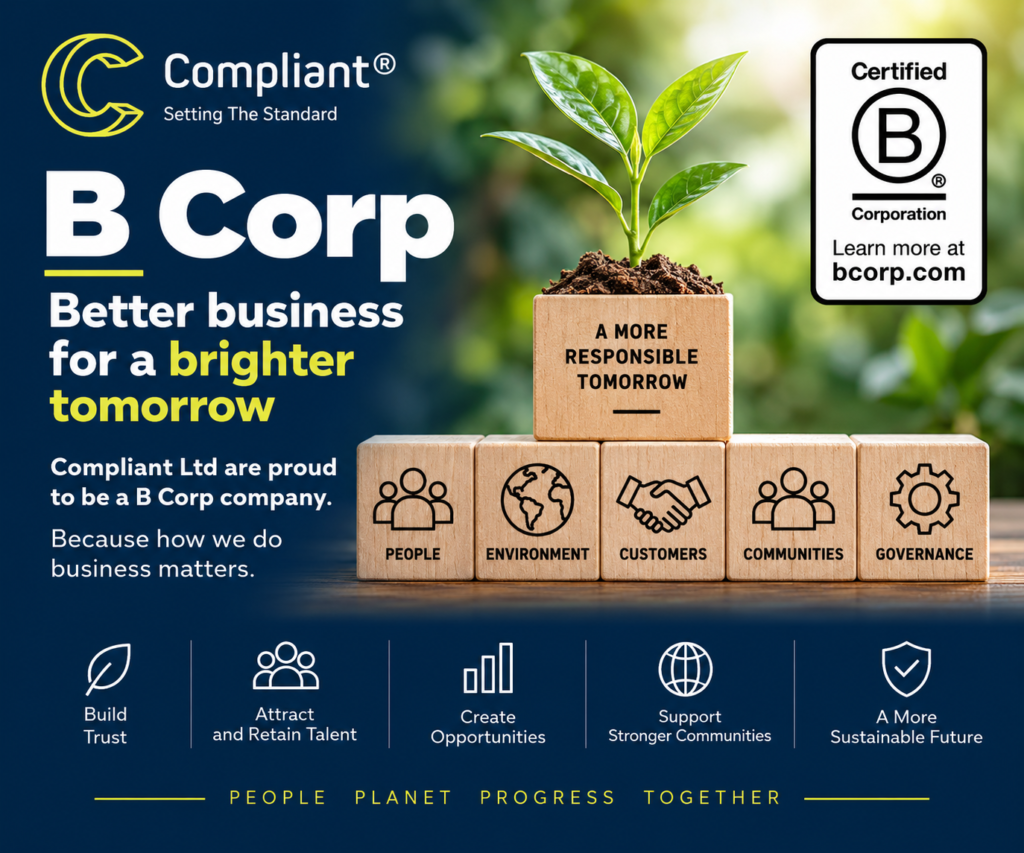
B Corp certification looks beyond what a company sells. It considers the wider impact a business has and encourages companies to think about people, communities, customers, governance and the environment alongside financial performance.
At Compliant Ltd, we are proud to be a B Corp company.
That matters to us because responsible business should not simply be something an organisation talks about.
It should influence how decisions are made.
And increasingly, businesses that can demonstrate those values may find they have something valuable that competitors cannot simply copy overnight.
Trust.
What Does Responsible Business Actually Mean?
“Responsible business” can sound like a very broad phrase.
In reality, it comes down to decisions.
How do you treat employees?
How do you choose suppliers?
How do you use resources?
How do you consider environmental impact?
How do you support customers?
How are decisions made?
How does the business affect its wider community?
What happens when doing the right thing is not necessarily the easiest option?
These decisions happen every day.
That is important because responsible business should not exist separately from normal business operations.
It should be part of them.
A company can publish an impressive statement about its values.
But what happens inside the organisation matters far more.
Do those values affect decisions?
Can employees see them?
Can customers experience them?
Can the business provide evidence to support what it says?
That is where the conversation becomes much more meaningful.
What Is a B Corp?
A B Corp is a company that has gone through B Lab’s certification process and demonstrated that it meets the required standards for social and environmental performance, accountability and transparency.
The important point is that B Corp looks at business more widely.
Success is not viewed only through financial results.
The wider impact of the organisation matters too.
That encourages businesses to think about questions such as:
How are employees treated?
How does the organisation affect the environment?
How does it interact with customers?
What impact does it have on communities?
How is the business governed?
This broader view reflects something many businesses are already discovering.
How you achieve success matters.
Customers Can See More Than Ever Before
There was a time when customers knew relatively little about the companies they bought from.
They saw an advert.
They saw a product.
They spoke to a salesperson.
Today, information is everywhere.
A customer can visit your website.
Look at your social media.
Read employee reviews.
Check customer feedback.
Research your environmental commitments.
Look at certifications.
Compare you with competitors.
Find stories about your organisation.
All within minutes.
That has changed expectations.
Businesses cannot easily separate what they say from what they do.
If a company makes strong claims about being responsible but its actions tell a different story, customers may notice.
Trust can take years to build.
It can disappear much faster.
This is one reason recognised frameworks such as B Corp can have value.
They help move the conversation beyond a company simply saying:
“We are a responsible business.”
Trust Is Becoming a Business Asset
Price matters.
Quality matters.
Service matters.
But trust matters too.
Consider two businesses offering similar services at similar prices.
One provides very little information about how it operates.
The other can demonstrate commitments to its employees, environmental responsibility, customers and wider community.
For some buyers, that difference will matter.
Not every purchasing decision will be based on responsible business practices.
That would be unrealistic.
But when everything else is close, trust can become a deciding factor.
This is particularly important where customers are choosing a long-term supplier or partner.
They are not only buying today’s service.
They are entering a relationship.
They want confidence in the organisation behind it.
Your Customers Have Their Own Responsibilities
Responsible business is also becoming important because organisations increasingly look beyond their own operations.
Think about a large company trying to improve its environmental and social impact.
It cannot only look at its own offices.
It needs to think about the businesses it buys from.
Its suppliers form part of the wider picture.
This means questions can move through the supply chain.
What environmental commitments do your suppliers have?
How do they treat employees?
What responsible business practices can they demonstrate?
What evidence supports their claims?
This creates an opportunity for businesses that have already taken these areas seriously.
Being able to demonstrate responsible practices can help you answer questions that competitors may struggle with.
Competitive Advantage Is Not Always About Being Cheaper
When people hear “competitive advantage”, they often think about price.
Can we do it cheaper?
But competing only on price can become difficult.
Someone can nearly always offer less.
A stronger advantage may come from being different in ways customers value.
Better service.
Greater reliability.
Stronger expertise.
Better relationships.
More confidence.
Responsible business can become part of that difference.
If customers care about who they work with, your values and actions matter.
B Corp can help demonstrate that responsible business is not simply a marketing phrase.
It is something the organisation has chosen to put under external scrutiny.
Employees Are Looking at Businesses Differently Too
Competition is not only about customers.
Businesses compete for people.
Finding and keeping good employees can be difficult.
Salary matters.
Of course it does.
But people may also care about what it feels like to work somewhere.
Do employees feel valued?
Are they listened to?
Does the company behave in a way they respect?
Does the organisation have a purpose beyond simply making money?
Can they be proud to tell people where they work?
These things can influence how employees feel about an organisation.
A responsible business cannot guarantee that everyone will stay forever.
But creating a workplace people respect can support employee engagement and retention.
Your People Notice What You Really Value
A company can have excellent values written on a wall.
Employees quickly discover whether they are real.
Imagine a business says:
“Our people come first.”
But managers rarely listen to employees.
Development is ignored.
Poor behaviour is tolerated.
Decisions are made without considering the impact on staff.
The words become meaningless.
Responsible business has to appear in everyday behaviour.
How are people treated when things are difficult?
What happens when an employee raises a concern?
Are people given opportunities to develop?
Does leadership listen?
Are decisions explained?
Employees see these things.
That is why culture cannot be built by statements alone.
It is built through repeated actions.
Responsible Business Can Help Attract Talent
Imagine somebody has two job offers.
The salary is similar.
The roles are similar.
The journey to work is similar.
What helps them decide?
They may start looking at the organisations themselves.
Which one feels like somewhere they want to work?
Which business shares their values?
Which company appears to take its responsibilities seriously?
Which organisation seems to invest in its people?
For some candidates, evidence of responsible business can influence that choice.
This means your approach to people is not simply an internal matter.
It can affect your ability to attract future employees too.
Environmental Responsibility Is Part of the Picture
Environmental responsibility has moved much higher up the business agenda.
Energy use.
Waste.
Carbon emissions.
Transport.
Purchasing.
Resources.
Supply chains.
Customers increasingly hear about these issues.
Employees do too.
Businesses are therefore being challenged to think more carefully about their environmental impact.
Again, the key word is evidence.
It is easy to describe a business as green.
It is harder to demonstrate what you are actually doing.
Responsible businesses should be prepared to look at their impact, identify opportunities and make improvements.
Not because every company can solve every environmental problem.
They cannot.
But every business can consider the impact of its own decisions.
Small Decisions Matter
Responsible business can sound like something requiring enormous projects.
Sometimes it does involve significant changes.
But small decisions matter too.
Choosing a different supplier.
Reducing unnecessary waste.
Improving energy efficiency.
Supporting employee development.
Listening to customer feedback.
Reducing unnecessary travel.
Improving accessibility.
Supporting a local community project.
Reviewing how purchasing decisions are made.
One action may seem small.
But responsible business is built through repeated decisions.
Over time, those decisions shape the organisation.
Responsible Purchasing Can Have a Wider Impact
Every purchase sends money somewhere.
That means purchasing decisions can have influence.
Businesses can ask more questions about suppliers.
Not only:
“How much does it cost?”
But also:
What are we buying?
Do we need it?
How long will it last?
Where does it come from?
How is it packaged?
What do we know about the supplier?
Are there more responsible alternatives?
Price will always matter.
Responsible purchasing does not mean choosing the most expensive option every time.
It means considering more than price where it makes sense to do so.
Communities Matter
Businesses do not operate in isolation.
They employ people.
Use local services.
Work with suppliers.
Pay taxes.
Use infrastructure.
Interact with communities.
Responsible business encourages organisations to consider that wider relationship.
Support does not always need to involve large donations.
Businesses can contribute in different ways.
Volunteering.
Sharing expertise.
Supporting local initiatives.
Creating opportunities.
Using local suppliers where appropriate.
Helping charities.
Providing work experience.
The right approach will depend on the organisation.
What matters is recognising that a successful business can create value beyond its own balance sheet.
Governance May Not Sound Exciting, but It Matters
Governance is essentially about how a business is directed and how decisions are made.
It may not sound as engaging as environmental projects or community work.
But it is important.
Who is responsible?
How are decisions made?
What values guide those decisions?
How does the organisation make sure commitments are followed?
How are risks considered?
How is performance reviewed?
Without good governance, responsible business can become a collection of disconnected activities.
One team does something for the environment.
Another supports a charity.
HR introduces an employee programme.
All positive.
But what connects them?
Responsible business becomes stronger when it forms part of how the organisation is managed.
Leadership Has to Mean It
If responsible business is only important to the marketing department, people will notice.
Leadership needs to support it.
That does not mean every decision will be easy.
Businesses need to make money.
They have customers to serve.
Employees to pay.
Suppliers to manage.
Bills to meet.
Responsible business does not remove commercial reality.
Instead, it asks leaders to consider the wider effects of their decisions alongside commercial needs.
Sometimes there will be difficult choices.
That is where values become meaningful.
It is easy to be responsible when there is no cost or inconvenience.
The real test often comes when there is a trade-off.
Beware of Saying More Than You Can Prove
As customers become more interested in environmental and social responsibility, businesses naturally want to talk about what they are doing.
That is understandable.
But claims need to be supported.
Do not simply say:
“We’re sustainable.”
“We’re ethical.”
“We’re environmentally friendly.”
“We put people first.”
Ask:
What does that actually mean?
What evidence supports it?
Can we explain it clearly?
Are there areas where we still need to improve?
Honesty matters.
Responsible businesses do not need to pretend they are perfect.
In fact, being open about progress and improvement can be far more credible than making huge claims.
B Corp Is Not About Being Perfect
This is an important point.
Responsible business does not mean having solved every problem.
Businesses are complicated.
They change.
The world around them changes.
New challenges appear.
There will always be opportunities to improve.
The value of a framework such as B Corp is that it encourages businesses to look across different areas of their impact and continue thinking about how they operate.
That mindset matters.
Ask:
What are we doing well?
Where could we improve?
What impact are our decisions having?
What should we do next?
Improvement becomes part of the journey.
Why Being a B Corp Matters to Compliant Ltd
At Compliant Ltd, we are a B Corp company.
For us, that is more than something to place on a website or add to a company profile.
It reflects a wider commitment to thinking about how we operate as a business.
How we treat people matters.
How we work with customers matters.
Our environmental impact matters.
Our wider responsibilities matter.
And how we make decisions matters.
Being a B Corp does not mean claiming to be perfect.
It means being willing to look at the business more widely and recognise that success should involve more than financial performance alone.
That fits naturally with something we talk about regularly in management systems:
Improvement.
There is always another question to ask.
Another process to review.
Another opportunity to do something better.
Responsible Business and Management Systems Have Something in Common
Although B Corp certification and ISO management systems are different, there is an interesting idea they share.
Good intentions are not enough.
Businesses need structure.
A company may genuinely want to improve its environmental performance.
But who is responsible?
What are you trying to achieve?
How will you know whether things are improving?
A business may care deeply about employees.
But how is feedback gathered?
What happens when concerns are raised?
How is progress reviewed?
Structure helps turn intentions into actions.
Actions create evidence.
Evidence creates confidence.
That principle can apply across many areas of responsible business.
Customers Can Spot Performative Responsibility
Today’s customers are used to businesses making big claims.
That has also made them more questioning.
A beautiful campaign about sustainability may attract attention.
But if the business cannot explain what it actually does, trust can disappear quickly.
Responsible business should start inside the organisation.
Then communicate it.
Not the other way around.
Do the work first.
Understand your impact.
Make improvements.
Collect evidence.
Be open about where you are.
Then tell the story.
That story will be much stronger because it is real.
Responsible Business Can Support Stronger Relationships
Customers and suppliers are still people.
Relationships matter.
Organisations that behave responsibly can build confidence with the people around them.
They communicate clearly.
They keep commitments.
They deal with problems properly.
They treat people fairly.
They listen.
They improve.
Over time, those behaviours can strengthen relationships.
And strong relationships have commercial value.
Customers who trust a supplier may be more comfortable continuing to work with them.
Employees who trust management may be more engaged.
Suppliers who have strong relationships with customers may be more willing to work together to solve problems.
Responsibility and commercial success do not have to sit on opposite sides of the table.
Often, they support each other.
Reputation Takes Time to Build
A strong reputation is rarely created by one campaign.
It develops slowly.
One customer interaction.
One employee experience.
One decision.
One project.
One response when something goes wrong.
Again and again.
Responsible business contributes to that reputation.
Not because everyone is checking whether you have a particular certification before every interaction.
But because responsible practices influence how the business behaves.
People experience those behaviours.
And experiences shape reputation.
Think About the Long Term
One of the most valuable parts of responsible business is the shift away from only asking:
“What helps us today?”
towards:
“What kind of business are we building?”
Short-term decisions matter.
Cash flow matters.
Targets matter.
But businesses also need people who want to work there next year.
Customers who trust them.
Suppliers who value the relationship.
Communities that welcome their presence.
Resources that are used responsibly.
A reputation worth protecting.
Responsible business encourages longer-term thinking.
And that can create resilience.
Could Responsibility Become Your Difference?
Imagine a potential customer comparing you with three competitors.
Your services are similar.
Your prices are reasonably close.
Everyone claims to provide great customer service.
How do they choose?
Perhaps your responsible business practices become part of the answer.
Maybe your B Corp certification matters to them.
Perhaps your environmental commitments support their own goals.
Maybe your approach to employees gives them confidence about the type of organisation they are partnering with.
Perhaps your values simply align with theirs.
You cannot guarantee responsible business will win every contract.
Nor should that be the only reason to behave responsibly.
But it can create meaningful difference.
And in competitive markets, meaningful differences matter.
Start by Asking Better Questions
You do not need to begin with a huge responsible business programme.
Start by asking questions.
How do our decisions affect our employees?
What environmental impact do we create?
What do our customers expect from us?
What do we know about our suppliers?
How do we support our community?
Are our values visible in everyday behaviour?
Can we prove the claims we make?
Where could we improve?
Ask employees too.
They may see opportunities management has missed.
Ask customers what matters to them.
Look at your supply chain.
Review your everyday decisions.
Responsible business begins with awareness.
Why Responsible Business Is Becoming a Competitive Advantage
Businesses will always need to make money.
Without financial success, organisations cannot employ people, pay suppliers, invest, grow or continue operating.
B Corp does not change that reality.
What it challenges is the idea that financial performance has to be the only measure that matters.
Businesses have wider impacts.
On employees.
On customers.
On communities.
On suppliers.
On the environment.
Increasingly, people want to understand those impacts before deciding who to buy from, work for or partner with.
That changes the competitive landscape.
Being responsible is no longer necessarily something businesses do quietly alongside their commercial strategy.
It can become part of that strategy.
At Compliant Ltd, being a B Corp company is something we are proud of because it reflects our commitment to looking beyond business performance alone and considering the wider impact of how we operate.
But responsible business is not about collecting a badge and deciding the work is finished.
It is about continuing to ask:
Can we do this better?
Can we reduce our impact?
Can we support our people better?
Can we make better purchasing decisions?
Can we contribute more positively?
Can we be more open?
Can we create more value for the people and organisations around us?
Those questions matter.
Because the businesses that succeed in the future may not simply be the ones offering the lowest price.
They may be the organisations people trust.
The businesses people want to work for.
The companies customers want in their supply chain.
The organisations that can demonstrate that their values exist beyond the words on their website.
Responsible business is not about choosing between doing good and doing well.
Increasingly, the two can support each other.
And that is why responsibility is becoming a genuine competitive advantage.