Skip to main content
Skip to footer
Skip to main content
Skip to footer

Five Simple Ways to Build a Stronger Health and Safety Culture
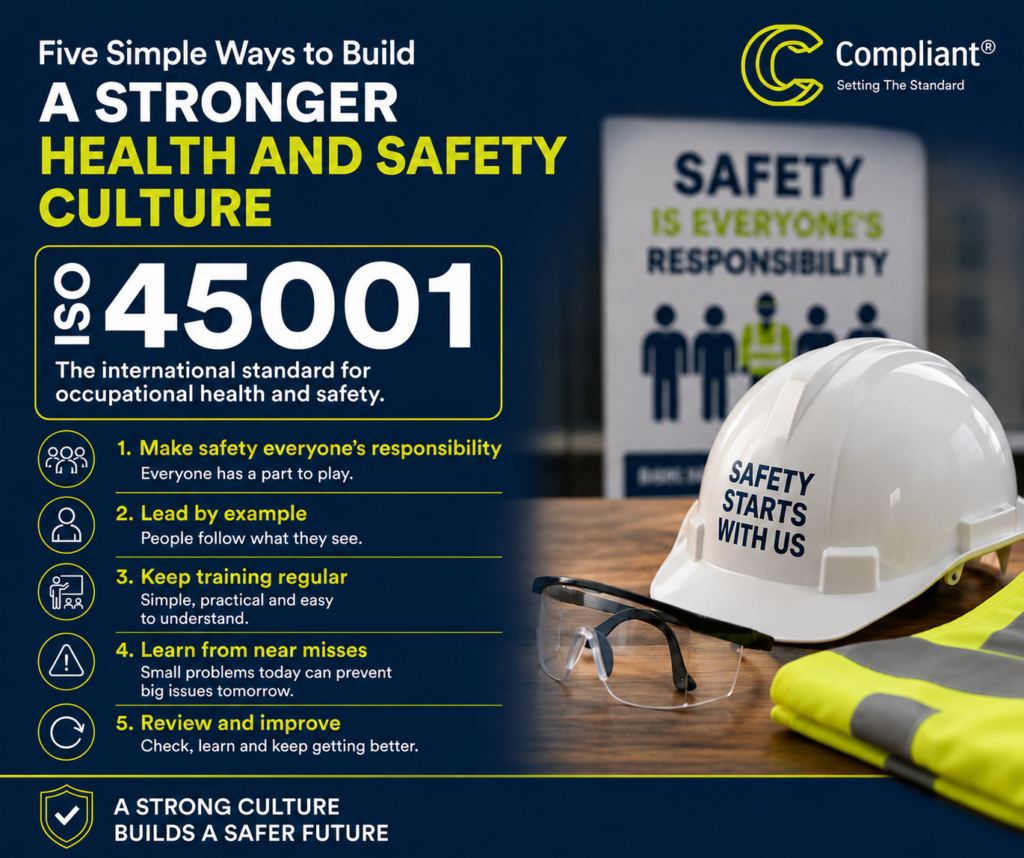
Five Simple Ways to Build a Stronger Health and Safety Culture
A strong health and safety culture does not happen by chance. It happens by choice.
Too many businesses only think about health and safety after something has gone wrong.
A near miss. An accident. An injury. A visit from an inspector. A complaint from an employee.
By that point, the damage has already been done.
People may have been hurt. Work may stop. Customers may lose confidence. Your business could face extra costs that could have been avoided.
The good news is that creating a strong health and safety culture does not have to be difficult.
It is not about filling shelves with paperwork or asking people to follow rules they do not understand. It is about creating an environment where everyone feels responsible for keeping themselves and others safe.
This is exactly where ISO 45001 can make a real difference. It gives businesses a clear way to improve health and safety every day instead of only reacting when problems appear. With the benefits of an ISO consultant’s support, the journey can become simpler, clearer and far more effective.
In this guide, we will look at five practical ways to build a stronger health and safety culture that benefits your people, your customers and your business.
What Is Health and Safety Culture?
Health and safety culture is the way people think and behave when it comes to safety at work.
It is what people do when nobody is watching.
Do employees report hazards?
Do managers lead by example?
Do people feel comfortable speaking up?
Are lessons learned after mistakes?
These everyday actions create the culture inside an organisation.
A business with a strong culture sees health and safety as part of normal working life.
A business with a weak culture often treats health and safety as something to think about only when there is an audit or inspection.
The difference can be huge.
Strong cultures reduce accidents, improve teamwork and help people enjoy coming to work.
Why ISO 45001 Matters
ISO 45001 is the international standard for occupational health and safety management systems.
Its purpose is simple.
Help organisations prevent injuries and illness while creating safer workplaces for everyone.
Instead of reacting to problems, ISO 45001 encourages businesses to identify risks early, reduce them and continually improve.
It works for organisations of all sizes and across many industries.
Whether you work in construction, manufacturing, engineering, professional services or logistics, the principles remain the same.
Health and safety should be part of everyday business, not an afterthought.
1. Make Safety Everyone’s Responsibility
One of the biggest mistakes businesses make is believing health and safety belongs to one person.
Perhaps there is a Health and Safety Manager.
Maybe there is a Compliance Officer.
Sometimes it is left to directors.
The reality is different.
Everyone has a role to play.
People on the front line often notice risks before managers do.
Encouraging employees to share concerns creates a workplace where issues are solved before they become accidents.
Simple actions make a big difference.
Ask for ideas during team meetings.
Encourage people to report hazards.
Thank employees who raise concerns.
Celebrate improvements.
When people feel heard, they become more involved.
This creates trust.
Trust creates stronger safety habits.
ISO 45001 supports employee participation because it recognises that the people doing the work often understand the risks best.
2. Lead by Example Every Day
People notice what leaders do.
If managers ignore safety procedures, employees often do the same.
If leaders wear the correct protective equipment, follow procedures and encourage safe working, others usually follow.
Leadership shapes culture more than any policy ever will.
Good leaders ask questions.
They listen.
They encourage conversations instead of placing blame.
When something goes wrong, they focus on learning rather than pointing fingers.
This helps employees feel confident reporting mistakes and near misses.
That information can prevent future incidents.
ISO 45001 places strong importance on leadership because lasting improvements begin at the top.
3. Keep Training Simple and Regular
Many organisations provide training when someone joins the business.
Then nothing happens for months or even years.
People forget.
Processes change.
New risks appear.
Health and safety training should not be a one-time event.
It should become part of everyday business.
Short refresher sessions often work better than long presentations.
Talk about one topic during team meetings.
Discuss recent near misses.
Share lessons learned.
Ask questions.
Encourage discussion.
People remember conversations far better than lengthy documents.
Training should also be easy to understand.
Avoid complicated language.
Use real examples from your own workplace.
Employees are much more likely to remember practical advice they can relate to.
ISO 45001 encourages organisations to make sure employees remain competent and aware of their responsibilities.
4. Learn From Small Problems Before They Become Big Ones
Not every incident causes an injury.
Sometimes equipment fails.
Sometimes someone nearly slips.
Sometimes a process almost goes wrong.
These are opportunities to learn.
Unfortunately, many businesses ignore them because nobody was hurt.
That can be an expensive mistake.
Near misses often reveal weaknesses before serious accidents happen.
Recording them allows organisations to spot patterns.
Perhaps one area has poor lighting.
Maybe equipment needs replacing.
Perhaps employees need extra guidance.
Small improvements today can prevent major problems tomorrow.
ISO 45001 encourages continual improvement by reviewing incidents, analysing trends and making positive changes.
The goal is always prevention.
5. Review and Improve Continuously
Health and safety is never finished.
Businesses grow.
New employees join.
New equipment arrives.
Customer expectations change.
New working methods develop.
That means health and safety should also evolve.
Regular reviews help businesses understand what is working and what needs improving.
Internal audits.
Management reviews.
Employee feedback.
Performance monitoring.
These activities all help organisations identify opportunities for improvement.
Instead of waiting for problems to appear, businesses stay ahead of them.
This creates a culture where improvement becomes normal rather than something driven by inspections.
That mindset is one of the biggest strengths of ISO 45001.
The Benefits of an ISO Consultant’s Support
Many organisations understand the value of ISO 45001 but are unsure where to begin.
Others have already started but find the process confusing or time-consuming.
This is where the benefits of an ISO consultant’s support become clear.
An experienced consultant helps simplify the journey.
Rather than trying to interpret every requirement alone, businesses receive practical guidance based on real experience.
A consultant can help you:
- Understand what ISO 45001 requires.
- Identify gaps in your current processes.
- Create practical documentation that reflects how your business actually works.
- Prepare for internal and external audits.
- Support managers and employees throughout implementation.
- Build systems that are easy to maintain.
- Reduce unnecessary paperwork.
- Encourage continual improvement rather than simply achieving certification.
Perhaps most importantly, a good consultant helps businesses avoid common mistakes.
Many organisations spend months creating documents they never use.
Others overcomplicate their systems.
Some introduce processes that employees struggle to follow.
A consultant helps keep everything practical.
The goal is not simply achieving certification.
The goal is building a system that genuinely improves your organisation.
Common Mistakes That Damage Safety Culture
Many businesses have good intentions.
Unfortunately, intentions alone are not enough.
Some common mistakes include:
- Treating health and safety as paperwork.
- Only discussing safety after an accident.
- Failing to involve employees.
- Ignoring near misses.
- Providing training once and never reviewing it.
- Expecting one person to manage all health and safety.
- Not reviewing systems regularly.
These mistakes slowly weaken culture.
Over time they can lead to poor habits becoming normal.
ISO 45001 helps organisations recognise these weaknesses before they become serious problems.
The Business Benefits Go Beyond Safety
Many organisations begin their ISO 45001 journey because they want to reduce accidents.
That is an excellent reason.
However, the benefits often reach much further.
Businesses with strong health and safety cultures often experience:
- Better employee confidence.
- Higher staff morale.
- Improved teamwork.
- Fewer workplace disruptions.
- Better planning.
- Greater operational consistency.
- Increased trust from customers.
- Improved reputation.
- Stronger opportunities when bidding for contracts.
- Better business resilience.
People perform better when they feel safe.
Customers notice businesses that operate professionally.
Good health and safety becomes part of your overall quality.
Building a Culture Takes Time
Culture cannot be changed overnight.
It develops through small actions repeated consistently.
Every conversation matters.
Every improvement matters.
Every leader sets an example.
Every employee contributes.
Some businesses expect dramatic results within weeks.
Real improvement happens gradually.
As trust grows, people become more willing to speak up.
As communication improves, risks are identified earlier.
As leaders remain committed, safe behaviours become everyday habits.
That is when health and safety stops being something employees are told to do.
It simply becomes the way the organisation works.
ISO 45001 provides the structure to support this journey.
Combined with the benefits of an ISO consultant’s support, organisations often find it easier to introduce meaningful improvements without unnecessary complexity.
Final Thoughts
Building a stronger health and safety culture is not about creating more paperwork or introducing complicated rules.
It is about creating an environment where everyone understands that safety matters.
The five steps are simple.
Make safety everyone’s responsibility.
Lead by example.
Provide regular training.
Learn from small problems.
Keep improving.
Individually, each step helps.
Together, they create lasting change.
ISO 45001 gives organisations a practical framework for embedding these habits into everyday operations. With the benefits of an ISO consultant’s support, businesses can develop systems that are easy to understand, practical to maintain and designed to support continual improvement long after certification.
A positive health and safety culture protects more than your workforce.
It protects your reputation, strengthens your organisation and helps create a workplace where people can do their best work every single day.
Continue Learning
If you are reviewing your current health and safety arrangements, start by asking one simple question:
Would every employee in your organisation say that health and safety is part of your everyday culture, or just something discussed when there is a problem?
The answer could reveal your biggest opportunity for improvement. Whether you are considering ISO 45001 for the first time or looking to strengthen an existing management system, taking small, consistent steps today can lead to safer workplaces and stronger business performance for years to come.