Skip to main content
Skip to footer
Skip to main content
Skip to footer

How Standardised Processes Deliver Consistent Results with ISO 9001
How Standardised Processes Deliver Consistent Results with ISO 9001
Every Business Wants Consistent Results. So Why Do So Many Get Different Outcomes?
One team delivers excellent customer service. Another handles the same task completely differently.
One project finishes on time. The next overruns by weeks.
One customer receives an outstanding experience. Another leaves disappointed.
If this sounds familiar, you are not alone.
Many businesses believe inconsistency is simply part of growth. They accept mistakes, repeated problems, and different ways of working because they think every employee has their own style.
The truth is very different.
Most inconsistency comes from one simple problem.
People are working without standardised processes.
When there is no agreed way of completing work, everyone creates their own method. That means quality changes from person to person, department to department, and even day to day.
Customers notice.
Employees become frustrated.
Managers spend more time fixing problems than improving the business.
This is exactly why ISO 9001 exists.
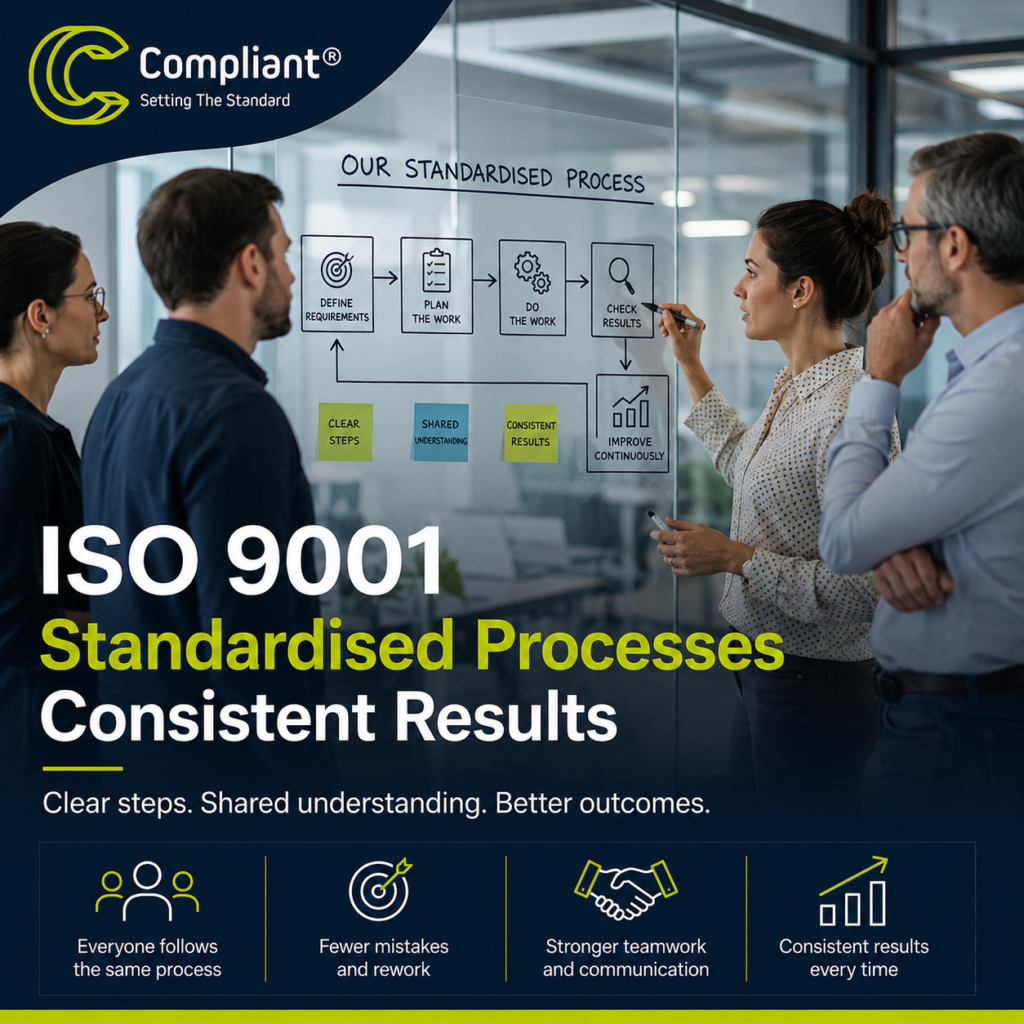
Rather than creating unnecessary paperwork, ISO 9001 helps businesses build clear, repeatable processes that deliver reliable results every single time.
Let’s look at why standardised processes matter and how they can transform the way your organisation performs.
What Are Standardised Processes?
A standardised process is simply an agreed way of completing a task.
It means everyone understands:
- What needs to happen
- Who is responsible
- When it should happen
- How it should be completed
- What success looks like
Think about making a cup of tea.
If ten people all make tea differently, every cup tastes different.
Some use one tea bag.
Others use two.
Some leave it brewing for one minute.
Others wait five.
The result changes every time.
Now imagine following one simple method.
Every cup becomes consistent.
Businesses work in exactly the same way.
Standardised processes remove uncertainty and help everyone work towards the same outcome.
Why Consistency Matters More Than Speed
Many businesses focus on working faster.
But speed without consistency creates problems.
Imagine sending products quickly that contain mistakes.
Or replying to customers immediately with incorrect information.
Working faster only helps if the work is right.
ISO 9001 encourages organisations to improve quality first.
Once quality becomes consistent, efficiency naturally follows.
Customers remember reliable businesses.
They return because they know exactly what to expect.
That confidence becomes a competitive advantage.
The Hidden Cost of Inconsistent Processes
Many organisations underestimate how much inconsistency costs them.
It often appears in small ways that slowly become expensive.
For example:
- Staff asking the same questions every day
- Work needing to be checked repeatedly
- Customer complaints
- Missed deadlines
- Confusion over responsibilities
- Duplicate work
- Poor communication
- Lost documents
- Different departments following different rules
Each issue may seem small.
Together, they waste hundreds of hours every year.
ISO 9001 helps identify these hidden problems before they become larger issues.
Why People Create Different Ways of Working
People naturally find shortcuts.
Sometimes those shortcuts improve efficiency.
Sometimes they create risk.
Without clear guidance, employees will often:
- Copy previous colleagues
- Learn through trial and error
- Develop personal habits
- Make assumptions
- Skip important steps
After several years, no two people complete the same task in exactly the same way.
Managers often discover this only when something goes wrong.
ISO 9001 brings everyone back to one agreed process.
ISO 9001 Creates a Reliable Foundation
ISO 9001 is built around managing processes instead of reacting to problems.
Rather than asking:
“What went wrong?”
It encourages organisations to ask:
“How do we stop this happening again?”
That small change creates a completely different culture.
Instead of constantly fixing mistakes, businesses start preventing them.
Better Processes Create Better Customer Experiences
Customers may never read your procedures.
They never need to.
They simply experience the results.
Good processes mean:
- Faster responses
- Fewer mistakes
- Better communication
- Reliable delivery
- Higher quality
- Greater confidence
Customers remember consistency.
They know what to expect every time they work with your organisation.
That trust is incredibly valuable.
Employees Benefit Too
Some people believe procedures limit creativity.
The opposite is usually true.
When employees understand exactly how routine work should be completed, they spend less time guessing.
Instead, they can focus on solving real problems.
Clear processes also reduce stress.
People know:
- What is expected
- Where to find information
- Who makes decisions
- How work should flow
That confidence leads to better performance.
Training Becomes Much Easier
One of the biggest challenges for growing organisations is training new employees.
Without documented processes, training depends entirely on experienced staff.
That creates several problems.
Knowledge stays in people’s heads.
If someone leaves, valuable experience disappears with them.
ISO 9001 encourages organisations to capture important knowledge.
New employees can learn faster.
Managers spend less time repeating the same instructions.
Training becomes more consistent across the organisation.
Strong Processes Reduce Business Risk
Every business faces risk.
The difference is how well those risks are managed.
Poorly controlled processes increase the chance of:
- Customer complaints
- Missed legal requirements
- Data being lost
- Incorrect products being supplied
- Financial mistakes
- Poor decision making
ISO 9001 introduces planned controls that reduce these risks.
Problems become easier to identify before they affect customers.
Continual Improvement Is Built Into ISO 9001
Many businesses only improve after something goes wrong.
ISO 9001 encourages continual improvement.
That means regularly asking:
- Can this process be simpler?
- Can we reduce waste?
- Can we improve quality?
- Can customers receive a better experience?
- Can staff complete this task more easily?
Small improvements made consistently often create remarkable results over time.
Leadership Makes Standardisation Successful
Processes alone do not improve a business.
People do.
Leaders play a critical role in making ISO 9001 successful.
They set expectations.
They provide resources.
They encourage improvement.
They demonstrate that quality matters.
When leaders follow the same standards as everyone else, employees are far more likely to do the same.
Consistency starts at the top.
Why Documentation Should Be Simple
One of the biggest myths about ISO 9001 is that it creates endless paperwork.
Modern ISO 9001 does not require unnecessary documents.
Instead, it encourages organisations to keep information that helps people perform their work correctly.
Good documentation should be:
- Easy to understand
- Easy to access
- Relevant
- Kept up to date
- Useful
If nobody uses a document, it probably does not need to exist.
The focus should always be supporting the process, not creating paperwork for its own sake.
Measuring Performance Helps Maintain Consistency
If you do not measure performance, it is difficult to know whether processes are working.
ISO 9001 encourages organisations to monitor key areas such as:
- Customer satisfaction
- Delivery performance
- Product quality
- Internal audit findings
- Corrective actions
- Process effectiveness
These measures provide valuable insight.
They help businesses make informed decisions instead of relying on assumptions.
Common Mistakes Businesses Make
Many organisations attempt to standardise processes but fall into common traps.
These include:
Making procedures too complicated
Long documents rarely get read.
Simple guidance is usually more effective.
Creating documents but never updating them
Processes change.
Documentation should change too.
Ignoring employee feedback
Employees often know where improvements can be made.
Listening to them strengthens processes.
Treating ISO 9001 as a one-time project
Certification is only the beginning.
Real value comes from continual improvement.
The Benefits of an ISO Consultant’s Support
Implementing ISO 9001 can seem straightforward at first.
However, many organisations discover that understanding the standard and applying it in a practical way are very different things.
This is where the benefits of an ISO consultant’s support become clear.
An experienced consultant helps businesses avoid common mistakes and keeps the project focused on real improvement rather than simply achieving certification.
A consultant can help by:
- Identifying gaps in your current processes
- Explaining ISO 9001 in plain language
- Creating practical documentation that people will actually use
- Helping leaders understand their responsibilities
- Preparing your organisation for certification audits
- Training employees with confidence
- Supporting continual improvement after certification
Perhaps most importantly, an experienced consultant brings an independent view.
Because they work with many different organisations, they can often identify opportunities that internal teams may overlook.
Instead of spending months trying to interpret the requirements alone, businesses can move forward with greater confidence and avoid unnecessary delays.
The right support makes implementation smoother, less stressful, and far more effective.
Standardised Processes Build Stronger Businesses
Businesses rarely fail because people do not work hard.
More often, they struggle because people work differently.
Consistency creates confidence.
Confidence builds trust.
Trust strengthens customer relationships.
ISO 9001 provides a practical framework that helps organisations achieve exactly that.
By creating clear, repeatable processes, businesses reduce mistakes, improve communication, strengthen customer satisfaction, and create a culture of continual improvement.
The result is not simply better compliance.
It is a stronger, more resilient organisation that delivers quality every single day.
Final Thoughts
Standardised processes are not about removing flexibility or making people follow unnecessary rules.
They are about giving everyone the tools they need to succeed.
With ISO 9001, organisations create reliable ways of working that support employees, improve customer satisfaction, and make continual improvement part of everyday business.
Whether your organisation is beginning its quality journey or looking to strengthen an existing management system, investing time in well-designed processes is one of the most valuable decisions you can make.
And with the support of an experienced ISO consultant, that journey becomes clearer, faster, and far more rewarding.