Skip to main content
Skip to footer
Skip to main content
Skip to footer

ISO 13485: Why Quality Cannot Be Compromised in Medical Devices
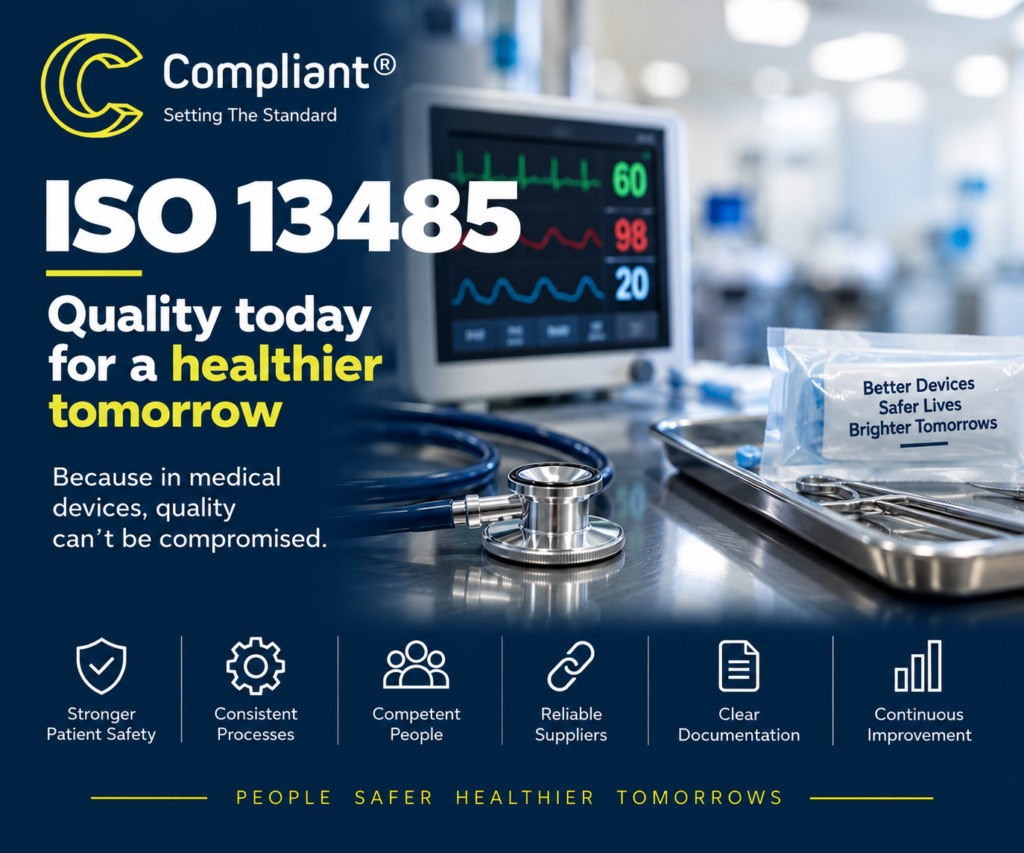
ISO 13485: Why Quality Cannot Be Compromised in Medical Devices
Imagine buying a product and discovering a small fault.
It is frustrating.
Perhaps you return it, receive a replacement and carry on with your day.
Now imagine that product is a medical device.
Suddenly, a small fault can mean something very different.
A measurement could be wrong.
A component could fail.
Important information could be missing.
A device may not perform when somebody needs it.
A manufacturing change that seemed minor could affect the finished product.
In the medical device sector, quality is not simply about keeping customers happy.
It can directly affect people’s health and safety.
That is why ISO 13485 matters.
It provides a framework for organisations involved with medical devices to build quality into their processes and maintain it consistently.
The important word is consistently.
Producing one good device is not enough.
Quality needs to be controlled across purchasing, design and development where applicable, production, storage, distribution and other relevant activities.
People need to understand their responsibilities.
Suppliers need to be controlled.
Records need to be reliable.
Problems need to be investigated.
Risks need to be understood.
And when something changes, the possible effects of that change need careful consideration.
Because when the product may affect someone’s health, “good enough” is not a quality standard.
What Is ISO 13485?
ISO 13485 is an international quality management system standard designed specifically for organisations involved in medical devices and related services.
At first glance, some of its principles may feel familiar to businesses that already understand quality management.
You need controlled processes.
Clear responsibilities.
Competent people.
Suitable records.
Supplier controls.
Internal audits.
Corrective action.
Management involvement.
But medical devices operate in a highly controlled environment, and ISO 13485 reflects that.
The standard places strong emphasis on meeting applicable regulatory and customer requirements and on maintaining effective processes throughout relevant stages of the medical device lifecycle.
That distinction is important.
A medical device quality management system should not exist simply to achieve certification.
It should help an organisation repeatedly produce products and services that meet requirements.
Quality Needs to Be Built In
You cannot inspect quality into a product at the very end.
Imagine producing 10,000 devices and relying entirely on a final check to decide whether they are acceptable.
What if the problem began much earlier?
Perhaps the wrong material was purchased.
Maybe a supplier changed something.
An instruction was unclear.
Equipment had not been maintained properly.
An employee had not received suitable training.
A process slowly moved outside its expected limits.
A final inspection might identify some problems.
But it is far better to control the processes that can create those problems in the first place.
This is one of the key ideas behind effective quality management.
Prevention is stronger than correction.
ISO 13485 helps organisations build control throughout their processes rather than relying solely on finding mistakes at the end.
Start With Clear Responsibilities
Quality becomes difficult when nobody is quite sure who owns what.
Who approves a document?
Who can release a product?
Who checks a supplier?
Who investigates a complaint?
Who approves a change?
Who decides whether corrective action is effective?
Who maintains particular records?
These questions need clear answers.
When responsibilities are vague, important tasks can be missed.
One person assumes somebody else completed a check.
Another believes a manager approved a change.
A record remains incomplete because nobody realised they owned it.
Clear responsibilities remove uncertainty.
People should know what they are responsible for and understand the importance of their work.
People Are Part of the Quality System
You can have excellent procedures and modern equipment.
But people still need to use them correctly.
Employee competence therefore matters.
Different roles require different knowledge and skills.
Someone working in production may need specific process training.
A person carrying out inspection needs to understand what they are checking and what acceptance criteria apply.
Someone dealing with complaints needs to understand how concerns should be recorded and assessed.
Employees involved with internal audits need suitable knowledge to perform them effectively.
Training should not simply be about getting a signature on a form.
The important question is:
Can the person perform the work they have been given correctly?
That means organisations need to think about competence, training and appropriate evidence.
Procedures Need to Reflect Reality
There is little value in having a beautifully written procedure that nobody follows.
This can happen when documentation becomes disconnected from everyday operations.
A procedure says one thing.
Employees do another.
Perhaps the process changed but the document did not.
Maybe the instructions are too complicated.
Perhaps employees created a shortcut because the written process does not work in practice.
That creates risk.
Under an effective medical device quality management system, documented processes need to support actual work.
Employees should be able to understand what is expected.
Documents need to be controlled.
Changes need to be managed.
Old information should not remain in use accidentally.
Documentation should create clarity.
Not confusion.
Document Control Is More Important Than It Looks
Imagine an employee is using an old version of a work instruction.
The latest version includes an important change.
But the employee never received it.
They continue producing devices using the previous method.
How many products could be affected before somebody notices?
Document control can sometimes feel administrative.
But situations like this show why it matters.
People need access to the correct information.
Documents need suitable approval.
Changes need to be identified and controlled.
Old versions need to be managed appropriately.
Records also need protection.
When somebody looks at a record months or years later, they need confidence that it is reliable.
Good document control supports good decisions.
Records Tell the Story
Records provide evidence of what happened.
They can show that an inspection took place.
That equipment was checked.
That training was completed.
That a supplier was reviewed.
That a product met specified requirements before release.
That a complaint was investigated.
That corrective action was completed.
Without reliable records, organisations may struggle to demonstrate that important controls actually happened.
This is why “we always do that” is not enough.
Can you demonstrate it?
Good records should make the answer clear.
But this does not mean creating paperwork without purpose.
Every record should have a reason.
The aim is useful evidence, not unnecessary administration.
Supplier Quality Becomes Your Quality
Your organisation may have excellent internal controls.
But what happens when an important component arrives from a supplier?
The quality of that component can affect your finished device.
That means supplier management matters.
Organisations need appropriate ways to evaluate and select suppliers based on their ability to meet requirements.
Control should also continue after selection.
Is the supplier performing as expected?
Are there repeated problems?
Have requirements changed?
Has the supplier made changes?
Does anything need further investigation?
Not every supplier needs exactly the same level of control.
The level of attention should make sense for what they provide and the effect it could have.
The important point is not to assume that purchasing something externally transfers the quality responsibility away.
Cheapest Does Not Always Mean Best Value
Purchasing teams often face pressure to control costs.
That is understandable.
Businesses need to remain commercially healthy.
But purchasing decisions involving medical devices cannot be based on price alone.
Imagine Supplier A provides a critical component at a lower price.
Supplier B costs slightly more but has stronger controls, more consistent performance and fewer problems.
Which represents better value?
The answer may not be found on the initial quote.
Poor quality creates other costs.
Investigation.
Rework.
Scrap.
Delays.
Complaints.
Returns.
Additional inspection.
Potential regulatory consequences.
And, most importantly, possible effects on users or patients.
Good supplier decisions consider the wider picture.
Traceability Can Become Critical
When something goes wrong, one of the first questions may be:
What was affected?
Can you identify the relevant products?
What materials or components were used?
Which records relate to them?
Where did they go?
Which processes were involved?
The level of traceability required depends on the device and applicable requirements, but the principle can be extremely important.
Poor traceability turns a controlled problem into a much larger uncertainty.
If you cannot clearly identify what is affected, you may need to assume more products could be involved.
Good records and traceability help organisations respond with greater confidence.
Risk Needs to Be Considered Throughout the Process
Risk management is central to medical devices.
The important thing is that risk is not something considered once and then forgotten.
Decisions can create new risks.
Changes can affect existing risks.
Supplier problems can change risk.
Complaints may reveal something previously missed.
Production information can provide new evidence.
Organisations need to remain alert.
Ask:
What could go wrong?
What could cause it?
What would the effect be?
What controls are in place?
Are those controls working?
Has anything changed?
These questions help keep risk connected to real business activities.
Change Needs Control
Change is normal.
Businesses improve.
Suppliers change.
Equipment is replaced.
Materials change.
Software is updated.
Employees find better ways of working.
Processes develop.
The danger is not change itself.
The danger is uncontrolled change.
Imagine replacing a component because the alternative is cheaper.
It appears almost identical.
But has anybody assessed what effect that change could have on the device?
Could it interact differently with another component?
Could it affect performance?
Does anything need testing?
Do documents need updating?
Are there regulatory implications?
Does the change affect risk?
A change that appears small in isolation may have wider consequences.
ISO 13485 helps organisations create a structured approach so changes are considered before being introduced.
Equipment Needs to Be Reliable
If equipment is being used to manufacture or inspect medical devices, you need confidence in it.
What happens if a measuring device is inaccurate?
You could believe products meet requirements when they do not.
What happens if production equipment slowly moves outside its expected performance?
The finished product could be affected.
Organisations therefore need suitable controls around equipment.
Maintenance.
Calibration where required.
Checks.
Records.
Clear identification.
Suitable handling.
Again, the aim is prevention.
It is far better to identify a problem with equipment before it affects products.
The Working Environment Can Affect Quality
Quality is not only about machinery and documents.
The environment in which work takes place may matter too.
Cleanliness.
Contamination.
Temperature.
Humidity.
People.
Clothing.
Handling.
The relevant controls will depend on the device and processes involved.
The important point is to understand whether the working environment could affect product quality and put suitable controls in place where needed.
Employees also need to understand why those controls matter.
A rule followed without understanding can easily become a rule ignored when people are busy.
Explain the reason.
Inspection Is More Than Looking at the Product
Inspection needs clear criteria.
What exactly are you checking?
What is acceptable?
What is not?
Who is authorised to make the decision?
What happens if something fails?
How is the result recorded?
Without clear criteria, two employees may make different decisions about the same product.
One accepts it.
The other rejects it.
That inconsistency creates risk.
Employees carrying out checks need appropriate instructions, equipment and competence.
The organisation needs confidence that the decision is repeatable.
What Happens When Something Does Not Meet Requirements?
No quality system can guarantee that nothing will ever go wrong.
What matters is how the organisation responds.
If a product or component does not meet requirements, it needs to be controlled.
You do not want it accidentally mixed with acceptable products.
You need to understand what has happened.
What is affected?
What should happen to it?
Who needs to make that decision?
Does the problem indicate something wider?
Is investigation required?
The response should match the situation.
But simply correcting the immediate item may not be enough.
Stop Fixing the Same Problem Repeatedly
Imagine the same defect appears every few months.
Each time, someone fixes the affected product.
Then everyone moves on.
That is correction.
But why does the problem keep returning?
Perhaps a process is unclear.
Maybe equipment is causing the issue.
A supplier could be responsible.
Training may be weak.
The design could contribute.
There may be several causes.
Effective quality management looks beyond the immediate problem.
Why did this happen?
And where appropriate:
What needs to change to stop it happening again?
That is where corrective action becomes valuable.
Complaints Are Valuable Information
Nobody enjoys receiving a complaint.
In medical devices, however, complaints can provide extremely important information.
A customer or user may have identified something that internal controls did not.
Do not see complaints only as something the customer service team needs to resolve.
They can provide evidence about product performance.
Look for patterns.
Are similar complaints appearing?
Do they involve the same product?
The same component?
The same supplier?
The same process?
Has the problem become more frequent?
Does the complaint need further action?
Complaint information can help organisations identify weaknesses and improve.
It needs to be taken seriously.
Do Not Wait for a Serious Problem
Sometimes the warning signs appear before a major failure.
An increase in minor defects.
A supplier becoming less consistent.
More rework.
A piece of equipment requiring repeated adjustment.
An unusual customer comment.
A process becoming harder to control.
One event may not look significant.
A pattern might be.
Businesses need ways to review information and recognise trends.
Quality management is strongest when it helps people act early.
Waiting until a problem becomes impossible to ignore can make the response far more difficult.
Internal Audits Should Find Weaknesses
An internal audit that never finds anything worth improving may not be asking enough questions.
The purpose is not to catch people out.
It is to check whether the quality management system is working.
Look at actual processes.
Speak to employees.
Follow records.
Choose a product or activity and trace what happened.
Check whether procedures match reality.
Review previous problems.
Look at corrective actions.
Check supplier controls.
Look at training.
Ask whether changes have been managed properly.
A useful internal audit gives management information.
Finding a weakness internally is a good opportunity.
You can correct it before it creates a bigger problem.
Management Needs to Stay Involved
ISO 13485 cannot belong only to the quality manager.
Leadership matters.
Senior management needs to understand how the quality management system is performing.
Are objectives being achieved?
What are audits showing?
What are customers saying?
Are suppliers performing?
Are there recurring problems?
Are resources adequate?
Does anything need to change?
Quality decisions often need management support.
Perhaps new equipment is required.
Additional training may be needed.
A supplier might need replacing.
A process may need investment.
If senior management is disconnected from the system, improvements can become difficult.
Quality needs leadership.
Quality Culture Matters
You can learn a great deal about an organisation by watching what happens when something goes wrong.
Does the employee report the problem?
Or hide it?
Does the manager investigate?
Or tell everyone to keep production moving?
Are people encouraged to raise concerns?
Or treated as difficult when they do?
Do employees understand why procedures matter?
Or do they simply follow them because an auditor might ask?
A strong quality culture encourages people to speak up.
If something does not look right, stop and question it.
That behaviour can prevent a small issue becoming much larger.
Never Let Production Pressure Silence Quality
Every business has deadlines.
Customers are waiting.
Orders need shipping.
Targets need meeting.
Pressure is real.
That is precisely when the quality system matters most.
Imagine an employee identifies a concern just before a large order is due to leave.
Stopping to investigate may cause a delay.
Ignoring the concern may feel easier.
But if the product later proves unsuitable, the consequences could be far greater than the original delay.
Employees need to know that legitimate quality concerns will be taken seriously, even when the timing is inconvenient.
A quality system that only works when the business is quiet is not a strong quality system.
Why Experienced ISO Consultant Support Can Help
ISO 13485 can feel challenging.
Medical devices operate within a demanding environment, and organisations need to understand both the standard and the regulatory requirements that apply to their activities and markets.
An experienced ISO consultant can help bring structure to the process.
Where are the gaps?
Which processes need better control?
Do responsibilities need clarification?
Are supplier controls appropriate?
Does documentation reflect reality?
Are internal audits providing useful information?
How are complaints managed?
Can the business demonstrate employee competence?
Are changes controlled effectively?
An outside view can be valuable because businesses become familiar with their own processes.
Something may have been done the same way for years.
That does not automatically mean it remains the best or correct way.
Consultant Support Should Not Mean Creating Mountains of Paperwork
A common fear around management systems is paperwork.
Procedures.
Forms.
Spreadsheets.
Records.
More forms.
That should not be the goal.
ISO 13485 does have important documentation and record requirements.
But every document should have a purpose.
A good ISO consultant can help organisations understand what is needed and create a system that people can actually use.
Documentation should help control quality.
It should provide clarity.
It should provide evidence.
It should support consistent work.
If employees spend more time feeding the management system than using it to manage quality, something may need reviewing.
Your System Needs to Reflect Your Organisation
Medical device organisations vary enormously.
A system suitable for one organisation may be completely inappropriate for another.
Your activities matter.
Your products matter.
Your processes matter.
Your regulatory position matters.
Your risks matter.
Your suppliers matter.
Your customers matter.
ISO consultant support can help an organisation interpret ISO 13485 in the context of what it actually does rather than copying another company’s system.
That makes the management system more useful.
And useful systems are far more likely to be maintained properly.
Certification Is Not the Finish Line
Achieving ISO 13485 certification can be an important milestone.
But the work does not stop on certification day.
People change.
Suppliers change.
Processes change.
Products change.
Requirements change.
Problems appear.
Audits identify opportunities.
Customer feedback provides information.
The quality management system needs to remain active.
If everything becomes quiet until the next audit approaches, the organisation is missing much of the value.
Quality needs managing every day.
Ask One Question Today
Choose one important medical device process within your organisation.
It could involve purchasing.
Production.
Inspection.
Training.
Complaints.
Supplier management.
Product release.
Document control.
Now ask:
What could go wrong here that could affect product quality?
Then go further.
How would we know?
What control should prevent it?
Can we prove that control is working?
What would happen if it failed?
Who would notice?
Who would act?
Those questions can tell you far more about the strength of your quality management system than simply checking whether a procedure exists.
Why Quality Cannot Be Compromised in Medical Devices
Every organisation wants efficient processes.
Costs matter.
Delivery times matter.
Productivity matters.
Growth matters.
But in medical devices, those priorities must sit alongside something that cannot be forgotten.
The product may affect a person’s health or safety.
That changes the meaning of quality.
ISO 13485 provides organisations with a structured way to manage that responsibility.
It helps businesses control processes.
Manage suppliers.
Maintain suitable evidence.
Support competent people.
Investigate problems.
Control changes.
Learn from complaints.
Review performance.
And continually maintain an effective quality management system.
Experienced ISO consultant support can help businesses understand those requirements and turn them into practical controls that fit the organisation.
But the real value does not come from having ISO 13485 written on a certificate.
It comes from what happens when nobody is auditing.
When an employee notices something unusual and speaks up.
When a supplier problem is investigated rather than ignored.
When an old document is prevented from being used.
When a change is properly reviewed before implementation.
When a complaint becomes a lesson.
When a product is held back because something does not look right.
Those decisions protect quality.
And in medical devices, protecting quality can mean protecting something far more important than a company’s reputation.
It can mean protecting the person who ultimately depends on the device working exactly as it should.
That is why quality cannot be compromised.