Skip to main content
Skip to footer
Skip to main content
Skip to footer

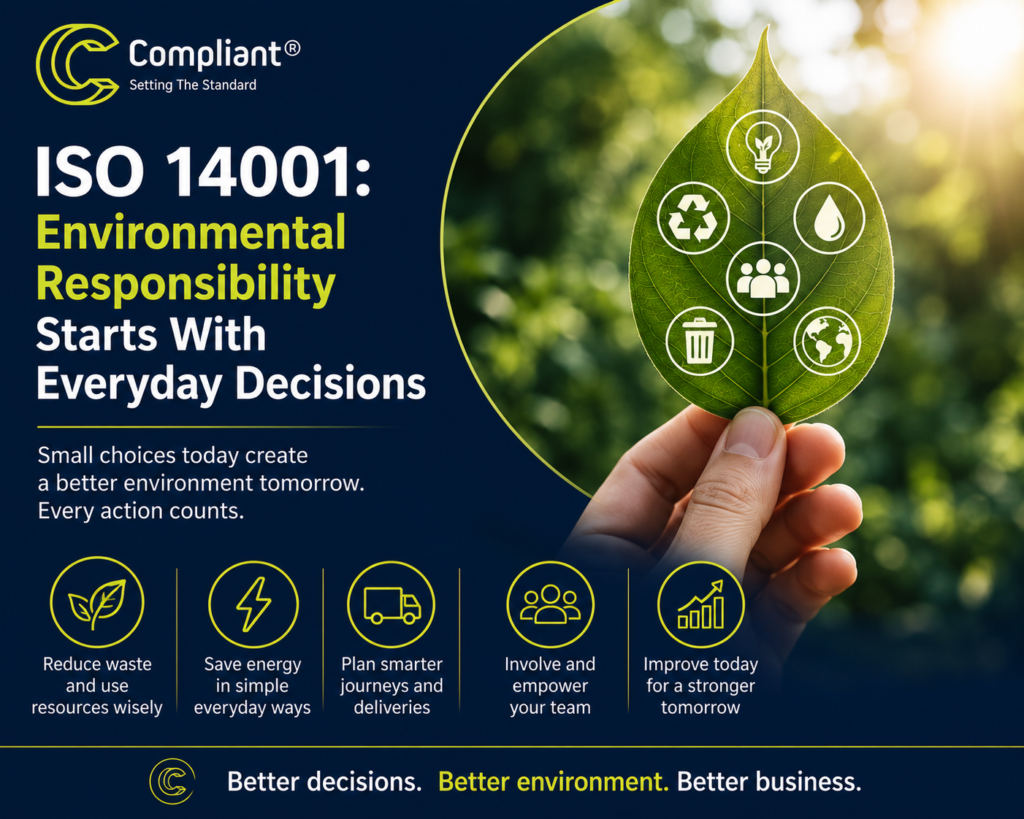
ISO 14001: Environmental Responsibility Starts With Everyday Decisions
Environmental responsibility can sound like a huge task.
Carbon targets. Waste plans. Energy use. Supply chains. New rules. Customer expectations.
For many businesses, the subject quickly becomes overwhelming.
You may know your organisation should be doing more. You may already have environmental targets in place. Perhaps you have achieved ISO 14001 certification or are working towards it.
But there is one problem.
The environmental policy looks impressive while everyday behaviour tells a different story.
Lights are left on in empty rooms.
Equipment runs when nobody needs it.
Waste goes into the wrong bins.
Products are ordered in quantities that are never used.
Employees print documents they could read on a screen.
Deliveries are arranged separately when they could have been combined.
A leaking tap is ignored.
Materials are thrown away because too much was ordered.
Nobody thinks much about it because each individual action seems too small to matter.
But environmental responsibility is built from these small decisions.
One wasted sheet of paper will not change the world.
One unnecessary journey will not either.
But multiply those decisions across every employee, every working day and every year.
Suddenly, small decisions are not so small.
This is where ISO 14001 can make a real difference.
It gives businesses a structured way to understand their environmental impact, decide what matters and make improvements that become part of everyday working life.
Because environmental responsibility does not begin with one huge project.
It begins with what your business chooses to do today.
Your Environmental Policy Cannot Do the Work for You
Many businesses have an environmental policy.
That is a useful starting point.
It might promise to reduce waste, use resources responsibly and improve environmental performance.
But a policy cannot switch off a light.
It cannot reduce unnecessary packaging.
It cannot decide whether a journey is really needed.
It cannot question why so much material is being wasted.
People make those decisions.
That is why the success of an Environmental Management System depends on more than having the right documents.
Employees need to understand what the business is trying to achieve and how their own actions contribute.
If environmental responsibility belongs only to one manager, progress will always be limited.
ISO 14001 should become part of how the whole organisation works.
From the person placing an order to the person using the materials.
From senior management to somebody starting their first week.
Everyone makes decisions.
Those decisions can create waste or reduce it.
They can use unnecessary energy or save it.
They can create environmental risks or help control them.
The system gives you the structure.
Your people make it work.
Start by Understanding Your Real Environmental Impact
Before you can improve, you need to understand where your impact comes from.
This sounds obvious.
But businesses sometimes focus on the most visible environmental issues rather than the most important ones.
Recycling bins are easy to see.
So recycling receives attention.
But what about the amount of waste being created before anything reaches those bins?
What about electricity?
Fuel?
Water?
Raw materials?
Packaging?
Deliveries?
Business travel?
Suppliers?
How products are stored?
How waste is removed?
What happens when equipment reaches the end of its useful life?
Your environmental impact will depend on what your organisation does.
A construction company will have different concerns from an office.
A manufacturer will have different impacts from a consultancy.
A transport business will have different priorities from a software company.
ISO 14001 helps businesses identify the parts of their activities that interact with the environment.
Once you understand those areas, you can decide where attention will make the biggest difference.
That matters because environmental improvement should be focused.
Trying to change everything at once usually creates frustration.
Understanding what matters most allows you to start where improvement can have genuine value.
Waste Is Often a Sign of a Bigger Business Problem
Waste is one of the easiest environmental issues to see.
Bins fill up.
Skips need emptying.
Unused materials pile up.
Packaging gets thrown away.
But waste should not only be viewed as an environmental problem.
It can also be a business problem.
Every item you throw away had to be bought, produced or transported.
That cost money.
Then you may have to pay again to remove it.
Imagine your business regularly orders more material than it needs.
The unused material eventually becomes waste.
You paid to buy it.
You may have paid to deliver it.
You used space to store it.
Then you paid to dispose of it.
Reducing waste can therefore support environmental improvement while also improving efficiency.
ISO 14001 encourages businesses to look at why waste is being created.
Could ordering be improved?
Could materials be reused?
Could packaging be reduced?
Could damaged stock be prevented?
Could employees receive better guidance?
Could suppliers offer another option?
The best waste is often the waste you never create.
Energy Use Is Made Up of Thousands of Small Decisions
Businesses use energy every day.
Lighting.
Heating.
Cooling.
Computers.
Machinery.
Chargers.
Kitchen equipment.
Production equipment.
The exact sources will depend on your organisation.
Individual actions can seem insignificant.
Someone leaves a monitor switched on overnight.
No big problem.
A room is heated while nobody is using it.
Again, it may seem minor.
But environmental performance is often the result of repeated behaviour.
This is why awareness matters.
Employees do not need a long lesson about environmental management every time they enter the workplace.
They need simple expectations.
Switch things off when they are not needed.
Report problems.
Avoid unnecessary use.
Think before using resources.
Managers also need to look beyond individual behaviour.
If energy use is unusually high, there may be a larger problem.
Old equipment might be inefficient.
Heating controls may be poor.
A process could be using more power than necessary.
ISO 14001 encourages organisations to measure and review performance so decisions are based on evidence rather than guesses.
Small Improvements Become Powerful When Everyone Takes Part
Imagine a business with 100 employees.
One person changing a habit may not produce a noticeable result.
But what happens when 100 people change?
What happens when those behaviours continue for a year?
That is why employee involvement is so important.
Your team sees things managers may never notice.
Someone working with materials every day may know exactly where waste occurs.
A driver may see opportunities to plan journeys better.
An employee using equipment may notice that it is regularly left running unnecessarily.
The person responsible for ordering may see how much packaging arrives.
Your employees are close to the processes.
Ask them what could improve.
Environmental improvement should not always travel from management downwards.
Some of the best ideas can come from the people doing the work.
Purchasing Decisions Have Environmental Consequences
Environmental responsibility begins before a product even arrives at your business.
Every purchasing decision can have an impact.
What are you buying?
How much are you buying?
Where is it coming from?
How is it packaged?
How long will it last?
Can it be repaired?
Can it be reused?
What happens when you no longer need it?
The cheapest option at the point of purchase may not always be the best choice over time.
A low-cost item that needs replacing frequently could create more waste and cost more in the long term.
Large amounts of unnecessary packaging create disposal problems.
Ordering small quantities repeatedly can create additional deliveries.
ISO 14001 encourages businesses to consider environmental factors when making relevant purchasing and supplier decisions.
That does not mean environmental concerns must control every purchase.
It means they become part of the conversation.
When environmental thinking becomes part of normal decision-making, improvement becomes much easier.
Your Suppliers Matter Too
Your environmental impact does not necessarily stop at your front door.
Suppliers can influence your performance.
They deliver goods.
Provide services.
Create packaging.
Remove waste.
Supply materials.
Transport products.
Some may carry out work on your behalf.
You cannot control every part of another organisation.
But you can ask better questions.
Can packaging be reduced?
Can deliveries be combined?
Are there alternative materials?
How is waste handled?
Could products be supplied in reusable containers?
Are environmental requirements clearly explained?
Supplier relationships can create opportunities for improvement that your business cannot achieve alone.
This is another reason environmental management should not sit in isolation.
Purchasing teams need to understand it.
Operations teams need to understand it.
Managers need to understand it.
Environmental responsibility connects with everyday business decisions.
Environmental Risk Is About More Than Recycling
When people hear “environment”, recycling often comes first.
Recycling matters.
But ISO 14001 takes a much wider view.
Consider a business that stores chemicals.
A spill could cause environmental damage.
A company operating vehicles may need to think about fuel use and emissions.
A manufacturer may create waste, use large amounts of energy or produce substances that require careful control.
An office may use fewer physical resources but still consume electricity, purchase equipment and create electronic waste.
Every organisation is different.
This is why copying another company’s Environmental Management System rarely works well.
Your system needs to reflect your activities, your risks and your opportunities.
A useful ISO 14001 system should help you understand what could go wrong and what controls are needed.
Prevention is usually much easier than dealing with the consequences of an environmental incident.
What Would Happen if Something Went Wrong Tomorrow?
Consider your environmental risks.
What would happen if there was a spill?
What if waste was stored incorrectly?
What if a supplier failed to collect something hazardous?
What if equipment leaked?
Would your employees know what to do?
Who would they tell?
What action should they take?
Where is the equipment they might need?
Who has responsibility?
Plans become valuable when something unexpected happens.
There is little benefit in having an emergency process nobody understands.
People need clear instructions.
Relevant employees may need practice.
Equipment may need checking.
Responsibilities need to be understood.
ISO 14001 encourages organisations to prepare for possible environmental emergencies rather than waiting until an incident happens.
Targets Need to Mean Something
“Become more environmentally friendly.”
It sounds positive.
But what does it actually mean?
How will you know when you have achieved it?
Good environmental objectives need direction.
Perhaps your organisation wants to reduce electricity use.
Cut waste.
Reduce fuel use.
Increase reuse of materials.
Reduce unnecessary printing.
Improve recycling.
Lower water consumption.
The exact objective matters less than making it relevant to your organisation.
Then you need to measure it.
If you want to reduce waste, understand how much waste you currently create.
If you want to reduce energy use, look at your current consumption.
Without a starting point, improvement becomes difficult to prove.
ISO 14001 can help organisations move from good intentions to measurable action.
That is important because environmental responsibility should be more than saying the right things.
It should create visible progress.
Do Not Set Targets Nobody Can Achieve
Ambition is useful.
Unrealistic targets are not.
Businesses sometimes set impressive environmental goals without understanding what will be required to achieve them.
The target is announced.
Everyone feels positive.
Then six months later, little has changed.
Employees stop paying attention.
A better approach is to understand your current position and build from there.
What can realistically improve?
What resources are available?
Who needs to be involved?
What changes are required?
How will progress be measured?
Small, achievable improvements build confidence.
Once those changes become normal, you can move further.
Continual improvement does not mean transforming everything overnight.
It means continuing to move in the right direction.
Leadership Makes Environmental Responsibility Real
Employees notice what leaders care about.
If management talks about environmental responsibility but ignores waste, employees notice.
If targets are set but nobody reviews them, employees notice.
If environmental concerns disappear whenever they become inconvenient, employees notice that too.
Leadership does not require senior managers to know every detail of ISO 14001.
It means showing that environmental performance matters.
Review progress.
Ask questions.
Support improvements.
Provide resources where they are needed.
Listen to employees.
Take problems seriously.
Good leadership turns environmental responsibility from a written promise into normal behaviour.
Internal Audits Should Help You Find Opportunities
Internal audits are sometimes treated as something businesses need to complete because ISO requires them.
That misses much of their value.
A useful internal audit should help you understand what is actually happening.
Do employees follow the process?
Are environmental controls working?
Are records useful?
Have new risks appeared?
Are objectives moving in the right direction?
Is waste being managed correctly?
Do employees know what to do if something goes wrong?
Audits can also identify improvement opportunities.
Perhaps a process uses more material than expected.
Maybe employees have developed a better way of working that has never been formally reviewed.
Perhaps a waste area is causing confusion.
These findings are valuable.
An internal audit is not about finding somebody to blame.
It is about finding ways to make the system stronger.
Management Reviews Should Lead to Decisions
Environmental performance needs leadership attention.
Management review gives senior leaders an opportunity to look at the wider picture.
Are objectives being achieved?
What did internal audits find?
Have there been environmental incidents?
Have legal or other requirements changed?
Are complaints being received?
Have new activities introduced new environmental risks?
Are resources needed?
What opportunities exist?
A management review should not simply repeat what was discussed last year.
It should help leaders make decisions.
If waste is increasing, why?
If an objective is not being achieved, what needs to change?
If energy use has fallen, what caused the improvement and can that success be repeated elsewhere?
Information becomes valuable when you use it.
Legal Requirements Cannot Be Ignored
Environmental responsibility is not only about voluntary improvement.
Businesses may also have environmental rules and legal duties that apply to their activities.
What applies will depend on what your organisation does.
This can feel difficult, particularly for businesses that do not have environmental specialists in-house.
But not knowing about a requirement does not make it disappear.
ISO 14001 encourages organisations to understand the requirements that apply to them and keep that knowledge up to date.
This is an area where the benefits of an ISO consultant’s support can be particularly helpful.
An experienced consultant can help you understand how ISO 14001 applies to your organisation and where you may need to investigate further.
The goal should always be understanding.
Your business needs to know its responsibilities rather than simply relying on somebody outside the organisation to tell you what to do.
Where an ISO Consultant Can Add Value
ISO 14001 can initially feel complicated.
Businesses may wonder where to begin.
What needs documenting?
Which environmental impacts matter most?
What should be measured?
How should internal audits work?
Are objectives realistic?
Do employees understand their responsibilities?
This is where an experienced ISO consultant can provide useful support.
One of the biggest benefits of an ISO consultant’s support is an outside view.
When you work inside the same business every day, some habits become invisible.
Waste becomes normal.
Old processes remain because nobody questions them.
Environmental controls may exist but no longer match how the organisation works.
A consultant can ask questions.
Why do you do this?
Could it be simpler?
What environmental impact does this process create?
How do you know this control works?
What evidence are you reviewing?
Where could improvement have the greatest effect?
Good consultant support should not create paperwork for the sake of paperwork.
It should help your business build an Environmental Management System that fits the way you operate.
Your ISO Consultant Should Help Build Internal Knowledge
An ISO consultant should support your organisation.
They should not become your entire environmental system.
Your employees need to understand their responsibilities.
Managers need to understand the information they are reviewing.
Senior leaders need to understand environmental risks and opportunities.
The system ultimately belongs to your business.
One of the important benefits of an ISO consultant’s support is the ability to transfer knowledge.
A consultant can explain requirements in straightforward language.
They can support internal audits.
They can help review your current system.
They can identify gaps.
They can help employees understand how ISO 14001 connects with everyday work.
The strongest result is a business that becomes more confident in managing its own Environmental Management System.
Five Everyday Questions That Can Drive Environmental Improvement
You do not need to wait for a major environmental project to start improving.
Encourage your team to ask five simple questions.
1. Do we really need to use this?
Think before using materials, energy or other resources.
2. Are we creating unnecessary waste?
Look at why waste is produced, not only where it goes afterwards.
3. Could we do this in a simpler way?
A more efficient process can often reduce environmental impact too.
4. What happens when we are finished with this?
Consider reuse, recycling and disposal before buying something.
5. Is there a better option?
Small improvements often begin with somebody questioning the normal way of doing things.
These questions are simple enough to use every day.
That is exactly the point.
ISO 14001 Should Be Visible in Everyday Behaviour
You should not need to wait for an audit to see whether your Environmental Management System is working.
Look around your business.
Are people thinking about waste?
Do employees report environmental problems?
Are objectives being discussed?
Are environmental risks considered when processes change?
Do purchasing decisions consider environmental impact where appropriate?
Are managers reviewing performance?
Are improvements being made?
If yes, ISO 14001 is becoming part of everyday business.
If environmental activity suddenly increases a month before the audit, there may be a problem.
A good Environmental Management System should operate throughout the year.
Audit readiness then becomes a result of good management rather than a last-minute project.
Small Decisions Can Create Big Change
Environmental challenges are huge.
That can make individual businesses feel powerless.
What difference can one organisation really make?
The answer becomes clearer when you stop looking for one enormous action.
Improvement happens through thousands of decisions.
Ordering less unnecessary material.
Reducing waste.
Using less energy.
Planning journeys more carefully.
Choosing better suppliers.
Maintaining equipment.
Preventing spills.
Training employees.
Reviewing performance.
Questioning inefficient processes.
Each decision may look small.
Together, they shape your environmental performance.
That is why ISO 14001 can be so valuable.
It gives organisations a way to turn environmental responsibility into structured, repeatable action.
Not once.
Not just before an audit.
Every day.
Environmental Responsibility Starts With What You Do Next
Your organisation does not need to solve every environmental problem tomorrow.
It does need to understand its own impact.
Then it needs to act.
Look at where your resources are going.
Look at what you throw away.
Look at energy use.
Talk to employees.
Review suppliers.
Understand your risks.
Set meaningful objectives.
Measure progress.
Learn when things go wrong.
And keep looking for ways to improve.
Where additional knowledge is needed, consider the benefits of an ISO consultant’s support in helping your team understand ISO 14001 and turn its requirements into practical actions.
The aim is not to create the biggest environmental manual.
It is to create better decisions.
Because an Environmental Management System is only useful when it changes what happens in the real world.
Your environmental policy may explain your intentions.
Your ISO 14001 certificate may demonstrate your commitment.
But your everyday decisions show what environmental responsibility actually looks like.
Educational CTA
Choose one everyday activity in your business this week and follow it from beginning to end.
It could be ordering materials, using energy, arranging deliveries, printing documents or managing waste.
Ask your team where resources are being used unnecessarily, where waste is being created and what one simple change could improve the process.
Do not try to solve everything at once.
Find one improvement.
Make it work.
Measure the difference.
Then look for the next one.
That is how ISO 14001 becomes more than a management system.
It becomes part of how your business makes better decisions every day.