Skip to main content
Skip to footer
Skip to main content
Skip to footer

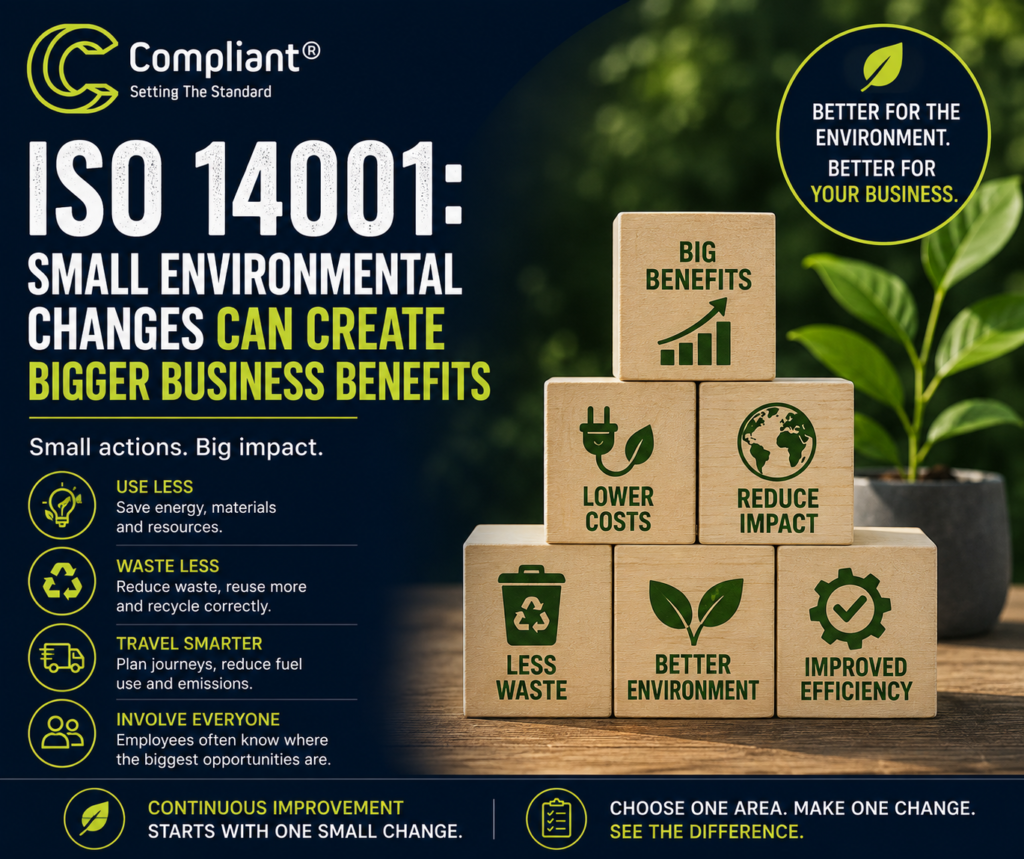
ISO 14001: Small Environmental Changes Can Create Bigger Business Benefits
Environmental improvement can feel like a huge job.
Businesses hear about carbon reduction, climate targets, waste, energy use, recycling, supply chains and environmental laws. Before long, it can seem as though making a real difference will require a large budget, new equipment and major changes across the whole organisation.
That can lead to one very common response.
“We’ll deal with it later.”
But environmental improvement does not always begin with a major project.
Sometimes it starts with something surprisingly small.
A light being switched off.
A delivery route being planned better.
Less packaging being used.
A leaking tap being repaired.
Waste being separated properly.
Equipment being turned off overnight.
One unnecessary journey being removed from the week.
Individually, these changes may not look impressive.
Repeated every day, across a whole business, they can become significant.
And this is where ISO 14001 can provide real value.
ISO 14001 helps businesses take a structured approach to environmental management. Rather than making random improvements when somebody remembers, organisations can understand where their biggest environmental effects come from, decide what matters and make sensible changes.
The result can be better for the environment.
But it can also be better for the business.
Less waste can mean lower costs. Lower energy use can reduce bills. Better planning can improve efficiency. Clear processes can help employees make better decisions.
Small environmental changes really can create bigger business benefits.
Environmental Improvement Does Not Have to Mean Spending More
One of the biggest misunderstandings around environmental management is that it is expensive.
Sometimes investment is needed.
A business might decide to replace old equipment, improve a building or change vehicles.
But spending money is not the only way to improve environmental performance.
Often, the first opportunity is to stop wasting what you already pay for.
Think about electricity.
Are lights left on in empty rooms?
Are computers running overnight?
Is equipment operating when nobody needs it?
Is heating being used while windows or doors are open?
Now think about materials.
How much gets thrown away?
Could products be ordered in different quantities?
Could packaging be reduced?
Are mistakes creating wasted materials?
Could something currently treated as waste be reused?
Then consider travel.
Are employees making unnecessary journeys?
Could deliveries be grouped together?
Could meetings sometimes take place online?
Could routes be planned better?
None of these questions automatically requires a major investment.
They require attention.
That is one of the strengths of ISO 14001. It encourages businesses to understand what is happening before deciding what needs to change.
Start With What Your Business Actually Does
Environmental management should not begin with a generic checklist.
Every organisation is different.
A manufacturing company may use large amounts of energy and raw materials.
A construction business may need to think carefully about waste, fuel and site activity.
An office-based company may have fewer direct environmental effects but still use energy, purchase products, create waste and require employees to travel.
A transport company will have different priorities again.
ISO 14001 encourages businesses to consider how their own activities interact with the environment.
This is important because it stops organisations wasting time on improvements that make very little difference while ignoring bigger opportunities.
For example, reducing paper use can be worthwhile.
But if paper represents a tiny part of your environmental impact while large amounts of fuel are being wasted every week, fuel may deserve more attention.
The aim is not to find hundreds of environmental issues.
It is to understand which ones matter.
Then you can decide what to do about them.
Small Waste Problems Can Become Expensive Habits
Waste is an obvious place to look for environmental improvements.
But do not think only about what goes into the bin.
Waste can happen throughout a business.
Wasted electricity.
Wasted water.
Wasted fuel.
Wasted packaging.
Wasted raw materials.
Wasted products because mistakes were made.
Wasted journeys.
Even wasted time can sometimes lead to unnecessary environmental effects.
Consider a business that regularly makes errors during production.
Materials are used.
Energy is consumed.
Employees spend time carrying out the work.
Then the product cannot be used.
The business has not only created a quality problem.
It has created an environmental one too.
Improving the process could therefore deliver several benefits at once.
Fewer mistakes.
Less waste.
Lower material costs.
Lower energy use.
Better productivity.
That is why environmental management should not sit in isolation from the rest of the business.
A good improvement can solve more than one problem.
Your Energy Bill Can Tell You Something
Businesses receive energy bills every month.
They are often treated as something to pay rather than something to learn from.
But changes in energy use can provide useful information.
Has consumption increased?
Why?
Did the business become busier?
Was new equipment introduced?
Has something been left running?
Is heating being managed effectively?
Are there unusual patterns?
ISO 14001 encourages organisations to monitor areas that are important to their environmental performance.
You do not need complicated systems to begin.
For some businesses, simply recording monthly energy use and comparing it over time can reveal useful patterns.
Suppose energy use remains high during a period when production falls.
That deserves a closer look.
Or perhaps one site consistently uses far more electricity than another similar location.
Why?
The information itself does not create improvement.
The questions you ask because of it do.
Give Employees a Reason, Not Just a Rule
“Turn the lights off.”
“Recycle this.”
“Do not waste water.”
“Switch equipment off.”
Rules are easy to create.
Changing behaviour can be harder.
People are more likely to support environmental improvements when they understand why they matter.
Instead of simply telling employees to switch equipment off, explain the difference it can make.
If the business has an environmental target, share it.
If energy use has fallen, tell people.
If a change has reduced waste, show the result.
People like to know that their actions matter.
ISO 14001 works best when environmental management is not something understood by one manager and ignored by everyone else.
Employees carry out many of the activities that affect environmental performance.
They use equipment.
They order materials.
They drive vehicles.
They dispose of waste.
They speak to suppliers.
They see problems.
Their involvement matters.
Your Employees May Already Know Where the Waste Is
Ask your employees where the business wastes resources.
You may get some very useful answers.
People working within a process every day often see things managers do not.
They know which materials regularly get thrown away.
They know which equipment is left running unnecessarily.
They know when deliveries arrive with far too much packaging.
They know which process creates repeated mistakes.
They know where bins are confusing.
They know when unnecessary journeys happen.
The challenge is creating a way for that information to reach the people who can act on it.
Environmental improvement does not always need to come from senior management.
A small suggestion from an employee could save resources every day for years.
Ask simple questions.
Where are we wasting materials?
What could we use less of?
What do we throw away unnecessarily?
What takes more energy than it should?
What environmental change would make your job easier?
Then listen.
Set Targets That People Can Understand
A target should help people focus.
It should not exist simply because ISO 14001 is mentioned.
“Improve environmental performance” sounds positive.
But what does it mean?
How will you know whether you have succeeded?
A clearer target might be to reduce electricity use.
Reduce a certain type of waste.
Cut unnecessary journeys.
Increase recycling.
Reduce fuel use.
The exact target will depend on the business.
The important part is making it meaningful.
Employees should understand what the organisation is trying to achieve.
Managers should be able to review progress.
And if the target is not being achieved, the business should ask why.
Perhaps the target was unrealistic.
Maybe employees were not given the tools they needed.
Perhaps the action chosen did not work.
That is not a reason to abandon environmental improvement.
It is a reason to learn and adjust.
Do Not Make ISO 14001 a Paper Exercise
ISO 14001 requires businesses to maintain certain information.
Records matter.
Processes matter.
Evidence matters.
But environmental management should not become a collection of documents that only appear when an audit approaches.
A beautifully written procedure does not reduce waste.
A spreadsheet does not switch equipment off.
An environmental policy does not automatically change behaviour.
People do.
Your management system should help those people make better decisions.
If an environmental process is so complicated that employees avoid using it, simplify it.
If nobody understands a form, ask why it exists.
If information is being collected but never reviewed, question whether it is useful.
ISO 14001 should become part of everyday business activity.
Not another job sitting beside it.
Environmental Improvement Can Reduce Costs
Environmental and financial benefits often overlap.
Use less electricity and the business may pay less for energy.
Use fewer materials and purchasing costs can fall.
Create less waste and disposal costs may reduce.
Plan journeys better and fuel costs may fall.
Reduce mistakes and fewer materials need replacing.
Improve equipment use and it may last longer.
This does not mean every environmental improvement will immediately save money.
Some actions require investment.
Others may be carried out because they are the right way to manage environmental responsibilities.
But businesses should not assume environmental management is simply another cost.
Look for opportunities where environmental and business improvements support each other.
These are often some of the easiest changes for employees and managers to understand.
Look at What You Buy
Environmental impact does not begin when something arrives at your door.
Purchasing decisions matter too.
What materials are you buying?
How much packaging comes with them?
How far have products travelled?
How often are deliveries made?
Are you ordering more than you need?
Could items be reused?
Are there alternatives that create less waste?
Could suppliers help you reduce packaging?
You may not always have complete control over these issues.
But asking the questions can uncover opportunities.
Suppose a supplier sends five separate deliveries each week.
Could those orders be combined?
That one change might reduce journeys, fuel use, packaging and administration.
Small change.
Several benefits.
This is exactly the type of practical thinking ISO 14001 should encourage.
Look Beyond Your Front Door
Businesses often focus on what happens inside their own building.
But environmental effects can happen elsewhere too.
Employees travel.
Suppliers deliver goods.
Contractors work on your behalf.
Waste leaves your site.
Products are transported to customers.
Understanding these wider activities can help identify environmental risks and opportunities.
Again, this does not mean trying to control everything.
You cannot control every action taken by every supplier.
But you can consider where your business has influence.
Could environmental expectations be included when choosing suppliers?
Could contractors receive clear site instructions?
Could customers be given better information about using or disposing of a product?
ISO 14001 encourages businesses to think about the wider life of their activities and services.
That can lead to improvements that would otherwise be missed.
Small Changes Need to Be Repeated
Doing something environmentally friendly once is easy.
Doing it every day is where the real benefit comes from.
Imagine one employee saves a small amount of electricity.
Not much changes.
Now imagine fifty employees doing the same thing every working day.
The numbers begin to look different.
This is why processes matter.
Good intentions are useful.
Consistent habits are better.
If you identify a change that works, build it into the normal way of working.
Make responsibilities clear.
Provide simple instructions if needed.
Train people where appropriate.
Then check whether the change continues.
Environmental improvement is not a one-day event.
It grows through repeated action.
Measure Before and After
If you make an improvement, find out whether it worked.
This sounds simple, but it is often missed.
A business introduces new recycling bins.
Six months later, nobody knows whether recycling increased.
Equipment settings are changed to reduce energy use.
Nobody checks the energy figures.
Delivery routes are altered.
Fuel use is never compared.
Without measurement, the business may believe an improvement worked when it did not.
Or it may fail to recognise a very successful change.
ISO 14001 encourages monitoring because decisions are stronger when they are based on information.
Keep the measurement suitable for the improvement.
You do not need a complicated report for every action.
Sometimes a simple before-and-after comparison is enough.
Did waste decrease?
Did energy use fall?
Were fewer journeys made?
Did the cost change?
What did employees notice?
Learn from the result.
Mistakes Can Highlight Environmental Opportunities
Something going wrong can reveal a weakness.
A spill happens.
Waste is put in the wrong container.
Materials are ordered incorrectly.
Equipment is left running.
A supplier delivers something in unsuitable packaging.
Do not simply correct the immediate issue and move on.
Ask why it happened.
Was the process unclear?
Did the employee know what to do?
Was suitable equipment available?
Had something changed?
Was responsibility unclear?
Could the problem happen again?
ISO 14001 should help businesses learn from environmental problems rather than simply record them.
The goal is not to find someone to blame.
The goal is to reduce the chance of the same issue happening again.
Environmental Laws Cannot Be Ignored
Environmental improvement is not only about voluntary changes.
Businesses also need to understand the environmental rules that apply to their activities.
Those requirements will vary depending on what the organisation does.
Waste may be one area.
Storage of certain materials may be another.
Some businesses may have requirements around emissions, water or other environmental effects.
ISO 14001 provides a structured way to identify relevant requirements and consider how the organisation meets them.
This is important because assuming “we’ve always done it this way” is not enough.
Requirements can change.
Businesses change too.
New activities may create new responsibilities.
Regular review helps make sure important obligations are not forgotten.
The Benefits of an ISO Consultant’s Support
For businesses beginning ISO 14001, one of the hardest parts can be knowing where to start.
Everything can seem important.
Waste.
Energy.
Travel.
Suppliers.
Environmental risks.
Legal requirements.
Targets.
Training.
Records.
Trying to tackle everything at once can make the process feel much larger than it needs to be.
This is where the benefits of an ISO consultant’s support can become valuable.
An experienced consultant can help the business understand what ISO 14001 requires and how those requirements apply to its actual activities.
They can help identify which environmental effects deserve the most attention.
They can challenge existing processes.
Why are you measuring this?
What does this information tell you?
Where is most of your waste coming from?
How do you know employees understand the process?
How are environmental requirements kept up to date?
What happens when something goes wrong?
The consultant should not simply create paperwork.
Their role should help the business understand the system it is building.
Your team knows your organisation.
The consultant understands ISO 14001.
Bringing those two areas of knowledge together can create a system that works in practice rather than one designed only to get through an audit.
Leadership Makes Environmental Improvement Visible
Employees notice what leaders pay attention to.
If environmental management is mentioned once a year before an audit, people will quickly understand its real priority.
If managers regularly review performance, ask questions and support sensible improvements, the message is different.
Leadership does not mean senior managers need to check recycling bins every morning.
It means environmental performance should form part of business decisions.
When purchasing equipment, consider energy use.
When changing suppliers, consider environmental factors where relevant.
When reviewing performance, include important environmental measures.
When employees suggest improvements, listen.
Small actions from leadership can make environmental responsibility feel like part of the business rather than an extra task.
Internal Audits Should Look at What Really Happens
An internal audit should not simply check whether environmental documents exist.
Go and look.
Are waste containers being used correctly?
Do employees understand what they should do?
Are environmental checks actually happening?
Are records accurate?
Have improvements been completed?
Are there obvious areas of waste?
Speak to employees.
Ask them how the process works.
Compare their answer with what the written procedure says.
Sometimes the difference between those two versions reveals the best improvement opportunity.
An internal audit is not about catching people out.
It is about finding out whether your environmental management system works.
Improvement Does Not Need to Be Perfect
Businesses can delay environmental action because they are waiting for the perfect answer.
The perfect technology.
The perfect system.
The perfect target.
The perfect budget.
Meanwhile, simple improvements are missed.
ISO 14001 is based on ongoing improvement.
That means you do not need to solve every environmental problem immediately.
Understand where you are now.
Choose sensible priorities.
Make improvements.
Measure what happened.
Learn.
Then improve again.
A series of small changes can create significant results over time.
Start With One Question
Walk through your business this week and ask:
Where are we using more than we need?
More electricity.
More water.
More fuel.
More packaging.
More materials.
More journeys.
More waste.
Do not try to solve everything at once.
Choose one answer.
Understand why it is happening.
Speak to the people involved.
Decide on one realistic improvement.
Then measure what happens.
That is environmental management in practical terms.
ISO 14001 gives businesses the structure to turn those individual improvements into an ongoing system.
And when that system works well, the benefits can spread much further than environmental performance alone.
Processes can become more efficient.
Waste can fall.
Costs may reduce.
Employees can become more involved.
Risks can become easier to understand.
Customers may see stronger evidence of environmental responsibility.
Most importantly, the organisation develops a habit of looking for better ways to work.
You do not always need a huge environmental project to make progress.
Sometimes you simply need to notice the small things happening every day.
Because one small improvement repeated hundreds or thousands of times is no longer a small improvement.
It becomes part of the way your business works.