Skip to main content
Skip to footer
Skip to main content
Skip to footer

ISO 14001:2015: How Better Environmental Performance Helps Your Business Grow
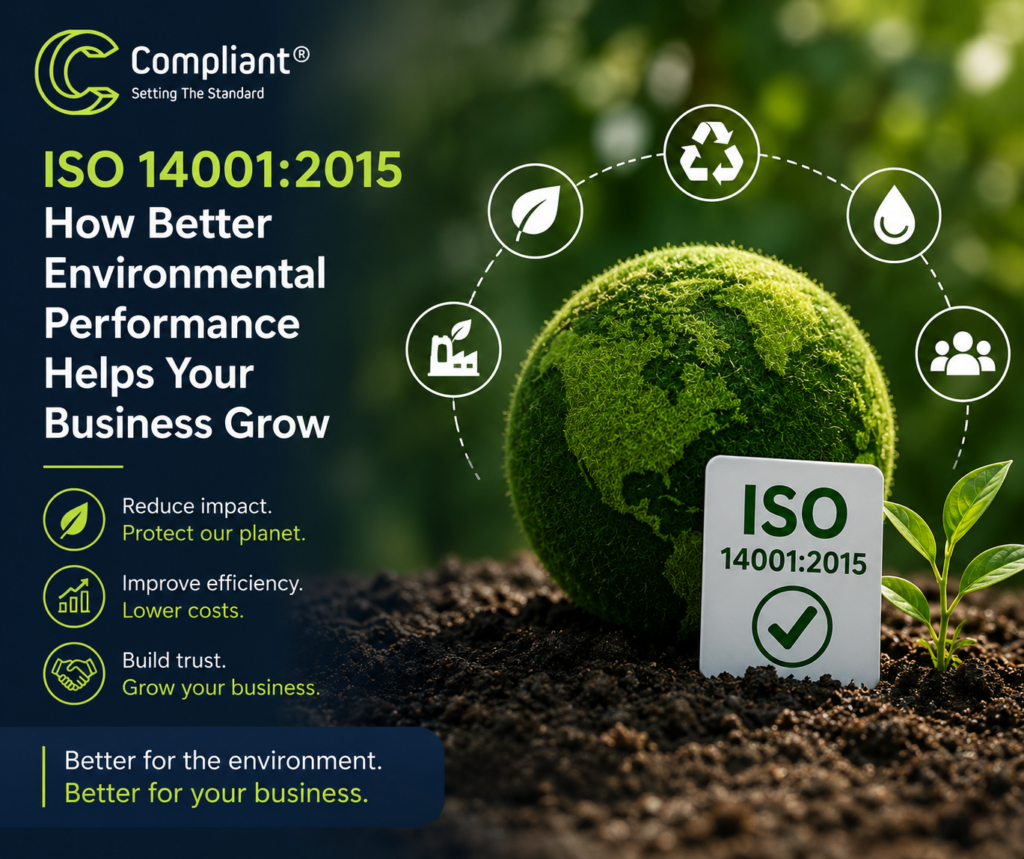
ISO 14001:2015: How Better Environmental Performance Helps Your Business Grow
Every Business Has an Impact. The Question Is Whether You Are Managing It Well.
Every business leaves a mark on the environment.
Some use large amounts of energy. Others produce waste, use water, create emissions or rely on raw materials. Even a small office creates an environmental footprint through electricity, paper, travel and daily operations.
The challenge is that many organisations do not fully understand the impact they have. They often focus on keeping customers happy, meeting deadlines and controlling costs. Environmental management slips down the list until regulations change, customers ask difficult questions or rising costs force action.
By then, the problem has usually grown.
Waste has increased. Energy bills have climbed. Resources are being used without clear planning. Opportunities to improve have been missed.
Customers are also paying closer attention than ever before. Many now expect businesses to show that they take environmental responsibility seriously. Investors, suppliers and public sector organisations are asking similar questions.
They want proof, not promises.
This is where ISO 14001:2015 makes a real difference.
Rather than treating environmental management as a one-off project, the standard helps businesses build a clear system for managing their environmental responsibilities every day.
The result is Improved Environmental Performance, better control over resources and stronger confidence from customers and stakeholders.
If your organisation wants to reduce waste, lower costs and prepare for the future, understanding ISO 14001:2015 is an excellent place to start.
Why Environmental Management Matters More Than Ever
Businesses today operate in a different world than they did just a few years ago.
Energy prices have risen.
Customers expect organisations to act responsibly.
Governments continue to introduce environmental legislation.
Supply chains are becoming more demanding.
Winning new contracts increasingly depends on demonstrating responsible business practices.
Environmental management is no longer something that only affects large manufacturers.
It affects construction companies, engineering firms, logistics businesses, healthcare providers, offices, retailers, schools and service providers.
No matter what industry you work in, your organisation uses resources and creates some level of environmental impact.
Ignoring that impact can become expensive.
Managing it properly can create opportunities.
That is exactly what ISO 14001:2015 helps organisations achieve.
What Is ISO 14001:2015?
ISO 14001:2015 is the internationally recognised standard for environmental management systems.
Its purpose is simple.
It helps organisations identify how their activities affect the environment and provides a structured way to improve over time.
Rather than telling businesses exactly what environmental targets they must meet, it provides a framework for setting goals that suit their own operations.
This allows organisations of every size to improve in ways that are practical and achievable.
The standard encourages businesses to:
- Understand their environmental impact.
- Reduce waste.
- Improve the use of energy.
- Use resources more efficiently.
- Meet legal requirements.
- Continually improve environmental performance.
Instead of reacting to problems, organisations begin preventing them.
That shift often leads to better results across the entire business.
What Does Improved Environmental Performance Really Mean?
Many people hear the phrase Improved Environmental Performance and immediately think about recycling.
Recycling is important.
But it is only one part of the picture.
Real environmental improvement often starts with asking simple questions.
Can energy use be reduced?
Is water being wasted?
Could materials be reused?
Are unnecessary deliveries increasing fuel use?
Can packaging be reduced?
Are chemicals being stored safely?
Small improvements in many different areas quickly add up.
For example, a manufacturer may reduce material waste through better planning.
An office could lower electricity use by reviewing lighting and equipment.
A logistics company might reduce fuel consumption by improving delivery routes.
Each improvement benefits both the environment and the business.
Lower waste often means lower costs.
Better efficiency often means higher profits.
That is why environmental management should never be viewed as simply another compliance exercise.
It can become a genuine business advantage.
Who Can Benefit from ISO 14001:2015?
One of the biggest misconceptions is that ISO 14001:2015 is only for factories or heavy industry.
The reality is very different.
Almost every organisation can benefit because every organisation uses resources.
Businesses that commonly implement ISO 14001:2015 include:
- Manufacturers
- Construction companies
- Engineering firms
- Transport businesses
- Warehousing organisations
- Retailers
- Schools and colleges
- Healthcare providers
- Local authorities
- Professional service firms
- Technology companies
- Hospitality businesses
- Charities
Even organisations with relatively small environmental impacts can improve the way they use resources.
The standard is flexible enough to suit organisations of all sizes.
Whether you employ ten people or ten thousand, the principles remain the same.
Why Customers Are Paying More Attention
Customers are becoming more informed.
Many now ask suppliers about sustainability before signing contracts.
Large organisations are also placing greater environmental expectations on their supply chains.
In some sectors, demonstrating good environmental management has become a requirement rather than an advantage.
ISO 14001:2015 helps organisations answer these questions with confidence.
Instead of making broad claims, businesses can demonstrate that they have established processes for managing environmental responsibilities.
This creates reassurance.
It builds credibility.
It helps strengthen relationships.
Customers appreciate organisations that take responsibility for their impact.
Saving Money Through Better Environmental Management
Some organisations assume environmental improvements always require expensive investment.
That is not always true.
Many improvements begin by removing waste rather than adding new technology.
Simple changes can produce significant savings.
These might include:
- Reducing electricity consumption.
- Improving recycling.
- Cutting unnecessary printing.
- Using fewer raw materials.
- Preventing product waste.
- Improving maintenance schedules.
- Reducing water use.
Over time these savings often become substantial.
Businesses frequently discover that environmental improvement and financial improvement go hand in hand.
ISO 14001:2015 encourages organisations to review these opportunities regularly.
Understanding Risk Before It Becomes a Problem
Every business faces environmental risks.
A chemical spill.
Incorrect waste disposal.
Excessive energy use.
Failure to meet legal requirements.
Poor supplier practices.
Many organisations only discover these risks after something goes wrong.
ISO 14001:2015 encourages businesses to identify risks early.
Once risks are understood, practical controls can be introduced.
This proactive approach reduces surprises and creates greater confidence across the organisation.
Planning ahead is almost always easier than responding to an incident after it has happened.
Building Environmental Responsibility Across the Business
Environmental improvement is not just the responsibility of one department.
Everyone plays a part.
Employees who understand good environmental practices make better decisions every day.
They switch off equipment.
They reduce waste.
They report problems.
They suggest improvements.
ISO 14001:2015 encourages organisations to involve staff rather than simply issuing instructions.
When employees understand why environmental management matters, they are far more likely to support it.
This creates lasting change.
The Benefits of an ISO Consultant’s Support for Implementing ISO 14001:2015
Many organisations recognise the value of ISO 14001:2015 but feel uncertain about where to begin.
The standard contains several requirements, and understanding how they apply to your business can seem overwhelming without previous experience.
This is where the benefits of an ISO consultant’s support for implementing ISO 14001:2015 become clear.
A knowledgeable consultant helps translate the standard into practical actions that fit your organisation. Rather than offering generic advice, they work with your existing processes and identify where improvements can be made.
An ISO consultant can help by:
- Explaining the standard in clear, simple language.
- Identifying your environmental aspects and impacts.
- Reviewing your current ways of working.
- Helping you meet legal and regulatory requirements.
- Developing practical policies and procedures.
- Supporting employee awareness and training.
- Preparing your organisation for internal and certification audits.
- Helping avoid common mistakes that slow down implementation.
One of the greatest benefits is perspective.
When businesses work on ISO 14001:2015 alone, it can be difficult to know whether they are focusing on the right priorities.
An experienced consultant has seen many different organisations and understands what works in practice.
They help keep the project focused, reduce unnecessary work and ensure that the environmental management system reflects how your business actually operates.
The aim is not simply to achieve certification.
It is to build a system that continues delivering value long after the audit has finished.
ISO 14001:2015 Supports Continuous Improvement
Environmental management is never complete.
New technology becomes available.
Customer expectations change.
Laws evolve.
Business operations grow.
ISO 14001:2015 encourages organisations to review their environmental performance regularly and look for opportunities to improve.
This approach creates steady progress.
Small improvements made consistently often produce better long-term results than occasional large projects.
Continuous improvement also helps businesses stay prepared for future environmental challenges.
Instead of reacting under pressure, organisations remain in control.
Common Myths About ISO 14001:2015
Like many ISO standards, ISO 14001:2015 is often misunderstood.
Let’s look at some common myths.
“It is only for manufacturers.”
No.
Every organisation has an environmental impact, even if it is small.
“It is too expensive.”
Many improvements reduce costs through better use of energy, materials and resources.
“It creates too much paperwork.”
A well-designed environmental management system should support your business, not slow it down.
“It is only about recycling.”
Recycling is just one part of environmental management.
The standard covers energy, waste, resources, legal compliance, planning and continual improvement.
“Certification is the end.”
Certification is an important milestone, but the real value comes from continually improving environmental performance.
Looking Ahead with Confidence
Businesses that understand their environmental impact are often better prepared for future challenges.
They use resources more wisely.
They reduce waste.
They strengthen customer confidence.
They improve operational efficiency.
They build resilience.
ISO 14001:2015 provides a structured framework that helps organisations achieve these outcomes while supporting long-term growth.
Rather than treating environmental management as an obligation, businesses can turn it into an opportunity to improve how they operate every day.
That benefits employees.
It benefits customers.
It benefits the wider community.
Most importantly, it creates a stronger, more sustainable organisation for the future.
Learn More About ISO 14001:2015 Before You Start
Every organisation begins its environmental journey from a different place. Take time to understand how your business affects the environment, where resources are being used and where improvements are possible. Read trusted guidance on ISO 14001:2015, involve your team and explore best practices before making changes. The more you understand the standard, the easier it becomes to achieve Improved Environmental Performance and build an environmental management system that delivers lasting value for your organisation.