Skip to main content
Skip to footer
Skip to main content
Skip to footer

ISO 27001: Could One Employee Mistake Put Your Business at Risk?
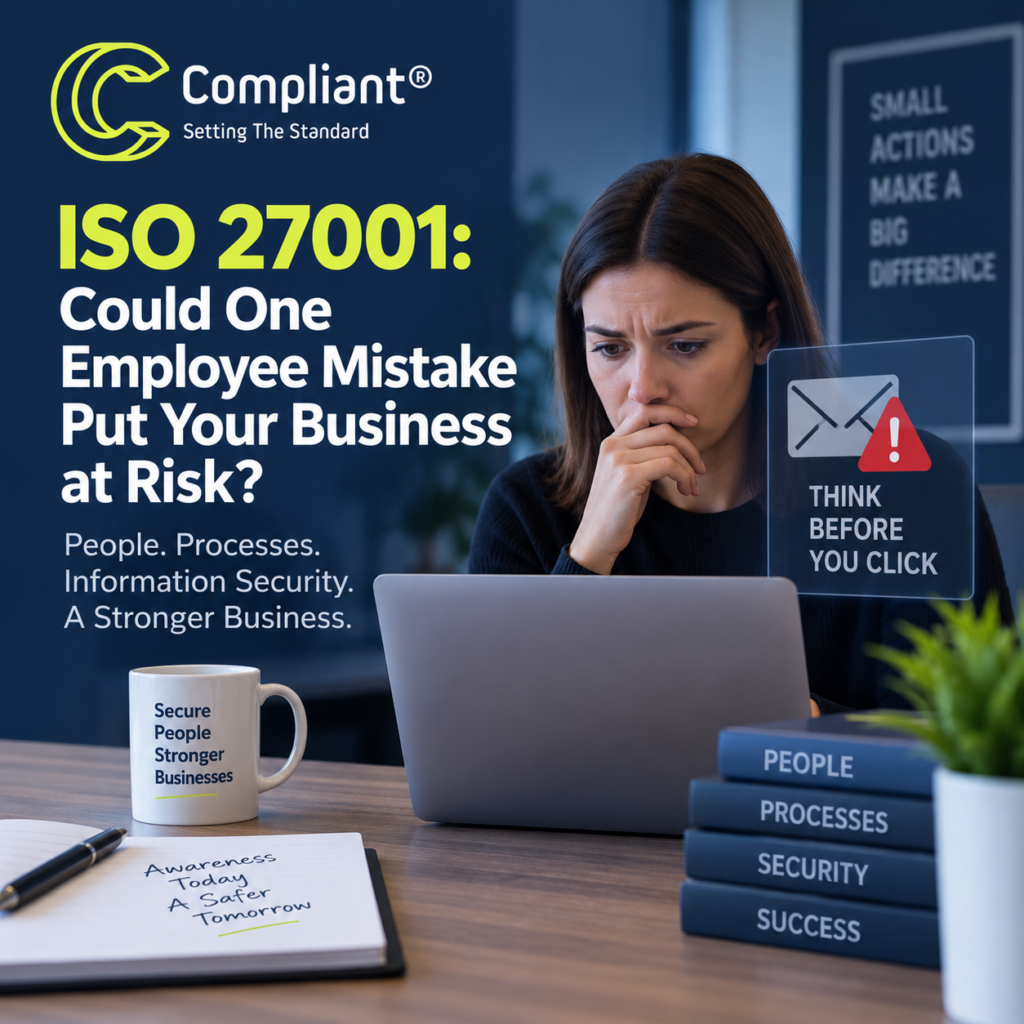
ISO 27001: Could One Employee Mistake Put Your Business at Risk?
It only takes one click.
One employee opens an email that looks genuine. They click a link, enter their password and carry on with their day.
Nothing appears to happen.
But behind the scenes, someone now has access to information they should never have seen.
Or perhaps the mistake is much simpler.
A confidential document is sent to the wrong customer. A laptop is left on a train. Someone shares a password because a colleague needs quick access. An old employee still has access to a system months after leaving.
None of these actions may be done with bad intent.
They are human mistakes.
But one small mistake can create a very large problem.
Data could be lost. Systems could become unavailable. Customers may lose trust. Employees could be unable to work. The business might face financial costs and difficult questions about how its information was protected.
This is why information security cannot be left entirely to the IT team.
ISO 27001 helps businesses take a wider view.
Technology matters, but so do people.
And if your employees do not understand the part they play in protecting information, even the best security systems can have weaknesses.
Your biggest risk may be sitting at a desk
When businesses think about cyber attacks, they often picture highly skilled criminals breaking through complex security systems.
That can happen.
But attackers do not always need to break through technology.
Sometimes, it is much easier to trick a person.
An email arrives asking an employee to reset their password.
A message appears to come from a senior manager requesting an urgent payment.
Someone receives a document from what looks like a trusted supplier.
An employee is under pressure. They are answering emails, taking calls and trying to finish several jobs at once.
They click.
That one action could give someone access to the business.
This does not mean employees are the problem.
It means employees are part of the way information is protected.
Your people need the right knowledge, clear processes and enough support to make good decisions.
Telling them to “be careful” is not enough.
Human mistakes are normal
People make mistakes.
That will not change because your business becomes ISO 27001 certified.
The aim should therefore not be to create a workplace where nobody ever gets anything wrong.
That is unrealistic.
Instead, your business should make mistakes less likely and reduce the damage if one does happen.
Think about a simple example.
An employee needs to send a document containing confidential customer information.
There are several ways this could go wrong.
They could select the wrong person from their email contacts.
They could attach the wrong file.
They could send information that the recipient does not need.
They could forward an old email chain without checking what information is already contained within it.
Now ask another question.
What has your business done to reduce those risks?
If the answer is simply, “Our employees know they need to be careful”, you may be relying too heavily on people never making a mistake.
Good information security provides layers of protection.
ISO 27001 is about more than cyber security
One common misunderstanding about ISO 27001 is that it is purely about computers.
It isn’t.
ISO 27001 focuses on protecting information.
That information may be stored on a computer, but it could also exist in an email, on paper, in a conversation or inside someone’s head.
Think about the information your business handles every day.
Customer details.
Employee records.
Prices.
Contracts.
Financial information.
Passwords.
Business plans.
Supplier information.
Designs.
Reports.
Some of it will be more sensitive than others.
Your business needs to understand what information it holds, why it matters, who needs access to it and what could happen if it is lost, changed, shared with the wrong person or made unavailable.
Your employees are involved in almost every part of that process.
That makes their behaviour important.
One password can open several doors
Password habits are a good example of how a small employee action can create a much wider risk.
People have a lot of passwords.
So it is understandable why someone might reuse the same one.
It is easier to remember.
But imagine an employee uses the same password for a personal account and a work account.
The personal service suffers a data breach and the password becomes known.
An attacker may then try that email address and password elsewhere.
If the same details work on a business system, a problem outside your organisation has suddenly become your problem too.
The employee did not mean to put the company at risk.
They probably did not even know their password had been exposed.
This is why information security needs to be designed around real human behaviour.
Clear password rules, extra login checks and sensible access controls can all reduce risk.
But employees also need to understand why those controls exist.
Rules make more sense when people understand the reason behind them.
Access should be based on need
Does everyone in your business need access to everything?
Probably not.
Yet access can build up over time.
An employee joins one department and receives access to the systems they need.
Six months later, they move into another role.
New access is added.
Old access is never removed.
A year later, they may be able to view information that has nothing to do with their current job.
This creates unnecessary risk.
The more information a person can access, the greater the possible impact if their account is taken over or they make a mistake.
ISO 27001 encourages businesses to think carefully about access.
Who needs what?
Why do they need it?
When should access be changed?
What happens when somebody leaves?
These questions sound basic.
But basic controls are often the ones that make the biggest difference.
What happens when somebody leaves?
An employee leaves on Friday.
Their email account is closed.
Job done?
Maybe not.
What about cloud systems?
Shared folders?
Remote access?
Company phones?
Third-party services?
Keys?
Building access?
Passwords they knew?
Information stored on personal devices?
A good leaving process should consider all the places that person could access company information.
The same applies when someone changes jobs internally.
Access that was necessary yesterday may no longer be appropriate today.
This is not about distrusting employees.
It is about good control.
If someone does not need access, there is little reason for them to have it.
Training cannot be a once-a-year exercise
Many businesses provide information security training.
That is positive.
But there can be a problem.
Employees complete an online course once a year, answer a few questions and return to work.
By the following week, much of it has been forgotten.
Meanwhile, risks continue to change.
A better approach is to make information security part of normal working life.
Training can still play a role, but it should be supported by regular reminders and conversations.
Keep the messages simple.
How do employees report a suspicious email?
What should they do if they send information to the wrong person?
Who should they tell if a device goes missing?
How should sensitive documents be handled?
What should happen if someone asks for information and the employee is unsure whether they should provide it?
Employees should not have to search through a 40-page document to find these answers.
Make the right action clear.
Test understanding, not attendance
There is a difference between someone attending training and someone understanding it.
A signed training record proves that training took place.
It does not prove that the employee knows what to do when something unusual happens.
Ask questions.
Give people realistic examples.
For instance:
A customer calls and asks you to change the email address on their account. What checks should you make first?
You receive an urgent email from a director asking you to send sensitive information. What would you do?
You realise you have sent a document to the wrong person. Who do you tell?
You find a USB drive in the car park. Should you connect it to your computer?
Simple examples help turn information security from an idea into something people can understand.
This is especially useful for employees who do not work in IT.
They do not need to become security experts.
They need to know how to make safer decisions in their own role.
Make it easy to report mistakes
Imagine an employee clicks a suspicious link.
They immediately realise something might be wrong.
What happens next?
If your company has created a culture where mistakes lead straight to blame, that employee may stay quiet.
They might hope nothing happens.
Those lost minutes or hours could make the problem much worse.
Your employees need to know that reporting a possible security problem quickly is important.
The message should be clear:
If something does not look right, tell someone.
The sooner the right people know, the sooner they can respond.
That does not mean there should never be consequences for deliberately ignoring important rules.
But genuine mistakes need to be reported.
You cannot deal with an incident you do not know about.
A mistake can reveal a weak process
Suppose an employee accidentally shares a confidential document.
It is easy to stop the investigation at:
“Employee error.”
But that does not tell you very much.
Ask why it happened.
Was the file clearly marked?
Did the employee understand that it was confidential?
Was access wider than necessary?
Was the process confusing?
Were they under unusual pressure?
Could a technical control have prevented the information being shared?
Had the employee received suitable training?
Has something similar happened before?
The employee made the final mistake, but there may be several weaknesses behind it.
This is where ISO 27001 can add real value.
It encourages businesses to look at risk in a structured way rather than waiting for something to go wrong.
What information would hurt most if it disappeared tomorrow?
This is a useful question for any business.
Imagine arriving tomorrow morning and discovering you cannot access an important system.
What stops?
Could employees work?
Could you contact customers?
Could you process orders?
Could you send invoices?
Could you pay staff?
How long could the business operate without that information?
Now consider what would happen if the information was not lost, but shared publicly.
Which information would cause the greatest problem?
These questions help businesses understand what needs the strongest protection.
Not every piece of information carries the same level of risk.
Your security measures should reflect that.
Employees need to understand the value of information
People protect things better when they understand why they matter.
Consider two files.
One is called:
document-final-v4.xlsx
The other contains personal customer information.
To the employee, it may just look like another spreadsheet.
If they do not understand the information inside it or why it needs protection, they may handle it in the same way as any other file.
Businesses need clear ways of identifying and handling important information.
Again, keep it practical.
Employees should understand what they can share, with whom, through which methods and what needs extra protection.
Complicated rules that nobody remembers do not create strong security.
Clear rules people can follow do.
Remote working has changed the picture
Information no longer stays inside the office.
Employees work from home, hotels, customer sites, trains and shared workspaces.
They use laptops and mobile phones.
Meetings happen online.
Documents are stored in cloud systems.
These ways of working can bring huge benefits.
They also create different risks.
Can somebody see sensitive information on an employee’s screen?
Is a work device being used by other family members?
Are confidential calls taking place where others can hear them?
What happens if a laptop is stolen?
Can employees securely access the information they need?
ISO 27001 can help organisations consider these situations as part of their wider information security risks.
The answer should not simply be to ban flexible working.
It should be to understand how people actually work and protect information accordingly.
Your suppliers can create human risks too
Employees are not the only people who may have access to your information.
Suppliers, contractors and other outside organisations may also handle it.
Perhaps your payroll provider holds employee information.
Your IT support company may have access to systems.
A marketing company might hold customer contact details.
A contractor may receive confidential documents.
The same questions apply.
What information can they access?
Why do they need it?
How is it protected?
What happens when the relationship ends?
You can have excellent internal controls and still face risk through another organisation.
Information security does not stop at your front door.
Leadership sets the standard
Employees watch what leaders do.
If managers regularly share passwords, ignore security rules or look for shortcuts, employees notice.
If a director complains that an important security check is inconvenient and tells staff to bypass it, that sends a message.
The written policy says one thing.
Leadership says another.
Guess which one employees are likely to follow?
Strong information security needs support from the top.
Leaders do not need to understand every technical detail.
But they should understand the important risks and demonstrate that protecting information matters.
Security cannot be something employees are expected to take seriously while management treats it as an inconvenience.
Do not make security harder than it needs to be
There is another side to this.
Controls need to be practical.
If the approved way of doing something is extremely difficult, employees may find another way.
For example, imagine your approved system makes sharing a large file with a customer almost impossible.
An employee is under pressure to meet a deadline.
They use a personal file-sharing account instead.
The employee has broken the rules.
But there is also a process problem.
Why was the unsafe option easier than the safe one?
Good information security should support the business rather than fight against it.
Employees need secure ways to complete their work.
This is one reason staff involvement matters when building an ISO 27001 management system.
The people doing the work can often tell you where controls are causing problems.
Listen to them.
How an ISO consultant can support your business
Understanding ISO 27001 and applying it to a real business are two different things.
This is where the benefits of an ISO consultant’s support can become valuable.
A good consultant should help you understand the risks that actually apply to your organisation.
They should not arrive with a pile of documents and force your business to work around them.
Your business is different from the company next door.
You hold different information.
You have different employees.
Your systems are different.
Your customers expect different things.
An experienced ISO consultant can help you ask the right questions.
Where is important information stored?
Who can access it?
What could go wrong?
What controls already exist?
Where are the gaps?
Do employees understand their responsibilities?
Are your processes working in practice?
This outside view can be useful because businesses often become used to their own ways of working.
Something may have been done the same way for ten years.
That does not automatically mean it is still the safest or best way.
The goal should be a practical system that helps protect the organisation every day, not one that only looks good during an audit.
ISO 27001 should not create fear
Information security can sometimes be presented in a frightening way.
Cyber criminals.
Data breaches.
Huge fines.
Business failure.
Those risks are real, but fear alone does not create good behaviour.
Employees need confidence.
They should know what is expected of them.
They should understand the basic risks.
And they should know where to go when they are unsure.
The aim is not to make people frightened to open an email.
It is to help them recognise when something looks unusual and know what to do next.
That difference matters.
One employee can create a risk, but one employee can also stop one
It is easy to focus on employee mistakes.
But employees are also one of your strongest forms of protection.
An employee spots a strange email and reports it.
Another questions an unusual payment request.
Someone notices that an old colleague still appears on a system and raises it.
A member of staff realises confidential papers have been left in a meeting room and removes them.
A manager challenges unnecessary access to sensitive information.
These actions protect your business.
That is why awareness matters so much.
Your goal should not be to remove people from information security.
It should be to help people become part of it.
Do not wait for an incident to test your system
Many weaknesses remain hidden because nothing bad has happened yet.
“We’ve never had a data breach.”
“We’ve always done it this way.”
“Nobody has ever clicked one of those emails.”
That can create false confidence.
No previous incident does not mean there is no risk.
Ask yourself what would happen if an employee made a mistake today.
Would you know?
Could they report it easily?
Would the right people respond?
Could you limit the damage?
Would you understand what information had been affected?
Could you learn from the incident afterwards?
If you cannot answer those questions confidently, there may be work to do.
Make information security part of everyday work
The strongest approach is often the simplest.
Do not treat information security as something that only appears during annual training or before an ISO audit.
Talk about it.
Include it when employees join.
Review access when roles change.
Remove access promptly when people leave.
Share lessons when something goes wrong.
Remind staff how to report concerns.
Review new risks when the way you work changes.
And listen to employees.
If a process is confusing, find out why.
If people keep making the same mistake, look at the process as well as the person.
ISO 27001 should help create a cycle of learning and improvement.
The question is not whether somebody will make a mistake
At some point, somebody probably will.
They may click something they should not.
Send an email to the wrong person.
Lose a device.
Forget a rule.
Misunderstand a request.
That is human.
The more important question is:
How prepared is your business when it happens?
A strong ISO 27001 information security management system does not depend on every employee being perfect.
It combines people, processes and suitable controls so that risks are understood and managed.
Employees receive clear guidance.
Access is controlled.
Important information is identified.
Incidents are reported.
Lessons are learned.
And the business keeps improving.
One employee mistake can put a business at risk.
But one mistake does not have to become a disaster.
Value-focused CTA
Choose one everyday task involving important information in your business this week.
It could be sending customer details, approving a payment, giving someone system access or working remotely.
Then ask three simple questions:
What could an employee accidentally do wrong?
What currently helps prevent that mistake?
If it happened anyway, how quickly would we know and respond?
Do not use the exercise to find someone to blame.
Use it to find one practical improvement.
Because effective ISO 27001 is not about expecting people to be perfect.
It is about building a business that is prepared when they are not.