Skip to main content
Skip to footer
Skip to main content
Skip to footer

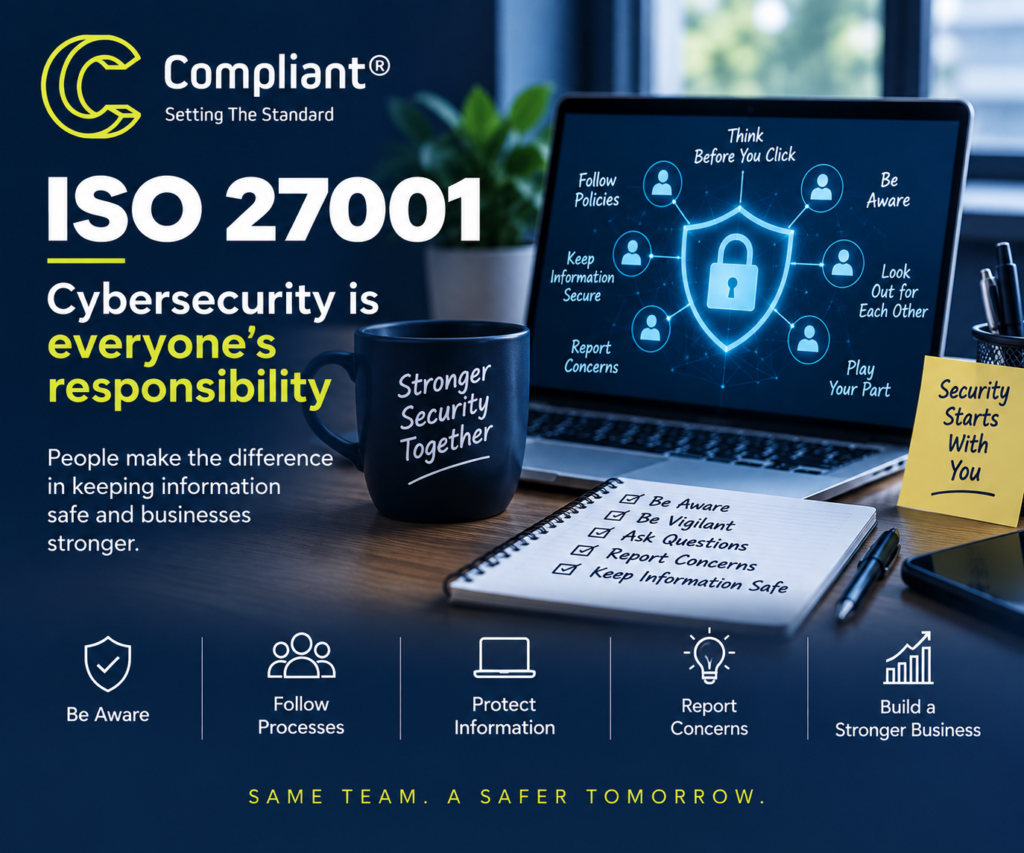
ISO 27001: Cybersecurity Is Everyone’s Responsibility
ISO 27001: Cybersecurity Is Everyone’s Responsibility
A business can spend thousands of pounds protecting its systems.
It can have firewalls, backups, antivirus software, secure servers and strong passwords.
Then one employee clicks the wrong link.
Another sends sensitive information to the wrong person.
Someone leaves their laptop unlocked.
A member of staff uses the same password for several accounts.
Or an employee receives an urgent email that appears to come from their manager and follows the instructions without checking.
Suddenly, all that technology is only part of the defence.
Because cybersecurity is not simply an IT problem.
It is everyone’s responsibility.
That is one of the important lessons behind ISO 27001.
Good information security is not achieved by giving responsibility to the IT department and hoping everyone else stays out of trouble. It comes from creating a business where people understand the risks, know what is expected of them and feel confident enough to question something when it does not look right.
Your people can be one of your greatest security risks.
But with the right cybersecurity awareness, they can also become one of your strongest lines of defence.
Cybersecurity Is Not Just About Computers
When people hear the word cybersecurity, they often think about technology.
Hackers.
Viruses.
Firewalls.
Passwords.
Computer systems.
All of those things matter.
But information security is much wider.
Think about the information your organisation holds.
Customer names and contact details.
Employee records.
Financial information.
Contracts.
Quotes.
Business plans.
Supplier information.
Passwords.
Designs.
Reports.
Emails.
Some of this information is stored digitally.
Some might still be on paper.
Some is carried around in people’s heads.
Protecting information therefore requires more than installing security software.
You need to think about how information is collected, accessed, shared, stored and eventually removed.
And people are involved at almost every stage.
That is why ISO 27001 looks beyond technology.
It helps businesses create a structured approach to protecting their information.
One Small Mistake Can Create a Big Problem
Imagine an employee receives an email.
It looks completely normal.
The sender appears to be somebody they know.
The message says an invoice needs to be paid urgently and provides new bank details.
The employee is busy.
They follow the instructions.
Only later does someone discover the email was fake.
This type of incident does not necessarily happen because an employee is careless.
The email may have been extremely convincing.
The person may have been under pressure.
Perhaps nobody had ever explained what warning signs to look for.
Maybe the business did not have a clear process for checking changes to bank details.
Simply telling employees to “be careful” is not enough.
People need practical guidance.
What should they check?
What should they question?
Who should they contact?
What should happen if they think they have made a mistake?
ISO 27001 can help organisations build those answers into everyday ways of working.
Your IT Team Cannot Watch Everyone
Your IT team may do an excellent job.
But they cannot stand behind every employee every minute of the day.
They cannot check every email before someone opens it.
They cannot see every document being printed.
They cannot stop someone discussing confidential information in the wrong place.
They cannot always know when information has been sent to the wrong person.
Information security needs to happen wherever information is being used.
That means responsibility has to extend across the organisation.
From senior management to new starters.
From finance to sales.
From operations to HR.
From people working in the office to those working from home.
Everyone has a part to play.
The role may be different, but the responsibility remains.
What Does ISO 27001 Actually Do?
ISO 27001 is an international standard for information security management.
In simple terms, it helps organisations understand what information they need to protect, what could put that information at risk and what they should do about those risks.
It creates structure.
Rather than responding to security problems only after they happen, the organisation looks at risks in advance.
What information do we hold?
Where is it?
Who can access it?
Why do they need access?
What could go wrong?
How serious would that be?
What controls do we already have?
Do we need to do more?
This turns information security into an ongoing business activity rather than an occasional IT project.
And that distinction matters.
Technology changes.
People change.
Risks change.
Your approach to information security needs to change with them.
Start With What You Are Protecting
You cannot protect information properly if you do not know what you have.
That sounds obvious.
In practice, information can spread throughout a business.
It might be in a main computer system.
On laptops.
In email accounts.
On phones.
In cloud storage.
On memory sticks.
In filing cabinets.
On printed documents.
With suppliers.
With employees working from home.
Before deciding how information should be protected, businesses need to understand what information exists and why it matters.
Not every piece of information needs exactly the same level of protection.
A public brochure is very different from employee payroll information.
ISO 27001 encourages organisations to think about those differences and put suitable controls in place.
Access Should Have a Reason
Does everybody in your business need access to everything?
Probably not.
A member of the sales team may not need access to payroll information.
A new employee may not need access to confidential management documents.
A contractor may only need access to one part of a system.
Giving people access “just in case” can create unnecessary risk.
A useful principle is simple:
People should have access to the information they need to do their job.
No more than necessary.
This also means access needs to change when people’s roles change.
Someone moves department.
Their access should be reviewed.
Someone leaves.
Their access should be removed.
A temporary contractor finishes their work.
Their account should not remain active indefinitely.
These may seem like small administrative tasks.
From a security point of view, they can be extremely important.
Passwords Matter, but Behaviour Matters Too
Most employees understand that passwords are important.
But knowing something and consistently doing it are different things.
People have many accounts.
They need to remember many passwords.
Convenience starts to win.
The same password gets reused.
A password is written down.
Someone shares login details with a colleague because it is quicker.
These actions may seem harmless at the time.
But they weaken security.
Businesses need clear rules around passwords and account access, supported by suitable technology where appropriate.
But rules alone are not enough.
Employees need to understand why those rules exist.
When people understand the risk behind a requirement, they are more likely to take it seriously.
Cybersecurity awareness should therefore explain rather than simply instruct.
Phishing Is Designed to Fool People
A suspicious email used to be relatively easy to spot.
Bad spelling.
Strange formatting.
An unusual email address.
An unbelievable story.
Today, fake messages can look very convincing.
They may use familiar names.
They may copy the style of a real company.
They can create urgency.
“Your account will be closed.”
“Payment is overdue.”
“Please review this document immediately.”
“This needs to be paid today.”
Pressure encourages people to act before thinking.
That is exactly what the attacker wants.
Training employees to recognise suspicious messages is important.
But there is another part that businesses sometimes overlook.
Employees need permission to slow down.
If someone receives an unusual request involving money, sensitive information or account details, checking should be encouraged.
Call the person.
Check through another method.
Ask a manager.
Report the email.
Taking an extra minute can prevent a much bigger problem.
Mistakes Need to Be Reported Quickly
Imagine someone clicks a link and immediately realises they should not have.
What happens next?
Do they tell somebody?
Or do they keep quiet because they are embarrassed?
That response can make a huge difference.
If an employee reports the incident quickly, the business may be able to act.
Passwords can be changed.
Accounts can be checked.
Systems can be reviewed.
Affected people can be informed where necessary.
If the employee stays quiet, the problem may continue unnoticed.
This is why culture matters.
Employees need to understand that quickly reporting a genuine mistake is far more useful than trying to hide it.
A strong information security culture does not pretend people will never make mistakes.
It prepares the organisation to respond when they do.
Working From Home Changed the Picture
For many organisations, work is no longer limited to one building.
Employees work from home.
They travel.
They use laptops.
They join meetings from different locations.
They may access business systems from several devices.
That flexibility brings benefits.
It also creates questions.
Can other people see confidential information on a screen?
Are paper records being stored safely?
Is business equipment protected?
What happens if a laptop is lost?
Are employees using secure connections?
How are confidential conversations handled?
How is information disposed of?
These issues do not mean remote working is unsafe.
They mean information security needs to reflect how people actually work.
A security policy written for a business where everyone sat in the same office may no longer be enough.
ISO 27001 encourages businesses to review changes like these and consider the risks they create.
Physical Security Still Matters
Not every information security incident starts online.
A printed document left on a desk can expose sensitive information.
A visitor walking into an area without permission can create risk.
An unlocked laptop can provide access to business systems.
A confidential conversation can be overheard.
A document placed in an ordinary bin may contain information that should have been destroyed securely.
Cybersecurity often receives most of the attention, but physical security remains important.
Information needs protecting wherever it exists.
That is another reason information security cannot belong solely to IT.
Everyone handles information in different ways.
Leaders Have to Set the Example
Imagine a business introduces a rule requiring employees to lock their computers when they leave their desks.
But senior managers regularly walk away without doing it.
What message does that send?
Or perhaps employees are told never to share passwords, but a manager asks someone to send their login because it is quicker.
Policies say one thing.
Behaviour says another.
People notice.
Leadership has an important role within ISO 27001 because information security needs support from the top of the organisation.
Managers need to take the requirements seriously.
They need to provide resources.
They need to support training.
They need to follow the rules themselves.
Most importantly, they need to show employees that protecting information matters.
Culture is built by what leaders repeatedly do, not only by what policies say.
Training Cannot Be a Once-a-Year Exercise
Many businesses provide information security training when an employee joins.
Perhaps there is then a yearly refresher.
That is useful.
But cybersecurity awareness should not disappear for the other 364 days.
Risks change.
New scams appear.
People forget.
New systems are introduced.
Different ways of working create different risks.
Short, regular reminders can help keep information security in people’s minds.
This does not have to mean hours of training.
It could be a short discussion in a team meeting.
A reminder following a new type of phishing attempt.
A quick test.
An update after a process changes.
A lesson learned from an incident.
The aim is to make security part of normal business conversation.
Not something employees think about once a year because they have been asked to complete an online course.
Policies Need to Make Sense
A policy can look impressive and still be useless.
If it is twenty pages long and written in language employees do not understand, how many people will actually use it?
Good information security guidance should be clear.
People need to understand what they can and cannot do.
What information needs protecting?
Can business information be stored on personal devices?
How should information be shared?
What happens when equipment is lost?
Who should suspicious emails be reported to?
What should happen when somebody leaves?
Clear rules make it easier for people to do the right thing.
If employees have to guess, different people will make different choices.
ISO 27001 should help create consistency, not confusion.
Suppliers Can Create Security Risks Too
Your employees are not the only people who may have access to your information.
Suppliers can play an important role.
You might use external IT support.
Cloud systems.
Payroll services.
Software providers.
Consultants.
Contractors.
Data storage providers.
If another organisation holds or accesses your information, its security can affect you.
Businesses therefore need to think carefully about supplier relationships.
What information can they access?
Why do they need it?
How is it protected?
What happens when the relationship ends?
What happens if the supplier has a security incident?
These questions should be considered before a problem occurs.
Your organisation may have excellent internal controls, but weak supplier arrangements can still create exposure.
Learn From Things That Nearly Went Wrong
Not every security concern becomes a full incident.
Sometimes an employee spots a fake email before clicking.
A document is nearly sent to the wrong customer but is caught in time.
Someone notices that an old account is still active.
A visitor enters an area they should not have accessed but is challenged.
These events are valuable.
Do not simply celebrate that nothing bad happened and move on.
Ask what you can learn.
Why did the situation occur?
Could it happen again?
Does something need to change?
Near misses can show you weaknesses without the cost of a serious incident.
Use them.
Internal Audits Should Test Reality
An internal audit should not simply check whether policies exist.
The real question is whether they work.
If the policy says access is removed when an employee leaves, check whether that actually happens.
If employees are expected to report suspicious emails, ask whether they know how.
If important information is backed up, check whether those backups can be restored.
If security training is required, look at whether people understand what they learned.
Good internal audits help businesses find gaps before someone else does.
They should challenge the system.
That is valuable.
Finding a weakness during an internal audit gives you an opportunity to correct it under controlled conditions.
Finding the same weakness after a security incident can be far more painful.
Why ISO Consultant Support Can Help
Implementing ISO 27001 can feel complicated.
There is a lot to consider.
People.
Technology.
Suppliers.
Physical security.
Risk.
Policies.
Training.
Access.
Incidents.
Business changes.
An experienced ISO consultant can help bring structure to the process.
That support can be particularly valuable because businesses often struggle to see their own weaknesses.
When you have worked in the same organisation for years, certain ways of working become normal.
Everyone shares information that way.
Everyone uses that spreadsheet.
That account has always been shared.
Nobody has ever questioned why that person still has access.
An outside view can challenge those assumptions.
Not to make life difficult.
To help the business understand where unnecessary risks may exist.
A Consultant Can Help Turn the Standard Into Real Actions
One of the biggest mistakes organisations can make with ISO 27001 is becoming too focused on the wording of the standard.
Employees do not need to become ISO experts.
They need to understand what they are expected to do.
An experienced consultant can help turn requirements into practical questions.
What information are you protecting?
Who needs access?
What happens when someone leaves?
How do employees report a problem?
How do you know your backups work?
What happens if a supplier suffers an incident?
When did you last review your risks?
What training do people need?
This keeps the focus on the business rather than creating paperwork simply to satisfy an audit.
The goal should be a management system that protects the organisation every day.
Not a folder that only gets opened when an auditor arrives.
ISO 27001 Should Fit Your Business
There is no single information security system that suits every organisation.
A small consultancy has different risks from a large manufacturer.
A technology company may rely heavily on cloud systems.
Another organisation may hold large amounts of paper information.
Some businesses have remote teams.
Others work mainly from secure sites.
That is why your ISO 27001 system should reflect your organisation.
Consultant support can help you understand what is relevant and avoid making the system more complicated than necessary.
The aim is not to introduce controls simply because another business uses them.
It is to understand your risks and decide what is appropriate.
Cybersecurity Awareness Is About Confidence
Good training should not make employees frightened to use technology.
It should make them more confident.
They should know what normal looks like.
They should recognise when something feels wrong.
They should know where to go for help.
They should feel comfortable asking questions.
And they should understand that information security is part of their role.
A receptionist may notice an unknown visitor.
A finance employee may question an unusual payment request.
A sales employee may spot a suspicious email.
A manager may challenge unnecessary access to confidential information.
An employee working from home may recognise that a document needs to be stored differently.
These small actions can protect the whole organisation.
Everyone Has a Role
The person responsible for information security cannot protect the business alone.
Neither can the IT team.
Neither can senior management.
Good security depends on people working together.
Leadership provides direction.
IT provides technical protection.
Managers make sure processes are followed.
Employees stay alert.
Suppliers meet agreed requirements.
Internal audits check whether arrangements are working.
Incidents provide lessons.
Training keeps awareness fresh.
ISO 27001 helps connect these different parts.
That is where its real value lies.
Ask Your Team One Question Today
You do not need to wait until your next audit to start improving cybersecurity awareness.
Ask your employees:
“If you thought something was wrong with an email, document, system or request, would you know exactly what to do?”
Listen carefully to the answers.
If people are unsure who to contact, improve the process.
If they are worried about reporting mistakes, look at the culture.
If different teams give different answers, consider whether guidance needs to be clearer.
If everyone knows exactly what to do, that is a positive sign.
Then ask another question.
Keep learning.
Because information security is never completely finished.
Cybersecurity Is Everyone’s Responsibility
The biggest lesson is simple.
Your business can buy excellent technology.
It can introduce strong systems.
It can write detailed policies.
But people will still make decisions every day that affect the security of your information.
They decide whether to click.
Whether to share.
Whether to question.
Whether to report.
Whether to lock a screen.
Whether to check an unusual request.
Whether to follow the agreed process.
That does not make employees a problem that needs to be controlled.
It makes them an important part of the solution.
ISO 27001 can help businesses create the structure needed to support them.
Clear responsibilities.
Useful training.
Sensible controls.
Regular reviews.
Good leadership.
Lessons from incidents.
And a culture where information security belongs to everyone.
Experienced ISO consultant support can make that journey easier by helping organisations understand the standard, identify their real risks and turn requirements into practical actions people can actually follow.
Because cybersecurity is not something that happens quietly in the IT department.
It happens every time someone opens an email.
Every time information is shared.
Every time a system is accessed.
Every time a document is handled.
And every time an employee stops for a moment and thinks:
“Does this look right?”
When your people understand that their everyday actions matter, cybersecurity becomes much stronger.
Not because nobody will ever make a mistake.
But because everyone understands that protecting information is part of their job.