Skip to main content
Skip to footer
Skip to main content
Skip to footer

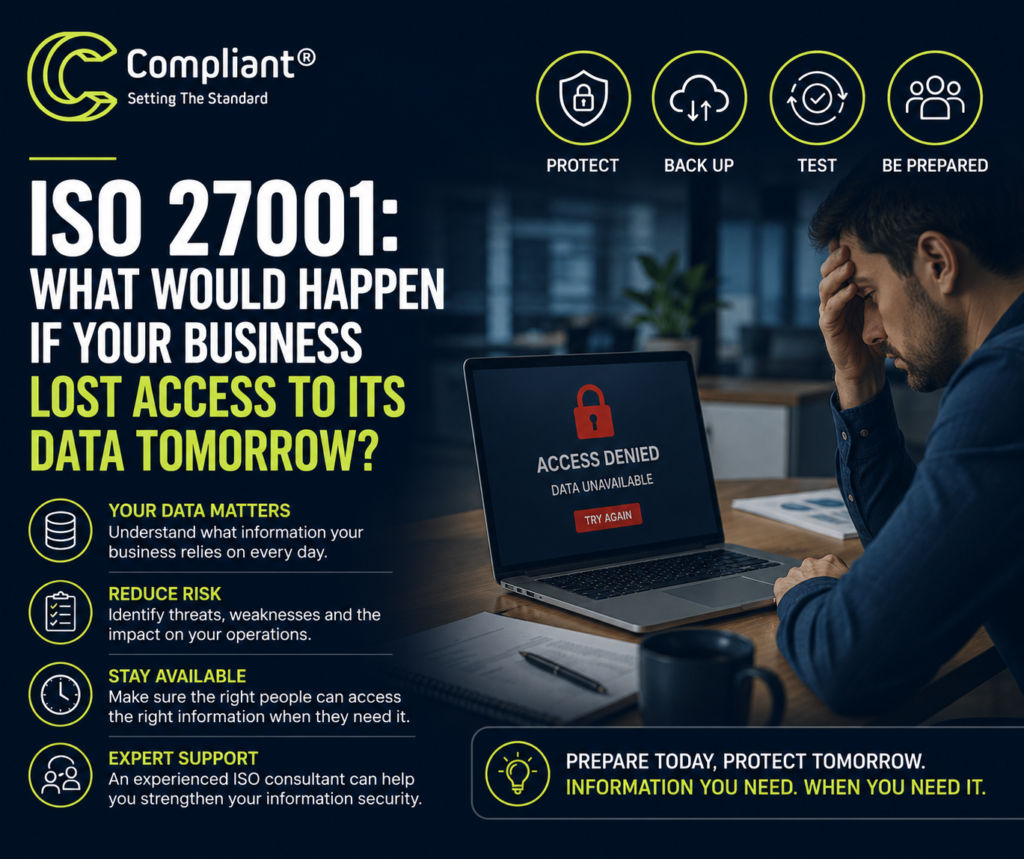
ISO 27001: What Would Happen If Your Business Lost Access to Its Data Tomorrow?
ISO 27001: What Would Happen If Your Business Lost Access to Its Data Tomorrow?
Imagine arriving at work tomorrow morning and discovering you cannot access your business data.
No customer records.
No emails.
No order history.
No contracts.
No employee files.
No project information.
No financial records.
Your systems are running, but the information your people need to do their jobs is unavailable.
What happens next?
For many businesses, the first few hours would be filled with confusion. People would try different passwords, restart computers and contact IT. Teams would start asking each other whether they could access certain systems.
Then the real impact would begin to show.
Customers would still expect answers. Orders would still need processing. Employees would still need information. Suppliers would still need paying.
Yet the business might struggle to do even simple tasks.
This is why information security is about much more than stopping someone from stealing data.
ISO 27001 helps organisations think about protecting information so it remains secure, correct and available when people need it.
And that last point, availability, can easily be overlooked.
Because having data is not much use if nobody can access it.
Data Has Become Part of Almost Every Business Process
Think about how much information your business uses during an ordinary working day.
Someone answers a customer enquiry.
They need customer information.
Someone prepares a quote.
They may need prices, previous correspondence and product information.
Someone completes a project.
They need plans, instructions and records.
Finance sends an invoice.
They need customer and order details.
Managers review performance.
They need reports.
Even businesses that do a lot of physical work now depend heavily on digital information.
Take that information away and work can quickly slow down.
Or stop completely.
This is what makes data availability such an important business issue.
The question is not simply whether your information is protected from theft.
You also need to ask:
Can the right people access the right information when they need it?
ISO 27001 helps businesses consider both.
Losing Access Does Not Always Mean Losing Data Forever
When people hear the words “data loss”, they often imagine everything being permanently deleted.
That can happen.
But there are many other situations where your information still exists but you cannot use it.
A system could fail.
Your internet connection could go down.
A cloud service could become unavailable.
Someone could accidentally delete an important folder.
A software update could cause a problem.
Equipment could be damaged.
A cyber attack could lock your files.
An employee could lose a device.
Access rights could be changed incorrectly.
A supplier that hosts an important system could have its own problem.
In each case, the information may still exist somewhere.
The problem is that your people cannot reach it.
And from an operational point of view, that can feel very similar to losing it.
How Long Could Your Business Cope?
This is a useful question for every organisation.
Not:
Could we cope?
But:
How long could we cope?
Five minutes without access to a system may cause very little disruption.
Five hours could be different.
Five days could be extremely serious.
The answer will depend on the information and the business.
Perhaps your marketing files could be unavailable for a day without causing major problems.
Your customer ordering system might be different.
Payroll information may become critical at certain times of the month.
Project information could be essential every day.
ISO 27001 encourages organisations to understand what information matters and what could happen if it becomes unavailable.
That allows you to focus your attention where it is most needed.
Not everything requires the same level of protection.
Understanding that can save time as well as improve security.
Start by Understanding What You Actually Have
You cannot protect information properly if you do not know where it is.
That sounds obvious.
Yet many businesses would struggle to produce a clear picture of all the places where important information is stored.
Some information might sit in a main business system.
Some may be in cloud storage.
Some could be on employee laptops.
There may be spreadsheets saved locally.
Documents could be attached to emails.
Older information may sit on shared drives.
Employees might even be using systems that management does not know about because they found them easier.
Over time, information spreads.
That makes protection more difficult.
A useful starting point is to identify the information your business relies on and understand:
Where is it stored?
Who needs access?
Who currently has access?
How important is it?
What would happen if it disappeared?
How quickly would you need it back?
Is another copy available?
Who is responsible for it?
These are practical business questions.
They are also exactly the sort of thinking that makes an ISO 27001 system useful rather than simply becoming another collection of documents.
A Backup Is Only Helpful If You Can Restore It
Most businesses understand the importance of backups.
That is good.
But there is a dangerous assumption hidden inside the sentence:
“We back everything up.”
The next question should always be:
Can you get it back?
A backup that has never been tested can create false confidence.
The business may believe everything is protected until the day something goes wrong.
Then someone discovers that certain files were not included.
Or the backup has failed.
Perhaps nobody knows how to restore the information.
Maybe the person who set the system up has left the company.
The password needed to access the backup might not be available.
The information may restore, but it could take two days when the business expected two hours.
Testing matters.
ISO 27001 encourages businesses to think about whether their protections actually work.
A written backup process does not protect your business.
A working backup process does.
There is a big difference.
Ask What You Would Need First
Imagine your main systems became unavailable at 9am tomorrow.
What would your teams ask for first?
Customer contact details?
Current orders?
Production information?
Project documents?
Staff records?
Supplier details?
Financial information?
Knowing this helps you understand priorities.
Businesses sometimes try to protect everything in exactly the same way.
That can become expensive and difficult to manage.
A better approach is to understand which information would cause the greatest problems if it became unavailable.
You can then make sensible decisions about how it should be protected.
This is where ISO 27001 becomes very practical.
It asks organisations to think about risk.
In simple terms:
What could go wrong, how much would it matter and what should we do about it?
Your People Need to Know What to Do
Technology is only part of the answer.
Imagine the business loses access to an important system.
Your technical team may know exactly what to do.
But what about everyone else?
Do employees keep trying to log in?
Do they start using personal email accounts?
Do they move customer information onto their own devices so they can continue working?
Do they call customers?
Who tells them what is happening?
Who decides whether work should stop?
A poorly managed incident can create new security problems.
People want to be helpful.
When normal systems stop working, they naturally look for another way to get the job done.
That workaround may not be safe.
This is why employees need clear, simple guidance.
They should know how to report a problem and where to get instructions.
They do not need to become information security experts.
They simply need to understand their part.
Small Mistakes Can Cause Big Problems
Not every data problem starts with a criminal.
Sometimes somebody clicks the wrong button.
A file gets deleted.
A laptop gets damaged.
Access is removed from the wrong person.
Someone changes a setting without understanding what it does.
An important document gets overwritten.
Human mistakes happen in every organisation.
The answer cannot be expecting people to never make mistakes.
A stronger approach is to build systems that reduce the chance of one mistake causing serious harm.
For example, important information might have protected copies.
Access may be limited to people who actually need it.
Changes could be recorded.
Important actions might require an additional check.
Employees could receive simple training.
ISO 27001 helps organisations think about these safeguards in a structured way.
The goal is not to remove every possible risk.
That would be unrealistic.
The goal is to understand risk and manage it properly.
Access Is Just as Important as Protection
Businesses sometimes become so focused on stopping unauthorised access that they forget about authorised access.
Security needs balance.
Too little control creates risk.
Too much control can make work unnecessarily difficult.
If employees regularly struggle to access information they genuinely need, they may start finding other ways to work.
They might save local copies.
Send files to themselves.
Share passwords.
Create new spreadsheets.
That can make information security worse.
A good ISO 27001 system should support the way people actually work.
Employees need appropriate access.
Not access to everything.
Not access to nothing.
Access to what they need to perform their role.
And when somebody changes roles or leaves the business, that access should be reviewed.
Simple ideas often provide strong protection when they are applied consistently.
Do You Know Who Has Access to Your Information?
This is worth checking.
Businesses change constantly.
People join.
People leave.
Employees move departments.
Suppliers change.
Temporary staff come and go.
Someone who needed access two years ago may no longer need it today.
If access is never reviewed, permissions can build up.
That creates unnecessary risk.
ISO 27001 encourages organisations to manage access based on business need.
Think of it like keys to a building.
You would not normally give every employee a key to every room.
Digital access should receive similar thought.
Who needs this information?
Why?
What should they be able to do with it?
And when should that access be removed?
Regular reviews can uncover permissions that nobody realised were still active.
Your Suppliers Matter Too
Your information does not always stay inside your business.
You may depend on outside companies for email, cloud storage, payroll, customer management systems, IT support or other services.
That means their problems can become your problems.
If a key supplier experiences an outage, could your business continue working?
If they lost your information, what would happen?
If their service was unavailable for three days, how would you respond?
This does not mean you should distrust every supplier.
It means you should understand what you depend on.
ISO 27001 encourages businesses to think about information security within supplier relationships.
Before relying heavily on a service, understand what happens if it becomes unavailable.
Ask sensible questions.
Know what your agreement covers.
Understand who is responsible for what.
A supplier saying “we handle the backups” should not automatically end the conversation.
An Incident Plan Should Work Outside a Folder
Many businesses have incident plans.
Fewer know whether those plans would actually work.
There may be a document explaining what everyone should do.
But when was it last reviewed?
Do the named employees still work there?
Are telephone numbers correct?
Can people access the plan if the main system is unavailable?
Does everyone understand their responsibility?
Has anyone practised using it?
An emergency is a poor time to discover that your plan is out of date.
ISO 27001 can help make incident planning part of normal information security management.
Again, testing is important.
You do not need to deliberately shut down the whole business.
A simple exercise can still teach you a great deal.
Ask the relevant people:
“The main customer system is unavailable. What happens now?”
Work through the response.
You may discover gaps immediately.
That is useful.
Finding a gap during an exercise is far better than finding it during a real incident.
Where an ISO Consultant Can Add Value
ISO 27001 can feel complicated when a business first looks at it.
There are requirements to understand, risks to consider and decisions to make.
This is where the benefits of an ISO consultant’s support can become clear.
A good ISO consultant should not arrive with a large collection of documents and tell you to use them.
They should start by understanding your business.
What information do you rely on?
Where is it stored?
What are the biggest risks?
What controls already exist?
Where are the gaps?
What does ISO 27001 actually require in your situation?
An experienced consultant can help turn the language of the standard into practical actions.
They can also challenge assumptions.
If somebody says, “Our backups are fine,” the consultant may ask when they were last tested.
If the answer is, “Everyone has access because it is easier,” they may help the business consider a safer approach.
If management believes there is an incident plan, they may ask employees whether they know what to do.
Those questions can uncover problems before an auditor does.
More importantly, they can uncover problems before a real incident does.
Your ISO 27001 System Must Belong to Your Business
Consultant support can provide knowledge and direction.
But your organisation still needs to understand its own system.
This matters.
If only the consultant understands the ISO 27001 processes, what happens when they are not there?
Your people need to know what is expected.
Managers need to understand the risks.
Responsibilities need to be clear.
The system should become part of everyday business activity.
That is the difference between preparing for an audit and building genuine information security.
Passing an audit is important.
Being able to operate safely the day after the audit matters even more.
Learn From Small Incidents
Not every information security incident is a major cyber attack.
A small event can teach you something valuable.
Perhaps someone accidentally shared a document with the wrong person.
Maybe an employee could not access a system because their permissions were wrong.
A laptop may have been lost.
A backup might have failed.
An email account could have been temporarily unavailable.
Do not automatically dismiss these incidents because no serious harm occurred.
Ask what they reveal.
Could the same weakness cause a larger problem next time?
Was the incident reported quickly?
Did people know what to do?
Did the existing controls work?
Does anything need changing?
ISO 27001 supports this cycle of learning.
Problems become information.
Information leads to improvement.
Leadership Needs to Ask Difficult Questions
Information security cannot sit entirely with IT.
Senior leaders have a role because the consequences affect the whole organisation.
If systems become unavailable, the impact may include customers, employees, finances, reputation and contractual commitments.
Leaders should understand the major information risks facing the business.
They do not need to understand every technical detail.
They do need to ask questions.
What information could we not operate without?
How are we protecting it?
When did we last test our backups?
What would happen during a major outage?
Who would make decisions?
How quickly could we recover?
What are our biggest weaknesses?
These conversations matter.
They turn information security from an IT problem into a business responsibility.
Do Not Wait for Data Loss to Test Your Plans
It is easy to assume everything works when nothing has gone wrong.
That is the dangerous part.
A backup can appear fine.
A recovery plan can look complete.
Access controls can seem sensible.
An incident procedure can sit neatly in a folder.
None of that tells you what will happen when those protections are actually needed.
Test them.
Review them.
Ask questions.
Make improvements.
Then test again later.
ISO 27001 is built around ongoing improvement because businesses and risks change.
New systems appear.
New employees join.
Suppliers change.
Technology develops.
New threats emerge.
Information security cannot be completed once and forgotten.
Ask Yourself the Question Today
What would happen if your business lost access to its data tomorrow?
Not in theory.
Think about tomorrow morning.
Which systems would stop working?
Which employees could not do their jobs?
Which customers would be affected?
How long could you continue?
What information would you need back first?
Who would lead the response?
Would your backups work?
Could you contact employees and customers without your normal systems?
Would everyone know what to do?
If some of those questions are difficult to answer, that is useful information.
You have found somewhere to start.
ISO 27001 is not simply about preparing for cyber attacks or protecting confidential files.
It is about understanding the information your organisation depends on and managing the risks around it.
That includes keeping information available when your people need it.
You do not need to solve everything today.
Start with one important system.
Ask what would happen if it became unavailable tomorrow.
Find out how long the business could manage without it. Check what protections exist. Test whether the information could be recovered and make sure the right people understand what they would need to do.
Then move to the next system.
That simple exercise can teach you far more than assuming everything is protected because nobody has experienced a serious problem yet.
The best time to discover a weakness in your information security is before you need to rely on it.
Use ISO 27001 as a reason to ask the difficult questions now.
Because when your data becomes unavailable, the question will no longer be whether your plans look good on paper.
It will be whether they actually work.