Skip to main content
Skip to footer
Skip to main content
Skip to footer

ISO 27001: Your Biggest Information Security Risk Might Not Be Technology
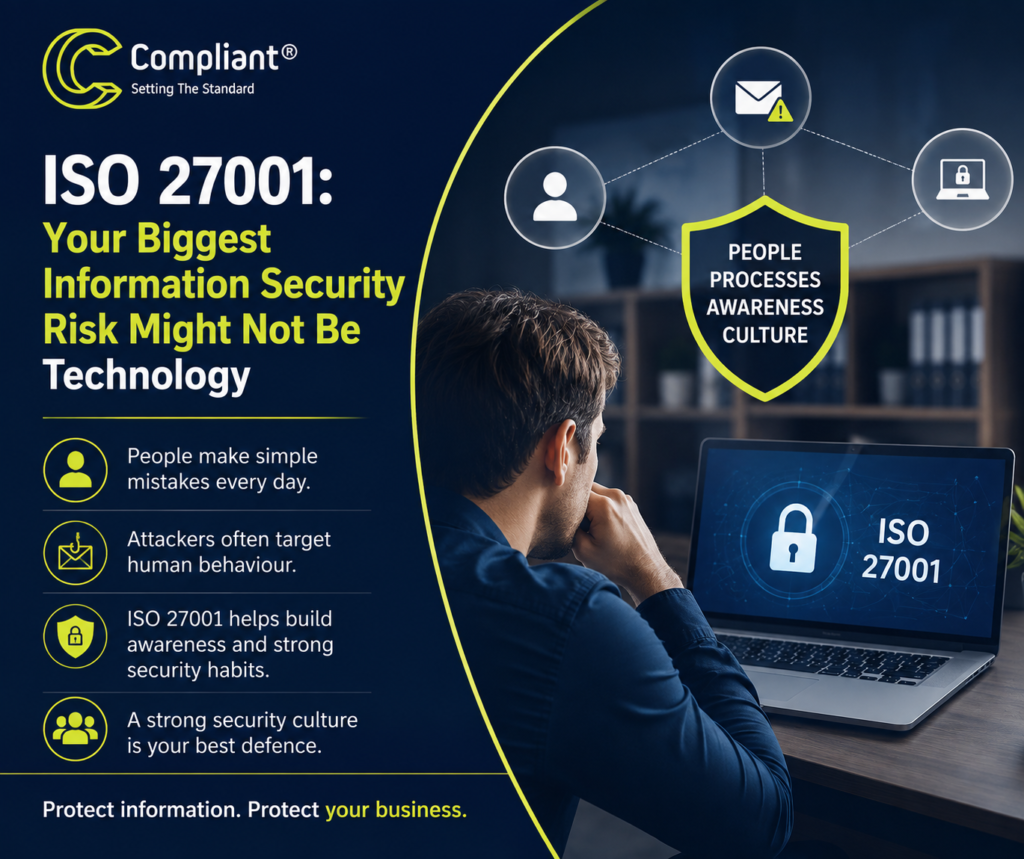
ISO 27001: Your Biggest Information Security Risk Might Not Be Technology
When businesses think about information security, technology is usually the first thing that comes to mind.
Firewalls.
Passwords.
Anti-virus software.
Backups.
Security systems.
All of these things matter.
But there is another risk sitting much closer to home.
People.
An employee clicks a link without checking it.
A password is shared because it is quicker.
Sensitive information is sent to the wrong person.
A laptop is left unlocked.
Someone discusses confidential information where other people can hear it.
An employee receives an urgent email that appears to come from a senior manager and follows the instructions without questioning it.
None of these situations necessarily involve a failure of technology.
The technology might be working exactly as it should.
The problem is human behaviour.
That is why ISO 27001 is about much more than computers and cyber security tools.
A strong Information Security Management System helps a business look at the whole picture.
Technology matters.
But so do people, processes, responsibilities, training and everyday decisions.
And if your business is spending heavily on technology while ignoring the people using it, you could be leaving one of your biggest information security risks wide open.
Your Security Can Be Strong Until Someone Makes One Small Mistake
Imagine your business has invested heavily in information security.
You have strong passwords.
Your systems are updated.
Files are backed up.
Access is controlled.
Your IT provider regularly checks your systems.
Everything looks secure.
Then an employee receives an email.
It looks genuine.
The name is familiar. The logo looks correct. The message creates a sense of urgency.
They click the link.
Suddenly, all the money you have spent protecting your systems is being tested because of one decision made in a few seconds.
This is not about blaming employees.
People are busy.
They are answering emails, speaking to customers, dealing with suppliers and trying to complete their work.
Attackers understand this.
They know that tricking a person can sometimes be easier than trying to break through technical security.
That is why information security needs to become part of normal business behaviour.
Your employees need to understand what they are protecting, why it matters and what they should do when something does not look right.
That does not happen simply because you have an information security policy stored somewhere.
It happens through awareness, training, clear processes and regular conversations.
ISO 27001 Looks Beyond Technology
One of the biggest misunderstandings about ISO 27001 is that it belongs to the IT department.
It does not.
Information moves throughout almost every part of a modern organisation.
Sales teams hold customer information.
HR holds employee records.
Finance deals with bank details, invoices and payments.
Managers may have access to confidential business plans.
Customer service teams could handle names, addresses and account information.
Employees send emails.
People use phones.
Documents are printed.
Files are shared.
Information may be discussed during meetings.
Some employees work from home.
Others travel.
Some information is stored digitally, while other information may still exist on paper.
Information security therefore affects almost everyone.
That is why responsibility cannot simply be handed to one person in IT.
Your technical team can protect systems.
They cannot control every decision an employee makes.
A strong Information Security Management System helps the whole organisation understand its role.
The Innocent Mistakes That Can Create Serious Problems
Not every information security incident begins with someone deliberately doing something wrong.
In many cases, it begins with an ordinary mistake.
Imagine an employee needs to send a confidential document to a customer.
They begin typing the customer’s name into their email.
The email system automatically suggests an address.
They click it.
They attach the document.
They press send.
Then they realise it went to the wrong person.
The whole thing took seconds.
Or perhaps someone is working from home.
They leave their laptop open while they make a drink.
Another person in the house can see confidential information on the screen.
Perhaps an employee prints a sensitive document and forgets to collect it.
Maybe someone writes a password on a note because they are worried about forgetting it.
Or a member of staff shares their login details with a colleague because it seems quicker than requesting proper access.
These actions can appear small.
The possible consequences are not.
Confidential information could be exposed.
Customers could lose trust.
The business may have to investigate what happened.
Operations could be disrupted.
Time and money may be needed to put things right.
That is why ISO 27001 encourages businesses to think about information security before an incident happens.
Do Your Employees Know What Information Is Sensitive?
You cannot protect something properly if you do not know it needs protecting.
Businesses often hold far more sensitive information than they realise.
Customer details.
Employee information.
Financial records.
Contracts.
Supplier information.
Passwords.
Pricing.
Business plans.
Designs.
Internal reports.
Personal information.
Commercial information.
The list will be different for every organisation.
Your employees need to understand which information requires additional care.
They also need to understand what that care looks like.
Who should have access?
Can the information be emailed?
Where should it be stored?
Can it be printed?
How should it be disposed of?
Can it be discussed outside the office?
What should happen if it is accidentally shared?
Clear answers make safe behaviour easier.
Confusion creates risk.
ISO 27001 helps organisations think carefully about the information they hold and the protection that information needs.
Passwords Are Important, but Behaviour Matters Too
Strong passwords remain important.
But a strong password is not much help if someone willingly gives it away.
Employees can be tricked into revealing information through emails, phone calls or messages.
An attacker might pretend to be a customer.
They may pretend to work for a supplier.
They could even pretend to be a senior member of your own organisation.
The request might sound completely normal.
“Can you send me that document?”
“I’ve forgotten my login. Can you help?”
“I need this payment made urgently.”
“Can you confirm these details?”
The pressure to respond quickly can stop people questioning what they have been asked to do.
This is where good awareness makes a difference.
Employees should feel comfortable stopping and checking.
A few minutes spent confirming a request could prevent days or weeks of disruption.
Security should never depend on employees remembering a long list of technical rules.
It should become a habit.
Stop.
Check.
Question anything unusual.
Report concerns.
Those simple behaviours can be extremely powerful.
Training Cannot Be a Once-a-Year Exercise
Many organisations provide information security training.
That is positive.
But there is a problem when training becomes something employees complete once a year and immediately forget.
Information security threats change.
Your business changes.
Employees change roles.
New people join.
New software is introduced.
Working arrangements change.
Regular reminders keep security visible.
These do not always need to be long training sessions.
Short conversations can work.
A quick reminder about suspicious emails.
A discussion about locking screens.
An example of a false payment request.
A reminder about how confidential information should be shared.
The goal is not to frighten people.
It is to help them recognise risk.
Employees who understand what could happen are more likely to stop before clicking an unusual link or sharing sensitive information.
Create a Culture Where People Report Mistakes
There is another side to human behaviour that businesses sometimes overlook.
What happens when somebody makes a mistake?
Imagine an employee clicks a suspicious link.
They immediately realise something does not feel right.
What do you want them to do?
Tell somebody straight away?
Of course.
But will they?
If employees believe they will be blamed, embarrassed or punished for reporting a genuine mistake, they may stay quiet.
That delay can make the problem worse.
A healthy information security culture encourages quick reporting.
Employees should know:
Who to tell.
How to report a concern.
What information they need to provide.
What happens next.
Most importantly, they should understand that reporting something quickly is helpful.
Mistakes will happen.
What matters is how quickly the organisation can respond.
A strong ISO 27001 system should help create clear reporting processes so employees are not left wondering what to do.
Access Should Match the Job
Another important area is access to information.
Does everybody in your organisation have access only to what they need?
Or has access slowly built up over time?
This happens easily.
Someone joins one department and receives access to certain folders.
They move into another role.
New access is added.
Old access is never removed.
A few years later, they can see information they no longer need.
The same issue can happen when employees leave.
Access should be removed quickly when it is no longer required.
This is not about distrusting employees.
It is about reducing unnecessary risk.
If an account is affected by an attack, limiting its access can also limit the amount of information that may be exposed.
ISO 27001 encourages businesses to think carefully about who needs access to what.
Simple question.
Important answer.
Working From Home Changed the Security Picture
Modern working has made information security more complicated.
Employees may work from offices, homes, hotels, customer sites or shared spaces.
Information travels with them.
Laptops leave the office.
Phones contain emails.
Documents may be viewed on trains.
Calls take place outside traditional workplaces.
This flexibility can be valuable.
But it introduces new questions.
Can other people see an employee’s screen?
Are paper documents being stored safely at home?
What happens if a laptop is lost?
Are devices locked when they are left unattended?
Can confidential conversations be overheard?
Employees need clear guidance that works in the real world.
A policy that simply says “keep information secure” does not tell somebody what to do when working from a coffee shop or hotel.
Good processes should be practical.
They should help people make sensible decisions wherever they work.
Suppliers Can Create Human Risks Too
Your information security risks do not stop at your own employees.
Suppliers may have access to your systems or information.
IT providers.
Accountants.
Software companies.
Contractors.
Marketing agencies.
Payroll providers.
Cloud services.
Other partners.
Each relationship can involve information.
That means supplier management should form part of your information security approach.
What information can the supplier access?
Why do they need it?
How is it protected?
What happens when the relationship ends?
Who is responsible if something goes wrong?
ISO 27001 encourages organisations to consider these relationships rather than assuming information is safe simply because it has left their own systems.
Leadership Sets the Standard
Employees pay attention to what leaders actually do.
A policy might say one thing.
Management behaviour can say something completely different.
Imagine employees are told never to share passwords.
Then a manager asks somebody to use their login because it is quicker.
What message does that send?
Employees are told to report suspicious requests.
Then managers complain when checks slow something down.
Again, the message is clear.
Information security culture starts at the top.
Leaders do not need to become technical experts.
But they do need to demonstrate that protecting information matters.
They need to support training.
They need to provide resources.
They need to take incidents seriously.
They need to follow the same rules as everybody else.
ISO 27001 works best when information security is seen as a business responsibility rather than an IT task.
When Did You Last Test What Your Employees Know?
There is a difference between giving people information and knowing they understand it.
You might have excellent policies.
But can employees explain them?
Ask a few simple questions.
What would you do if you received a suspicious email?
Who would you tell if you accidentally sent information to the wrong person?
What information in your role is confidential?
What should happen if you lose a company device?
How do you check an unusual request for information?
The answers can reveal gaps.
Those gaps are useful.
They show you where more support may be needed.
Finding a weakness during a conversation is far better than discovering it during a real information security incident.
Your Processes Need to Work When People Are Busy
A security process that is too difficult will often be ignored.
That is human nature.
If employees need to complete ten steps every time they share a document, they may look for shortcuts.
If requesting access takes several days, people may start sharing accounts.
If policies are 40 pages long, employees may not read them.
Security needs to be strong.
But it also needs to work.
This is where reviewing your processes becomes important.
Ask employees what causes frustration.
Ask where shortcuts are happening.
Do not immediately assume the employee is the problem.
The process itself may need improving.
Sometimes the safest process is also the simplest.
How an ISO Consultant Can Support Your Organisation
Implementing and maintaining ISO 27001 can feel difficult, particularly when information security is not your main area of work.
The standard covers many parts of an organisation.
Understanding how those requirements apply to your particular business can take time.
This is where the benefits of an ISO consultant’s support can become valuable.
An experienced ISO consultant can provide an outside view of your Information Security Management System.
They can help you understand where your real risks may exist.
And those risks may not always be where you expect.
You might be focused heavily on technology while employee awareness needs more attention.
You may have strong policies but weak reporting processes.
Perhaps access has not been reviewed recently.
Maybe your supplier checks need improvement.
An ISO consultant can help you ask the right questions.
They can also help make the requirements easier to understand.
ISO should not feel like a different language.
Your employees need practical guidance that relates to their actual jobs.
The role of good consultant support is not to make your system bigger.
It is to help make it useful.
Consultant Support Should Build Knowledge Inside Your Business
There is an important point here.
Your ISO consultant should not become the only person who understands your Information Security Management System.
The knowledge needs to remain inside your organisation.
Managers should understand their responsibilities.
Employees should know what is expected.
Leaders should understand the risks.
People should know how to report problems.
One of the key benefits of an ISO consultant’s support is having somebody who can guide your team while helping them build their own understanding.
That creates a stronger system in the long term.
The consultant provides experience.
Your business provides the knowledge of how you actually operate.
Together, those two views can help create an Information Security Management System that fits your organisation rather than one built around generic paperwork.
Internal Audits Can Reveal Human Risks
Internal audits are an important part of ISO 27001.
But they should not simply check whether documents exist.
Use them to understand what really happens.
Talk to employees.
Ask how they share information.
Check whether access matches people’s roles.
Look at how new starters are introduced to information security.
Review what happens when employees leave.
Look at incidents and near misses.
Check whether people know how to report concerns.
The purpose is not to catch people doing something wrong.
It is to find weaknesses before someone else finds them.
An employee taking a shortcut may reveal a process that needs improving.
A forgotten access permission might show that the leaving process needs attention.
A team that cannot explain how to report a suspicious email may highlight a training gap.
These findings have value.
They give you something to improve.
Learn From Near Misses, Not Just Incidents
Imagine an employee receives a false email asking them to change a supplier’s bank details.
They notice something unusual and check with the supplier.
The request is false.
No money is lost.
Nothing bad happened.
So should you forget about it?
No.
That near miss can teach you something.
How convincing was the email?
Would another employee have spotted it?
Did your existing process help?
Could you use the example during staff training?
Do payment changes require enough checks?
Learning before damage occurs is one of the best forms of improvement.
Do not wait for a serious incident to expose a weakness.
People Can Also Be Your Strongest Defence
We have talked about people as a risk.
But that is only half of the story.
Your employees can also become one of your strongest protections.
A trained employee can spot a suspicious email.
A confident employee can challenge an unusual payment request.
An aware manager can notice that someone has unnecessary access.
A team member can report a lost device immediately.
Someone can notice confidential information has been left somewhere unsafe.
Technology can identify many threats.
People can identify things technology may miss.
The goal should never be to remove people from information security.
It should be to give them the knowledge and confidence to play their part.
That is when culture begins to change.
Employees stop seeing information security as somebody else’s job.
They understand that every email, document, password and conversation can matter.
Five Questions to Ask Your Business Today
You do not need to wait for your next ISO 27001 audit to start improving.
Ask these five questions:
1. Do our employees know which information they need to protect?
If the answer is unclear, awareness may need strengthening.
2. Would employees know what to do if they made a security mistake?
Reporting needs to be simple and understood.
3. Does everyone have the right level of access?
Review access regularly, especially when people change roles or leave.
4. Are our security processes practical?
If people regularly take shortcuts, understand why.
5. Are leaders following the same rules as everyone else?
Culture begins with behaviour at the top.
These questions are simple.
The conversations they create can be extremely valuable.
ISO 27001 Is About Protecting Information, Not Just Computers
Technology will always be an important part of information security.
You need secure systems.
You need good technical controls.
You need backups.
You need protection against attacks.
But technology alone cannot make every decision.
It cannot stop an employee from discussing confidential information in the wrong place.
It cannot always know that an email that looks genuine is actually trying to trick somebody.
It cannot guarantee that people understand why information needs protecting.
That is why ISO 27001 takes a wider view.
People matter.
Processes matter.
Training matters.
Leadership matters.
Suppliers matter.
Culture matters.
When all of these areas work together, your organisation becomes much stronger.
Your Biggest Risk Could Become Your Greatest Strength
If people are one of the biggest information security risks in your organisation, the answer is not to distrust them.
Educate them.
Support them.
Give them clear processes.
Make it easy to report concerns.
Help them understand why their actions matter.
Listen when they tell you a process is difficult.
Learn from mistakes and near misses.
And make information security part of everyday business rather than something discussed only before an audit.
ISO 27001 provides a framework for doing this.
The benefits of an ISO consultant’s support can also help you see areas that may have become invisible through familiarity and turn complicated requirements into practical actions your team can understand.
But responsibility ultimately sits within the organisation.
Your Information Security Management System should belong to your business.
It should protect the information your organisation depends on while helping your people make safer decisions.
Because your biggest information security risk might not be your technology.
It could be the person sitting behind it.
And with the right knowledge, processes and support, that same person could become one of your strongest lines of defence.
Educational CTA
Choose one team in your organisation this week and have a ten-minute information security conversation.
Do not start by showing them a policy.
Ask questions.
What information do they handle every day?
What worries them?
What would they do if they sent something to the wrong person?
Would they recognise an unusual request?
Do they know who to contact if something goes wrong?
Their answers will give you a useful picture of how information security works in practice.
Because understanding what your people actually know is one of the best places to start improving your ISO 27001 Information Security Management System.