Skip to main content
Skip to footer
Skip to main content
Skip to footer

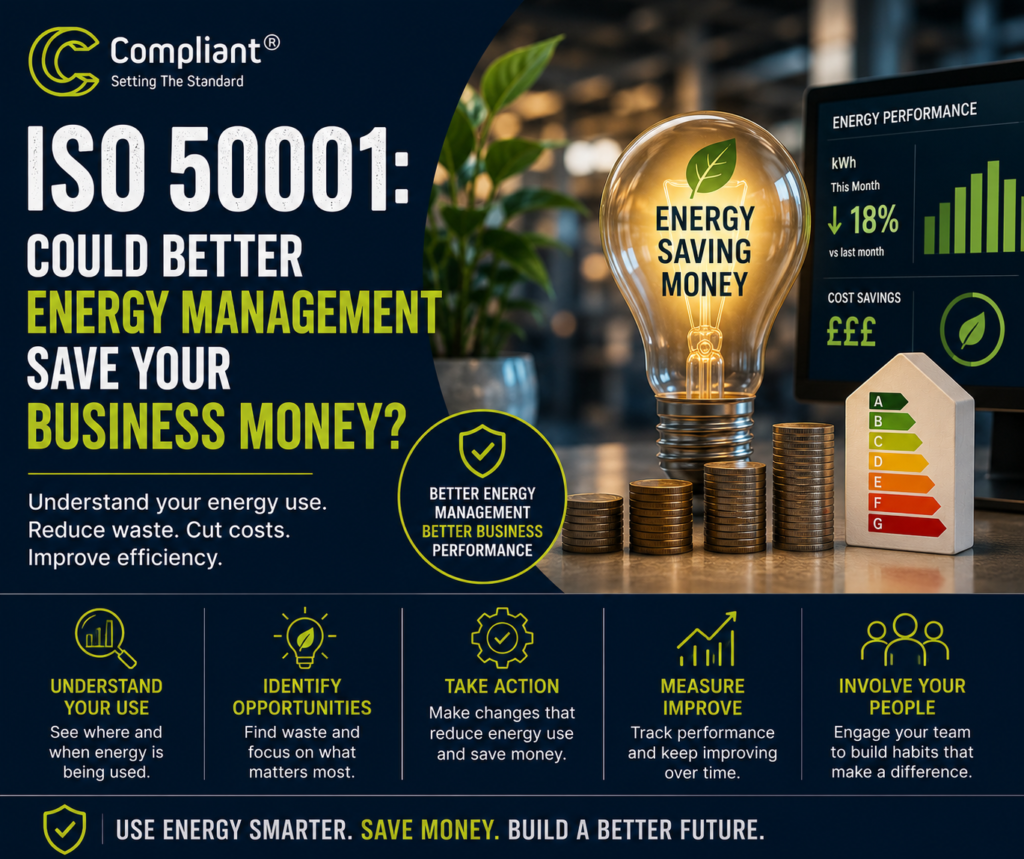
ISO 50001: Could Better Energy Management Save Your Business Money?
ISO 50001: Could Better Energy Management Save Your Business Money?
Energy is one of those business costs that can quietly become accepted.
The electricity bill arrives. It gets paid.
Fuel costs increase. The business absorbs them.
Equipment runs throughout the working day, and sometimes long after everyone has gone home.
Heating and cooling systems work harder than they need to.
Nobody deliberately chooses to waste energy. But without a clear way of understanding where energy is being used, waste can become part of normal business activity.
And that waste costs money.
A machine running unnecessarily for an extra hour might not seem significant.
Neither does a light left on overnight.
One poorly planned journey probably will not damage the year’s finances.
But multiply those small amounts of wasted energy across dozens of employees, machines, vehicles, buildings and hundreds of working days.
The numbers can become very different.
This is where ISO 50001 can help.
ISO 50001 provides businesses with a structured approach to energy management. It helps organisations understand how energy is being used, identify opportunities for improvement, set sensible goals and measure whether changes actually work.
It is not simply about using less energy at any cost.
It is about using energy better.
And when businesses use energy better, there can be a financial benefit too.
Do You Actually Know Where Your Energy Goes?
Most businesses know how much they spend on energy.
Far fewer understand exactly where it goes.
That distinction matters.
Imagine your electricity bill increases by 15%.
Why?
Did production increase?
Did energy prices change?
Was new equipment introduced?
Is an old machine becoming less efficient?
Has equipment started running for longer?
Is heating being used differently?
Has something developed a fault?
Without useful information, it can be difficult to tell.
The bill tells you there is a cost.
It does not necessarily tell you what caused it.
ISO 50001 encourages businesses to understand their energy use in greater detail.
You do not need to make everything complicated.
Start by understanding where the largest amounts of energy are being used.
For one organisation, that may be manufacturing equipment.
For another, it could be heating and cooling.
Transport may be a major factor.
An office-based business might find its buildings and IT equipment are the main areas.
The answer will be different for every organisation.
That is why good energy management should begin with your business, not somebody else’s checklist.
Energy Waste Often Hides in Everyday Habits
Some energy waste is obvious.
An empty office with every light switched on.
A vehicle left running unnecessarily.
Heating operating while doors are wide open.
Equipment running overnight when nobody needs it.
Other waste is harder to spot.
A machine may still work perfectly but use far more electricity than a newer alternative.
Heating controls may have been set years ago and never reviewed.
Employees may switch equipment on first thing every morning even though it is not needed until much later.
Deliveries may be planned individually when several could be combined.
None of these actions looks particularly serious in isolation.
That is the problem.
Small amounts of waste can become normal because nobody sees them as important enough to challenge.
ISO 50001 gives businesses a reason to challenge them.
Start With the Biggest Opportunities
Trying to reduce every form of energy use at once can quickly become overwhelming.
It can also waste time.
Imagine spending weeks trying to reduce the electricity used by one small office appliance while a large piece of equipment is consuming unnecessary energy every day.
Both might matter.
But one clearly deserves more attention.
This is why businesses need to understand where their significant energy use occurs.
Look at the areas that consume the most.
Then ask whether those areas are operating as efficiently as they reasonably can.
This allows resources to be focused where improvement could have the greatest effect.
It also makes energy management easier for employees to understand.
Instead of announcing:
“We need everyone to save energy.”
You can explain:
“This piece of equipment represents a large part of our electricity use, so we are looking at how we operate it.”
That is much clearer.
Better Energy Management Starts With Better Information
You cannot improve what you do not understand.
Data helps.
But collecting numbers for the sake of having numbers achieves very little.
The information should help you make decisions.
You might track electricity use.
Gas consumption.
Fuel.
Operating hours.
Production levels.
Energy cost.
The exact measures depend on your business.
The important part is comparing information in a meaningful way.
Suppose energy consumption rises.
That could look bad.
But perhaps production increased by 30% while energy use increased by only 10%.
The business may actually have become more efficient.
Context matters.
ISO 50001 encourages organisations to understand energy performance rather than simply staring at bills.
Your Energy Bill Is a Starting Point, Not the Whole Picture
Monthly bills are useful.
But they can hide a lot.
Imagine a business uses too much electricity every night.
A monthly bill may show high consumption, but it will not necessarily reveal exactly when that electricity was used.
More detailed information may uncover patterns.
Perhaps equipment is not being shut down correctly.
Maybe heating starts hours before employees arrive.
Perhaps weekend energy use is surprisingly high.
Once you know the pattern, you can investigate.
This does not mean every organisation needs expensive monitoring equipment immediately.
Start with the information you already have.
Then decide whether more detail would help you make better decisions.
Good energy management should be proportionate.
Small Changes Can Produce Repeated Savings
Businesses sometimes assume energy improvement requires a large investment.
Solar panels.
New vehicles.
New machinery.
Major building work.
These can all form part of an energy strategy where appropriate.
But they are not the only options.
Sometimes the first savings come from changing behaviour.
Switching equipment off.
Adjusting operating times.
Improving maintenance.
Planning journeys better.
Changing heating settings.
Reducing unnecessary use.
One small saving repeated every working day can become meaningful over a year.
Suppose a change saves only £5 each working day.
That may not sound exciting.
Across roughly 250 working days, it becomes £1,250.
Now imagine finding ten similar opportunities.
Small improvements can add up.
Maintenance Can Affect Energy Use
Equipment does not always fail dramatically.
Sometimes it simply becomes less efficient.
A problem develops.
The machine continues working.
Because production has not stopped, nobody considers it urgent.
Meanwhile, it may be using more energy than necessary.
Regular maintenance can help.
It may identify wear, poor settings, blocked filters, leaks or other issues that affect energy performance.
This is an important connection.
Maintenance is not only about preventing breakdowns.
It can also support energy efficiency.
A well-maintained piece of equipment may operate more effectively and use less energy than one that has been neglected.
That can help reduce costs while improving reliability.
Your Employees Can See Things Your Reports Cannot
Energy reports provide numbers.
Employees provide context.
The person using a machine every day may know it runs unnecessarily during breaks.
A driver may know a delivery route makes little sense.
An office employee may notice that heating is running in unused rooms.
A facilities team may know certain equipment is regularly left on.
Ask them.
Where do you think we waste energy?
What runs when it does not need to?
What could we change without making your job harder?
What causes unnecessary journeys?
Which equipment seems inefficient?
You may be surprised by how quickly opportunities appear.
Employees are far more likely to support an energy management system when they feel involved in it.
Do Not Make Energy Saving Harder Than the Job
Energy-saving processes need to be practical.
If switching equipment off safely takes fifteen complicated steps, people may avoid doing it.
If employees have no control over heating but are constantly told to reduce energy use, they will become frustrated.
If a new process makes work significantly harder, it may not last.
Good energy management needs to work alongside the needs of the business.
This is where employee feedback matters.
Ask whether the proposed improvement is realistic.
Test it.
Review what happens.
Adjust where needed.
ISO 50001 should support better working practices, not create unnecessary barriers.
Set Targets That Mean Something
“Reduce energy.”
That is not a particularly helpful target.
How much?
Where?
By when?
How will you know?
A useful energy target should give the business something clear to work towards.
Perhaps the organisation wants to reduce electricity consumption in a particular area.
Maybe it wants to reduce fuel used per delivery.
It might want to improve the energy performance of a production process.
The right target depends on the organisation.
Do not choose a target simply because it sounds impressive.
Choose one based on your energy information and realistic opportunities.
Then measure progress.
Measure the Result, Not Just the Action
A business changes its heating settings.
Success?
Not yet.
A new shut-down process is introduced.
Success?
Again, not necessarily.
An action has taken place.
You still need to understand the result.
Did energy consumption fall?
Did the change cause any problems?
Was the improvement maintained?
Did employees follow the new process?
Was the saving as large as expected?
This is where measurement becomes valuable.
Without it, businesses can spend time on changes that achieve very little.
Or they can fail to recognise improvements that are working extremely well.
ISO 50001 encourages businesses to make decisions using evidence.
Energy Efficiency Can Support Productivity
Energy management and productivity are not necessarily separate issues.
Imagine a machine that regularly breaks down.
It causes delays.
It also consumes more energy than it should.
Replacing or improving that machine could reduce energy use and improve production.
Or consider poorly planned deliveries.
Vehicles use unnecessary fuel.
Drivers lose time.
Customers may wait longer.
Better route planning can improve several things at once.
Look for improvements where energy, cost and operational performance meet.
These can be some of the strongest opportunities because the benefits are easy for the whole business to understand.
Purchasing Decisions Can Lock In Energy Costs
The cheapest piece of equipment is not always the cheapest equipment to own.
Imagine two machines.
Machine A costs less to buy but consumes far more electricity.
Machine B has a higher purchase price but uses significantly less energy.
Which one is cheaper?
You cannot answer that question from the purchase price alone.
Energy use across the life of equipment can matter.
ISO 50001 encourages businesses to consider energy performance when purchasing products, equipment and services that can have a significant effect on energy use.
This can lead to better long-term decisions.
Instead of asking only:
“How much does it cost?”
Businesses can also ask:
“How much will it cost to run?”
Think About Buildings Too
Buildings can represent a significant source of energy use.
Heating.
Cooling.
Lighting.
Ventilation.
Hot water.
IT equipment.
The way a building is used can change over time.
More employees may be working from home.
Certain areas may be used less frequently.
Working hours may change.
Yet heating and lighting schedules can remain exactly the same.
Review them.
Does the building need to be heated at 6am if nobody arrives until 8am?
Are unused areas being treated the same as busy ones?
Does lighting remain on when natural light would be enough?
Small adjustments can sometimes reduce energy use without affecting comfort or productivity.
Transport Deserves Attention
For businesses with vehicles, fuel can represent a significant energy cost.
Again, improvement does not always mean replacing the fleet tomorrow.
Look at how vehicles are used.
Are journeys planned efficiently?
Could deliveries be combined?
Are vehicles carrying unnecessary weight?
Are employees making journeys that could be avoided?
Is maintenance affecting fuel efficiency?
Could driver behaviour be improved?
These questions can uncover practical opportunities.
And reducing fuel use can benefit both the business and the environment.
Energy Management Supports Environmental Goals
ISO 50001 focuses specifically on energy performance.
But better energy management can also support wider environmental goals.
Using less energy can help reduce environmental impact.
Reducing fuel use can lower emissions.
More efficient equipment can use fewer resources.
This means ISO 50001 can work well alongside other management systems, including ISO 14001.
The two standards have different purposes, but there can be useful overlap.
Businesses already measuring environmental performance may already hold some of the information needed to understand energy use.
The important thing is avoiding duplicate work.
Leadership Needs to Care About the Numbers
Energy management cannot be left entirely to one employee.
Some improvements require decisions.
Money may need to be invested.
Equipment may need replacing.
Working practices may need changing.
Targets may need resources.
Senior leaders therefore need to understand what the energy information is telling them.
They do not need to study every meter reading.
They should understand the important areas.
Where is most energy being used?
What is it costing?
What improvements are planned?
Are targets being achieved?
Where could investment create a worthwhile benefit?
Energy management becomes far more effective when it is considered during normal business decisions.
The Benefits of an ISO Consultant’s Support
ISO 50001 can appear daunting when a business first looks at it.
Energy reviews.
Performance measures.
Targets.
Monitoring.
Responsibilities.
Improvement plans.
For organisations without dedicated energy specialists, it can be difficult to know where to begin.
This is where the benefits of an ISO consultant’s support can be valuable.
An experienced consultant can help explain the requirements in plain language.
They can work with the organisation to understand where energy is being used and how existing information can support the management system.
They can also challenge assumptions.
Why is this equipment running overnight?
How do you know this is your biggest energy user?
What does this target achieve?
How are you measuring improvement?
Does anyone review these figures?
What happens when energy use unexpectedly increases?
These questions help move the system beyond paperwork.
A good consultant should not simply produce a set of documents for an audit.
The goal should be helping the organisation understand its energy use and build processes it can continue using.
Your team understands your business.
The consultant understands ISO 50001.
Both are needed to build something practical.
Do Not Collect Data Nobody Uses
One of the easiest ways to make an ISO management system feel burdensome is to collect too much information.
A spreadsheet grows.
Then another spreadsheet appears.
Reports become longer.
Employees spend hours entering figures.
But nobody makes a decision because of them.
Stop.
Ask what each piece of information is for.
What does it tell you?
Who reviews it?
What decision could it influence?
If nobody can answer, question whether you need it.
ISO 50001 should help the business understand energy performance.
It should not create an industry devoted to maintaining spreadsheets.
Internal Audits Should Follow the Energy
Internal audits provide an opportunity to see whether the energy management system works in practice.
Do not only check that procedures exist.
Choose an important area of energy use.
Look at what happens.
Are employees following the agreed process?
Is equipment being operated as expected?
Are energy figures being recorded?
Are targets being reviewed?
Have improvement actions been completed?
Speak to employees.
Do they understand what they are expected to do?
Internal audits can uncover small weaknesses before they become established habits.
They can also identify good ideas worth using elsewhere.
Look for Unexpected Changes
One of the benefits of monitoring energy is that unusual changes become easier to see.
If consumption suddenly increases, investigate.
Do not simply accept the higher bill.
Something may have changed.
Production may have increased.
That could explain it.
But perhaps equipment is developing a fault.
Maybe operating hours changed.
A control setting may have been altered.
The earlier the cause is identified, the sooner the business can decide whether action is needed.
A good energy management system turns unusual numbers into questions.
Improvement Is Not a One-Off Project
A business might complete a major energy-saving project and achieve excellent results.
That does not mean energy management is finished.
Things change.
Equipment ages.
Energy prices change.
The business grows.
New technology becomes available.
Working patterns change.
New opportunities appear.
ISO 50001 is based on ongoing improvement for this reason.
Review performance.
Learn.
Find the next opportunity.
It does not always need to be a huge one.
Consistent small improvements can deliver significant benefits over time.
Could Better Energy Management Save Your Business Money?
For many organisations, the answer could be yes.
But the saving will not come simply from having ISO 50001 certification.
It comes from what the business does with the information the system provides.
Understanding where energy is being used.
Finding waste.
Setting useful targets.
Maintaining equipment.
Involving employees.
Considering energy when purchasing.
Measuring improvements.
Learning from the results.
These activities can help businesses make more informed decisions about one of their regular operating costs.
Some improvements may cost almost nothing.
Others may require investment.
The important thing is making those decisions with better information.
Start With Yesterday
You do not need to redesign your entire energy system tomorrow.
Start with one day.
Look at yesterday.
What equipment was running?
Which vehicles were used?
When did heating start?
What remained switched on after people left?
Where was energy used without creating useful work?
Choose one area.
Understand it.
Then ask:
Could we achieve the same result using less energy?
If the answer is yes, investigate how.
Make one sensible change.
Measure what happens.
If it works, keep it.
Then find the next opportunity.
That is how better energy management begins.
Not with a huge promise to transform everything overnight.
With understanding.
With evidence.
And with a willingness to question everyday habits that may be costing the business more than anyone realises.
ISO 50001 gives organisations a framework for doing that consistently.
Because the energy you do not need to use is not simply better for energy performance.
It may also be money your business does not need to spend.