Skip to main content
Skip to footer
Skip to main content
Skip to footer

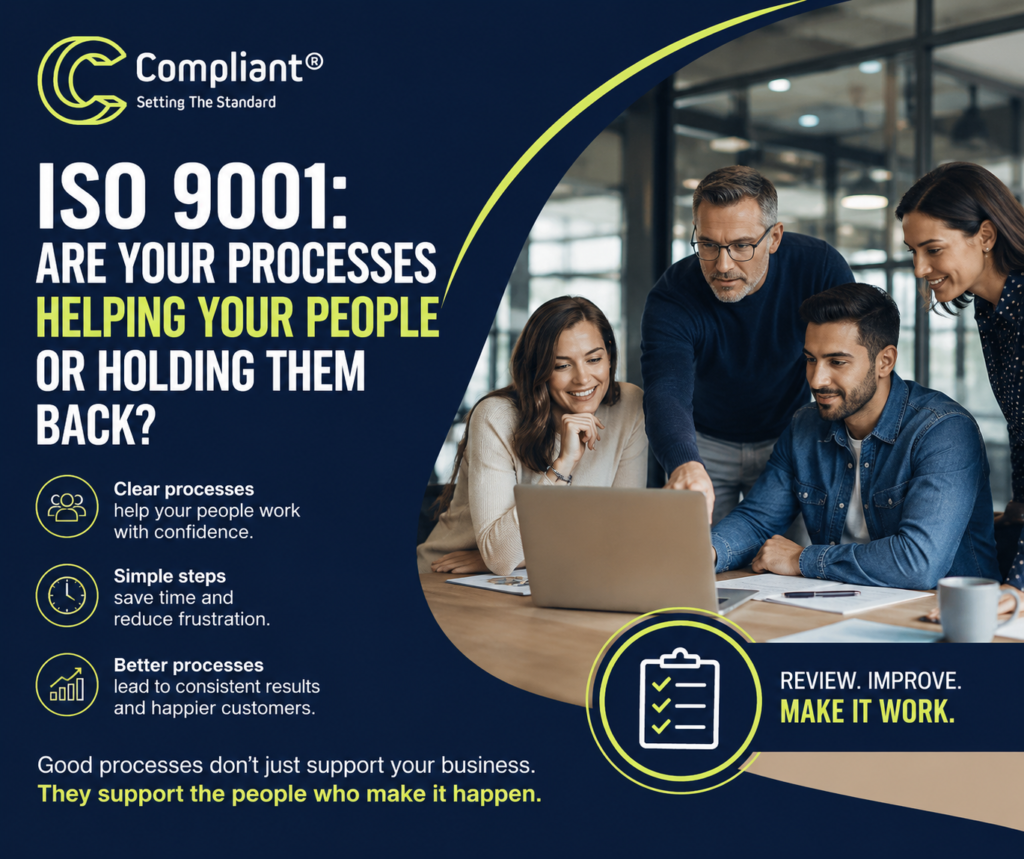
ISO 9001: Are Your Processes Helping Your People or Holding Them Back?

ISO 9001: Are Your Processes Helping Your People or Holding Them Back?
A process should make work easier.
It should give people a clear way to get something done, reduce mistakes and help the business deliver the same good result time after time.
But that is not always what happens.
Over time, even a good process can become difficult.
A new form gets added. Then another check. Someone creates a spreadsheet because the old system does not quite work. Another person starts keeping their own notes. Before long, a task that should take ten minutes takes half an hour.
People stop asking why.
They simply accept that “this is how we do it.”
That can become a serious problem.
ISO 9001 is not about creating more paperwork or forcing people to follow processes that no longer make sense. Used properly, it should help a business understand how work gets done, where problems happen and what could be improved.
The important question is not simply:
Do we have a process?
It is:
Is that process actually helping our people do their jobs well?
If the answer is no, it may be time to look at it again.
Your Processes Could Be Creating Problems Without You Realising It
Most poor processes do not start out poor.
They grow that way.
Imagine a customer places an order.
At first, the process is simple. The order comes in, the right information is recorded, the work is completed and the customer receives what they asked for.
Then something goes wrong.
A new check is introduced.
A few months later, another problem happens. A new form is created.
Someone wants better records, so another spreadsheet appears.
A manager wants to approve certain orders, so another stage is added.
None of these decisions seems unreasonable on its own.
Put them together, though, and the simple process can become a maze.
People are copying the same information into different places. They are waiting for approval when it is not really needed. They are completing forms nobody looks at. They are spending time proving that work has happened rather than doing the work itself.
That affects far more than efficiency.
It can affect morale.
People become frustrated when they can see an easier way to do something but feel unable to change it.
Mistakes can increase because there are too many steps to remember.
Customers may wait longer.
Managers can lose sight of what is really happening because there is so much information to review.
This is where ISO 9001 can provide real value.
It encourages businesses to look at their processes as part of a connected system rather than a collection of forms and instructions.
The aim is not to make work more complicated.
It is to make good results more likely.
ISO 9001 Should Work for Your Business
There is a common misunderstanding around ISO 9001.
Some businesses think certification means creating a large set of rules and then making everyone follow them forever.
It does not.
ISO 9001 provides a framework for managing quality. Your business still needs to decide how its own work should be carried out.
That difference matters.
A construction company will not work in the same way as a software company.
A manufacturer will have different risks from a recruitment business.
A company with ten employees will often need a very different approach from an organisation with several hundred people.
Your quality management system should reflect the business you actually have.
Not an imaginary “ISO business.”
Not somebody else’s system.
And certainly not a collection of documents created simply because somebody thought an auditor might want to see them.
Good processes should have a purpose.
They should help people understand what needs to happen, who is responsible and what a good result looks like.
If they do not do that, they need attention.
Start With What Really Happens
One of the best ways to understand whether a process works is surprisingly simple.
Talk to the people who use it.
Managers often understand how a process is supposed to work.
Employees know how it actually works.
Those two versions are not always the same.
A written procedure might say that information is entered into one system. In reality, the team may also be keeping a spreadsheet because the system does not give them everything they need.
A procedure might require approval from a manager. In practice, that manager may be so busy that staff regularly wait two days for a simple decision.
The official process might contain eight steps.
The person doing the job may have discovered that only five are useful.
These differences matter.
They can reveal where time is being lost and where mistakes are more likely.
ISO 9001 gives businesses a reason to look closely at these areas.
Instead of asking people to work around poor processes, businesses can ask a much better question:
Why does the workaround exist in the first place?
Sometimes the answer reveals an easy improvement.
Good Processes Give People Clarity
Unclear processes create uncertainty.
Who needs to approve this?
Where should this information be saved?
Which version of the document should we use?
Who tells the customer?
What happens if something goes wrong?
When employees have to ask these questions every day, the process is not giving them enough support.
That can be particularly difficult for new employees.
Someone who has worked in the business for ten years may know exactly what to do because they have learned through experience.
A new starter does not have that knowledge.
They need clear guidance.
ISO 9001 can help a business capture important ways of working so that knowledge does not live entirely inside people’s heads.
That does not mean writing a twenty-page procedure for every task.
Sometimes a simple checklist is enough.
Sometimes a flow chart works better.
Sometimes a short instruction is all that is needed.
The amount of information should suit the task and the risk involved.
The goal is clarity.
People should know what good work looks like and have the information they need to achieve it.
Processes Should Prevent Problems, Not Just Record Them
A weak system often becomes very good at recording mistakes.
A strong system tries to stop the same mistake happening again.
There is a big difference.
Suppose a customer receives the wrong product.
The business records the complaint.
Someone apologises.
The correct product is sent.
The complaint is then marked as closed.
Problem solved?
Not necessarily.
Why was the wrong product sent?
Was the order entered incorrectly?
Was the product labelled badly?
Did someone misunderstand the customer’s request?
Was there a final check?
Has the same problem happened before?
If nobody asks these questions, another customer could experience exactly the same problem next week.
ISO 9001 encourages businesses to look beyond the immediate fix.
A mistake can become useful information.
It tells you where a process may be weak.
That does not mean looking for someone to blame.
Blame often stops people speaking openly about problems.
Improvement requires the opposite.
People need to feel able to say, “This isn’t working.”
That sentence can be extremely valuable.
Listen to the People Doing the Work
Your employees often know where your biggest process problems are.
They live with them every day.
They know which spreadsheet takes too long to complete.
They know which form asks for information nobody uses.
They know which customer questions keep appearing.
They know where work gets delayed.
They know which instructions are out of date.
The problem is that businesses do not always ask them.
Or worse, they ask but nothing changes.
ISO 9001 gives organisations an opportunity to make improvement part of normal business activity.
When reviewing a process, involve the people who actually use it.
Ask simple questions.
What makes your job harder than it needs to be?
Where do mistakes normally happen?
What do customers regularly ask us to correct?
Which step takes the most time?
What information do you need but struggle to find?
If you could change one thing about this process, what would it be?
The answers can be far more useful than another management meeting.
Too Much Paperwork Can Hide the Real Problems
Documentation has an important place within ISO 9001.
But documentation should support the business.
The business should not exist to support the documentation.
This distinction is important.
Some organisations create too many records because they are worried about certification.
They document everything.
Every meeting has a form.
Every activity has a checklist.
Every decision needs a signature.
Eventually, employees spend so much time maintaining the system that they begin to see ISO 9001 as extra work.
That is a warning sign.
A quality management system should be part of the way the business works.
It should not feel like a second business running alongside the real one.
This is also one area where the support of an experienced ISO consultant can be valuable.
Someone with experience across different businesses can often spot unnecessary steps that people inside the organisation have become used to.
They can ask:
Why are you recording this?
Who uses this information?
What would happen if you stopped doing it?
Could this information already be available somewhere else?
Is there a simpler way?
Those questions can help businesses strip away work that adds little or no value.
An ISO Consultant Should Help You Understand the Standard
There is another trap businesses can fall into.
They become dependent on someone else to “do ISO” for them.
That misses the point.
A good ISO consultant should help the people within the business understand what ISO 9001 means and how it applies to them.
The consultant can provide guidance.
They can explain requirements in simple terms.
They can help identify gaps.
They can challenge processes that do not appear to be working.
They can help prepare the organisation for audits.
But the quality management system ultimately belongs to the business.
That is important because your employees will use it every day.
An outside consultant cannot know every customer, every problem or every small detail of your operation.
The best results usually come from combining two types of knowledge.
Your team understands your business.
The consultant understands ISO 9001.
Put those together and you can build a system that both meets the requirements of the standard and makes sense in everyday work.
Look for Repeated Problems
One mistake does not always mean a process is poor.
The same mistake happening again and again is different.
Repeated problems are clues.
Customer complaints are one example.
If customers regularly complain about late deliveries, the answer may not be telling the delivery team to work faster.
The real problem could start much earlier.
Perhaps sales teams are promising dates that cannot realistically be achieved.
Maybe stock levels are inaccurate.
Perhaps production planning is poor.
Maybe information reaches the delivery team too late.
A good review looks at the whole process.
This is one of the strengths of ISO 9001.
It encourages organisations to think about how different activities connect.
A problem at the end of a process may have been created right at the beginning.
Measure Things That Help You Make Decisions
Businesses can collect huge amounts of information.
That does not automatically make the information useful.
A report containing fifty figures may look impressive.
But if nobody uses those figures to make a decision, what value are they providing?
ISO 9001 encourages organisations to monitor how their quality management system is performing.
Choose measures that tell you something useful.
Customer complaints could be one.
Late deliveries might be another.
Returns, mistakes, wasted materials, repeated work or customer satisfaction may all provide useful information depending on your business.
The important part comes next.
Do something with what you learn.
If a figure starts moving in the wrong direction, investigate.
If performance improves, understand why.
Data should start conversations.
It should not simply fill reports.
Internal Audits Should Find Opportunities
The words “internal audit” can make people nervous.
They should not.
An internal audit is not supposed to be an exercise in catching employees doing something wrong.
Used well, it is an opportunity to look at whether the business is working as intended.
Does the process make sense?
Are people following it?
If not, why not?
Are records useful?
Are responsibilities clear?
Have previous problems been resolved?
Could something be done better?
An internal audit can uncover small issues before they become large ones.
This is another area where ISO consultant support can bring value.
A consultant can provide a fresh pair of eyes.
People working inside a business every day naturally become familiar with its systems.
Something inefficient can start to feel normal simply because it has been done that way for years.
An outside view can challenge that.
Not for the sake of finding fault.
For the sake of improvement.
Leadership Has a Bigger Role Than Signing Documents
ISO 9001 cannot sit with one person.
Giving somebody the title of “ISO Manager” does not remove responsibility from everyone else.
Leadership matters.
If managers treat ISO 9001 as paperwork required for an annual audit, employees will probably treat it the same way.
If leaders use the system to understand problems, improve work and make better decisions, employees are more likely to see its value.
This means leaders need to listen.
They need to look at what the quality management system is telling them.
They need to provide time and resources when improvements are needed.
Most importantly, they need to support change.
There is little value in asking employees for improvement ideas if every suggestion is ignored.
People quickly stop contributing.
Ask Whether Every Step Still Has a Purpose
Processes should change as businesses change.
A process that worked five years ago may not work today.
Your team may be larger.
Your software may have changed.
Customers may expect faster service.
You may offer new products.
You may work with different suppliers.
Yet old processes often remain untouched.
That is why regular review matters.
Take a process and examine each step.
Why do we do this?
What does it achieve?
Who benefits from it?
What risk does it control?
Could it be simpler?
Could technology help?
Does the next person in the process actually need this information?
If nobody can explain why a step exists, investigate further.
There may be a good reason.
Or it may simply be something the business has always done.
“We’ve always done it this way” is not a strong reason to keep doing something.
ISO 9001 Should Make Improvement Normal
Continuous improvement can sound like a huge project.
It does not need to be.
Some of the best improvements are small.
Removing a duplicate form.
Changing a confusing instruction.
Making a checklist clearer.
Giving employees access to the right information.
Changing when an approval happens.
Fixing a repeated customer complaint.
Improving how two teams share information.
One small improvement might save only five minutes.
But if twenty employees carry out that task every day, those minutes quickly become hours.
More importantly, small improvements show people that the system can change.
That creates a healthier relationship with ISO 9001.
Instead of seeing processes as fixed rules, employees begin to see them as tools.
Tools can be improved.
The Goal Is Better Work, Not More Work
ISO 9001 certification can bring important benefits.
But certification should not be the only goal.
The greater opportunity is to create a business that understands how it works.
A business where people know what is expected.
Where mistakes are investigated rather than hidden.
Where customer feedback leads to improvement.
Where information helps leaders make decisions.
Where employees can question processes that no longer make sense.
And where the quality management system supports everyday work instead of getting in its way.
The benefits of an ISO consultant’s support can be particularly valuable here.
A good consultant can challenge assumptions, explain ISO 9001 clearly and help the organisation see where its system has become more complicated than it needs to be.
But the aim should never be to create paperwork simply to satisfy an auditor.
The aim should be to leave the business with a system its people understand and can use.
Take One Process and Follow It From Beginning to End
You do not need to redesign your entire quality management system tomorrow.
Start smaller.
Choose one process.
Ideally, choose one that regularly causes delays, mistakes or frustration.
Then follow it from beginning to end.
Speak to the people involved.
Look at what actually happens rather than what the procedure says should happen.
Find the delays.
Find the repeated information.
Find the unnecessary checks.
Look at where people have created their own workarounds.
Then ask one final question:
Is this process helping our people deliver a good result, or is it making their job harder?
That question captures much of what an effective ISO 9001 system should achieve.
Processes are there for people.
They should provide structure without creating needless barriers. They should reduce mistakes without making simple work complicated. They should help the business learn when things go wrong and repeat what works when things go right.
Your next improvement does not need to be dramatic.
It simply needs to make something better.
So this week, choose one process and ask the people who use it what they would change.
Listen carefully to the answer.
You may discover that the best opportunity to improve your ISO 9001 system has been sitting in front of you all along.