Managing several ISO standards separately could be costing your business more time, more money and more effort than you realise.
Managing several ISO standards separately could be costing your business more time, more money and more effort than you realise.
Many organisations begin with a single ISO standard.
Perhaps it is ISO 9001 to improve quality.
Later they introduce ISO 14001 to strengthen environmental performance.
Then comes ISO 27001 to protect information, or ISO 45001 to improve workplace health and safety.
Each standard brings valuable benefits.
The problem is that many businesses manage them as completely separate systems.
Separate documents.
Separate audits.
Separate reviews.
Separate objectives.
Before long, people are doing the same work several times over.
The quality team has one process.
Health and safety has another.
Environmental management has its own paperwork.
Information security operates separately again.
The result is often duplication, confusion and wasted time.
This is where an Integrated Management System can make a real difference.
Rather than managing each standard in isolation, an Integrated Management System brings them together into one clear framework that supports the whole business.
In this blog, we explore how integrating your management systems can improve efficiency, reduce duplication and help your organisation gain greater value from its ISO standards. We will also look at the benefits of an ISO consultant’s support when creating an Integrated Management System.
What Is an Integrated Management System?
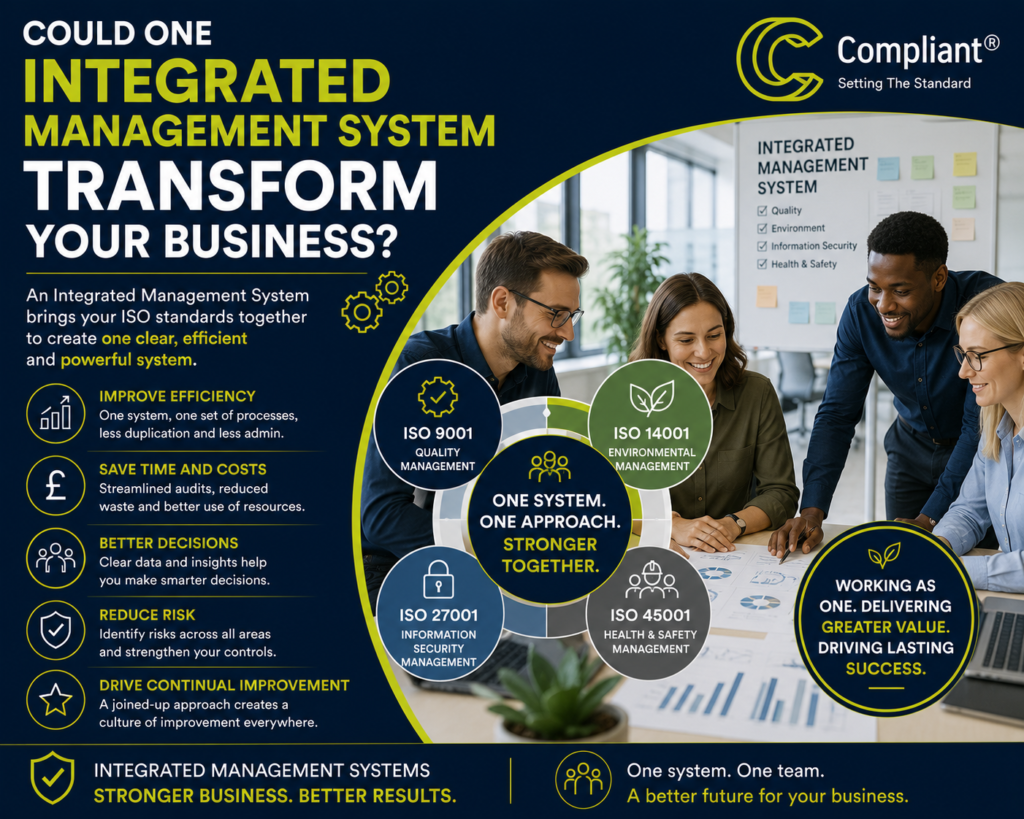
An Integrated Management System (IMS) combines two or more management systems into one.
Instead of running separate systems for quality, environmental management, information security and health and safety, businesses create one joined-up approach.
Many ISO standards already share a similar structure.
This makes integration much easier than many organisations expect.
An IMS allows businesses to manage common activities together, including:
- Internal audits
- Document control
- Risk management
- Leadership reviews
- Objectives
- Corrective actions
- Continual improvement
- Staff competence and training
Rather than repeating these activities for every standard, one well-designed system supports them all.
Why Businesses Choose an Integrated Management System
One of the biggest advantages is simplicity.
Employees only need to understand one management system instead of several.
Processes become easier to follow.
Responsibilities become clearer.
Communication improves.
This often leads to greater employee engagement because people spend less time navigating different procedures and more time delivering value.
Less Duplication Means Greater Efficiency
Many organisations unknowingly duplicate work.
For example, separate internal audits may cover similar processes several times.
Management reviews may discuss the same information under different standards.
Risk assessments may overlap.
An Integrated Management System removes much of this duplication.
One process can satisfy multiple ISO requirements.
This reduces administration while improving consistency.
Employees spend less time completing paperwork and more time focusing on improving the business.
Better Decisions Through Better Information
Every management system collects valuable information.
Customer feedback.
Environmental performance.
Health and safety incidents.
Information security risks.
When these are reviewed separately, opportunities can be missed.
An Integrated Management System allows leaders to see the bigger picture.
Patterns become easier to identify.
Risks are easier to manage.
Improvement opportunities become clearer.
Better information supports better decisions.
Stronger Leadership Across the Organisation
Leadership is a requirement throughout modern ISO standards.
An Integrated Management System helps leaders bring these responsibilities together.
Instead of managing several sets of objectives, leaders can focus on one clear business strategy.
Quality.
Environmental performance.
Information security.
Health and safety.
All become part of everyday decision-making rather than separate priorities.
This creates a stronger culture across the organisation.
Continual Improvement Becomes Easier
Every ISO standard encourages continual improvement.
When systems operate independently, improvement activities can become fragmented.
An Integrated Management System creates one coordinated approach.
Teams work together.
Ideas are shared more easily.
Lessons learned in one area can benefit another.
This joined-up thinking helps organisations improve faster while reducing unnecessary effort.
An Integrated Approach Can Reduce Costs
Many businesses are surprised by how much time they save after integrating their systems.
Fewer duplicated documents.
Simpler audits.
More efficient meetings.
Better use of resources.
Reduced administration.
These efficiencies often lead to lower operating costs while maintaining high standards across the organisation.
The Benefits of an ISO Consultant’s Support
Although many ISO standards share common requirements, designing an Integrated Management System still requires careful planning.
This is where the benefits of an ISO consultant’s support become valuable.
An experienced consultant can help organisations:
- Identify overlapping processes.
- Reduce unnecessary duplication.
- Create practical documentation.
- Align business objectives.
- Simplify internal audits.
- Prepare for certification audits.
- Build systems employees can easily understand.
- Ensure continual improvement remains at the centre of the management system.
Most importantly, an experienced consultant helps build a system that works for your organisation rather than forcing your organisation to work around the system.
Common Mistakes Businesses Make
Some organisations unintentionally make integration more difficult than necessary.
Common mistakes include:
- Keeping separate documents for identical processes.
- Running separate internal audits.
- Creating different objectives for each standard.
- Failing to involve department managers.
- Overcomplicating documentation.
- Treating integration as a paperwork exercise instead of a business improvement project.
Avoiding these mistakes allows organisations to enjoy the full benefits of an Integrated Management System.
Final Thoughts
Managing several ISO standards separately often creates unnecessary complexity.
An Integrated Management System brings everything together.
It simplifies processes.
Reduces duplication.
Improves communication.
Supports better decision-making.
Most importantly, it allows organisations to focus on improving the business rather than managing multiple management systems.
Supported by the benefits of an ISO consultant’s support, businesses can build an Integrated Management System that is practical, efficient and designed for continual improvement.
Sometimes the biggest transformation does not come from adding another system.
It comes from bringing your existing systems together.