NHSS: Why Consistency Matters From the Office to the Highway
NHSS: Why Consistency Matters From the Office to the Highway
Primary keyword: NHSS quality management
Secondary keyword: Benefits of an ISO consultant’s support
A perfect procedure sitting in an office means very little if the work happening on the highway tells a completely different story.
That is where consistency matters.
Your documents might say that checks are completed. Your records might show that people have been trained. Your processes may clearly explain how work should be planned, controlled and recorded.
But what happens when the team arrives on site?
Are those processes still being followed?
Does everyone know what they are responsible for?
Is the correct equipment being used?
Can competence be demonstrated?
Are the right checks taking place?
And importantly, can you prove it afterwards?
For organisations working within National Highways Sector Schemes, commonly known as NHSS, the gap between the office and the highway can create real problems.
It is not enough for a management system to work when an audit is approaching.
It needs to work on a wet Wednesday morning when a team is out on the highway and there is a job to complete.
The office and the site cannot operate as two separate worlds.
Information needs to flow between them.
Processes need to make sense.
People need to understand what is expected.
Records need to reflect what actually happened.
That is why consistency is such an important part of effective NHSS quality management.
Because good management is not about what your paperwork says you do.
It is about being able to show that it happens in practice.
What happens in the office affects what happens on the highway
It can be easy to think of office processes as separate from site work.
They are not.
Before a team reaches the highway, a great deal may already have happened.
The work has been accepted.
Requirements have been reviewed.
People have been selected.
Competence may have been checked.
Equipment has been arranged.
Materials may have been ordered.
Documents have been prepared.
Risks have been considered.
Instructions have been provided.
If any of those stages go wrong, the effect may not become clear until the work starts.
Imagine the wrong information is given to the site team.
Perhaps an old version of a document has been used.
Maybe somebody has been allocated to work they are not approved or competent to carry out.
Perhaps equipment was not checked properly before leaving the depot.
The problem becomes visible on site.
But that does not necessarily mean the problem started there.
It may have started hours or days earlier in the office.
That is why organisations need to look at the whole process.
Not just the final job.
Consistency does not mean doing everything the same way regardless of the situation
Consistency can sometimes be misunderstood.
It does not mean blindly following the same steps when circumstances are different.
Different jobs can have different risks.
Different locations can create different challenges.
Weather can change.
Traffic conditions vary.
Client requirements may differ.
Good processes need to allow people to respond appropriately.
Consistency is about making sure the important controls are applied reliably.
For example, the details of two jobs might be different.
But the organisation should still have a consistent way to check requirements before work begins.
It should consistently confirm that people are competent for the work they are being asked to do.
It should consistently control important documents.
It should consistently inspect equipment where required.
And it should consistently record evidence.
The exact outcome may change.
The discipline behind the process should remain.
A process nobody follows is not a strong process
One of the biggest weaknesses in any management system is the gap between documented processes and real working practices.
A procedure may look excellent.
It might contain every step someone believes an auditor wants to see.
But if the people doing the work do not follow it, there is a problem.
Why does this happen?
Sometimes the process is too complicated.
Perhaps it was written without speaking to the people who actually do the job.
Maybe it contains unnecessary steps.
It could use language employees do not understand.
Or perhaps the process worked five years ago, but the organisation has changed.
Employees then find their own way to get the work done.
That creates inconsistency.
One team follows the written process.
Another has developed a shortcut.
A third person does something slightly different again.
Before long, the business may have several ways of completing the same task.
That makes control much harder.
If people regularly avoid a process, do not immediately assume they are the problem.
Ask why.
The answer might show you that the process needs improving.
Competence needs to be more than a name on a list
People are central to highways work.
You can have good processes and suitable equipment, but the people carrying out the work still need the right knowledge, skills and experience for their role.
That means competence needs proper attention.
A certificate can provide important evidence.
But simply having a copy of a certificate in a folder is not the whole story.
Is it current?
Does it relate to the work the person is actually doing?
Are there any limits or conditions?
Does the organisation know when it expires?
Has anything changed since it was issued?
What happens when renewal is due?
These questions matter.
The office may be responsible for maintaining competence records.
The effect of those records is felt on site.
If the information is wrong or out of date, somebody could be allocated to work they should not be doing.
This is another example of why the office and highway need to stay connected.
Good records support good decisions.
Poor records can create risk.
Do not wait until an audit to check your records
It is easy for records to slowly fall out of date.
One employee’s details change.
Another person’s certificate is renewed but the new copy is not saved in the right place.
Someone leaves.
A new employee joins.
A piece of equipment is replaced.
One small change does not seem serious.
Then another happens.
By the time an audit is due, somebody has to spend days trying to bring everything up to date.
That is a warning sign.
Your records should help you manage the business throughout the year.
They should not exist purely to satisfy an auditor.
If competence records are important, keep them current.
If equipment records matter, update them when things change.
If a process has been revised, make sure the correct version is available to the people who need it.
Good record keeping is not about creating more paperwork.
It is about having reliable information when a decision needs to be made.
Document control sounds boring until the wrong document is used
Few people get excited about document control.
But using the wrong information can create very real problems.
Imagine a process has changed.
The office updates the relevant document.
The new version is approved and saved.
But an employee has an old copy stored on their laptop.
Or a printed copy is still sitting in a vehicle.
The organisation believes the process has changed.
The employee believes they are following the correct process.
Both may think they are doing the right thing.
That is why document control matters.
People need access to the information they need.
They also need confidence that it is the correct information.
When a document changes, think beyond simply changing the date or version number.
Who needs to know?
How will they be told?
Are old copies still available?
Does anyone need additional guidance or training?
A document is only useful if the right person has the right version when they need it.
Communication connects the office and the site
Many consistency problems are really communication problems.
The office knows something the site does not.
The site discovers something the office never hears about.
A client makes a change, but the message does not reach everyone.
An employee spots a recurring problem but assumes somebody else already knows.
Communication needs to work in both directions.
Before work begins, teams need the right information.
During the job, there needs to be a way to raise changes or problems.
After the work, useful information needs to come back.
What went well?
What changed?
Were there any problems?
Was the planned process suitable?
Did something unexpected happen?
Is there anything the next team needs to know?
That feedback can improve future work.
Without it, the same problems may continue.
Evidence needs to tell the real story
If work was completed correctly but there is no evidence, proving it later can be difficult.
This is especially important when the person reviewing the work was not there.
An auditor may not have seen the job.
A manager may not have visited the site.
A customer may ask a question weeks later.
Records need to help explain what happened.
This does not mean taking hundreds of photographs or completing forms simply because someone might ask for them.
Evidence needs a purpose.
What needs to be demonstrated?
What record provides that evidence?
Who is responsible for creating it?
Where will it be stored?
How can it be found later?
The answers should be clear.
Poor evidence can create doubt even when the work itself was good.
Good evidence gives the organisation confidence that it can demonstrate what was done.
Small shortcuts can become normal very quickly
Shortcuts often begin with good intentions.
Someone is busy.
A process takes too long.
A form is difficult to use on site.
An employee finds a faster way.
Nothing goes wrong.
So they do it again.
Then someone else copies them.
Eventually the shortcut becomes the normal way of working.
This is where organisations need to be careful.
A shortcut may be harmless.
It might even reveal that the existing process can be improved.
But it could also remove an important control.
The key is not to ignore it.
Find out why people are doing something differently.
If their method is better and still provides the right control, perhaps the official process needs updating.
If the shortcut creates risk, employees need to understand why the original step matters.
Consistency becomes much easier when processes make sense to the people expected to follow them.
Equipment control matters before the vehicle leaves the depot
Imagine a team arrives on site and discovers that a piece of equipment is damaged, missing or unsuitable.
The immediate problem is on the highway.
But again, where did it begin?
Could it have been found before leaving?
Was there a check?
Who was responsible?
Was the equipment known to have a problem?
Were records up to date?
Good equipment control can help prevent avoidable disruption.
The exact controls needed will depend on the equipment and the work being carried out.
The important part is that responsibilities are clear.
People should know what needs checking, when it needs checking and what to do when something is not right.
A tick on a form is not the goal.
Suitable equipment being available when needed is the goal.
The record simply helps demonstrate that the process happened.
Suppliers and subcontractors need to fit into the system too
Consistency becomes harder when work involves other organisations.
A business may have strong internal controls, but what happens when subcontractors are used?
Do they understand the requirements?
Has their competence been checked?
Do they know which processes apply?
How is their work monitored?
What evidence is required?
How are problems reported?
The same questions can apply to suppliers.
If important materials or services are provided by another business, poor supplier performance can affect your own delivery.
The customer may not care which company caused the problem.
They see the final result.
This is why supplier and subcontractor controls need to be part of the management system rather than treated as somebody else’s responsibility.
Internal audits should follow the work, not just the paperwork
An internal audit that only checks office files may miss what is actually happening.
Documents can look perfect.
Records can be neatly organised.
But are the processes working on site?
A useful internal audit should help answer that question.
Where appropriate, follow a process from beginning to end.
Start with the office.
How was the job planned?
How were requirements reviewed?
How was competence checked?
What information was provided?
Then look at what happened during delivery.
Were the agreed processes followed?
Did employees understand their responsibilities?
Was evidence recorded?
Finally, look at what happened afterwards.
Were records returned?
Were issues reported?
Were actions taken?
This creates a much more complete picture.
The aim of an internal audit should not be to catch people doing something wrong.
It should be to understand whether the management system works.
If there is a gap between the office process and site practice, finding it internally gives the organisation a chance to improve.
Look at why things go wrong, not only what went wrong
Suppose a required check was missed.
The quickest response might be:
“Remind the employee to do it next time.”
That may be enough if it was a simple one-off mistake.
But what if checks are being missed regularly?
Then you need to look deeper.
Is the process clear?
Is the check practical?
Has the employee been trained?
Is responsibility clear?
Is the form difficult to use?
Is there enough time?
Are employees being given conflicting instructions?
The cause matters.
If you only correct the immediate issue, the same problem may return.
Effective NHSS quality management should help organisations learn from problems.
Not hide them.
Not blame people automatically.
Learn from them.
Management needs to know what is happening beyond the office
Senior management may not spend every day on the highway.
They still need to understand whether the management system is working.
That means having useful information.
Are site issues increasing?
Are there repeated problems?
Are internal audits identifying the same weakness?
Are competence records current?
Are customers raising concerns?
Are subcontractors performing as expected?
Are corrective actions actually being completed?
Are teams following processes consistently?
Management review provides an opportunity to look at this wider picture.
It should not become a meeting where people read documents simply because an audit requires it.
It should help leaders make decisions.
If the same issue keeps appearing, what needs to change?
If employees need better equipment, is investment required?
If a process no longer works, who will review it?
Consistency needs leadership support.
If management treats the system as paperwork, employees may do the same.
The benefits of an ISO consultant’s support
Businesses working within NHSS requirements can sometimes become too close to their own systems.
A process feels normal because it has always been done that way.
A gap may be obvious to an outsider but almost invisible to the people dealing with it every day.
This is where the benefits of an ISO consultant’s support can become valuable.
A consultant can look at the management system with fresh eyes.
More importantly, good support should look beyond the documents.
What does the process say?
What actually happens?
Do the two match?
A consultant may follow a process from the office through to delivery.
They can ask how competence is checked, how documents are controlled, how equipment is managed and how evidence returns from site.
They can identify areas where information stops flowing.
Perhaps the office has a good process, but site teams do not understand it.
Maybe employees are completing a check, but the evidence is not being stored.
Perhaps records are strong, but nobody reviews them for trends.
Consultant support can also help organisations understand requirements without turning the system into a mountain of paperwork.
This matters.
A management system should support the organisation.
It should not make everyday work harder simply for the sake of looking impressive during an audit.
Good support should help create processes that are clear, practical and suitable for the work being done.
It should also build knowledge inside the organisation.
The aim is not for the consultant to become the only person who understands the system.
Managers and employees need to understand their own responsibilities.
That is what helps create consistency.
Preparing for an audit should not mean changing how you work
One of the clearest signs of a weak management system is panic before an audit.
Files are updated.
Missing records are chased.
Employees are reminded what to say.
Documents are reviewed for the first time in months.
Everything suddenly becomes urgent.
Then the audit finishes and normal working returns.
That is not consistency.
An effective management system should operate throughout the year.
An audit should be a review of what normally happens.
Not a special performance.
That does not mean businesses should not prepare.
Checking that records are available and making sure people know when an audit is taking place is sensible.
But the organisation should not need to build its management system again every time an auditor is due.
If processes are followed consistently, much of the evidence should already exist.
Consistency builds confidence
There is another benefit to consistency.
Confidence.
Managers can be more confident that work is being controlled.
Employees know what is expected.
Customers receive a more reliable service.
Auditors can see that processes are embedded rather than created for the audit.
When something does go wrong, there is a known way to report it and respond.
This does not mean mistakes disappear.
Consistency is not perfection.
It means the organisation has a reliable way of working.
That makes problems easier to spot because they stand out.
If everyone does things differently, it becomes difficult to know what normal even looks like.
Do not make consistency harder than it needs to be
Sometimes businesses create complicated systems because they believe complexity looks more professional.
It rarely helps.
A simple process that people understand and follow is often more useful than a detailed process nobody reads.
Look at your forms.
Do all the fields serve a purpose?
Look at your procedures.
Could employees explain them in simple language?
Look at your records.
Does anyone use the information they contain?
Look at approvals.
Are they controlling something important, or simply slowing the process down?
Remove unnecessary difficulty where you can.
The easier it is to do the right thing, the more likely people are to do it consistently.
Follow one job from start to finish
If you want to test consistency within your organisation, choose one completed job.
Then follow its journey.
Start in the office.
How did the work arrive?
Were the requirements clear?
Who reviewed them?
How was the team selected?
Was competence checked?
What documents were provided?
Was the right equipment available?
Then move to the work itself.
Did the team receive the information they needed?
Were processes followed?
Were checks completed?
Did anything change?
Were problems reported?
Then look at the end.
What evidence came back?
Where was it stored?
Were any issues followed up?
Was useful information shared?
Could someone who was not there understand what happened?
This simple exercise can tell you a great deal.
You may find everything connects perfectly.
Or you might find small gaps.
Information that stops moving.
Checks that happen but are not recorded.
Records that exist but nobody reviews.
Processes that people have quietly stopped using.
Those gaps are opportunities to improve.
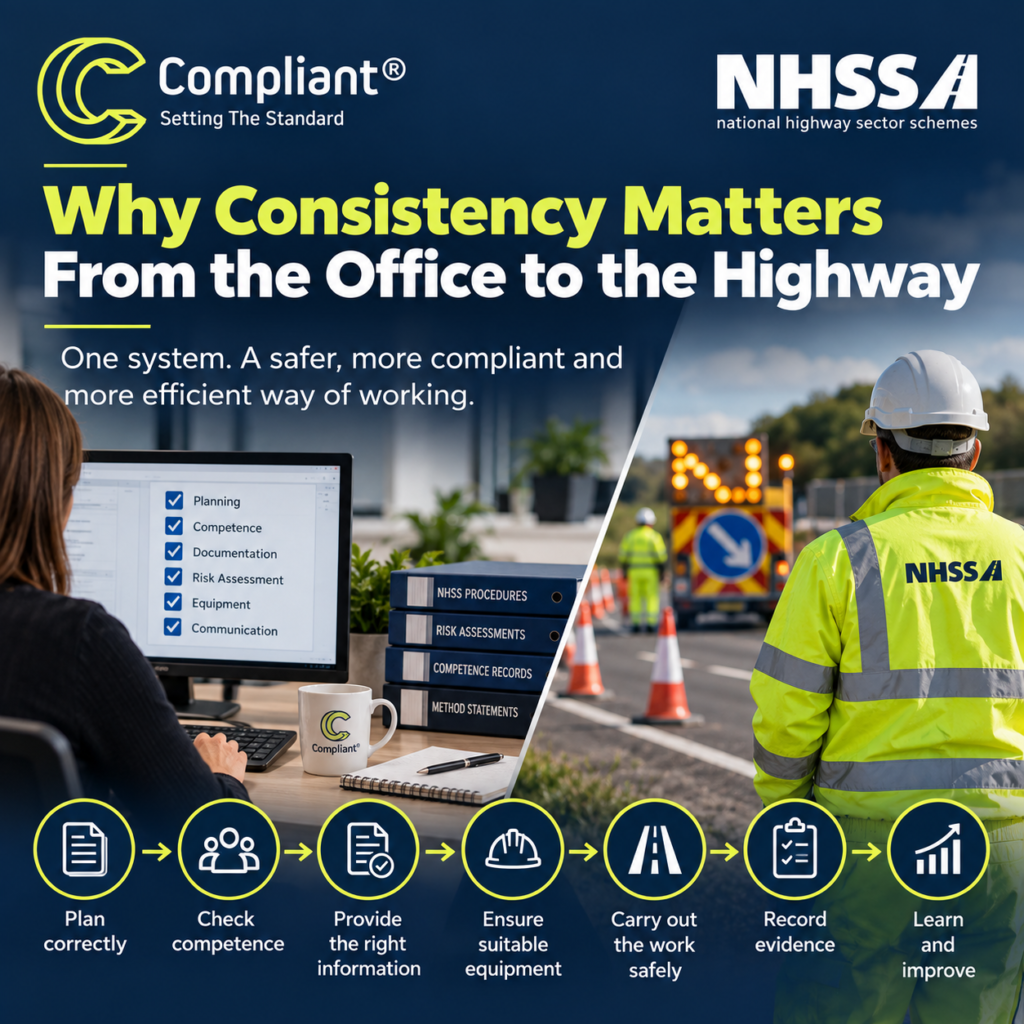
From the office to the highway, it should be one system
NHSS should not create an office system and a site system.
There should be one management system supporting the organisation’s work.
The office plans and provides information.
The site puts processes into practice.
The site provides evidence and feedback.
The office reviews what happened.
Management uses that information to make improvements.
Then the cycle continues.
When those parts connect, the management system becomes useful.
When they do not, inconsistency starts to appear.
And inconsistency can create mistakes, wasted time, missing evidence and unnecessary risk.
The goal is not to create a business where everybody behaves like a robot.
It is to create a business where the important things happen reliably.
Competence is checked.
Information is controlled.
Equipment is suitable.
Responsibilities are understood.
Evidence is kept.
Problems are reported.
Lessons are learned.
That is what consistency looks like in practice.
A useful next step
Pick one process that starts in your office and ends on the highway.
Do not just read the written procedure.
Follow it.
Talk to the people involved.
Ask the office team what they do.
Ask the site team what they receive.
Look at the evidence afterwards.
Then compare the three.
Does the written process match what actually happens?
Does the site receive everything it needs?
Does useful information make its way back?
If the answers are different, you may have found an area worth reviewing.
Because a management system is only as strong as the connection between what you say happens and what actually does happen.
For organisations working within NHSS, that connection matters from the first decision made in the office to the final piece of work completed on the highway.
Consistency is what joins the two together.