Passwords Alone Won’t Protect Your Business
Passwords are everywhere.
Your team uses them to access emails. Your finance staff use them to log into important systems. Managers use them to open files. Employees use them to access customer information, cloud software and business accounts.
So, it can be tempting to think that a strong password means your information is safe.
Unfortunately, it doesn’t.
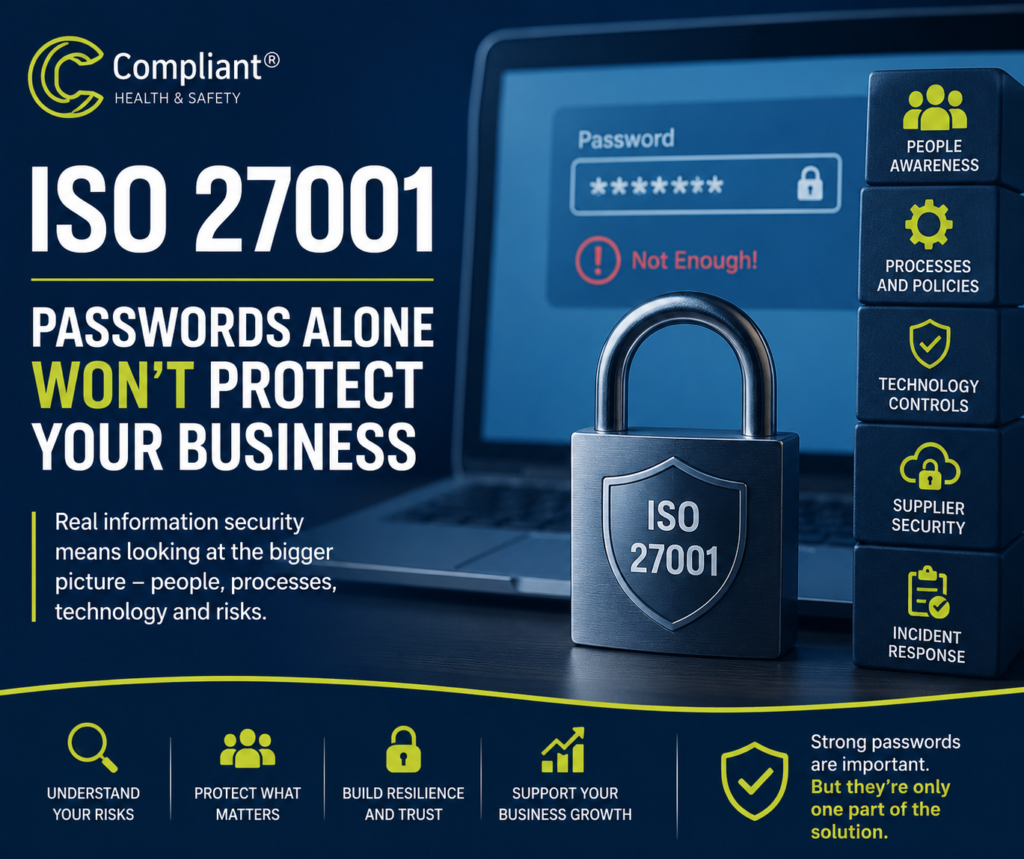
A password is only one small part of protecting a business.
You can have long passwords. You can change them often. You can tell employees never to share them. You can even use extra security when people log in.
But if the rest of your business is not protecting information properly, you can still be at risk.
An employee can click the wrong link.
A laptop can be left on a train.
Someone can send sensitive information to the wrong person.
An old member of staff might still have access to a system.
A supplier could suffer a security problem.
Important files might not be backed up properly.
And sometimes, nobody knows what to do when something goes wrong.
This is why ISO 27001 matters.
ISO 27001 helps businesses look beyond passwords and build a much wider approach to information security.
It is not simply about technology.
It is about people.
It is about processes.
It is about understanding risk.
And most importantly, it is about making information security part of the way your business works every day.
Your Password Could Be Strong While Your Business Is Still Weak
Imagine that your front door has one of the strongest locks available.
You spent good money on it. The key is difficult to copy. The lock is strong.
But the window next to the door is wide open.
Would you say your home was secure?
Probably not.
Information security works in much the same way.
A strong password can help stop someone from simply guessing their way into an account. But what happens if an employee gives their password away after receiving a convincing fake email?
What happens if someone is already logged in when their laptop is stolen?
What happens if an employee downloads sensitive information onto their own device?
Or if access is not removed when somebody leaves the business?
The password itself may never have failed.
The wider system did.
This is one of the biggest mistakes businesses can make with information security. They focus on individual security tools instead of looking at the whole picture.
ISO 27001 encourages you to look at that whole picture.
What Is ISO 27001?
ISO 27001 is an international standard for information security management.
In simple terms, it gives businesses a structured way to protect the information that matters to them.
That could include:
- Customer information
- Employee records
- Financial information
- Contracts
- Supplier information
- Business plans
- Emails
- Login details
- Intellectual property
- Important files and documents
ISO 27001 helps you understand what information you have, where it is, who can access it and what could happen to it.
Then you can decide what needs to be done to reduce those risks.
This is an important difference.
ISO 27001 is not about buying every security product available.
It is not about making your business impossible to work in.
And it is certainly not about creating rules simply so you can say that rules exist.
It is about understanding your real risks and putting sensible protection in place.
The Problem With Relying on Passwords
Passwords have a difficult job.
They are expected to protect a huge amount of information, yet they depend heavily on human behaviour.
And people are busy.
When employees have dozens of accounts, they may reuse passwords.
If passwords are difficult to remember, they may write them down.
If somebody receives a convincing email asking them to log in, they may enter their details without realising the website is fake.
Someone might even share their login details with a colleague because it feels like the quickest way to get a job done.
None of this means your employees do not care about security.
It means your security arrangements need to take normal human behaviour into account.
Simply telling people to “use strong passwords” does not solve the bigger problem.
You need to understand how information moves around your organisation and where weaknesses could appear.
That is where ISO 27001 becomes valuable.
ISO 27001 Starts With Understanding Risk
One of the most important ideas behind ISO 27001 is risk.
Before you decide how to protect something, you need to understand what could go wrong.
Consider your customer database.
Who can access it?
Where is it stored?
Could somebody outside the business gain access?
Could an employee accidentally delete information?
Could information be sent to the wrong customer?
What would happen if the system stopped working for two days?
Do you have a backup?
Has that backup actually been tested?
Who would be responsible for dealing with the problem?
These questions take you far beyond passwords.
They make you think about what would happen in the real world.
That is important because information security is not just about stopping hackers.
Information can be lost through mistakes, poor processes, damaged equipment, weak supplier controls and simple misunderstandings.
ISO 27001 gives you a framework for identifying these risks and deciding what action makes sense.
Your Employees Are Part of Your Security
Your employees can be one of your strongest forms of protection.
But only if they know what to look for and what is expected of them.
Imagine an employee receives an email that appears to come from a senior manager.
It says a payment needs to be made urgently.
There is pressure.
There is a link.
The message looks believable.
Would your employee know what to do?
Would they question it?
Would they know who to speak to?
Would they feel comfortable reporting it if they clicked the link by mistake?
A password cannot solve this problem.
Awareness can.
Clear processes can.
Good training can.
A culture where employees understand the importance of protecting information can.
ISO 27001 helps organisations think seriously about how people interact with information.
That includes making sure employees understand their responsibilities.
Training should not be something people complete once and immediately forget.
Security needs to become part of everyday working life.
Access Needs to Be Controlled
Not everybody needs access to everything.
It sounds obvious.
Yet access can quickly grow out of control.
An employee joins the business and receives access to several systems.
They move into another role and receive more access.
They cover for a colleague and get access to another folder.
Two years later, they may be able to see information they no longer need.
Then they leave.
Who checks that every account has been closed?
Who makes sure access has been removed from shared systems?
Who collects business devices?
Who changes shared login details if necessary?
Without a clear process, access can remain open for far longer than anyone realises.
ISO 27001 encourages businesses to think carefully about who needs access to information and why.
Access should be suitable for the person’s role.
It should also be reviewed.
When somebody changes jobs or leaves the organisation, their access should change with them.
This reduces unnecessary risk.
What Happens When Someone Leaves a Laptop Behind?
Picture the scene.
An employee finishes a long day of meetings.
They get on the train home.
Their laptop bag goes into the luggage area.
They arrive at their station, get off and realise ten minutes later that the laptop is still on the train.
Now what?
The password on that laptop is important.
But there are many more questions.
Is the device protected?
What information is stored on it?
Can the business block access?
Who should the employee contact?
How quickly can action be taken?
Is there sensitive information on the device?
Does the incident need to be recorded?
Could customer information be affected?
One lost laptop can become a serious problem if nobody knows what to do.
With a structured information security management system, you can prepare for situations like this before they happen.
That preparation can make a huge difference.
You Need to Know What Information You Are Protecting
You cannot protect something properly if you do not know you have it.
Many businesses collect information over years.
Files sit in old folders.
Documents remain on shared drives.
Customer information is stored in different systems.
Copies are downloaded onto devices.
Old accounts remain active.
Information gets passed between departments.
Eventually, nobody has a clear picture of where everything is.
That creates risk.
ISO 27001 encourages organisations to understand the information and other important assets they need to protect.
You can then ask sensible questions.
Who owns this information?
Who needs it?
Where is it stored?
How sensitive is it?
How long should we keep it?
What would happen if it was lost?
What would happen if somebody changed it?
What would happen if people could not access it?
These questions help turn information security from guesswork into a managed business process.
Your Suppliers Matter Too
Your business might have excellent security practices.
But what about the organisations you work with?
Many businesses rely on outside providers for software, IT support, cloud storage, payroll, customer systems and other important services.
Those suppliers may have access to your information.
Or your ability to operate may depend on their systems being available.
That creates another area of risk.
ISO 27001 encourages businesses to consider information security within supplier relationships.
Before relying on a supplier, it is sensible to understand how that relationship could affect your information.
What information will they access?
How will they protect it?
What happens when the relationship ends?
What happens if they suffer a security incident?
Who tells you?
How quickly?
Again, none of these questions can be answered by changing a password.
Backups Are Only Useful If They Work
“We back everything up.”
It sounds reassuring.
But when was the last time you checked that those backups could actually be used?
A backup that cannot be restored when needed provides very little comfort.
Businesses can lose access to information for many reasons.
A system can fail.
Files can be deleted.
Equipment can be damaged.
A security incident can stop people from accessing systems.
The important question is not simply whether a backup exists.
It is whether your business can recover.
ISO 27001 encourages organisations to think about maintaining the availability of important information and systems.
That means planning ahead.
What information needs to be available?
How quickly would you need it back?
Who is responsible?
What happens if your normal systems are unavailable?
Have your recovery arrangements been tested?
Planning these things before a problem occurs is much easier than trying to invent a solution during a crisis.
What Happens After a Security Incident?
Sooner or later, something may go wrong.
That does not automatically mean your information security system has failed.
What matters is how prepared you are.
If an employee receives a suspicious email, who do they tell?
If a customer reports that they received somebody else’s information, what happens next?
If a device disappears, who takes control?
If somebody gains access to an account they should not have, how is it dealt with?
Without a clear process, valuable time can be lost.
People may panic.
Different managers may give different instructions.
Important facts might not be recorded.
The same problem could even happen again because nobody investigated why it happened.
ISO 27001 encourages businesses to have a structured way to manage information security incidents.
That includes learning from them.
Instead of simply fixing the immediate problem and moving on, ask why it happened.
Could it happen elsewhere?
Does a process need changing?
Does somebody need more training?
Should a security measure be improved?
That is how security gets stronger over time.
ISO 27001 Is Not Just an IT Project
This point is worth making very clearly.
ISO 27001 should not simply be handed to the IT department.
Technology plays an important role, but information exists across the whole organisation.
Finance handles sensitive information.
HR handles employee records.
Sales teams handle customer details.
Managers handle business plans.
Operations teams use systems and data.
Senior leaders make decisions about risk, money and resources.
Information security therefore needs involvement from across the business.
Senior management also has an important role.
If leaders treat information security as a box-ticking task, employees are likely to do the same.
If leaders take it seriously, provide the right resources and make responsibilities clear, the message is very different.
ISO 27001 helps put information security where it belongs.
As a business issue.
Not simply an IT problem.
The Real Value Comes From Building Good Habits
One of the greatest benefits of ISO 27001 is that it encourages businesses to stop treating information security as a one-off project.
Threats change.
People change roles.
New employees join.
Suppliers change.
Software changes.
Businesses grow.
New information is collected.
A security process that worked three years ago may not be suitable today.
That is why regular review matters.
ISO 27001 encourages businesses to check whether their information security management system continues to work.
Problems can be identified.
Risks can be reviewed.
Changes can be made.
Lessons can be learned.
Over time, information security becomes part of normal business management rather than something only discussed after a problem.
Where Can an ISO Consultant Help?
For many organisations, understanding what ISO 27001 requires can feel difficult at first.
You may already know that your business needs stronger information security.
You might understand some of the risks.
You may even have many good processes already in place.
But turning all of that into a clear and structured information security management system can be difficult when you have never worked with ISO 27001 before.
This is where the benefits of an ISO consultant’s support for ISO 27001 can become clear.
An experienced ISO consultant can help you understand what the standard is asking for in plain language.
That matters.
ISO 27001 should not become a project where your team spends hours trying to understand complicated wording while their normal work piles up.
The aim should be to understand what applies to your organisation and then build sensible processes around it.
An ISO consultant can help you look at what you already do.
You may discover that many useful processes already exist.
The problem may simply be that they are not consistent, recorded or reviewed.
In other areas, there may be genuine gaps.
Perhaps access is not reviewed often enough.
Maybe nobody has clear responsibility for certain information.
Perhaps supplier risks have not been considered.
Maybe employees receive security training when they join but nothing after that.
A good ISO consultant can help bring these areas into focus.
An ISO Consultant Should Make Things Clearer, Not More Complicated
ISO 27001 can appear overwhelming when you first look at it.
There are requirements to understand.
Risks to consider.
Processes to review.
People to involve.
Records to maintain.
For a busy management team, it can feel like another large project sitting on top of everything else.
This is where good support matters.
An ISO consultant should help simplify the journey.
They can help you understand what needs attention first and what can follow later.
They can also help prevent one of the most common problems businesses face when working towards ISO standards: doing far more than they actually need to do.
More documents do not automatically mean better information security.
More forms do not automatically mean stronger controls.
And a process is not useful simply because somebody wrote it down.
Your management system needs to work for your organisation.
That means it should match your size, risks, people and way of working.
ISO Consultant Support Can Save Internal Time
Your managers already have jobs.
Your IT team has work to complete.
Your HR team has responsibilities.
Your senior leaders have a business to run.
When ISO 27001 is added to their workload, progress can slow very quickly.
Not because people do not care.
Because they have competing priorities.
Someone might spend hours researching one part of ISO 27001 when an experienced consultant could explain it in a short conversation.
Another person may create a process that later needs to be rewritten because they misunderstood what was needed.
An ISO consultant can help reduce this wasted effort.
They can provide direction.
They can help identify gaps.
They can help teams understand what evidence may be needed.
Most importantly, they can help keep the project moving.
That does not mean the consultant should do everything for you.
Your business needs to remain involved.
But having someone who understands the process can stop your team from getting stuck on problems that have straightforward answers.
Support Should Build Knowledge Inside Your Business
There is another important point.
Consultant support should not leave you dependent on the consultant.
Your organisation needs to understand its own information security management system.
Your employees need to know their responsibilities.
Your managers need to understand the risks.
Your senior team needs to understand what it is responsible for.
The best ISO consultant support should therefore educate as well as guide.
Why does this process exist?
What risk does it address?
Who needs to be involved?
How will we know whether it is working?
Those questions create understanding.
And understanding creates a management system that is far more likely to work after the initial ISO 27001 project has finished.
If your management system only works when the consultant is in the room, it has not been built properly.
The knowledge needs to stay with your business.
ISO 27001 Can Help Build Confidence
Information security is increasingly part of normal business conversations.
Customers want to know their information is safe.
Larger organisations may ask suppliers about security before agreeing to work with them.
Tender documents may contain detailed security questions.
Business leaders want to understand their risks.
Employees need confidence that there are clear processes to follow.
ISO 27001 can help provide a structured answer to those concerns.
Certification does not mean nothing will ever go wrong.
No responsible organisation should make that promise.
What ISO 27001 can show is that information security is being managed in a structured way.
Risks are considered.
Responsibilities are defined.
Suitable protection is selected based on need.
Performance is reviewed.
Problems are addressed.
Improvements continue.
That is far more meaningful than simply saying:
“Don’t worry. We have strong passwords.”
Start by Asking Better Questions
If you are thinking about ISO 27001, you do not need to begin by buying new software.
Start with questions.
What information would cause the biggest problem if we lost it?
What information would cause the biggest problem if the wrong person saw it?
Who currently has access to sensitive information?
Do they all need that access?
What happens when somebody leaves?
How quickly could we recover important information?
Do employees know how to report a security concern?
Do we understand the risks created by our suppliers?
When did we last review our information security risks?
Would we know what to do tomorrow morning if we discovered a serious security incident tonight?
The answers may be uncomfortable.
That is useful.
You cannot improve a weakness you refuse to look at.
Passwords Matter. They Just Aren’t Enough.
Strong passwords still have a place.
They are an important part of protecting accounts and systems.
But they are not an information security strategy.
Real information security goes much further.
It means understanding what information matters to your organisation.
It means knowing the risks.
It means controlling access.
It means educating employees.
It means thinking about suppliers.
It means preparing for incidents.
It means being able to recover when something goes wrong.
And it means reviewing all of these things as your business changes.
That is the wider thinking that ISO 27001 brings to an organisation.
Instead of relying on one lock, you start looking at the whole building.
A Useful Next Step
If you want to understand how well your organisation currently protects information, start with a simple internal review.
Choose five pieces of information that are important to your business.
For each one, write down:
- Where it is stored
- Who can access it
- Why they need access
- What could go wrong
- What protection you already have
- What would happen if that protection failed
Then ask one final question:
If something went wrong tomorrow, would we know exactly what to do?
You may discover that your organisation is already doing many things well.
You may also find gaps that have been sitting unnoticed for years.
Both answers are valuable.
The purpose of ISO 27001 is not to create fear around information security. It is to help you understand your risks and manage them in a clear, sensible and repeatable way.
And if you choose to seek ISO consultant support for ISO 27001, use that support as an opportunity to build knowledge inside your organisation, not simply to prepare for an assessment.
Ask questions.
Understand why each process matters.
Make sure your employees know their part.
Review what works.
Improve what does not.
Because the strongest information security does not come from one password, one piece of software or one person.
It comes from a business that understands what it needs to protect, knows why it matters and has a clear plan for keeping it safe.