Skip to main content
Skip to footer
Skip to main content
Skip to footer

The Key Principles of ISO 9001: Why Customer Focus and Leadership Drive Business Success
The Key Principles of ISO 9001: Why Customer Focus and Leadership Drive Business Success
Businesses Rarely Lose Customers Overnight. It Happens One Poor Experience at a Time.
Every business wants happy customers.
Every leader wants a team that delivers great work.
Yet many organisations find themselves dealing with the same problems again and again.
Customers complain about inconsistent service.
Projects overrun.
Mistakes keep happening.
Different departments seem to work in different ways.
Employees become frustrated because they are never quite sure what is expected of them.
The result?
Customers lose confidence.
Employees lose motivation.
Leaders spend more time putting out fires than planning for the future.
Many organisations believe these problems are simply part of doing business.
They are not.
Most of these issues happen because there is no clear system guiding how work should be done.
Without consistency, every person works differently. Every decision becomes harder. Every mistake costs time, money and trust.
This is exactly why ISO 9001 has become the world’s most recognised quality management standard.
It is not about creating paperwork or making businesses more complicated.
It is about creating better ways of working.
At the centre of the standard are several important ideas known as the Key Principles of ISO 9001.
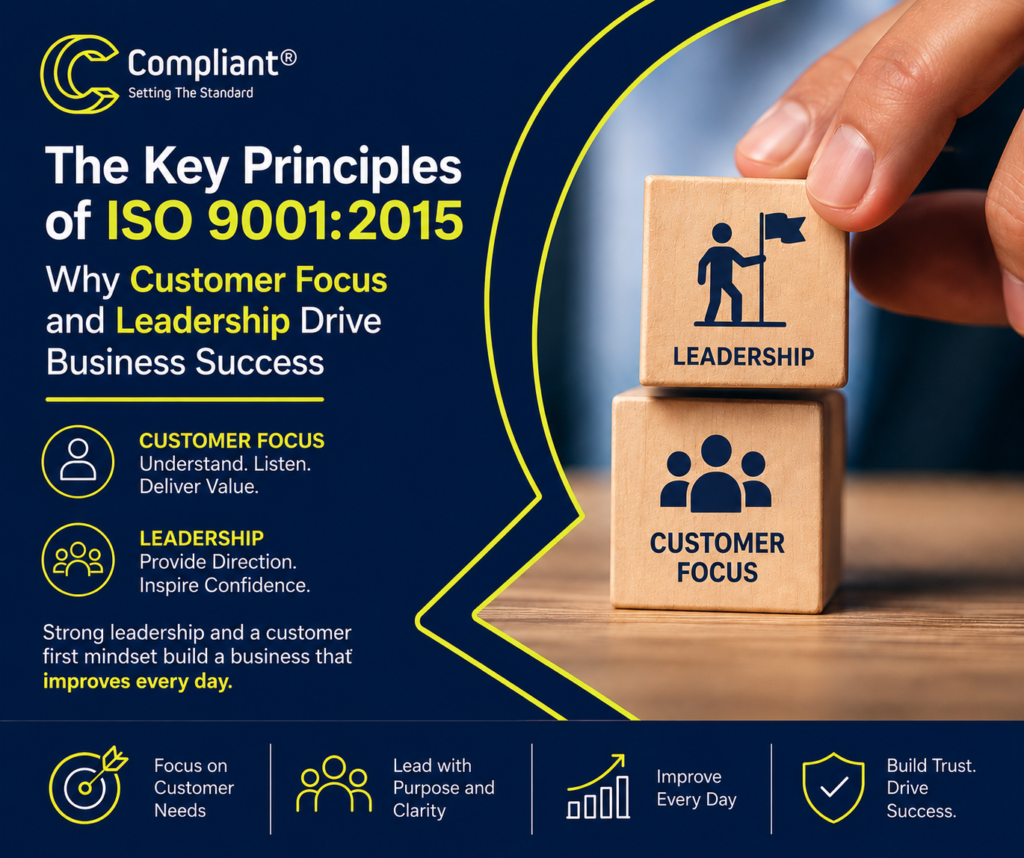
Among these principles, none are more important than Customer Focus and Leadership.
When these two areas are strong, businesses become more organised, customers become more loyal, and continuous improvement becomes part of everyday work.
Why Quality Matters More Than Ever
Customers today have more choice than ever before.
If one supplier disappoints them, another is only a few clicks away.
That means businesses cannot afford inconsistency.
People remember poor service.
They remember missed deadlines.
They remember products that fail.
Most importantly, they remember how a business made them feel.
Quality is no longer just about making a good product.
It is about creating a reliable experience every single time.
This applies whether you manufacture products, provide consultancy, run a construction company, deliver healthcare or offer professional services.
Every organisation has customers.
Every customer expects value.
ISO 9001 helps businesses deliver that value consistently.
What Is ISO 9001?
ISO 9001 is the internationally recognised standard for quality management.
Rather than focusing on one department, it looks at how the whole organisation works together.
The standard helps businesses:
- Improve consistency.
- Meet customer expectations.
- Reduce mistakes.
- Improve communication.
- Encourage continual improvement.
- Build confidence with customers and stakeholders.
Instead of relying on individual knowledge, businesses develop systems that everyone understands.
This creates stability.
It also creates opportunities for long-term growth.
Understanding the Key Principles of ISO 9001
The Key Principles of ISO 9001 provide the foundation for an effective quality management system.
These principles encourage organisations to think beyond simply meeting minimum requirements.
They help create businesses that continually improve, adapt and grow.
The principles include:
- Customer Focus
- Leadership
- Engagement of People
- Process Approach
- Improvement
- Evidence-Based Decision Making
- Relationship Management
Each principle supports the others.
Together, they create stronger organisations that consistently deliver value.
Let’s explore the two principles that influence every other part of the standard.
Customer Focus: The Heart of ISO 9001
Every successful business depends on its customers.
Without them, there is no business.
That sounds obvious.
Yet many organisations become so focused on internal processes that they lose sight of what customers actually need.
Customer Focus means understanding customer expectations and working consistently to meet or exceed them.
It is about listening.
Learning.
Improving.
This does not simply involve responding when customers complain.
It means actively looking for ways to improve before problems occur.
Businesses with strong customer focus often ask questions such as:
- What matters most to our customers?
- Are we making their experience easier?
- Where do mistakes happen?
- How can we improve communication?
- What feedback are we receiving?
These questions encourage continual improvement.
Over time, small improvements create better customer experiences.
Better experiences create stronger relationships.
Those relationships often lead to repeat business and positive recommendations.
Customer Focus Benefits Every Part of the Business
Many people think customer focus only affects sales or customer service.
In reality, every department contributes.
Purchasing affects product quality.
Operations affect delivery times.
Finance affects invoicing accuracy.
Human resources affect employee performance.
Leadership affects organisational culture.
Every decision eventually reaches the customer in some way.
That is why ISO 9001 encourages organisations to think about quality from beginning to end.
When everyone understands their role in creating customer satisfaction, quality becomes everyone’s responsibility.
Leadership Creates the Culture That Customers Experience
Strong systems do not appear by themselves.
They require direction.
They require commitment.
They require Leadership.
Leadership is far more than giving instructions.
It is about creating an environment where quality becomes part of everyday work.
Employees look to leaders for guidance.
If leaders ignore quality, employees often do the same.
If leaders demonstrate commitment, employees usually follow.
Within ISO 9001, leadership means:
- Setting a clear direction.
- Establishing realistic goals.
- Providing resources.
- Supporting employees.
- Encouraging improvement.
- Leading by example.
When leaders genuinely support quality, the entire organisation benefits.
Good Leadership Builds Confidence
Employees perform better when expectations are clear.
Customers feel more confident when organisations operate consistently.
Suppliers value businesses that communicate effectively.
Leadership connects all of these areas.
Good leaders create trust.
They encourage open communication.
They listen to ideas.
They celebrate improvement.
They learn from mistakes instead of hiding them.
This creates a workplace where people feel comfortable suggesting better ways of working.
Innovation grows naturally in these environments.
Engagement of People Makes Improvement Possible
Systems alone cannot improve a business.
People improve businesses.
Employees who understand their roles make better decisions.
They notice problems earlier.
They identify opportunities.
They support customers more effectively.
ISO 9001 encourages organisations to involve employees rather than simply telling them what to do.
When people feel valued, they often take greater pride in their work.
That benefits everyone.
Process Approach Brings Consistency
Imagine asking five employees how to complete the same task and receiving five completely different answers.
Unfortunately, this happens more often than many businesses realise.
The process approach encourages organisations to define how work should be completed.
This does not remove flexibility.
Instead, it creates consistency.
When everyone understands the process:
- Errors reduce.
- Training becomes easier.
- Customers receive consistent service.
- Improvements become easier to measure.
Consistency is one of the greatest strengths of ISO 9001.
Improvement Never Stops
One of the biggest misconceptions about ISO 9001 is that certification is the finish line.
It is not.
The standard encourages continual improvement.
Businesses should regularly ask:
Can we do this better?
Can we make this simpler?
Can we reduce mistakes?
Can we improve the customer experience?
Small improvements made regularly often produce remarkable results over time.
Better Decisions Come from Better Information
Guesswork creates risk.
Evidence creates confidence.
ISO 9001 encourages organisations to make decisions based on reliable information rather than assumptions.
That might include:
- Customer feedback.
- Internal audits.
- Employee suggestions.
- Performance measures.
- Delivery times.
- Complaint trends.
Good information helps leaders identify where improvements are needed.
Strong Relationships Build Strong Businesses
No organisation works alone.
Suppliers, contractors and partners all influence quality.
ISO 9001 encourages businesses to develop positive relationships throughout their supply chain.
Working collaboratively often improves quality, reduces delays and creates better outcomes for customers.
Healthy relationships support long-term success.
The Benefits of an ISO Consultant’s Support
Many organisations understand the value of ISO 9001 but feel unsure about how to implement it effectively.
That is perfectly normal.
The standard is straightforward once you understand its purpose, but knowing how to apply it to your own business can feel challenging.
This is where the benefits of an ISO consultant’s support become clear.
An experienced consultant helps organisations understand the Key Principles of ISO 9001 in practical terms rather than simply interpreting the standard word for word.
Their support can include:
- Explaining the requirements in plain English.
- Reviewing your current processes.
- Identifying opportunities for improvement.
- Helping document systems that reflect how your business actually works.
- Supporting employee awareness and training.
- Preparing your organisation for internal and external audits.
- Helping leaders understand their responsibilities.
- Keeping implementation focused and manageable.
Perhaps the greatest benefit is confidence.
Instead of second-guessing every decision, your organisation has experienced guidance throughout the implementation process.
A good consultant also helps avoid unnecessary paperwork.
The goal is not to create documents for the sake of certification.
The goal is to build a management system that supports your business every day.
When implemented well, ISO 9001 becomes a practical management tool rather than a collection of files stored on a shelf.
Why ISO 9001 Continues to Matter
Markets change.
Customer expectations evolve.
Technology develops.
Businesses grow.
Through all of these changes, one thing remains constant.
Customers expect consistent quality.
ISO 9001 provides a framework that helps organisations adapt while maintaining high standards.
It supports better communication.
Better planning.
Better leadership.
Better customer experiences.
Those improvements rarely happen overnight.
They develop through consistent effort, strong leadership and a commitment to learning.
Building a Business That Customers Trust
Quality is not achieved by accident.
It is created through clear direction, engaged employees and a genuine commitment to customers.
The Key Principles of ISO 9001 provide businesses with a practical framework for building these strengths.
When organisations place Customer Focus at the centre of every decision and demonstrate strong Leadership, they create more than efficient processes.
They create trust.
Customers notice consistency.
Employees notice clear direction.
Suppliers notice professionalism.
Together, these improvements build stronger organisations that are better prepared for future challenges.
Whether your organisation is beginning its quality journey or looking to strengthen an existing management system, understanding the principles behind ISO 9001 is the first step towards lasting improvement.
Learn More About the Key Principles of ISO 9001
Every organisation has opportunities to improve. Take time to explore the Key Principles of ISO 9001, especially Customer Focus and Leadership, and consider how they apply to your own business. Read trusted guidance, involve your employees and review your current processes regularly. The more you understand the purpose behind the standard, the easier it becomes to build a quality management system that delivers lasting value for your customers, your employees and your organisation.