Waiting for perfection could be holding your business back
Waiting for perfection could be holding your business back
There is always something that could work better.
A customer complaint keeps coming back.
An employee spends an hour every week fixing the same problem.
A process that worked when you had ten employees becomes frustrating when you have fifty.
Orders are occasionally wrong.
Deadlines get missed.
Information gets lost between departments.
People create their own ways of doing the same job because the agreed process no longer works.
Everyone knows these problems exist.
But nothing changes.
Why?
Sometimes businesses believe improvement needs to be big.
A new system.
A major project.
A complete change in the way people work.
A large investment.
Months of planning.
So they wait.
And while they wait, employees keep working around the same problems.
Customers keep experiencing the same frustrations.
Money keeps being wasted.
That is not what Continuous Improvement should look like.
And it is not what ISO 9001 expects.
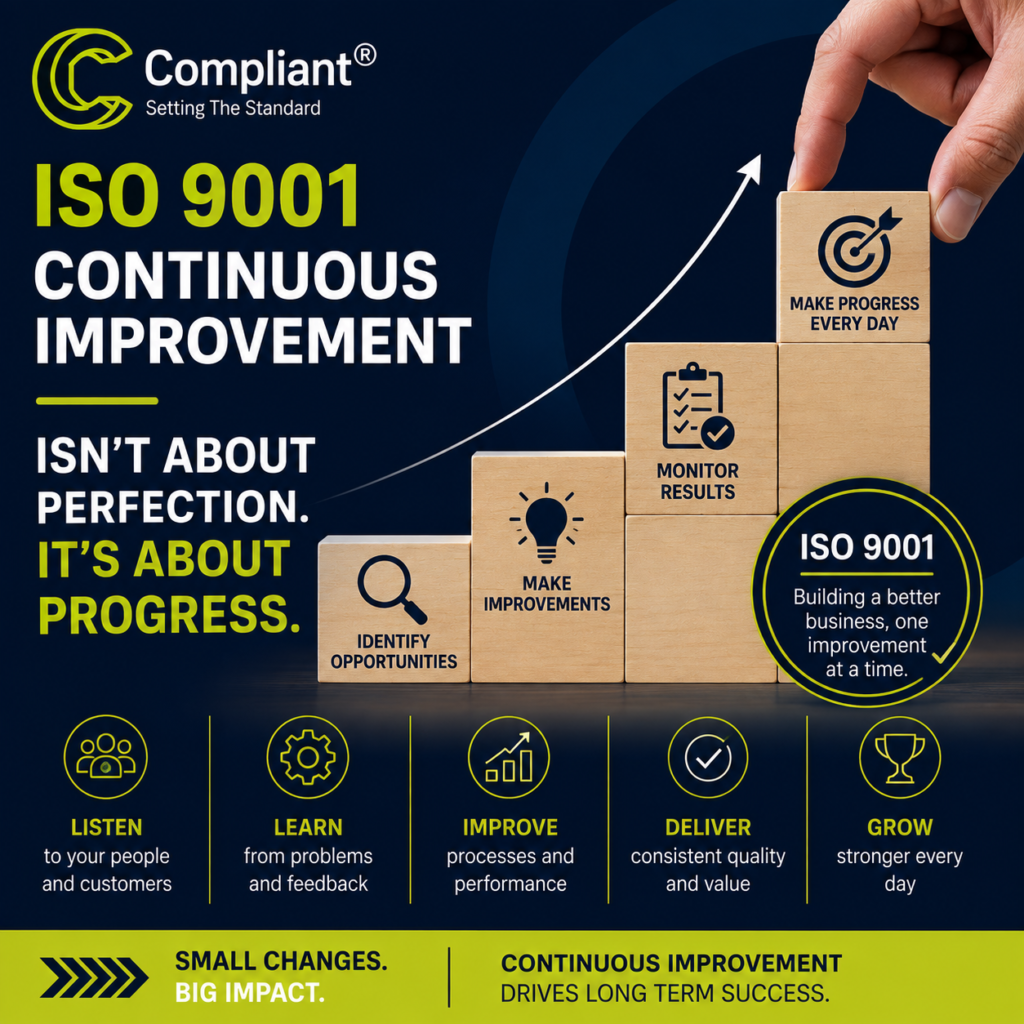
Improvement does not have to mean perfection.
It means progress.
Find something that could be better.
Understand why it is happening.
Make a sensible change.
Check whether that change worked.
Learn from it.
Then look for the next opportunity.
Small improvements made consistently can completely change a business over time.
Perfection is an impossible target
Imagine telling your employees:
“From next month, there must never be another mistake.”
What happens?
Do mistakes suddenly disappear?
Of course not.
People make mistakes.
Equipment fails.
Customers change their minds.
Suppliers have problems.
Information gets misunderstood.
Processes that worked yesterday may not work tomorrow.
Trying to remove every possible problem is not realistic.
Worse, a demand for perfection can create fear.
Employees may become worried about admitting mistakes.
Problems can get hidden.
People may try to fix things quietly rather than report them.
Managers can receive a false picture of how well the business is performing.
That is dangerous.
A business cannot improve a problem it does not know exists.
ISO 9001 takes a much more useful approach.
Problems are not something to hide.
They are information.
They show you where something may need attention.
The goal is not to create an organisation where nothing ever goes wrong.
The goal is to create an organisation that notices problems, learns from them and becomes better because of them.
That is Continuous Improvement.
Small problems become expensive when nobody fixes them
Businesses often tolerate small problems because each one seems unimportant.
Consider an employee who spends ten extra minutes every day looking for the correct document.
Ten minutes does not sound serious.
But imagine twenty employees have the same problem.
That is more than three hours being lost every working day.
Over a year, the cost becomes much bigger.
Now think about all the other small problems hiding inside an organisation.
Information entered twice.
Customers calling back because nobody responded.
Incorrect orders that need to be replaced.
Reports being manually corrected every month.
Meetings that do not achieve anything.
Old forms containing questions nobody needs.
Approvals that take days when they should take hours.
Employees walking across a building because something is stored in the wrong place.
None of these problems may be large enough to cause panic.
Together, they can quietly drain time, money and energy from the business.
Continuous Improvement encourages organisations to notice these frustrations.
Then do something about them.
You do not always need a major project.
Sometimes changing one form, removing one unnecessary step or giving someone clearer instructions can make a meaningful difference.
ISO 9001 makes improvement part of normal business
One of the biggest misunderstandings about ISO 9001 is that it is mainly about documents.
It is not.
Documents can be useful.
But a perfect folder full of procedures does not automatically create a good business.
ISO 9001 is concerned with how an organisation manages quality and consistently meets requirements.
Improvement is an important part of that.
The standard encourages organisations to look at how they are performing, understand problems and opportunities, and take action where improvement is needed.
That means improvement should not be something you think about once a year before an audit.
It should happen throughout the business.
Customer feedback can identify improvements.
Employee ideas can identify improvements.
Complaints can identify improvements.
Mistakes can identify improvements.
Internal audits can identify improvements.
Performance results can identify improvements.
Management reviews can identify improvements.
Changes in the business can identify improvements.
The opportunities are already around you.
ISO 9001 helps create a structure for noticing them and taking action.
Your employees probably know where many problems are
Ask someone who carries out the same task every day how that task could be improved.
You may be surprised by the answer.
Employees often know exactly where time is being wasted.
They know which form causes confusion.
They know which piece of equipment regularly causes trouble.
They know which customer questions keep coming back.
They know which instructions are unclear.
They know which part of a process creates delays.
They know because they live with these problems every day.
Yet some businesses never ask them.
Managers make decisions about processes without speaking to the people who actually use them.
That is a missed opportunity.
Continuous Improvement works best when employees feel able to suggest changes.
You do not need every idea to be accepted.
Some suggestions will not be practical.
Others may cost too much or create another problem somewhere else.
But listening matters.
When employees see that sensible suggestions are considered and acted upon, they are more likely to keep looking for ways to improve.
That creates a much healthier approach to quality.
Improvement becomes everyone’s business.
Customer complaints are free information
Nobody enjoys receiving a complaint.
The natural reaction can be to solve the immediate issue and move on.
Replace the product.
Refund the customer.
Apologise.
Correct the invoice.
Send the missing item.
Problem solved.
Or is it?
If you only fix what happened to that customer, you may have dealt with the result rather than the cause.
Another customer could experience exactly the same problem next week.
ISO 9001 encourages organisations to look deeper.
Why did the problem happen?
Has it happened before?
Could it happen again?
Is there something in the process that needs to change?
Imagine several customers complain that deliveries contain the wrong items.
You could tell the warehouse team to be more careful.
That might help temporarily.
But what if the real problem is that two products have almost identical packaging?
Or the picking list is difficult to read?
Or products are stored in confusing locations?
Or employees are rushing because the current process creates a delay?
“Be more careful” does not solve those problems.
Continuous Improvement means finding the reason behind the issue and deciding what change could stop it happening again.
A complaint has then created something valuable.
An opportunity to improve.
Stop fixing the same problem again and again
There is a big difference between correcting a problem and improving the process that created it.
Imagine an invoice is sent with the wrong price.
Someone notices.
They correct the invoice.
That is useful.
The immediate problem has been fixed.
But why was the wrong price used?
If nobody asks, another incorrect invoice may be created tomorrow.
Perhaps an old price list is still available.
Maybe information has to be copied manually between systems.
Perhaps the employee was never told about a price change.
The mistake is only the visible part of the problem.
Continuous Improvement looks underneath it.
Fixing the invoice helps one customer.
Removing the old price list could help every future customer.
That is progress.
ISO 9001 supports this way of thinking because quality is not simply about correcting things after they go wrong.
It is about learning and improving the way work is managed.
Data should help you decide where to improve
Improvement should not be based entirely on feelings.
“We seem to be getting more complaints.”
“Our deliveries feel slower.”
“I think customers are happier.”
These statements might be true.
But information can give you a much clearer picture.
You do not need complicated reports.
Start with information that helps you understand performance.
How many complaints are you receiving?
What are customers complaining about?
How many deliveries arrive on time?
How often is work returned because something is wrong?
How many products need to be remade?
Are customers leaving?
Are certain problems increasing?
Are the same issues appearing in different departments?
The right measures depend on your organisation.
The important point is to use information that helps you make decisions.
ISO 9001 encourages organisations to monitor and evaluate performance.
This can make Continuous Improvement much more focused.
Instead of trying to improve everything at once, you can see where attention is most needed.
Do not try to improve everything at once
Once a business starts looking properly, it may discover dozens of opportunities.
That can create another problem.
Trying to fix everything.
Immediately.
Employees suddenly receive new processes.
New forms.
New targets.
New systems.
New meetings.
New instructions.
Everyone becomes overwhelmed.
Then improvement itself starts to feel like a burden.
Priorities matter.
Ask:
Which problem has the biggest effect on customers?
Which creates the greatest risk?
Which wastes the most time?
Which costs the most money?
Which problem keeps happening?
Which improvement would make employees’ jobs easier?
Which change could create the greatest benefit for a sensible amount of effort?
Then choose where to begin.
Continuous Improvement is not a race.
You do not win by creating the longest improvement list.
You make progress by choosing useful changes, putting them into practice and checking whether they worked.
Improvement needs to be checked
A change is not automatically an improvement.
That distinction matters.
Imagine customers are waiting too long for orders.
The business changes its process to make dispatch faster.
Delivery times improve.
Great.
But then product errors increase because employees are rushing.
One problem has been reduced while another has been created.
This is why improvement needs to be measured.
After making a change, ask:
Did it solve the original problem?
Has performance improved?
What do employees think?
What do customers think?
Did the change create any new problems?
Does anything else need adjusting?
Sometimes the first solution will work perfectly well.
Sometimes it will need changing.
That is normal.
Continuous Improvement itself involves learning.
Try.
Check.
Learn.
Adjust.
Progress rarely happens in one perfect move.
Internal audits should help you improve
Mention an internal audit and some employees immediately become nervous.
They imagine someone arriving with a checklist and searching for mistakes.
That misses the point.
A useful internal audit should help an organisation understand whether its processes are working.
Yes, it should identify where requirements are not being met.
But it can also uncover opportunities.
Perhaps a process is being followed correctly but is unnecessarily complicated.
Maybe employees have developed a better way to complete a task, but the agreed process has never been updated.
Perhaps one department has solved a problem that another department is still struggling with.
An internal audit gives you an opportunity to ask questions.
Does this process work?
Does it produce the result we need?
Do employees understand it?
Is the process being followed?
Why or why not?
Could something be simpler?
The answers can provide excellent material for Continuous Improvement.
Audits should create understanding.
Not fear.
Management review should lead somewhere
ISO 9001 requires management to review the quality management system.
This should not become a yearly meeting that everyone attends because the standard says they have to.
Used properly, management review is a powerful improvement tool.
It gives leaders an opportunity to look across the organisation.
What is working?
What is getting worse?
What are customers telling us?
Are objectives being achieved?
Are there recurring problems?
Are resources still suitable?
Have risks changed?
Are improvements working?
What needs attention next?
These conversations connect individual problems to the bigger picture.
A small issue in one department may seem unimportant until leaders realise the same issue is affecting three other teams.
Management review helps bring those pieces together.
Most importantly, it should lead to decisions and actions.
If every management review discusses the same problem and nothing changes, the meeting is not creating much value.
Leadership sets the attitude towards improvement
Employees notice what leaders do.
If managers become angry whenever someone reports a mistake, employees learn to hide mistakes.
If improvement ideas are always ignored, people stop suggesting them.
If leaders constantly demand perfection, employees may become afraid to experiment.
But when leaders ask:
“What can we learn from this?”
the conversation changes.
When they ask:
“How can we stop this happening again?”
attention moves towards the process rather than blame.
When they ask employees:
“What would make this easier?”
people become part of the solution.
ISO 9001 places leadership at the centre of the quality management system for good reason.
Continuous Improvement needs support.
People need time to investigate problems.
Some improvements require money.
Others require decisions that only management can make.
Leaders also need to show that improvement matters through their own behaviour.
If quality is only important in the month before an audit, employees will quickly understand the real priority.
Progress can be small and still be valuable
Not every improvement will transform your organisation.
Nor should it.
Perhaps a team changes the layout of a form and saves two minutes on every order.
Maybe clearer instructions reduce calls to a supervisor.
A simple check prevents a common mistake.
A document is moved somewhere employees can actually find it.
A customer email is rewritten so fewer people need to ask questions.
A weekly meeting is reduced from an hour to thirty minutes because half the agenda adds no value.
A repeated manual task is made simpler.
These changes may not sound exciting.
But improvement does not need to be exciting.
It needs to be useful.
Imagine your organisation makes ten small improvements every month.
That is 120 improvements in a year.
Some will save minutes.
Some will save hours.
Some may prevent complaints.
Others could reduce waste, improve customer experience or make employees’ jobs easier.
Small progress compounds.
That is why Continuous Improvement can become so powerful over time.
Do not make ISO 9001 the enemy of improvement
Sometimes businesses accidentally use their management system to stop change.
“We can’t change that. It’s in the ISO procedure.”
That is the wrong way around.
If a process no longer works, review it.
If there is a better way to do something, consider it.
If a document is no longer useful, ask why you are keeping it.
ISO 9001 should support the way your business works.
Your business should not be trapped by paperwork created for ISO 9001.
Of course, changes need to be controlled where necessary.
You should think about possible effects.
People may need training.
Documents may need updating.
Responsibilities could change.
But the management system should help you improve safely.
It should not freeze the organisation in time.
A quality management system that never changes while the business around it changes will eventually stop being useful.
Progress creates a stronger quality culture
Continuous Improvement is more than a collection of projects.
Over time, it can change how people think.
Instead of saying:
“That’s not my problem.”
employees begin asking:
“Why does this keep happening?”
Instead of accepting wasted time, they ask whether there is a better way.
Instead of hiding mistakes, teams discuss what can be learned.
Instead of waiting for the annual audit, managers regularly look at performance.
This is when ISO 9001 becomes far more valuable.
The management system stops being something separate from the business.
It becomes part of how the organisation manages itself.
Quality is no longer the responsibility of one quality manager.
Everyone has a part to play.
Five questions that can start Continuous Improvement today
You do not need to wait for your next audit.
Choose one process and ask the people involved five simple questions.
1. What regularly frustrates you about this process?
Frustration often points towards wasted time or unnecessary difficulty.
2. What mistake happens most often?
Repeated mistakes deserve attention.
3. What do customers complain about or ask us to explain?
Confusion and complaints can show where a process needs improvement.
4. Which part of this work takes longer than it should?
Look for delays, repeated work and unnecessary steps.
5. If you could change one thing, what would it be?
Then listen.
You may find that the people closest to the work already know where the next improvement should begin.
ISO 9001 gives improvement somewhere to live
Improvement becomes much easier when it has structure.
Without structure, good ideas can disappear.
Someone mentions a problem in a meeting.
Everyone agrees.
Then everyone gets busy.
Three months later, the same problem is still there.
A quality management system gives improvement somewhere to live.
Issues can be recorded.
Actions can have owners.
Progress can be checked.
Results can be reviewed.
Lessons can be shared.
This does not mean creating paperwork for every tiny idea.
The amount of control should make sense for the size and importance of the change.
The aim is simple.
Make sure useful improvements actually happen.
Continuous Improvement is a journey, not a finish line
There will never be a day when your organisation has nothing left to improve.
That is not failure.
It is reality.
Customers change.
Employees change.
Technology changes.
Markets change.
Suppliers change.
Your business changes.
A process that is excellent today may need to be different in two years.
That is why the idea of perfection can be so unhelpful.
Perfection suggests there is a finish line.
Continuous Improvement recognises there isn’t one.
There is only the next opportunity to make something better.
ISO 9001 supports this mindset by encouraging organisations to keep reviewing performance, responding to change and looking for ways to improve the effectiveness of their quality management system.
The goal is not perfection.
The goal is to be better tomorrow than you are today.
Educational CTA: Find Your Next 1% Improvement
Do not start by asking how you can transform your entire business.
Start smaller.
Choose one process.
One complaint.
One repeated mistake.
One frustration your employees mention regularly.
Then ask:
What could we make slightly better?
Talk to the people doing the work.
Look at what the information tells you.
Understand the cause before jumping to a solution.
Make one sensible change.
Then check the result.
Did the problem happen less often?
Did customers notice a difference?
Did employees save time?
Did quality improve?
If it worked, keep it.
If it did not, learn from it and try something else.
Then move on to the next opportunity.
That is Continuous Improvement.
And that is where ISO 9001 can provide real value.
Not by demanding a perfect business.
Not by creating endless paperwork.
And not by pretending mistakes will never happen.
Its value comes from helping you build a business that notices problems, learns from them and keeps moving forward.
One improvement at a time.
Because perfection may always remain out of reach.
Progress doesn’t have to.