Skip to main content
Skip to footer
Skip to main content
Skip to footer

What Are the Benefits of ISO 9001:2015? A Complete Guide to Better Quality Management
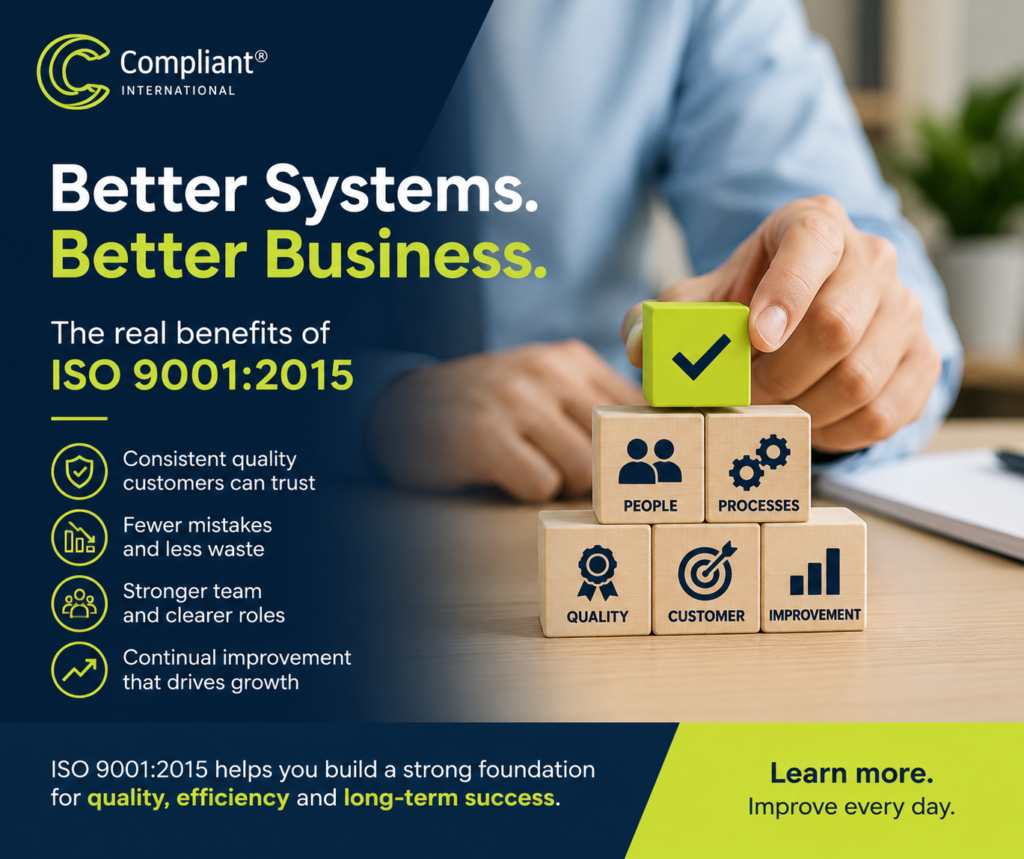
What Are the Benefits of ISO 9001:2015? A Complete Guide to Better Quality Management
Every Day Your Business Loses Time Without You Seeing It
Most businesses do not wake up one morning and realise they have a quality problem.
Instead, it happens slowly.
A customer has to chase for an update. A team member fixes the same mistake for the third time this week. One department blames another because a process was never written down. Deadlines slip. Costs rise. Customers begin to look elsewhere.
None of these problems seem huge on their own.
Together, they create something much bigger.
They waste time, reduce profits and make it harder for your business to grow.
Many organisations try to solve these issues by working harder. They hold more meetings. They introduce more checks. They send more emails. Yet the same problems keep coming back because the root cause has never been addressed.
This is where ISO 9001:2015 Quality Management Systems make a real difference.
Rather than fixing problems after they happen, ISO 9001:2015 helps organisations build better ways of working. It creates a clear framework that supports consistency, accountability and continual improvement.
The result is not just certification.
It is a business that works better every single day.
In this guide, we’ll answer one of the most common questions business leaders ask:
What are the benefits of ISO 9001:2015?
Whether you’re considering certification for the first time or looking to strengthen your existing Quality Management System, you’ll discover how ISO 9001:2015 can improve quality, support your people and help your organisation achieve long-term success.
Why Quality Matters More Than Ever
Quality is often misunderstood.
Some people think it simply means making a good product or delivering a good service.
In reality, quality is much bigger than that.
Quality means consistently meeting customer expectations while improving the way your business operates. It means doing things right the first time whenever possible. It means reducing mistakes before they happen instead of spending time fixing them afterwards.
Today’s customers have more choice than ever before.
If one supplier lets them down, another is only a click away.
That means businesses cannot rely on price alone.
Customers expect reliability.
They expect consistency.
They expect confidence.
This is exactly what ISO 9001:2015 Quality Management Systems are designed to support.
What Is ISO 9001:2015?
ISO 9001:2015 is the world’s most recognised standard for Quality Management Systems.
It provides organisations with a structured framework for managing their processes, improving customer satisfaction and driving continual improvement.
Importantly, ISO 9001:2015 does not tell businesses how to run their operations.
Instead, it helps organisations develop systems that work for their own goals, customers and industry.
Whether you employ five people or five thousand, the principles remain the same.
Understand your processes.
Manage risks.
Monitor performance.
Improve continuously.
Deliver consistent results.
That flexibility is one reason why millions of organisations across the world have chosen ISO 9001:2015.
The Biggest Benefits of ISO 9001:2015
Many organisations first consider ISO certification because a customer requests it.
While this may provide the initial reason, most businesses quickly discover that the biggest benefits come from within.
Let’s explore them.
1. Better Consistency Across Your Business
Imagine asking five employees how to complete the same task.
Would they all give the same answer?
In many organisations, they would not.
Different people develop different ways of working over time.
Although this may seem harmless, it often leads to inconsistent results.
Customers notice inconsistency.
Employees become frustrated.
Mistakes increase.
ISO 9001:2015 encourages organisations to document key processes so everyone understands how work should be completed.
This creates consistency without removing flexibility.
People know what is expected.
Managers have confidence in the process.
Customers receive a reliable experience.
2. Improved Customer Satisfaction
Every successful business depends on its customers.
Without them, growth becomes impossible.
ISO 9001:2015 places customer satisfaction at the centre of the Quality Management System.
Rather than guessing what customers want, organisations are encouraged to gather feedback, monitor performance and identify opportunities for improvement.
This creates a cycle of learning.
Businesses understand customer expectations.
They improve their services.
Customers receive a better experience.
Trust grows.
Satisfied customers are also more likely to remain loyal, recommend your business and return for future work.
3. Fewer Mistakes and Less Waste
Every mistake costs money.
Sometimes the cost is obvious.
A damaged product.
A missed deadline.
A returned order.
Other costs remain hidden.
Extra staff hours.
Customer complaints.
Lost confidence.
Reduced productivity.
ISO 9001:2015 helps organisations identify why mistakes happen rather than simply correcting them.
This focus on root causes means businesses spend less time repeating the same problems.
Over time, fewer mistakes lead to lower costs, greater efficiency and improved quality.
4. Stronger Decision-Making
Good decisions rely on good information.
Too many organisations make important decisions based on assumptions.
ISO 9001:2015 encourages businesses to monitor performance using measurable data.
Instead of asking,
“How do we think we’re doing?”
Leaders begin asking,
“What does the evidence tell us?”
This simple shift creates more informed decisions.
It also allows organisations to identify trends before they become larger problems.
5. Increased Employee Engagement
Quality is not just management’s responsibility.
It belongs to everyone.
Employees perform better when they understand their role, receive clear guidance and know how their work contributes to business success.
ISO 9001:2015 supports this by encouraging organisations to define responsibilities clearly, provide appropriate training and involve employees in continual improvement.
When people feel included, they become more engaged.
Engaged employees often produce better work.
They also identify improvement opportunities that management may never see.
6. Better Risk Management
Every business faces risk.
Supplier delays.
Staff shortages.
Cyber threats.
Equipment failures.
Changing customer demands.
The question is not whether risks exist.
The question is whether your organisation is prepared.
One of the biggest changes introduced within ISO 9001:2015 was a stronger focus on risk-based thinking.
Rather than reacting after problems occur, organisations are encouraged to identify potential issues early and plan suitable actions.
This proactive approach helps reduce disruption while improving resilience.
7. Continual Improvement Becomes Part of Everyday Business
Many organisations think improvement means making huge changes.
In reality, the biggest improvements often come from small actions repeated consistently.
ISO 9001:2015 encourages businesses to review their performance regularly.
What worked?
What didn’t?
What can be improved?
These small improvements build momentum over time.
Instead of standing still, organisations continue moving forward.
That culture of continual improvement often becomes one of the greatest long-term benefits of implementing a Quality Management System.
8. Greater Business Efficiency
Efficiency isn’t about asking employees to work harder.
It’s about removing unnecessary work altogether.
Many businesses operate with duplicated tasks, outdated processes or unnecessary paperwork simply because “that’s how we’ve always done it.”
ISO 9001:2015 encourages organisations to step back and review how work flows through the business.
Where are delays occurring?
Which activities add value?
Which activities don’t?
Once these questions are answered, processes can often be simplified.
Less duplication.
Less confusion.
Less wasted effort.
The result is a business that uses its time more effectively while delivering the same—or better—results.
9. Improved Communication Across Departments
Poor communication is one of the most common causes of operational problems.
Sales may promise something production cannot deliver.
Operations may make changes without informing customer service.
Management may assume everyone understands a new process when they don’t.
ISO 9001:2015 helps create clearer communication by defining responsibilities, documenting key processes and encouraging regular reviews.
When everyone works from the same information, misunderstandings become less common.
Teams spend less time fixing avoidable issues and more time focusing on delivering quality outcomes.
Communication improves because expectations become clearer.
Clarity creates confidence.
And confidence supports better performance.
10. Stronger Leadership and Clearer Direction
Successful businesses rarely grow by chance.
They grow because leaders set clear goals, communicate expectations and make informed decisions.
ISO 9001:2015 places leadership at the centre of the Quality Management System. It encourages senior leaders to take ownership of quality rather than leaving it to one department or one person.
When leaders actively support quality, it becomes part of the organisation’s culture.
People understand the direction of the business.
Objectives become clearer.
Everyone works towards the same outcome.
This creates alignment across the organisation.
Instead of teams pulling in different directions, they work together with a shared purpose.
That is one of the most valuable benefits of ISO 9001:2015.
How ISO 9001:2015 Supports Business Growth
Growth sounds exciting.
In reality, it often brings new challenges.
More customers.
More employees.
More suppliers.
More work.
Without strong systems in place, growth can expose weaknesses that were easy to manage when the business was smaller.
Processes that once worked begin to break down.
Communication becomes more difficult.
Customer complaints increase.
Leaders spend more time solving problems than planning for the future.
An effective ISO 9001:2015 Quality Management System helps businesses grow with confidence.
Because processes are defined, responsibilities are clear and performance is monitored, organisations are better prepared to handle increased demand.
Growth becomes controlled rather than chaotic.
Instead of constantly putting out fires, leaders can focus on developing the business.
The Benefits of ISO 9001:2015 for Different Types of Organisations
One of the greatest strengths of ISO 9001:2015 is its flexibility.
It is not designed for one industry.
It is designed for organisations.
Whether you manufacture products, provide professional services, work in construction, healthcare, education, logistics or technology, the principles remain relevant.
Small Businesses
Small businesses often believe ISO 9001 is only for large organisations.
That simply isn’t true.
In fact, smaller organisations often see improvements more quickly because processes are easier to review and changes can be implemented faster.
Benefits include:
- Better organisation
- Clearer responsibilities
- Improved customer confidence
- Reduced errors
- Stronger foundations for future growth
Medium-Sized Businesses
As businesses grow, consistency becomes harder to maintain.
Different teams develop different ways of working.
Knowledge becomes trapped with individuals.
Managers become stretched.
ISO 9001:2015 helps standardise processes while allowing departments to remain flexible where needed.
This creates consistency across the organisation without unnecessary bureaucracy.
Large Organisations
Larger organisations often manage multiple departments, sites or even countries.
Maintaining consistent quality across all locations becomes a significant challenge.
A robust Quality Management System provides a common framework that supports consistent performance while allowing local teams to operate effectively.
Common Misunderstandings About ISO 9001:2015
Many businesses delay certification because they believe common myths.
Let’s look at some of the biggest misconceptions.
“It’s just paperwork.”
This is probably the most common myth.
Modern ISO 9001:2015 is not about creating paperwork for the sake of it.
Documentation should support the business.
Not slow it down.
Good documentation provides clarity.
It helps people understand what needs to happen and why.
If documents no longer add value, they should be reviewed.
The focus is on effectiveness, not paperwork.
“It’s only useful if customers ask for it.”
Winning contracts can certainly be a benefit.
However, organisations that gain the greatest value from ISO 9001:2015 do so because they use it to improve the way they operate.
Certification may open doors.
The Quality Management System helps businesses perform better after those doors have opened.
“It’s only for manufacturers.”
ISO 9001 began with a strong manufacturing presence, but today it applies to almost every sector.
Professional services.
Healthcare.
Construction.
Engineering.
Education.
Technology.
Charities.
Public sector organisations.
Any organisation that wants to improve quality can benefit.
“It’s too expensive.”
Many businesses focus only on the cost of certification.
Few calculate the cost of poor quality.
Think about:
- Rework
- Customer complaints
- Lost contracts
- Staff frustration
- Wasted materials
- Missed deadlines
- Damage to reputation
These costs often exceed the investment required to implement an effective Quality Management System.
Why Continual Improvement Matters
One of the strongest principles behind ISO 9001:2015 is continual improvement.
Notice the wording.
Continual.
Not constant.
Businesses do not need to reinvent themselves every week.
Instead, they should look for regular opportunities to improve.
Perhaps a process can be shortened.
Perhaps customer feedback highlights a recurring issue.
Perhaps staff identify a simpler way of working.
These small improvements build over time.
Imagine improving by just one percent each month.
After several years, the difference is remarkable.
Organisations that embrace continual improvement rarely stand still.
They become more efficient.
More resilient.
More competitive.
And more trusted by customers.
The Benefits of an ISO Consultant’s Support
Implementing ISO 9001:2015 Quality Management Systems is achievable without outside support.
However, many organisations choose to work with an experienced ISO consultant because they want to avoid common mistakes and make the process more efficient.
A good consultant should never create a system that works only on paper.
Instead, they should help build a Quality Management System that reflects how your business actually operates.
Some of the key benefits include:
Saving Time
Most organisations implement ISO 9001 alongside their normal day-to-day responsibilities.
An experienced consultant helps keep the project moving by providing structure, guidance and practical advice.
This reduces delays and keeps momentum high.
Bringing Experience
A consultant has usually worked with many organisations across different industries.
That experience helps identify practical solutions that internal teams may not have considered.
Rather than starting from scratch, businesses can benefit from proven approaches that still suit their own way of working.
Helping Avoid Common Mistakes
Many organisations overcomplicate ISO 9001.
Others document too little.
Some create systems that employees never use.
An experienced consultant helps strike the right balance.
The aim should always be a Quality Management System that is simple, practical and effective.
Supporting Employee Engagement
People are more likely to support change when they understand it.
A consultant can explain the purpose behind ISO 9001:2015 in clear language, helping employees see how quality supports their daily work rather than adding unnecessary tasks.
This often leads to stronger engagement and smoother implementation.
How to Get the Most from ISO 9001:2015
Certification should never be the finish line.
It should be the starting point.
Businesses that gain the greatest value from ISO 9001:2015 treat it as part of everyday operations.
They regularly review performance.
They listen to customers.
They involve employees.
They learn from mistakes.
They celebrate improvements.
Most importantly, they continue asking one simple question:
“How can we do this better?”
That mindset creates lasting success.
Final Thoughts
So, what are the benefits of ISO 9001:2015?
The answer goes far beyond achieving a certificate.
A well-implemented ISO 9001:2015 Quality Management System helps organisations improve consistency, increase customer satisfaction, reduce waste, strengthen leadership, support employees and create a culture of continual improvement.
It provides a practical framework for managing quality while allowing each organisation to tailor its approach to its own goals and challenges.
Whether your business is taking its first steps towards certification or looking to improve an existing system, the real value lies in using ISO 9001:2015 as a tool for better business—not simply as a badge on the wall.
When quality becomes part of everyday thinking, better decisions follow.
Processes become stronger.
Customers notice the difference.
Employees gain confidence.
And the organisation is better prepared for whatever comes next.
Keep Learning About Quality Management
Improving quality is an ongoing journey, not a one-off project.
If you’re considering ISO 9001:2015, take the time to understand how its principles apply to your organisation. Read the standard, explore practical case studies, involve your teams in discussions about improvement and review your existing processes with fresh eyes.
The more you understand ISO 9001:2015 Quality Management Systems, the easier it becomes to identify opportunities to improve efficiency, strengthen customer satisfaction and build a business that delivers consistent quality for years to come.