Skip to main content
Skip to footer
Skip to main content
Skip to footer

What the New Prime Minister Could Mean for ISO-Certified Businesses

What the New Prime Minister Could Mean for ISO-Certified Businesses
Meta Title: What the New Prime Minister Could Mean for ISO-Certified Businesses | Compliance & Business Planning
Meta Description: Discover how a new Prime Minister could influence ISO-certified businesses, including compliance, procurement, regulation, and strategic planning. Learn how ISO standards help organisations adapt to change.
What the New Prime Minister Could Mean for ISO-Certified Businesses
Political change often brings uncertainty.
When a new Prime Minister takes office, many business leaders immediately begin asking the same questions. Will regulations change? Will government spending move in a different direction? Will public contracts become harder to win? What happens to the rules we already follow?
For organisations working hard to maintain ISO standards and achieve ongoing compliance, these questions matter.
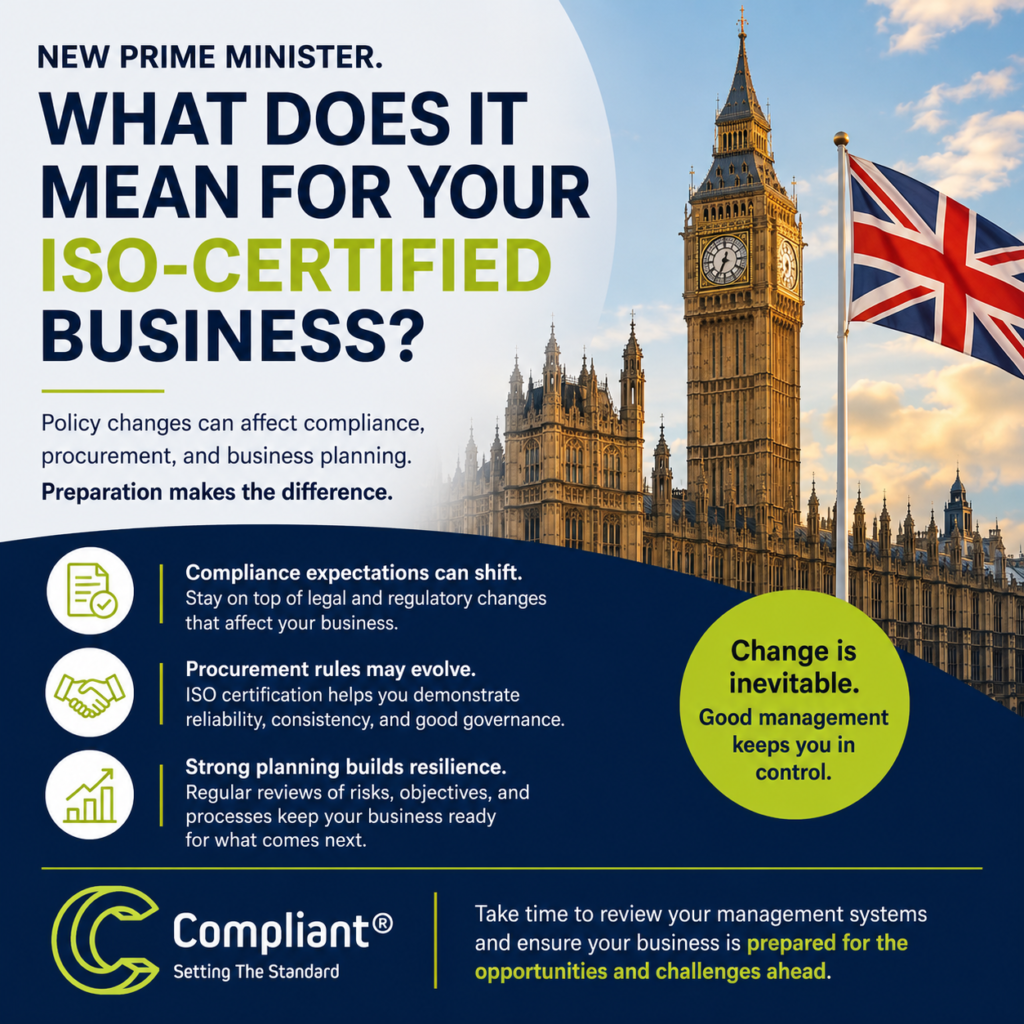
While ISO standards themselves are international and do not change because a country’s leadership changes, government priorities certainly can. Those priorities often influence procurement, legislation, funding, environmental targets, cyber security expectations, and workplace regulations.
The businesses that struggle are often the ones that wait until change arrives before preparing.
The businesses that succeed are usually the ones with strong management systems already in place.
This is exactly where ISO certification provides real value.
In this guide, we’ll explain what the UK’s new Prime Minister could mean for ISO-certified organisations, where the biggest changes may occur, and why the benefits of an ISO consultant’s support can make adapting much easier.
Political Change Doesn’t Change ISO Standards
One of the biggest misunderstandings businesses have is believing that a change in government means ISO standards themselves will change.
That is not how ISO works.
ISO standards are developed by the International Organization for Standardization and are recognised across the world. Whether the UK changes Prime Minister, government, or even political direction, standards like:
- ISO 9001
- ISO 14001
- ISO 27001
- ISO 45001
remain exactly the same until they are formally revised through the international standards process.
However, what governments can change is how businesses are expected to operate alongside those standards.
This includes:
- Procurement rules
- Environmental policies
- Data protection priorities
- Workplace expectations
- Funding opportunities
- Industry regulations
These changes can affect how organisations demonstrate compliance, even though the ISO standard itself remains unchanged.
Government Priorities Shape Business Expectations
Every government has different priorities.
Some focus heavily on economic growth.
Others invest more in infrastructure.
Some increase environmental commitments.
Others prioritise cyber security, housing, manufacturing, healthcare or public services.
These priorities often influence what buyers expect from suppliers.
For example, government departments may place greater emphasis on:
- Environmental responsibility
- Supply chain resilience
- Information security
- Quality management
- Health and safety
- Social value
Businesses already working within ISO management systems are usually in a much stronger position because these topics are already part of their everyday processes.
Instead of starting from scratch, they simply adjust existing systems.
That is a much easier position to be in.
Procurement Could Become More Competitive
Winning public sector contracts has never been simple.
A change in government can make competition even stronger.
As spending priorities change, organisations bidding for government work may see:
- New evaluation criteria
- Different funding programmes
- Updated supplier requirements
- Greater focus on value for money
- Increased evidence requests
Many public contracts already ask suppliers to hold recognised ISO certifications.
Why?
Because certification provides confidence.
It shows a business has documented systems, follows consistent processes and works towards continual improvement.
For procurement teams, that reduces risk.
Businesses without recognised management systems may find themselves needing to provide much more evidence to prove they can deliver.
ISO-certified organisations often already have much of that evidence available.
Compliance May Become More Important, Not Less
Some businesses assume a new government will reduce regulation.
Sometimes that happens.
Sometimes it does not.
In many cases, regulations simply change direction rather than disappear.
Organisations still need to demonstrate they understand their legal responsibilities.
This is one of the strengths of ISO management systems.
Many standards require organisations to identify legal and regulatory obligations as part of their normal management process.
That means businesses regularly review:
- Applicable laws
- Industry requirements
- Customer expectations
- Business risks
Instead of reacting to change, they are already monitoring it.
This helps organisations stay compliant even when the regulatory landscape evolves.
Environmental Policies Could Continue to Evolve
Environmental commitments often change with political leadership.
Targets may shift.
Funding may change.
Reporting expectations may increase or decrease.
Businesses with ISO 14001 are already used to reviewing environmental impacts and identifying opportunities for improvement.
That flexibility makes adapting to new environmental priorities much easier.
Rather than redesigning systems from the beginning, organisations can simply update objectives, legal registers and improvement plans.
This saves both time and resources.
Cyber Security Is Unlikely to Become Less Important
Regardless of political leadership, cyber threats continue to grow.
Businesses hold more data than ever before.
Customers expect information to remain secure.
Government departments increasingly expect suppliers to demonstrate strong cyber security practices.
That is why ISO 27001 continues to grow in importance.
Future governments may introduce:
- New cyber guidance
- Updated supplier requirements
- Stronger resilience expectations
- Greater protection for critical services
Organisations already certified to ISO 27001 have established systems for identifying and managing information security risks.
This gives them a strong starting point when expectations increase.
Quality Will Always Matter
Governments change.
Customers do not.
People still expect:
- Reliable products
- Good service
- Clear communication
- Consistent delivery
That is why ISO 9001 remains valuable regardless of political direction.
Businesses that understand customer needs, measure performance and continually improve are often better prepared for economic uncertainty.
Quality management does not become less important because of political change.
If anything, it becomes even more valuable.
Risk Management Helps Businesses Stay Calm
Periods of political change naturally create uncertainty.
That uncertainty often leads businesses to delay decisions.
However, uncertainty is exactly why risk management exists.
Most ISO management systems encourage organisations to think about:
- Internal risks
- External risks
- Business opportunities
- Future planning
This structured approach helps organisations make informed decisions instead of reacting emotionally to headlines.
It also gives leadership teams greater confidence when planning ahead.
Supply Chains May Face New Challenges
Government policy can influence:
- Imports
- Exports
- Manufacturing
- Construction
- Energy
- Infrastructure
These changes may affect supply chains.
Businesses with mature ISO systems often have supplier evaluation processes already in place.
They monitor supplier performance, identify risks and look for alternative options where necessary.
That makes them far more resilient when external conditions change.
Why Good Documentation Matters
One of the biggest strengths of ISO is documentation.
Some people see documentation as paperwork.
In reality, it provides consistency.
When government expectations change, documented systems are easier to review.
Policies can be updated.
Procedures can be revised.
Training can be refreshed.
Evidence remains clear.
This allows organisations to respond quickly without losing control of their operations.
Leadership Has an Important Role
Political change often encourages business leaders to pause and reassess their strategy.
That is good practice.
ISO standards encourage leadership involvement for exactly this reason.
Senior leaders should regularly review:
- Business objectives
- Risks
- Opportunities
- Customer expectations
- Resources
- Performance
These reviews help organisations stay aligned with changing market conditions.
Strong leadership creates confident organisations.
Why the Benefits of an ISO Consultant’s Support Matter More During Change
Political transitions can create uncertainty.
Even experienced organisations may wonder whether they have considered every possible impact.
This is where the benefits of an ISO consultant’s support become clear.
An experienced ISO consultant helps businesses:
- Understand changing requirements
- Review existing management systems
- Identify gaps
- Update documentation
- Prepare for future audits
- Keep improvement plans moving forward
Rather than waiting for problems to appear, organisations receive practical guidance that helps them stay prepared.
Consultants also bring experience from working across different industries.
They often spot emerging trends before individual organisations experience them directly.
That broader perspective can help businesses make better decisions.
Most importantly, an ISO consultant provides reassurance.
When the business environment changes, having expert guidance allows leaders to focus on running the organisation instead of worrying whether they have missed something important.
Planning Ahead Is Better Than Waiting
Many organisations wait until regulations change before taking action.
That approach often creates unnecessary pressure.
Businesses with strong ISO systems take a different path.
They:
- Monitor changes
- Review risks
- Update objectives
- Improve processes
- Train employees
- Record evidence
This makes future adjustments much smoother.
Preparation is almost always less expensive than reacting at the last minute.
ISO Supports Long-Term Business Success
Governments come and go.
Economic conditions change.
Markets evolve.
Customer expectations grow.
Yet the core principles behind ISO remain remarkably consistent.
Good leadership.
Good planning.
Good communication.
Good risk management.
Continual improvement.
These principles help organisations perform well regardless of political direction.
That is one reason why ISO certification continues to be recognised around the world.
It is built to support businesses through change, not just during periods of stability.
Final Thoughts
A new Prime Minister may influence business policy, procurement priorities, funding, and regulatory focus. Those changes can create uncertainty for organisations across every sector.
The good news is that ISO-certified businesses are often better prepared than they realise.
Strong management systems provide a structured way to monitor change, manage risk, maintain compliance, and continue improving even when the external environment shifts.
Rather than reacting to every announcement, organisations can make informed decisions based on evidence, planning, and continual improvement.
That is exactly what ISO is designed to support.
Understanding political change is important. Preparing for it is even more important.
And for many organisations, the benefits of an ISO consultant’s support lie in providing the guidance, experience, and independent perspective needed to adapt with confidence while keeping business objectives firmly on track.
Educational CTA
Political priorities will continue to change, but good management never goes out of date. Take time to review your ISO management systems, assess any new risks or opportunities, and ensure your organisation is ready for whatever comes next. Regular reviews today can help prevent bigger challenges tomorrow.