Skip to main content
Skip to footer
Skip to main content
Skip to footer

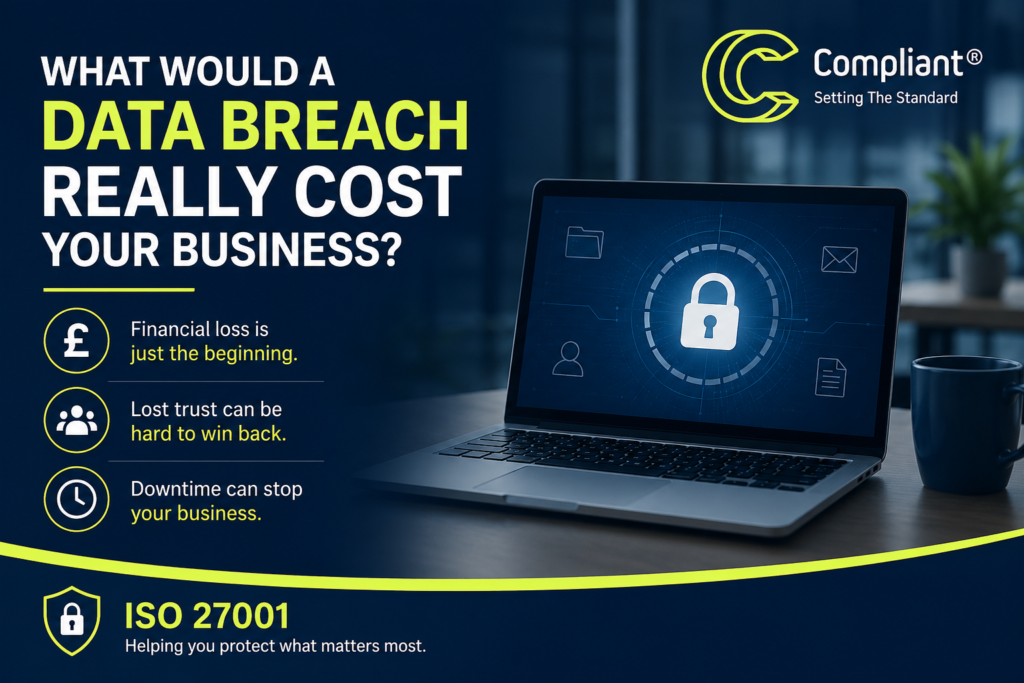
What Would a Data Breach Really Cost Your Business?
What Would a Data Breach Really Cost Your Business?
Every business believes it has enough security in place. Until the day it doesn’t.
A data breach is something many organisations think happens to someone else. Large companies make the headlines. Small businesses quietly deal with the damage behind closed doors. The truth is that no organisation is too small, too large, or too experienced to become a target.
Cyber criminals are not always looking for the biggest business. They are looking for the easiest one.
One weak password. One employee clicking the wrong link. One forgotten laptop. One supplier with poor security. That is often all it takes.
The financial cost is only part of the story. A breach can damage customer trust, interrupt daily operations, delay projects, affect contracts, and leave a business spending months putting things right.
That is why ISO 27001 has become one of the world’s most recognised standards for information security management. It helps businesses protect the information they rely on every single day while creating a clear plan for reducing risk before problems happen.
In this guide, we will explore the true cost of a data breach, why prevention is always better than recovery, and the benefits of an ISO consultant’s support when working towards ISO 27001 certification.
Data Is One of Your Most Valuable Assets
Think about everything your organisation stores.
Customer names and addresses.
Employee records.
Payroll information.
Contracts.
Bank details.
Emails.
Supplier information.
Business plans.
Passwords.
Designs.
Pricing.
Every piece of information has value. Some of it has value to your business. Some of it has value to criminals.
If the wrong people gain access to your information, the consequences can be serious.
Many businesses spend years building a strong reputation. A single security incident can damage that reputation in just a few hours.
That is why protecting information should never be viewed as an IT problem alone.
It is a business responsibility.
The Cost Everyone Thinks About
When people hear the words “data breach,” they usually think about money.
Yes, financial losses can be significant.
A breach may involve:
- Paying specialists to investigate what happened
- Restoring systems
- Recovering lost information
- Legal advice
- Customer communication
- Additional security improvements
- Staff overtime
- Business interruption
Some organisations also face fines if they fail to protect personal information properly.
These costs can quickly grow.
For many smaller businesses, even one serious incident can place enormous pressure on cash flow.
But money is only one part of the picture.
The Hidden Costs Can Last Much Longer
The biggest damage often cannot be measured on a spreadsheet.
Imagine you are one of your customers.
You trusted a company with your personal information.
You later discover that information has been stolen.
Would you still feel confident using that business?
Many customers begin asking difficult questions.
Can they trust the organisation?
Will it happen again?
Should they choose another supplier?
Trust takes years to earn.
It can disappear overnight.
Once confidence has been lost, winning it back is rarely quick or easy.
Downtime Can Stop Your Business
Many cyber attacks do not simply steal information.
They stop organisations from working.
Systems become unavailable.
Staff cannot access files.
Orders cannot be processed.
Emails stop working.
Customers cannot be supported properly.
Projects become delayed.
Every hour spent recovering is an hour not spent serving customers.
For some businesses, downtime is even more expensive than the data loss itself.
ISO 27001 encourages organisations to think about resilience before something goes wrong.
The aim is not only to reduce risk.
It is also to recover faster if an incident happens.
Your Reputation Is Always at Risk
Reputation is difficult to build.
It is incredibly easy to lose.
Customers expect organisations to protect their information.
Partners expect strong security.
Suppliers expect reliable systems.
Employees expect their personal information to remain private.
If these expectations are not met, confidence quickly falls.
Some customers may never return.
Others may tell friends, colleagues, or business contacts about their experience.
Negative publicity spreads much faster than positive news.
ISO 27001 demonstrates that information security is taken seriously.
Certification does not promise that a breach will never happen.
Instead, it shows that recognised processes are in place to manage and reduce security risks.
That reassurance can make a real difference when customers compare suppliers.
Could You Lose Future Contracts?
Many organisations now expect suppliers to demonstrate good information security.
Some sectors already require this.
Others strongly encourage it.
When tender opportunities arise, businesses are often asked questions such as:
How do you protect customer information?
How do you manage cyber risks?
What happens if your systems fail?
How do you control who can access sensitive data?
Without clear answers, businesses may lose opportunities before they even begin.
Having ISO 27001 certification provides independent evidence that recognised information security practices are already in place.
This can strengthen tender applications and increase confidence among potential clients.
Cyber Crime Continues to Grow
Cyber threats continue to evolve.
Criminals are becoming more organised.
Technology is changing.
Artificial intelligence is making phishing emails harder to spot.
Attack methods continue to improve.
That means businesses cannot rely on yesterday’s security measures.
Information security should be reviewed regularly.
Risks should be identified.
Controls should be improved.
Staff should receive ongoing training.
ISO 27001 supports continual improvement rather than one-time action.
That makes it far more effective than simply installing security software and hoping for the best.
People Are Often the Biggest Risk
Technology matters.
People matter even more.
Many breaches begin with human error.
Someone clicks a suspicious email.
A password is shared.
Sensitive information is sent to the wrong person.
A laptop is left unattended.
A document is uploaded to the wrong location.
None of these mistakes are usually intentional.
They happen because people are busy.
Or because they have never been shown what good information security looks like.
ISO 27001 recognises this.
Training and awareness form an important part of an effective information security management system.
When employees understand the risks, they become one of the strongest lines of defence rather than one of the weakest.
What Is ISO 27001?
ISO 27001 is the international standard for information security management.
It provides a structured framework that helps organisations identify, assess, manage, and reduce information security risks.
Rather than focusing on technology alone, ISO 27001 looks at the whole organisation.
It considers:
- People
- Processes
- Technology
- Physical security
- Risk management
- Leadership
- Continual improvement
The standard encourages organisations to understand what information they hold, where risks exist, and how those risks should be managed.
This creates a stronger, more consistent approach to protecting valuable information.
ISO 27001 Is About More Than Cyber Security
Many people think ISO 27001 only relates to hackers.
It does not.
Information can be damaged in many different ways.
For example:
A flood destroys paper records.
A laptop is stolen from a car.
A former employee still has access to systems.
Important files are deleted by mistake.
An email containing personal information is sent to the wrong customer.
All of these situations involve information security.
ISO 27001 helps organisations prepare for a wide range of risks, not just cyber attacks.
This broader approach helps reduce disruption across the entire business.
Why Leadership Matters
Strong information security starts at the top.
If leaders treat security as someone else’s responsibility, employees are likely to do the same.
ISO 27001 places clear responsibility on leadership.
Senior managers are expected to:
- Set clear objectives.
- Provide the right resources.
- Understand business risks.
- Support continual improvement.
- Encourage a positive security culture.
When leaders are involved, security becomes part of everyday decision making rather than an afterthought.
This creates lasting improvements across the organisation.
The Benefits of an ISO Consultant’s Support
Implementing ISO 27001 can seem overwhelming, especially for organisations approaching certification for the first time.
There are policies to create, risks to assess, controls to review, staff to engage, and evidence to gather. Without experience, it is easy to spend time on the wrong tasks or overlook important requirements.
This is where the benefits of an ISO consultant’s support become clear.
An experienced consultant helps simplify the process. Rather than guessing what is required, your organisation receives clear guidance based on the standard’s requirements and your business’s specific needs.
A consultant can help you:
- Understand the requirements of ISO 27001 in plain language.
- Carry out a gap analysis to identify what is already in place and what needs improving.
- Build a practical information security management system that works for your organisation.
- Develop policies and procedures that are relevant and easy for employees to follow.
- Support risk assessments and help prioritise actions.
- Prepare for internal and external audits with confidence.
- Train staff so everyone understands their role in protecting information.
Perhaps most importantly, a consultant keeps the project moving. They help avoid common mistakes, reduce unnecessary work, and ensure your efforts stay focused on achieving meaningful improvements rather than simply creating paperwork.
Good consultancy support should also leave your organisation stronger in the long term. The goal is not just to achieve certification, but to build a culture where information security becomes part of everyday business.
For many organisations, this guidance saves valuable time, reduces stress, and increases confidence throughout the certification journey.
ISO 27001 Is an Investment, Not a Cost
Some organisations hesitate because they see certification as another expense.
It is worth asking a different question.
What would the cost of not protecting your information be?
One successful cyber attack could cost far more than years of investment in better security.
Beyond the financial impact, there is the loss of trust, disruption to operations, damage to your reputation, and missed business opportunities.
ISO 27001 helps reduce those risks by encouraging a planned, proactive approach rather than reacting after something has gone wrong.
It is an investment in resilience, confidence, and long-term success.
Final Thoughts
A data breach is rarely just an IT problem. It is a business problem that can affect every part of an organisation.
The true cost goes far beyond recovering lost files or repairing systems. It includes lost time, damaged relationships, reduced customer confidence, interrupted operations, and opportunities that may never return.
The good news is that many of these risks can be reduced.
ISO 27001 provides a recognised framework for protecting information, strengthening security, and building trust with customers, suppliers, and stakeholders. It encourages organisations to understand their risks, improve their processes, and create a culture where information security becomes everyone’s responsibility.
For businesses beginning that journey, the benefits of an ISO consultant’s support can make a significant difference. Expert guidance helps simplify the process, avoid common pitfalls, and ensure your management system is practical, effective, and ready for certification.
Information is one of your organisation’s greatest assets.
Protecting it should never be left to chance.
Continue Learning
Every organisation faces different information security risks. Taking the time to understand where your vulnerabilities lie is the first step towards building stronger protection.
Learn more about ISO 27001, review your current security practices, and consider whether your existing controls are enough for the way your business operates today. Even small improvements can make a meaningful difference over time.