Skip to main content
Skip to footer
Skip to main content
Skip to footer

Why Combining ISO Standards Can Save Time, Money, and Effort
Why Combining ISO Standards Can Save Time, Money, and Effort
Is Your Business Working Harder Than It Needs To?
Many businesses begin with one ISO standard.
It solves one problem. Perhaps it improves quality. Maybe it helps protect information or creates a safer workplace.
Then something changes.
A customer asks for another certification. A tender requires additional compliance. Regulations become stricter. Before long, your business has two, three, or even four management systems running side by side.
At first, that sounds like progress.
In reality, it often creates a new challenge.
Different documents.
Different audits.
Different procedures.
Different meetings.
Different responsibilities.
Before you know it, your team spends more time managing paperwork than improving the business.
That is where many organisations begin to feel overwhelmed.
The good news is there is a better way.
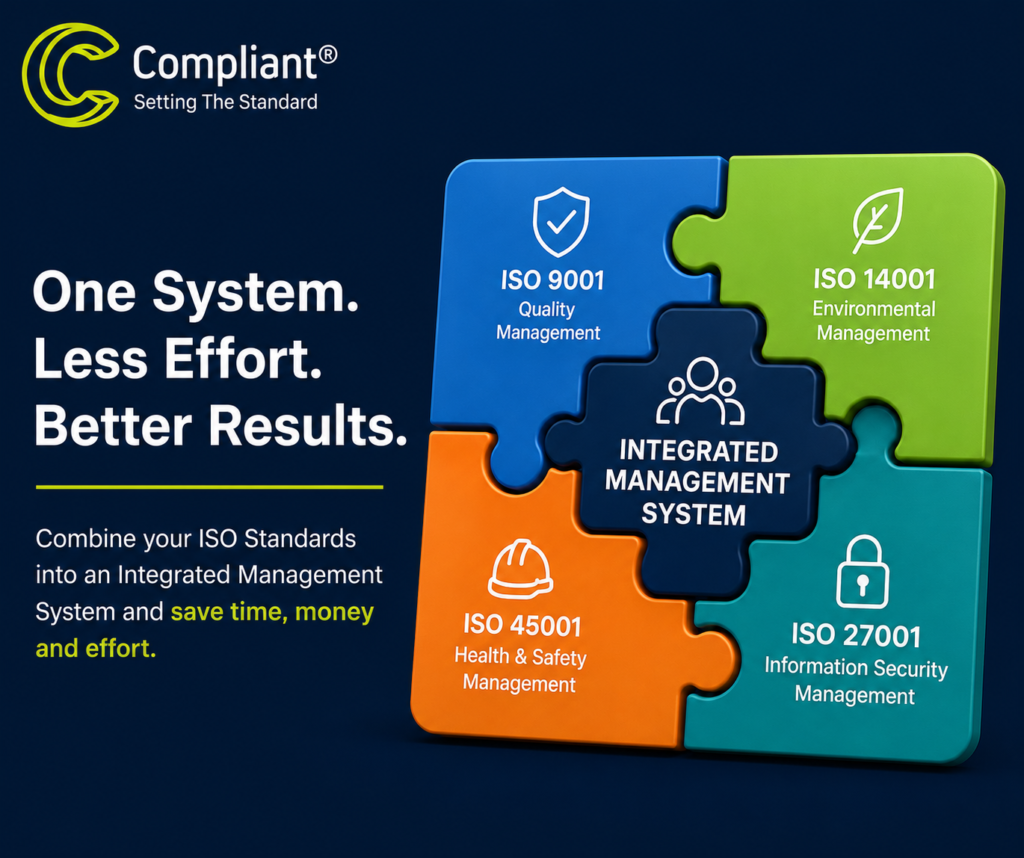
An Integrated Management System (IMS) allows businesses to combine multiple ISO Standards into one clear and simple management system. Instead of running separate processes for every certification, everything works together.
The result is less duplication, lower costs, improved compliance, and far less stress for everyone involved.
Let’s explore why more businesses are choosing this smarter approach.
What Is an Integrated Management System?
An Integrated Management System is exactly what it sounds like.
Rather than treating every ISO standard as its own separate project, an IMS combines them into one management system.
Many businesses choose to integrate standards such as:
- ISO 9001 for Quality Management
- ISO 14001 for Environmental Management
- ISO 45001 for Health and Safety
- ISO 27001 for Information Security
- ISO 50001 for Energy Management
Although each standard focuses on a different area, they all share many of the same requirements.
For example, they all require businesses to:
- Set clear objectives
- Assess risks
- Create policies
- Monitor performance
- Carry out internal audits
- Review management performance
- Continually improve
Instead of repeating these activities several times, an Integrated Management System allows them to happen once.
That simple change can make a remarkable difference.
Why Businesses Often End Up With Separate Systems
Most organisations never intend to create multiple systems.
It happens naturally.
A customer requests ISO 9001.
Later, another client asks for ISO 27001.
A contractor then requires ISO 45001 before awarding work.
Each certification is added one at a time.
Often, different consultants help at different stages.
Different people write different procedures.
Separate folders appear.
New forms are created.
Different audit schedules are introduced.
Eventually nobody has a complete picture of how everything fits together.
The business is still compliant, but maintaining compliance becomes much harder than it should be.
The Hidden Cost of Separate ISO Standards
Many businesses believe certification itself is expensive.
Often, the real cost comes afterwards.
Running separate management systems creates hidden costs that continue every year.
These include:
More Administration
Teams spend hours updating several versions of similar documents.
One policy becomes four.
One procedure becomes three.
Every small change takes much longer.
Repeated Audits
Each system requires planning, preparation, evidence gathering and follow-up.
When systems are separate, the same people may attend several different audits covering almost identical subjects.
That takes valuable time away from running the business.
Duplicate Training
Staff may receive similar training several times simply because each management system has its own programme.
This creates confusion and wastes resources.
Confusing Documentation
Employees often struggle to know which procedure applies.
Different departments may even follow different versions of the same process.
That increases mistakes and inconsistency.
Increased Risk
When systems are disconnected, important information can easily be missed.
A change made in one system may never reach another.
That can create compliance gaps.
Why Integration Makes Sense
An Integrated Management System removes much of this duplication.
Instead of managing several systems, your business manages one.
Instead of repeating work, your team completes it once.
That simple shift creates benefits across the whole organisation.
Save Time Across Every Department
Time is one of every business’s most valuable resources.
Every unnecessary task costs money.
Integration helps remove many of those unnecessary tasks.
Rather than maintaining multiple document libraries, you maintain one.
Rather than planning several management reviews, you hold one.
Rather than conducting separate internal audits, you combine them.
Instead of asking managers to attend different meetings throughout the year, information is reviewed together.
That gives people more time to focus on customers, projects and growth.
Reduce Costs Without Reducing Quality
Some people worry that combining systems means lowering standards.
The opposite is usually true.
Integration reduces waste.
Less paperwork means lower administration costs.
Fewer duplicated activities reduce staff time.
Combined audits often reduce certification costs.
Training becomes more efficient.
Resources are used more effectively.
Small improvements in each area quickly add up over a year.
For many businesses, the savings are significant.
Make Compliance Easier to Manage
Compliance should give confidence.
It should not create confusion.
An Integrated Management System provides one clear way of working.
Everyone understands where documents are stored.
Policies follow the same structure.
Objectives work together.
Responsibilities are clear.
Internal audits become easier to plan.
Management reviews become more meaningful.
Instead of chasing paperwork, leaders gain a clearer understanding of how the business is performing.
Better Decisions Through Better Information
Every ISO standard asks businesses to measure performance.
When systems are separate, information is often reviewed separately too.
That means opportunities can be missed.
An Integrated Management System brings everything together.
Quality data.
Environmental performance.
Health and safety.
Information security.
Customer feedback.
Business risks.
Viewed together, these measures provide a much clearer picture.
Leaders can identify trends sooner.
Problems become easier to solve.
Improvements become easier to prioritise.
Better information almost always leads to better decisions.
Employees Find It Easier Too
Employees rarely enjoy unnecessary paperwork.
They want clear instructions.
Simple processes.
Easy access to information.
An Integrated Management System helps achieve exactly that.
Instead of asking staff to learn different systems for different standards, they follow one consistent approach.
That improves confidence.
It reduces mistakes.
Training becomes quicker.
New employees settle into their roles faster.
The whole organisation works more consistently.
Continual Improvement Becomes Simpler
Every ISO standard encourages continual improvement.
But improvement can become difficult when systems are disconnected.
One department improves quality.
Another improves safety.
Someone else focuses on environmental performance.
Without integration, those improvements may never connect.
An Integrated Management System encourages everyone to work towards shared business goals.
Improvement becomes part of everyday work instead of separate projects.
The business moves forward together.
Customers Notice the Difference
Customers may never ask whether your management systems are integrated.
They will notice the results.
Projects run more smoothly.
Communication improves.
Problems are solved faster.
Quality becomes more consistent.
Deadlines are met more reliably.
Trust grows.
That can strengthen customer relationships and improve long-term success.