Skip to main content
Skip to footer
Skip to main content
Skip to footer

Why Leadership Is the Heart of ISO 9001
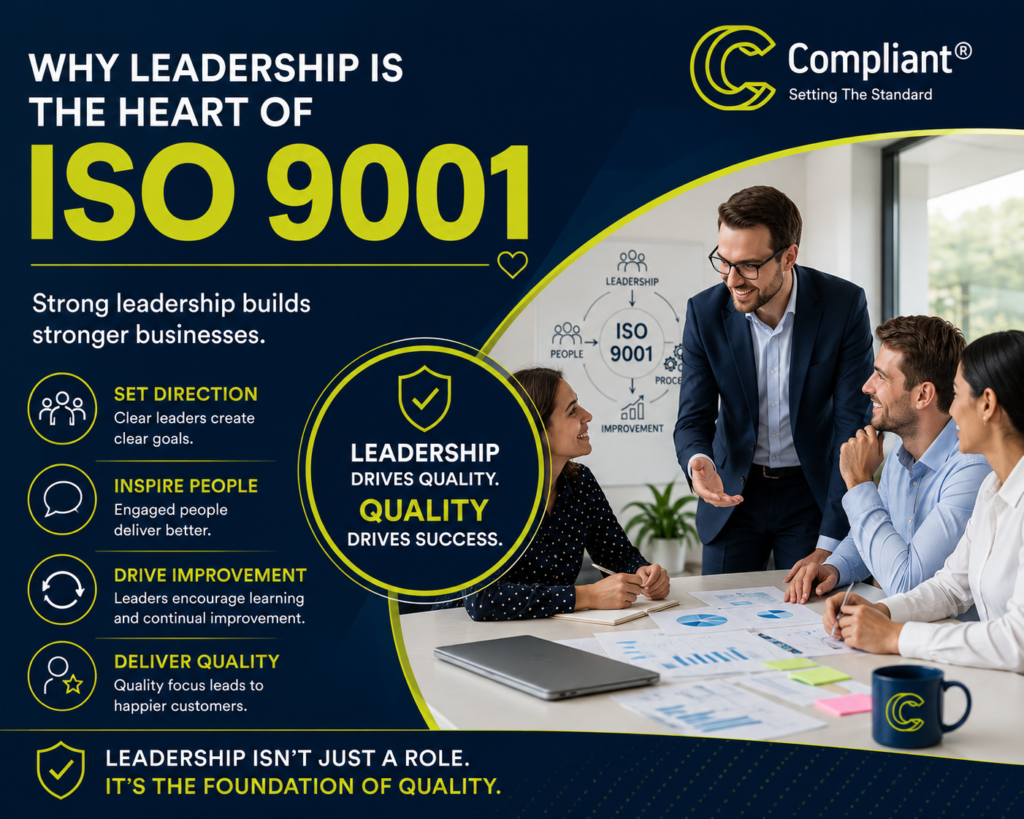

Why Leadership Is the Heart of ISO 9001
Without strong leadership, even the best quality management system will struggle to deliver results.
Many businesses invest time and money into achieving ISO 9001. They create procedures, write documents, train employees and prepare for audits.
Yet, after certification, something starts to happen.
Processes are no longer followed consistently. Improvements begin to slow. Staff lose interest. The quality management system becomes something people only think about when an audit is due.
The problem is rarely the system itself.
More often than not, the missing piece is leadership.
A quality management system cannot improve a business if the people leading that business are not fully committed to it.
That is why ISO 9001 places leadership at the centre of the standard. It recognises that quality is not created by documents. It is created by people, guided by leaders who set the direction, encourage improvement and make quality part of everyday working life.
In this article, we will explore why leadership is the heart of ISO 9001, how great leaders create a culture of quality, and why the benefits of an ISO consultant’s support can help organisations build a quality management system that delivers real value long after certification.
What Does ISO 9001 Say About Leadership?
One of the biggest changes introduced in modern versions of ISO 9001 was the increased focus on leadership.
In the past, many organisations believed quality belonged to one department.
There might have been a Quality Manager responsible for maintaining procedures.
Employees often viewed quality as someone else’s responsibility.
ISO 9001 changed that way of thinking.
Instead of placing responsibility on one individual, the standard makes leadership accountable for ensuring quality becomes part of the organisation’s everyday activities.
That means leaders should not simply approve policies.
They should actively support them.
They should communicate their importance.
Most importantly, they should demonstrate through their own actions that quality matters.
Employees notice what leaders do far more than what they say.
If leaders follow agreed processes, employees usually do the same.
If leaders ignore procedures whenever they become inconvenient, the rest of the organisation quickly follows.
Culture always starts at the top.
Leadership Creates Culture
Every organisation has a culture.
Whether it has developed naturally or been carefully planned, culture influences how people behave every day.
Some businesses have a culture where employees openly share ideas, report problems early and work together to improve.
Others have a culture where mistakes are hidden because people worry about being blamed.
The difference often comes down to leadership.
Strong leaders create environments where people feel valued.
They encourage questions.
They welcome feedback.
They see mistakes as opportunities to learn rather than reasons to criticise.
This creates trust.
Trust encourages communication.
Communication leads to improvement.
These are exactly the behaviours that support the goals of ISO 9001.
Leadership Gives People a Clear Direction
People work best when they understand what success looks like.
Imagine asking a team to improve quality without explaining what quality means.
Some employees might focus on speed.
Others may concentrate on reducing costs.
Someone else may believe avoiding complaints is enough.
Everyone would be working towards different goals.
Effective leaders remove that uncertainty.
They explain the organisation’s vision.
They make expectations clear.
They show how each person’s work contributes to customer satisfaction.
When employees understand the bigger picture, they make better decisions every day.
This consistency helps organisations deliver products and services that customers can rely on.
That is one of the biggest strengths of ISO 9001.
Great Leaders Focus on Customers
One of the key principles behind ISO 9001 is customer focus.
Customers return when they receive consistent quality.
They recommend businesses that meet their expectations.
They trust organisations that solve problems quickly and continue improving.
Leadership has a direct impact on all of this.
Leaders decide what matters.
When customer satisfaction becomes a priority for leadership, it naturally becomes a priority throughout the business.
Teams begin asking important questions.
How can we improve?
How can we reduce mistakes?
How can we make life easier for our customers?
Small improvements made every day often create the biggest long-term results.
Communication Builds Better Businesses
Poor communication creates confusion.
Confusion creates mistakes.
Mistakes reduce quality.
Strong leaders understand that communication is about more than sharing information.
It is about listening.
Employees often know where problems exist.
They work with processes every day.
They speak with customers.
They understand the challenges.
When leaders encourage open conversations, valuable ideas begin to emerge.
Perhaps a process could be simplified.
Maybe a recurring issue has an easy solution.
Sometimes a small improvement suggested by one employee can save hundreds of hours across the organisation.
ISO 9001 encourages businesses to involve people because continual improvement depends on shared knowledge.
Continual Improvement Starts with Leadership
Businesses that stop improving often fall behind.
Customer expectations change.
Technology changes.
Markets change.
Successful organisations recognise this.
They never assume their current way of working is the best it can be.
Leaders play a vital role in creating this mindset.
Instead of asking, “Have we always done it this way?”
They ask, “Can we do it better?”
That single question can transform an organisation.
When leaders encourage improvement rather than simply maintaining the status quo, innovation becomes part of everyday work.
Employees feel confident sharing ideas because they know those ideas will be heard.
This continuous learning culture sits at the heart of ISO 9001.
Leadership During Difficult Times
Strong leadership becomes even more important when organisations face challenges.
Economic uncertainty.
Supply chain problems.
Changes in customer demand.
Staff shortages.
These situations often place businesses under pressure.
The temptation can be to ignore quality while focusing only on immediate problems.
Strong leaders take the opposite approach.
They understand that maintaining quality during difficult times builds customer confidence.
Customers remember businesses that remain reliable when conditions become challenging.
ISO 9001 provides a structured framework that helps organisations remain consistent, even when circumstances change.
The Benefits of an ISO Consultant’s Support
Many leaders understand why quality matters.
What they may not know is how to translate that vision into a practical management system.
This is where the benefits of an ISO consultant’s support become clear.
An experienced consultant helps organisations build a quality management system that reflects how the business actually operates.
Rather than creating unnecessary paperwork, they focus on practical processes that employees can easily understand and follow.
A consultant can help leaders:
- Understand the requirements of ISO 9001.
- Identify strengths and areas for improvement.
- Build simple and effective processes.
- Prepare confidently for audits.
- Encourage employee engagement.
- Develop a culture of continual improvement.
- Avoid common implementation mistakes.
- Ensure the management system supports business goals rather than creating extra work.
Perhaps the greatest benefit is perspective.
An external consultant brings experience gained across many different organisations.
They can often identify opportunities that internal teams may overlook simply because they are too close to everyday operations.
Common Leadership Mistakes
Even well-intentioned leaders sometimes weaken their quality management system without realising it.
Common examples include:
- Delegating quality entirely to one department.
- Failing to communicate business objectives.
- Ignoring employee feedback.
- Only discussing quality during audits.
- Reacting to problems instead of preventing them.
- Focusing on paperwork rather than performance.
- Not recognising success or celebrating improvements.
These behaviours slowly reduce employee engagement.
Over time, quality becomes seen as another task rather than an important part of the organisation.
Leadership at Every Level
One common misunderstanding is that leadership only belongs to directors.
It does not.
Supervisors lead.
Team leaders lead.
Project managers lead.
Anyone who influences others demonstrates leadership.
ISO 9001 encourages organisations to develop leadership throughout the business.
When leadership exists at every level, improvements happen faster.
Problems are solved earlier.
Employees feel more supported.
The organisation becomes stronger because responsibility is shared.
The Long-Term Benefits of Strong Leadership
Businesses with strong leadership often experience benefits that extend far beyond certification.
These may include:
- Better customer satisfaction.
- Greater employee engagement.
- Improved communication.
- More consistent products and services.
- Higher staff confidence.
- Better decision-making.
- Greater operational efficiency.
- Stronger business reputation.
- Increased opportunities to win contracts.
- Sustainable long-term growth.
These improvements rarely happen overnight.
They develop because leaders consistently demonstrate the values they expect others to follow.
Final Thoughts
A successful ISO 9001 management system is never built on documents alone.
It is built on leadership.
Processes matter.
Audits matter.
Documentation matters.
But none of them deliver lasting value unless leaders actively support quality every day.
Great leaders create direction.
They encourage learning.
They build trust.
They involve people.
Most importantly, they make quality part of the organisation’s culture rather than something that only matters when an auditor arrives.
That is why leadership truly is the heart of ISO 9001.
Combined with the benefits of an ISO consultant’s support, organisations can create management systems that are practical, effective and designed to deliver continual improvement for years to come.
Continue Learning
Take a moment to reflect on your own organisation.
If someone asked every employee, “Who is responsible for quality?” would they all give the same answer?
If the answer is “everyone,” and your leaders demonstrate that through their actions every day, you are already building the kind of quality culture that ISO 9001 is designed to support.