Why Sustainable Businesses Stand Out
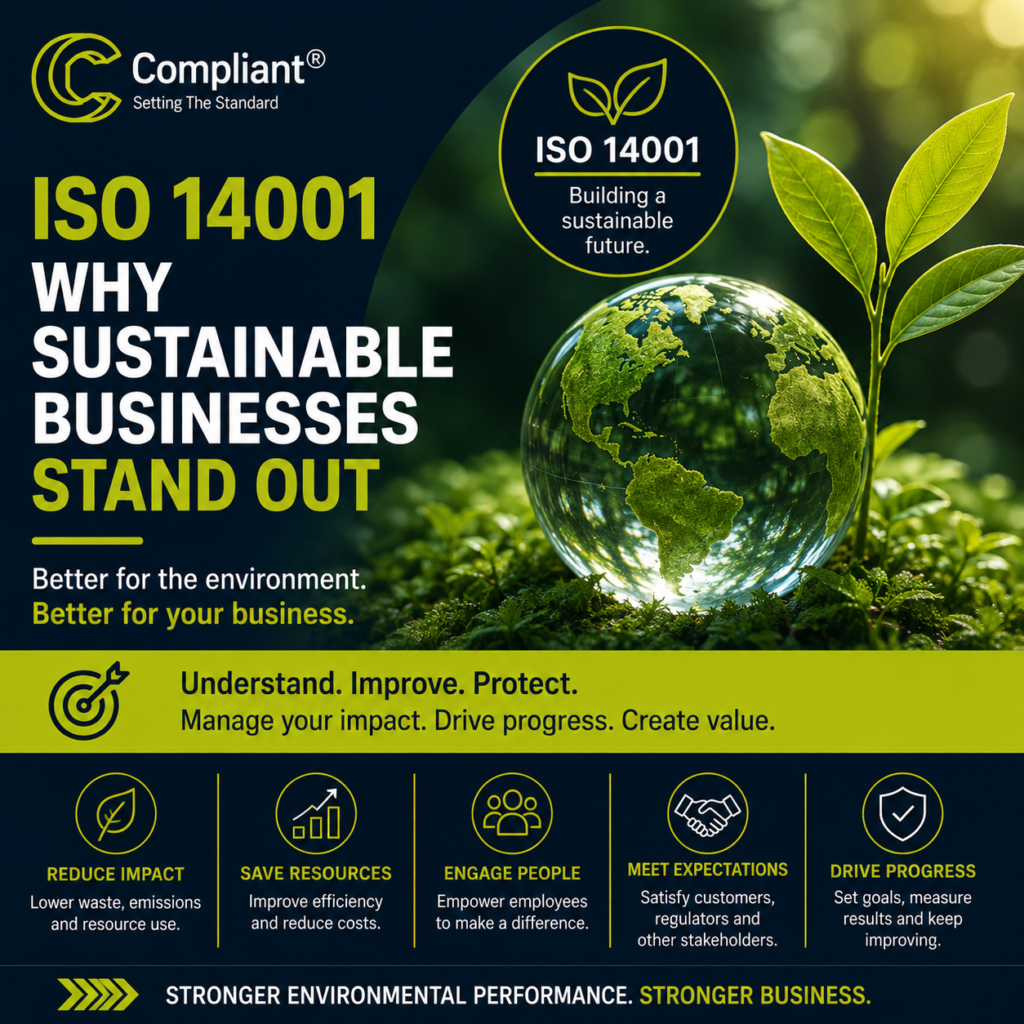
Why Sustainable Businesses Stand Out
Saying you care about the environment is no longer enough
Almost every business wants to look responsible.
Websites talk about sustainability.
Companies announce environmental promises.
Products carry green messages.
Annual reports explain how seriously environmental issues are being taken.
But there is a problem.
People are becoming much better at asking one simple question:
What are you actually doing?
Customers want evidence.
Larger organisations are asking suppliers about their environmental practices.
Employees want to work for businesses that take their responsibilities seriously.
Tender documents can include environmental questions.
Investors and other interested groups may want to understand environmental risks.
Simply saying, “We care about the environment”, is becoming less powerful.
Businesses need to show action.
That is one reason ISO 14001 can be so valuable.
It helps organisations move away from vague environmental promises and towards a structured way of managing their environmental impact.
You understand where your business affects the environment.
You decide what needs attention.
You set objectives.
You take action.
You measure what happens.
Then you improve.
That is how sustainable businesses stand out.
Not because they make the biggest promises.
Because they can show what they are doing.
Sustainability is becoming a business issue
Environmental responsibility was once treated by some organisations as something separate from everyday business.
Something nice to do when there was enough time or money.
That view is becoming harder to maintain.
Energy costs affect your business.
Waste costs affect your business.
Raw material use affects your business.
Transport affects your business.
Environmental laws affect your business.
Customer expectations affect your business.
Supplier requirements affect your business.
Climate-related events can affect your business.
Environmental performance is therefore not just about protecting nature.
It can affect cost, risk, reputation and the ability to win work.
This changes the conversation.
Instead of asking:
“Can we afford to become more sustainable?”
a better question might be:
“What is poor environmental management already costing us?”
The answer may be larger than you expect.
Waste is not just an environmental problem
Look inside almost any organisation and you will find waste.
Packaging.
Paper.
Electricity.
Water.
Fuel.
Raw materials.
Damaged products.
Unnecessary journeys.
Items being thrown away because too much was ordered.
Machines running when nobody needs them.
Lights left on in empty areas.
None of these things happens for free.
Your business paid for them.
Then, in many cases, it pays again to dispose of them.
Reducing waste therefore creates two possible benefits.
It can reduce environmental impact.
And it can reduce cost.
This is where ISO 14001 can help businesses think more clearly.
Instead of carrying out random environmental activities, organisations look at where their significant environmental impacts occur.
That helps them focus their attention.
Perhaps electricity use is a major issue.
Perhaps waste packaging is more important.
Maybe fuel use is significant.
For another organisation, chemicals or water could be the priority.
Sustainability should reflect the business.
Not somebody else’s checklist.
Sustainable businesses know where their impact comes from
You cannot manage something properly if you do not understand it.
That sounds obvious.
Yet businesses sometimes launch environmental programmes before identifying where their biggest impacts actually are.
They introduce recycling bins because recycling is visible.
Meanwhile, an inefficient process could be wasting far more resources every day.
ISO 14001 encourages organisations to understand their environmental aspects and impacts.
The language may sound complicated, but the idea is straightforward.
An environmental aspect is something your organisation does that can interact with the environment.
The impact is the change that can result.
For example, your business uses electricity.
That is an aspect.
The environmental effects connected with producing that energy are part of the impact.
Your organisation produces waste.
That is an aspect.
Disposal and the use of resources are connected impacts.
You operate vehicles.
Fuel use and emissions need to be considered.
You use chemicals.
Spills, waste and possible pollution could matter.
Once you understand these areas, you can decide which ones need the greatest attention.
That creates focus.
And focus helps turn good intentions into useful action.
ISO 14001 helps turn sustainability into everyday work
A sustainability statement on your website will not change much by itself.
Real improvement happens inside everyday processes.
How products are bought.
How materials are used.
How waste is handled.
How equipment is maintained.
How employees are trained.
How suppliers are selected.
How new projects are planned.
How environmental incidents are reported.
How performance is reviewed.
ISO 14001 provides a management system framework that helps connect these activities.
The aim is not to create a separate “environmental business” sitting alongside the real business.
Environmental thinking should become part of normal decisions.
For example, purchasing teams might consider packaging when choosing suppliers.
Operations might monitor wasted materials.
Facilities teams could track energy use.
Managers might include environmental performance when reviewing business results.
Employees could be encouraged to report leaks, waste or unnecessary energy use.
Small decisions begin to work together.
That is when environmental management becomes much more powerful.
Customers are asking more questions
Customers are increasingly interested in how organisations operate.
For some consumers, environmental responsibility can influence what they buy.
For business-to-business organisations, the pressure can be even more direct.
A large customer may ask suppliers to provide information about their environmental management.
Tender documents may ask whether you hold ISO 14001 certification.
Procurement teams may want evidence of environmental objectives.
Customers might ask how you manage waste, energy or environmental risk.
Why?
Because your environmental performance can become part of their environmental impact too.
A company trying to improve its own environmental performance cannot ignore its supply chain.
That means suppliers may increasingly need to demonstrate what they are doing.
A business with a structured environmental management system can be in a much stronger position to answer those questions.
Instead of saying:
“We take sustainability seriously.”
you can explain how environmental risks are managed, what objectives have been set and how performance is monitored.
That is a much stronger conversation.
Evidence builds trust
People have heard many environmental promises.
They have also seen promises that produced very little action.
That creates doubt.
Customers may question environmental claims.
Employees may become tired of hearing ambitious statements without seeing practical changes.
Business partners may want evidence before accepting what they are told.
Trust therefore matters.
ISO 14001 can support that trust because it gives organisations a recognised framework for environmental management.
Certification involves independent assessment.
That does not mean an ISO 14001-certified organisation has no environmental impact.
Nor does it mean the organisation has reached environmental perfection.
It means a management system is in place to identify and manage environmental issues and support ongoing improvement.
That distinction matters.
Sustainable businesses do not need to pretend they have solved every environmental problem.
They need to demonstrate that they understand their impact and are taking responsible action to manage and improve it.
Employees can see whether sustainability is real
Your employees know what happens inside your business.
They know whether waste is ignored.
They see equipment left running.
They know whether recycling bins are used properly.
They see whether environmental concerns are taken seriously.
This means employees can quickly spot the difference between a sustainability message and actual behaviour.
Imagine a company announces a major environmental commitment.
At the same time, employees watch useful materials being thrown away every day because nobody has fixed a poor process.
The message loses credibility.
ISO 14001 encourages employee awareness and clear responsibilities.
People need to understand how their work can affect environmental performance.
That does not mean every employee needs to become an environmental expert.
They need practical information.
What should they do?
What should they avoid?
What needs to be reported?
How can they help?
When people understand their role, sustainability becomes something employees can participate in rather than something they simply read about in company emails.
Your employees may already know where waste is hiding
Ask your employees one question:
“Where do we waste the most?”
The answers could be extremely useful.
Someone in production may know exactly where materials are regularly lost.
A warehouse employee might notice unnecessary packaging.
An office worker could know which process still prints hundreds of pages nobody needs.
A driver might see journeys that could be planned more efficiently.
A maintenance employee could know which equipment uses far more energy than it should.
People working closest to a process often see things managers do not.
ISO 14001 works best when environmental improvement is not restricted to one environmental manager.
People across the organisation should be able to identify issues and contribute ideas.
Not every idea will be possible.
But asking the question creates awareness.
And sometimes the simplest observations can lead to valuable improvements.
Environmental improvement can save money
Sustainability is sometimes presented as an expense.
In reality, environmental improvement can uncover waste that is already costing the business money.
Consider energy.
If equipment runs unnecessarily, you pay for electricity you did not need.
Consider materials.
If products regularly need to be remade, more resources are consumed.
Consider water.
A leak is both an environmental issue and a cost.
Consider waste disposal.
Reducing waste may reduce disposal charges.
Consider transport.
Better planning could reduce unnecessary journeys and fuel use.
The environmental benefit and the business benefit can often support each other.
ISO 14001 encourages organisations to set environmental objectives that make sense for their circumstances.
An objective might be to reduce electricity use.
Reduce waste.
Use fewer raw materials.
Improve recycling.
Reduce fuel use.
Prevent pollution.
The important part is making objectives meaningful.
“Be greener” is difficult to manage.
“Reduce electricity use by a measurable amount over a defined period” gives you something you can actually track.
Sustainable businesses think before problems happen
Environmental incidents can be expensive.
A spill can cause damage.
Incorrect waste disposal can create legal problems.
Poor storage can lead to pollution.
A supplier failure could disrupt important materials.
Extreme weather could affect operations.
ISO 14001 encourages organisations to think about risks and opportunities before something happens.
What could go wrong?
What controls are needed?
What would we do if there was an emergency?
Who needs to know?
Do employees understand their responsibilities?
Is equipment available?
Have arrangements been tested where necessary?
Prevention is usually much easier than dealing with the consequences afterwards.
This is another reason sustainable businesses can stand out.
They are not simply reacting.
They are preparing.
Legal requirements cannot be left to chance
Environmental responsibilities can include legal requirements.
These will vary depending on what an organisation does and where it operates.
The important point is that businesses need a way to understand which requirements apply to them and keep that information current.
Guessing is not enough.
“We think we’re compliant” is not a strong position.
ISO 14001 requires organisations to consider their compliance obligations and evaluate whether they are being met.
This creates structure.
Responsibilities can be assigned.
Requirements can be identified.
Compliance can be checked.
Changes can be reviewed.
If something is wrong, action can be taken.
Good environmental management helps move compliance away from assumption and towards evidence.
Suppliers are part of the environmental picture
Your environmental impact does not necessarily begin and end at your own doors.
What you buy matters.
Where it comes from matters.
How it is packaged matters.
How far it travels may matter.
How it is disposed of may matter.
ISO 14001 encourages organisations to consider environmental issues from a broader life-cycle view where appropriate.
That does not mean you suddenly become responsible for controlling everything every supplier does.
It means thinking beyond your immediate activities.
Could a product with less packaging be selected?
Could materials be sourced differently?
Can environmental requirements be included when choosing suppliers?
Could a product be designed to last longer?
What happens when something reaches the end of its useful life?
These questions can reveal opportunities that are easy to miss when you only look inside your own building.
Leadership determines whether sustainability survives
Environmental programmes often begin with enthusiasm.
Objectives are announced.
Teams are formed.
Ideas are shared.
Then normal business pressure returns.
Orders need completing.
Customers need attention.
Budgets become tight.
Environmental actions quietly move down the list.
This is why leadership matters.
If senior managers treat environmental performance as optional, everyone else will too.
ISO 14001 places responsibility on leadership to support the environmental management system.
Leaders need to make sure environmental considerations are connected with the direction of the business.
They need to provide appropriate resources.
They need to support people with responsibilities.
They need to review performance.
Most importantly, they need to demonstrate through their decisions that environmental management matters.
Employees watch actions more closely than statements.
Do not try to solve everything at once
Once you start examining environmental impact, the list of possible improvements can become long.
Energy.
Waste.
Packaging.
Water.
Travel.
Suppliers.
Materials.
Emissions.
Training.
Processes.
Trying to tackle everything immediately can result in very little being completed properly.
Priorities matter.
ISO 14001 helps organisations identify which environmental aspects are most significant.
This allows resources to be focused.
Ask questions such as:
Where is our biggest environmental impact?
Where is the greatest environmental risk?
Where are we wasting the most resources?
What matters most to our customers and other interested parties?
Where could an improvement create both environmental and business value?
Then start there.
Sustainability is a journey.
You do not need to complete it in one giant leap.
Small environmental changes can create large results
Not every environmental improvement needs major investment.
Some of the best changes can be simple.
Changing when equipment is switched off.
Reducing unnecessary printing.
Fixing leaks faster.
Changing packaging.
Improving waste separation.
Planning deliveries more effectively.
Adjusting how materials are ordered.
Maintaining equipment properly.
Giving employees clearer instructions.
Reviewing settings on heating or cooling systems.
One small change may not transform your environmental performance.
But repeat that approach across the organisation and the results can grow.
This is where continual improvement becomes important.
ISO 14001 does not expect organisations to reach environmental perfection.
It encourages ongoing improvement in the environmental management system to enhance environmental performance.
Understand.
Act.
Measure.
Learn.
Improve again.
Measure what matters
You cannot know whether environmental performance is improving if you never measure it.
But that does not mean producing hundreds of figures.
Choose information that helps you make decisions.
Depending on the organisation, that could include:
Energy use.
Water use.
Waste produced.
Waste recycled.
Fuel consumption.
Material use.
Environmental incidents.
Progress towards objectives.
Then look at trends.
Did energy use fall because of an improvement, or simply because production was lower?
Has waste increased?
Why?
Did a new process create an unexpected problem?
Are environmental objectives being achieved?
Numbers become useful when they lead to questions.
And good questions lead to better decisions.
ISO 14001 is about progress, not a green badge
Certification can be valuable.
It can help demonstrate environmental commitment.
It may support tender requirements.
It can provide independent recognition.
But treating ISO 14001 purely as a badge misses the bigger opportunity.
The real value is in the management system.
Understanding environmental impact.
Reducing waste.
Managing risk.
Improving compliance.
Engaging employees.
Setting objectives.
Measuring performance.
Making better decisions.
Improving over time.
A certificate can show that a recognised system has been independently assessed.
The everyday benefits come from using that system properly.
Sustainable businesses stand out because they can show progress
Customers do not need every organisation to be perfect tomorrow.
Employees do not expect every environmental challenge to disappear overnight.
What increasingly matters is credibility.
Does the organisation understand its environmental impact?
Does it have a plan?
Are people responsible?
Is progress measured?
Are problems addressed?
Are improvements being made?
Can the business provide evidence?
That is where ISO 14001 can make a meaningful difference.
It creates a framework around environmental responsibility.
Instead of sustainability being a collection of good intentions, it becomes something that can be managed.
And what gets managed has a much better chance of improving.
Environmental responsibility can strengthen your business
Sustainability should not sit in a corner of the organisation.
Done well, it can support wider business goals.
Reducing wasted materials can help control costs.
Reducing energy use can save money.
Better planning can reduce risk.
Clear responsibilities can improve employee awareness.
Strong environmental practices can help when customers ask difficult questions.
ISO 14001 can also help organisations approach environmental issues in a consistent way.
That consistency matters.
Especially as expectations increase.
Businesses that start building good environmental management now may be better prepared for the questions customers, employees and other organisations ask tomorrow.
Educational CTA: Find One Environmental Impact You Can Improve
You do not need to begin your sustainability journey with a huge promise.
Start with one honest question:
Where is our business having an environmental impact that we could manage better?
Look at your energy.
Look at your waste.
Look at the materials you buy.
Look at water use.
Look at transport.
Speak to your employees.
Ask them where they see waste every day.
Then choose one area that matters.
Understand what is happening now.
Set a realistic improvement.
Take action.
Measure the result.
Learn from what happens.
Then move to the next opportunity.
That simple process captures something important about ISO 14001.
Environmental responsibility is not about appearing perfect.
It is about understanding your impact and showing that you are serious about improving it.
Because when customers, employees and other businesses look beyond environmental promises, sustainable businesses have something stronger to offer.
Evidence of action.
Evidence that waste is being reduced.
Evidence that risks are being managed.
Evidence that people understand their responsibilities.
Evidence that objectives are being followed.
Evidence that environmental performance matters.
That is why sustainable businesses stand out.
Not because they say more.
Because they can show more.
And with ISO 14001 providing the structure, environmental responsibility can move from a promise on your website to something visible in the way your organisation works every single day.