Your biggest cyber security risk may not be your technology
Your biggest cyber security risk may not be your technology
You can spend thousands on cyber security.
You can install firewalls. You can use strong antivirus software. You can protect your systems with passwords and extra login checks.
But one employee clicking one convincing email can still create a serious problem.
One person can send sensitive information to the wrong email address.
Someone can use the same password across several accounts.
An employee working from home can connect to an unsafe network.
A member of staff can open a file that looks completely normal but contains something harmful.
And sometimes, an employee may not even realise they have made a mistake until days or weeks later.
This is why cyber security cannot sit with the IT team alone.
Your people need to be part of your defence.
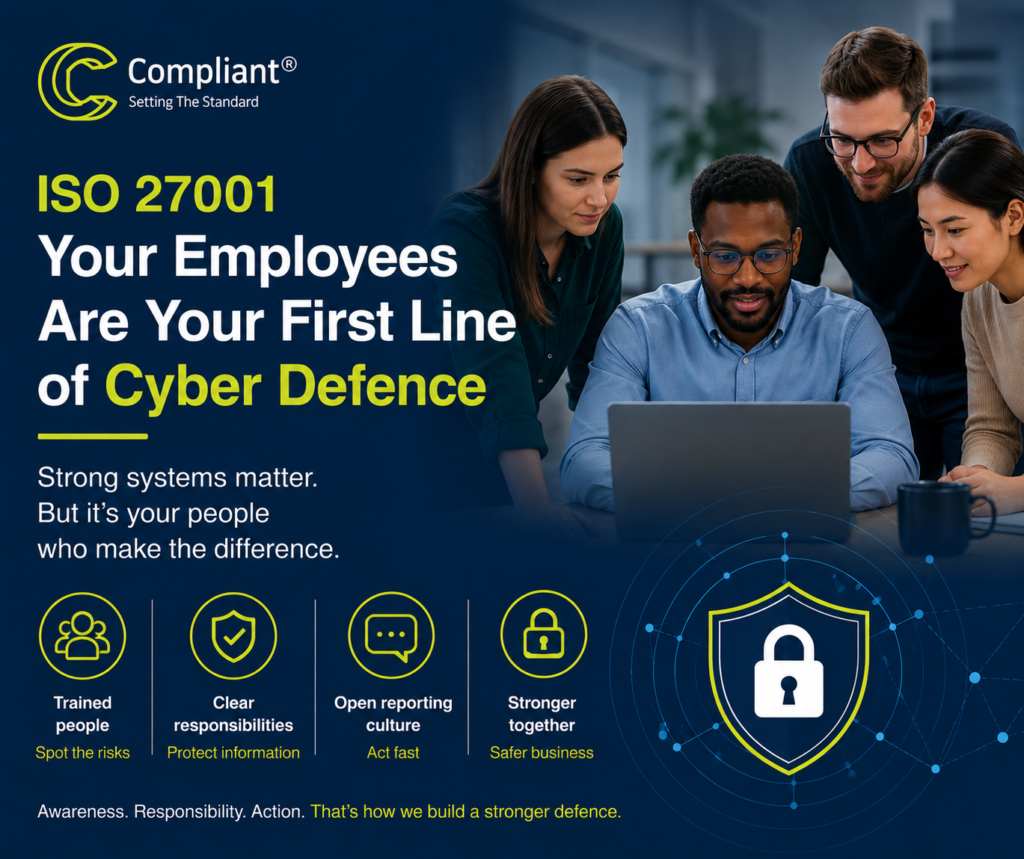
In fact, they are often your first line of defence.
The good news is that this does not mean turning every employee into a cyber security expert.
It means giving people simple rules, clear information, useful training, and the confidence to speak up when something does not look right.
That is where ISO 27001 can make a real difference.
ISO 27001 gives organisations a structured way to manage information security. Instead of relying on people to “be careful”, it helps a business understand its risks and put sensible controls in place.
More importantly, it helps make information security part of everyday work.
Because technology can protect your systems.
Your people help protect your whole organisation.
Cyber criminals do not always attack computers first
When people think about a cyber attack, they often picture a skilled criminal trying to break through complicated computer systems.
That certainly happens.
But there can be a much easier way into a business.
The employees.
Why spend hours trying to break through security systems when you can send someone an email and convince them to give you access?
This is why fake emails and messages can be so dangerous.
They can look real.
A message might appear to come from a senior manager asking for an urgent payment.
An email might look like it has come from a supplier asking an employee to open an invoice.
Someone may receive what appears to be a Microsoft password reset request.
A member of the finance team could receive a message saying that a supplier’s bank details have changed.
The criminal is attacking the person rather than the computer.
They create pressure.
They create fear.
Or they create trust.
Then they wait for someone to act.
A busy employee may not have time to study every email carefully. If they have never been shown what to look for, they might not recognise the warning signs.
That is not simply an employee problem.
It is a business problem.
If your organisation has not given people the right knowledge, processes, and support, you are leaving an important part of your security exposed.
ISO 27001 helps you stop relying on luck
“Everyone knows not to click suspicious emails.”
Do they?
“People know they should use strong passwords.”
Are you sure?
“Our staff would tell us if something went wrong.”
Would they know who to tell?
Would they feel comfortable reporting their own mistake?
These are dangerous assumptions.
Businesses make them every day.
Good information security cannot be built on assumptions.
ISO 27001 helps replace assumptions with a planned approach.
The standard is built around understanding information security risks and deciding what needs to be done about them.
That includes risks involving your people.
An organisation working towards ISO 27001 needs to think about questions such as:
- What information do employees have access to?
- What could happen if that information was shared with the wrong person?
- Do employees understand their security responsibilities?
- Have people received suitable awareness and training?
- What happens when somebody joins the business?
- What happens when somebody leaves?
- Are access rights still suitable when an employee changes role?
- Do people know how to report a security concern?
- What happens after an incident?
- Are lessons learned and improvements made?
These questions begin to change the way an organisation thinks about cyber security.
Security stops being something that happens quietly in the IT department.
It becomes part of the way the business works.
Your employees need to know what “good” looks like
Telling employees to “be cyber aware” is not enough.
It is too vague.
People need practical guidance that relates to their job.
A person working in finance may face different risks from someone working in marketing.
A senior manager may have access to highly sensitive information.
Someone in HR could hold personal employee records.
A salesperson might regularly work away from the office.
An IT administrator may have powerful access to important systems.
Each person needs to understand what is expected of them.
ISO 27001 helps organisations create that clarity.
Policies and processes can explain how information should be handled, but those documents need to work in real life.
A 40-page policy that nobody reads is not protecting anything.
Information should be simple.
Employees should understand what they can and cannot do.
They should know why the rules exist.
Most importantly, they should know what action to take when something feels wrong.
That is when a written policy becomes real protection.
Training should change behaviour, not tick a box
Security awareness training can easily become another yearly task.
Employees watch a video.
They answer a few questions.
They click “complete”.
Everyone moves on.
Technically, training has happened.
But has anything changed?
That is the more important question.
Effective training should help people make safer decisions.
An employee should know how to recognise a suspicious email.
They should understand why sharing passwords is dangerous.
They should know why company information should not simply be copied onto personal devices.
They should understand the risks of discussing sensitive information in public places.
They should know what to do if they lose a laptop or phone.
And they should know exactly how to report something suspicious.
ISO 27001 encourages organisations to think beyond simply proving that training took place.
You need to consider whether people are competent and aware of their responsibilities.
That creates a much more useful question:
Do our employees actually understand what they need to do?
The answer matters far more than having a training certificate stored in a folder.
Make reporting mistakes easy
One of the worst things an organisation can do is create a culture where employees are scared to report mistakes.
Imagine an employee clicks a suspicious link.
Nothing obvious happens.
They suddenly realise the email may have been fake.
But they are embarrassed.
They are worried their manager will be angry.
So they say nothing.
Hours pass.
Perhaps days.
Meanwhile, an attacker could be using the opportunity to gain further access.
The original mistake may be small.
The delay can make it much bigger.
Your employees need to understand that fast reporting is valuable.
If someone believes they have made a security mistake, you want them to tell the right person immediately.
No hiding it.
No hoping everything will be fine.
No waiting until Monday morning.
A good security culture makes reporting easy and clear.
Employees know who to contact and what information to provide.
They also understand that reporting a possible incident is the responsible thing to do.
ISO 27001 supports this structured approach to information security incidents.
The goal is not to create blame.
The goal is to respond, learn, and improve.
Access to information should match the job
Does every employee have access only to the information they need?
It sounds simple.
In practice, access can build up over time.
Someone joins the business and receives access to certain systems.
Six months later, they move departments.
They receive more access.
Two years later, they are promoted and receive even more.
But nobody removes the access they no longer need.
Now they can reach information that has nothing to do with their current role.
This creates unnecessary risk.
ISO 27001 encourages organisations to manage access in a controlled way.
The basic idea is straightforward.
People should have the access they need to do their job.
No more than necessary.
When roles change, access should be reviewed.
When somebody leaves, access should be removed at the right time.
This protects the business and the employee.
People cannot accidentally misuse information they cannot access.
It also makes it harder for a stolen employee account to provide an attacker with access across the entire organisation.
Senior leaders must set the standard
Cyber security habits spread from the top.
If senior leaders ignore security rules because they are inconvenient, employees will notice.
If a director regularly shares passwords, why should everyone else take password rules seriously?
If managers do not complete security training, employees may decide it is not important.
ISO 27001 places importance on leadership for a reason.
Information security needs support from senior management.
Leaders need to understand why it matters and demonstrate that through their actions.
This does not mean senior managers need to understand every technical detail.
They do need to understand the risks facing the organisation.
They need to make sure suitable resources are available.
They need to support the organisation’s information security objectives.
And they need to make it clear that protecting information is everyone’s responsibility.
Security culture is built through what an organisation repeatedly does.
Not what it says once a year.
Cyber security needs to become an everyday habit
The strongest organisations do not treat information security as a special event.
It becomes part of normal work.
Employees lock their computers when they walk away.
Sensitive information is stored in the right place.
Access requests follow a clear process.
Suspicious messages are questioned.
Security incidents are reported quickly.
New employees receive clear guidance.
People leaving the business have their access removed.
Risks are reviewed when new systems are introduced.
Suppliers are considered before sensitive information is shared with them.
None of these actions needs to feel complicated.
That is one of the biggest strengths of a well-managed ISO 27001 system.
Good security becomes routine.
When safe behaviour is the easiest and most normal way to work, employees are much more likely to follow it.
ISO 27001 is not just an IT project
This misunderstanding causes many organisations problems.
ISO 27001 involves technology, but it is not simply an IT standard.
Information exists everywhere.
It can be inside software.
It can be written on paper.
It can be discussed in meetings.
It can sit in someone’s email inbox.
It can be stored on a phone.
It can be shared with a supplier.
It can even exist in an employee’s memory.
That means information security affects almost every part of an organisation.
HR has a role.
Finance has a role.
Operations has a role.
Senior management has a role.
Employees have a role.
IT has a role too, of course.
But giving the entire ISO 27001 project to the IT manager and expecting them to solve everything can create gaps.
Successful information security needs involvement from across the business.
This is also an area where the benefits of an ISO consultant’s support can become clear.
The benefits of an ISO consultant’s support
ISO 27001 can feel overwhelming when you first look at it.
There are requirements to understand.
Risks to identify.
Processes to review.
Documents to create or improve.
People to train.
Controls to consider.
Evidence to collect.
And day-to-day work still needs to continue.
An experienced ISO consultant can help make the process much clearer.
The consultant should not simply arrive with a huge set of documents and tell you to use them.
Your business is unique.
Your people are unique.
Your risks are unique.
Good consultancy support starts by understanding how your organisation actually works.
A consultant can then help identify gaps between what you currently do and what ISO 27001 expects.
This can save a great deal of wasted time.
Instead of changing everything, you can focus on what actually needs attention.
You may discover that many good practices already exist.
They might simply need to be made clearer, recorded properly, or followed more consistently.
That can make the journey far less daunting.
A consultant can help turn ISO language into normal language
One of the biggest barriers to any ISO standard is understanding what the requirements mean for your business.
Standards have to work across many different types and sizes of organisations.
That means reading a requirement and knowing exactly what you need to do is not always easy.
An experienced consultant can help turn those requirements into practical actions.
Instead of asking:
“What does this clause mean?”
You can focus on:
“What does our business need to do?”
That difference matters.
Your employees do not need lessons in complicated ISO language.
They need to know their responsibilities.
A consultant can help you create processes and guidance that employees can actually understand and follow.
This supports the wider aim of ISO 27001.
You are not trying to build a management system that only makes sense to an auditor.
You are building a system that protects your organisation.
Outside support can help you see risks you have stopped noticing
Every organisation has habits.
Some are good.
Some create risk.
The problem is that when you work somewhere every day, unusual practices can start to feel completely normal.
“That’s how we’ve always done it.”
Those words can hide a lot of risk.
Perhaps passwords are being shared because it makes a process quicker.
Maybe former employees still have access to systems.
Sensitive documents might be stored in locations that are open to too many people.
Employees may be using personal email accounts for work because it feels easier.
Nobody necessarily intended to create a security weakness.
It simply developed over time.
An experienced ISO consultant brings an outside view.
They can ask questions that people inside the organisation may no longer think to ask.
Why do you do it this way?
Who can access this?
What happens when this person is away?
How would you know if this went wrong?
Who would report it?
Those simple questions can uncover important gaps.
ISO 27001 helps create improvement rather than perfection
No organisation can remove every information security risk.
People will still make mistakes.
Technology can still fail.
New threats will appear.
Businesses will change.
ISO 27001 is valuable because it does not depend on pretending these things will never happen.
Instead, it gives you a way to manage them.
You identify risks.
You decide how they should be treated.
You put suitable controls in place.
You monitor what is happening.
You review incidents and problems.
Then you improve.
That cycle matters because your business will not stay the same.
You may recruit new employees.
Introduce new software.
Open another office.
Start working with different suppliers.
Allow more people to work from home.
Launch new services.
Each change can create new information security risks.
Your management system needs to change with the organisation.
Your employees can become one of your greatest security strengths
Employees are often described as the “weakest link” in cyber security.
That description misses an important point.
People can also be one of your strongest forms of protection.
A trained employee can spot a suspicious email before it causes damage.
A confident employee can question an unusual payment request.
A careful manager can notice that somebody has access they no longer need.
A member of staff can report a lost device immediately.
Someone can challenge an unknown person trying to enter a secure area.
An employee can notice something unusual and raise the alarm before technology detects it.
That is powerful.
But it does not happen by accident.
People need knowledge.
They need clear responsibilities.
They need simple processes.
They need regular reminders.
And they need to know that information security matters to the organisation.
ISO 27001 can provide the structure needed to make those things happen.
Protecting information protects much more than data
Information security problems can affect almost every part of a business.
A serious incident can stop employees from working.
Customers can lose confidence.
Sensitive information can be exposed.
Important files can become unavailable.
Money can be lost.
Suppliers can be affected.
Senior managers can suddenly find themselves dealing with a major problem instead of running the business.
This is why ISO 27001 should not be viewed simply as a certificate.
The real value comes from what happens behind the certificate.
Better awareness.
Clearer responsibilities.
Stronger processes.
Better control over access.
Faster reporting.
Improved understanding of risk.
More confident employees.
And a business that is better prepared when something goes wrong.
Certification can provide valuable independent recognition.
But the greatest benefit is having a system that works every day.
Start by asking your people five simple questions
You do not need to wait for a cyber incident to discover whether your employees are prepared.
Ask them.
Choose people from different parts of your organisation and ask five simple questions:
- How would you recognise a suspicious email or message?
- What would you do if you accidentally clicked a suspicious link?
- Who would you tell if you thought company information had been lost or shared incorrectly?
- What information are you responsible for protecting in your role?
- What would you do if somebody asked you for information and you were not sure they should have it?
Listen carefully to the answers.
If employees hesitate, give very different responses, or simply do not know, you have found an opportunity to improve.
Do not use the exercise to catch people out.
Use it to understand where more guidance is needed.
That is the mindset behind effective ISO 27001 management.
Find the gap.
Understand the risk.
Make the improvement.
Check whether it worked.
Then keep improving.
Your first line of cyber defence is already inside your business
Cyber security is not something you can simply buy.
The latest software can help.
Strong technical controls matter.
But technology is only one part of the answer.
Every person who handles your information has a role to play.
From the newest employee to the managing director.
Your people make decisions every day that can either increase or reduce information security risk.
ISO 27001 helps you make those decisions safer by creating clear responsibilities, improving awareness, managing risk, and making information security part of normal business life.
And this is where the benefits of an ISO consultant’s support can be particularly valuable.
The right consultant can help you understand where you are today, identify the gaps that matter, explain the requirements clearly, and help you build an approach that fits your organisation rather than forcing your organisation to fit a pile of paperwork.
The aim should never be to make ISO 27001 feel complicated.
It should be to make information security clearer.
Because your employees do not need to become cyber security experts.
They need to understand the risks they face, recognise when something does not look right, know what is expected of them, and feel confident enough to act.
Educational CTA: Test Your First Line of Defence
Before investing in another security tool, spend some time looking at the people already protecting your information.
Ask employees what they would do if they received a suspicious email. Check whether they know how to report a possible incident. Review whether people have access only to the information they need. Look at when security awareness was last discussed and whether that training has changed behaviour.
If you are considering ISO 27001, use these findings as the beginning of your information security journey.
And if you are already working towards the standard, ask whether your management system is genuinely helping your employees make safer choices or simply producing more paperwork.
Your goal is not perfect people.
It is informed people.
People who understand the risks.
People who know what to do.
And people who recognise that protecting information is part of their everyday job.
Build that understanding, support it with a practical ISO 27001 management system, and your employees can become far more than a possible cyber security risk.
They can become your first, and one of your strongest, lines of cyber defence.