Skip to main content
Skip to footer
Skip to main content
Skip to footer

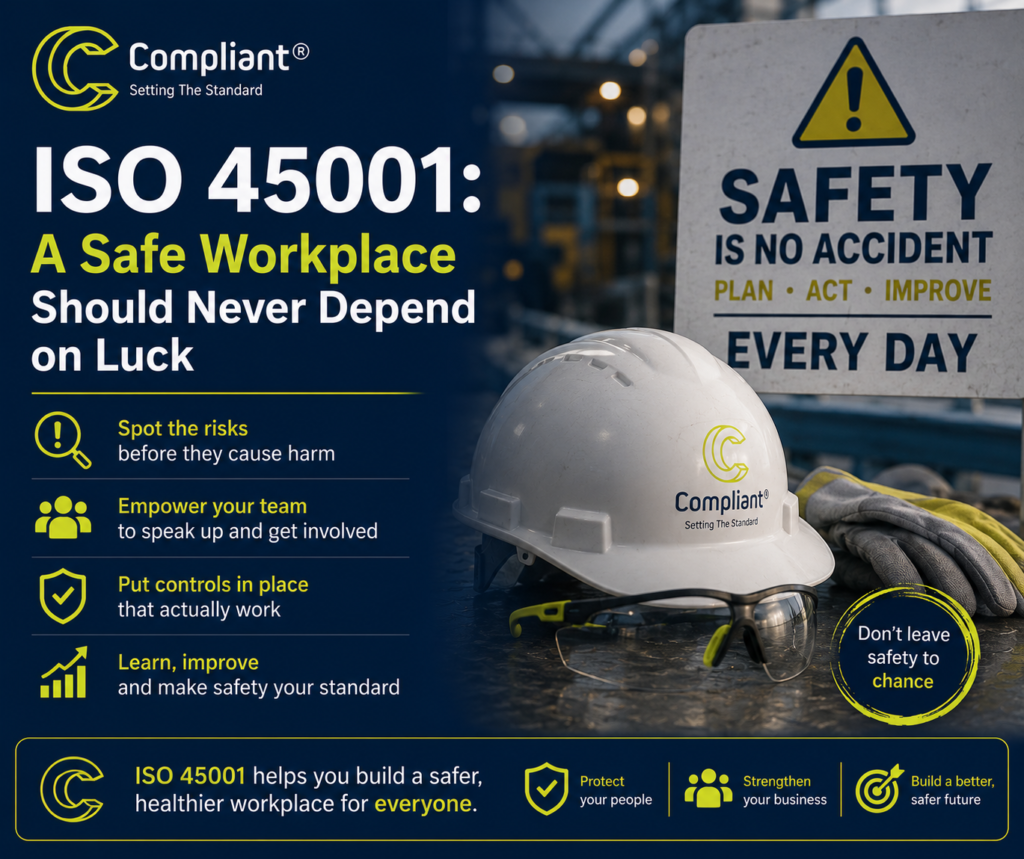
ISO 45001: A Safe Workplace Should Never Depend on Luck
ISO 45001: A Safe Workplace Should Never Depend on Luck
Nobody should finish a working day safely because they were lucky.
Yet in many workplaces, luck plays a much bigger role than anyone would like to admit.
A damaged piece of equipment is noticed just before somebody uses it.
An employee nearly slips but manages to catch themselves.
A vehicle reverses without hitting the person walking behind it.
Someone uses equipment incorrectly but escapes without injury.
A heavy item falls but lands where nobody happens to be standing.
Everyone carries on.
“No harm done.”
But something did happen.
The business received a warning.
The problem is that warnings are easy to ignore when nobody gets hurt.
People laugh about the close call. The damaged equipment gets moved. The spill is cleaned up. Work continues.
Then the same weakness appears again.
Next time, the outcome may be very different.
This is exactly why workplace health and safety cannot depend on luck.
A strong ISO 45001 Occupational Health and Safety Management System helps organisations move away from reacting to accidents and towards preventing them.
It encourages businesses to understand risks, involve employees, investigate incidents, learn from near misses and create safer ways of working.
Because “nothing has happened yet” is not evidence that your workplace is safe.
Sometimes, it simply means you have been fortunate.
“We’ve Never Had an Accident” Is Not a Safety Strategy
Businesses are often proud of their accident record.
And they should be pleased when people are working safely.
But there is an important difference between having no accidents and having strong safety controls.
Imagine a warehouse where employees regularly walk through an area used by moving vehicles.
There has never been a collision.
Does that mean the arrangement is safe?
Not necessarily.
Perhaps drivers have been careful.
Perhaps employees have been alert.
Perhaps everybody has simply been lucky.
Now imagine a machine where a safety guard is regularly removed because it makes the job quicker.
Nobody has been injured.
Does that make the practice acceptable?
Again, no.
A good safety system asks what could happen, not only what has already happened.
That shift in thinking is one of the most important parts of ISO 45001.
You do not wait for somebody to get hurt before deciding a risk deserves attention.
You identify the danger.
You understand who could be harmed.
You decide what controls are needed.
Then you check whether those controls actually work.
Prevention is always better than explaining afterwards why something was allowed to continue.
Near Misses Are Warnings, Not Good News
A near miss can be easy to dismiss.
Nobody was injured.
Nothing was damaged.
The job continued.
But a near miss can be one of the most useful pieces of safety information your business receives.
Imagine an employee trips over a cable but stays on their feet.
You could say:
“No harm done.”
Or you could ask:
Why was the cable there?
Could somebody else trip over it?
Has this happened before?
Can the cable be moved?
Does the area need a different layout?
That simple investigation could prevent a future injury.
The same applies to falling objects, vehicle movements, equipment failures, spills and countless other situations.
Near misses show you where controls may be weak before the worst happens.
ISO 45001 encourages organisations to learn from these events.
The aim is not to create mountains of paperwork every time something nearly happens.
It is to notice patterns and act.
If employees regularly have close calls in the same area, something needs attention.
If the same equipment repeatedly creates problems, investigate it.
If workers keep finding safer ways around a process, perhaps the process itself needs changing.
Every near miss is information.
Use it.
Your Employees Often See Risks Before Managers Do
Senior managers cannot be everywhere.
Health and safety managers cannot watch every task.
But your employees are close to the work every day.
They know which jobs are awkward.
They know which equipment causes problems.
They know where people take shortcuts.
They know which instructions are difficult to follow.
They know when time pressure changes behaviour.
They know which areas feel unsafe.
That knowledge is extremely valuable.
A strong ISO 45001 system recognises the importance of worker involvement.
Health and safety should not be something management does to employees.
Employees should be involved in it.
Ask questions.
What worries you?
What makes this job difficult?
Where do you see people taking shortcuts?
Is there a safer way?
What would make this task easier to complete correctly?
Then listen.
People are much more likely to support safety processes when they understand why they exist and have been given an opportunity to contribute.
Risk Assessments Should Reflect Real Work
Risk assessments are an important part of workplace safety.
But they only provide value when they reflect what actually happens.
A beautifully written risk assessment sitting in a folder will not protect anybody.
Imagine a process has changed.
New equipment has been introduced.
The team has grown.
The workspace has moved.
Employees now complete the task differently.
But the risk assessment has not changed for three years.
Is it still useful?
Maybe.
Maybe not.
Risk assessments need to remain connected to real work.
Go and look at the activity.
Talk to the people completing it.
Observe what happens.
Are the controls realistic?
Are they being followed?
Has anything changed?
Have employees identified new risks?
Have there been near misses?
Good risk management is not about producing the longest possible document.
It is about understanding danger and taking sensible action.
Procedures That Nobody Follows Will Not Keep People Safe
Businesses can create excellent safety procedures.
Then employees ignore them.
Why?
Sometimes people take shortcuts.
That needs addressing.
But sometimes the procedure itself is part of the problem.
Perhaps it is too complicated.
Maybe it takes much longer than the task itself.
Perhaps the instructions do not match the equipment being used.
Maybe employees were never properly shown what to do.
Or perhaps production pressure quietly encourages people to ignore certain steps.
This is why businesses need to understand what actually happens rather than assuming written procedures are always followed.
If several employees are taking the same shortcut, ask why.
Do not immediately assume the answer is poor behaviour.
The process may need improving.
Safety controls need to work in the real world.
Especially when people are busy.
Time Pressure Can Change Safe Behaviour
“We need this finished today.”
Most employees have heard something similar.
Deadlines are normal.
Customers expect work.
Projects need completing.
Businesses need to operate.
But pressure can change decisions.
Someone skips a check.
A worker decides not to collect the correct equipment because it will take another ten minutes.
A supervisor ignores a small problem because stopping work would cause a delay.
An employee rushes.
Nothing happens.
The shortcut worked.
That is where danger begins.
Because once an unsafe shortcut works without consequences, it can become normal.
Next time, somebody does it again.
Then somebody else copies them.
Eventually, the unsafe method becomes “how we do things.”
Leadership needs to be careful about the messages it sends.
If managers say safety comes first but regularly reward speed at the expense of safe working, employees notice.
The real culture of a business is shown by what happens when doing something safely becomes inconvenient.
Leadership Sets the Standard
ISO 45001 places strong importance on leadership.
That makes sense.
Senior leaders influence priorities.
They decide where resources go.
They set expectations.
They influence culture.
If a manager walks past an unsafe situation without saying anything, employees learn something.
If a director ignores safety rules because they are “only visiting for five minutes”, employees notice.
If managers complain every time safety slows down a task, people understand the message.
Leadership does not mean knowing every technical detail of health and safety.
It means demonstrating that protecting people matters.
Ask questions.
Review incidents.
Support improvements.
Provide suitable resources.
Follow the same rules as everyone else.
Listen to employees.
Take concerns seriously.
A strong safety culture cannot be built entirely from policies.
It is built through behaviour.
Training Is Not the Same as Competence
An employee has attended a training course.
Does that automatically mean they can complete the job safely?
Not always.
Training is important.
But competence can involve knowledge, skills, experience and the ability to apply what has been learned.
Someone may have completed training several years ago.
Are they still confident?
Has the equipment changed?
Has the process changed?
Do they regularly complete the task?
Do they need refresher training?
Businesses need to think beyond certificates.
A training record tells you that something happened.
It does not always tell you whether somebody can perform a task safely today.
ISO 45001 encourages organisations to consider the competence needed for work that can affect health and safety.
That requires active management.
New Employees May Face Greater Risk
Think about somebody’s first few weeks in your business.
Everything is unfamiliar.
New workplace.
New colleagues.
New equipment.
New processes.
New rules.
They may also want to make a good impression.
That can make people less likely to ask questions.
They do not want to appear difficult.
They may copy what other employees do without understanding why.
This makes induction important.
But induction should be more than signing a form.
New employees need to understand the risks that affect them.
They need to know what to do in an emergency.
They need to know how to report concerns.
They need to understand which tasks they can and cannot complete.
Most importantly, they need to know that asking a safety question is acceptable.
Nobody should feel pressured to pretend they understand something when they do not.
Reporting Needs to Feel Safe
Imagine an employee notices a safety problem.
They consider reporting it.
Then they think:
“Management will say I’m complaining.”
“I’ll get blamed.”
“It will cause too much paperwork.”
“Nobody will do anything anyway.”
So they stay quiet.
That is a serious problem.
Your reporting process can be perfectly designed on paper and still fail if employees do not trust it.
People need to believe that raising a genuine concern is useful.
The same applies when somebody makes a mistake.
If employees fear punishment every time something goes wrong, they may hide problems.
That removes valuable information from the business.
A healthy safety culture does not ignore poor behaviour.
But it does distinguish between deliberate unsafe actions and genuine mistakes.
The goal is to learn.
Incidents Need More Than a Quick Fix
An employee slips.
The floor is cleaned.
Problem solved?
Perhaps not.
Why was the floor wet?
Was something leaking?
Was cleaning taking place?
Was there a warning?
Has this happened before?
Could the flooring itself be contributing?
The first answer is rarely enough.
If you only fix the immediate problem, the underlying cause can remain.
ISO 45001 encourages organisations to investigate incidents and take action.
This is where learning happens.
The same thinking can apply to near misses.
Do not simply ask:
“What happened?”
Ask:
“Why was it possible?”
Then:
“What can we change?”
Contractors Need to Be Part of the Picture
Many businesses use contractors.
They may carry out maintenance.
Construction.
Cleaning.
Electrical work.
Specialist tasks.
Deliveries.
Other services.
Contractors can introduce different risks.
They may not know your site.
Your employees may not understand what the contractor is doing.
Work could affect people nearby.
Responsibilities can become unclear.
This is why contractor control matters.
Before work begins, ask:
What are they doing?
What risks does the work create?
Are they competent?
What information do they need from us?
What do our employees need to know?
Who is responsible for what?
Good communication prevents assumptions.
And assumptions are dangerous when safety is involved.
Change Can Introduce New Risks
Businesses change constantly.
New machinery.
New software.
New premises.
Different shifts.
More employees.
New products.
Different materials.
New suppliers.
Changes to layouts.
Each change can affect health and safety.
Yet organisations sometimes make operational changes first and think about safety afterwards.
ISO 45001 encourages businesses to consider health and safety when change is being planned.
That is much easier than discovering a problem once the change has already happened.
Before introducing something new, ask:
What could this change affect?
Does it create a new risk?
Do employees need training?
Do existing assessments need reviewing?
Does emergency planning change?
Do procedures need updating?
A few questions before implementation can prevent much larger problems later.
Do Your Emergency Plans Work Outside the Folder?
Most businesses have emergency plans.
But would they work?
Imagine an emergency happens tomorrow morning.
Would employees know what to do?
What about new starters?
What about contractors?
Visitors?
Night workers?
People working away from the main site?
When was the plan last tested?
Emergency planning is not about predicting every possible event.
It is about preparing for situations that could reasonably occur and making sure people know how to respond.
Practice reveals weaknesses.
Perhaps an exit is difficult to access.
Maybe people do not know where to assemble.
Perhaps responsibilities are unclear.
Finding these problems during a test is far better than discovering them during a real emergency.
Internal Audits Should Look Beyond Paperwork
Internal audits are an important part of ISO 45001.
But an audit should not simply confirm that documents exist.
Go into the workplace.
Talk to employees.
Look at tasks.
Compare what people do with what the procedure says.
Review near misses.
Check whether actions have been completed.
Look at training.
Check whether risk assessments still match reality.
Ask employees what concerns them.
A useful internal audit may uncover uncomfortable findings.
That is not a bad audit.
It may be a very good one.
Finding a weakness internally gives your business an opportunity to improve before somebody gets hurt.
Management Review Should Drive Action
Senior management needs a clear view of health and safety performance.
Management review provides an opportunity to look at information together.
Incidents.
Near misses.
Internal audit findings.
Objectives.
Employee concerns.
Changes.
Training.
Performance.
Actions.
Look for patterns.
Are the same types of near misses happening?
Are actions taking too long to close?
Has a change introduced new concerns?
Are employees reporting fewer issues because conditions improved, or because they stopped reporting?
Numbers alone do not always tell the whole story.
Leaders need to ask questions.
Management review should lead to decisions.
Otherwise, it is simply another meeting.
Where an ISO Consultant Can Add Value
Implementing and maintaining ISO 45001 can feel demanding.
There are many areas to consider.
Risks.
Worker involvement.
Leadership.
Competence.
Emergency planning.
Incidents.
Audits.
Objectives.
Continual improvement.
It can be difficult to see weaknesses when you work inside the same business every day.
This is where the benefits of an ISO consultant’s support can become valuable.
An experienced ISO consultant can provide an independent view.
They can look at your current system and ask questions.
Does the written process match what happens?
Are employees involved?
Are near misses being used to learn?
Do risk assessments reflect current work?
Are actions actually being completed?
Does management understand what the system is telling them?
A consultant can also help make ISO 45001 easier to understand.
The standard should not become something only one health and safety manager understands.
It needs to connect with everyday work.
Good consultant support can help translate requirements into practical actions.
Consultant Support Should Build Confidence Inside Your Team
There is an important difference between support and dependence.
Your consultant should help strengthen your business.
They should not become the only person who understands your Occupational Health and Safety Management System.
One of the important benefits of an ISO consultant’s support is knowledge sharing.
Managers can develop a better understanding of their responsibilities.
Employees can understand how their actions affect the system.
Internal auditors can become more confident.
Senior leaders can better understand what they should be reviewing.
The aim should be a business that understands its own system.
Because the safest workplace is not one where somebody outside the organisation manages everything.
It is one where safety is understood throughout the organisation.
Five Questions That Could Reveal Whether You Are Relying on Luck
Take a look at your workplace and ask:
1. What nearly went wrong this month?
Do not only review accidents. Look at close calls.
2. What unsafe shortcuts have become normal?
If something happens regularly, people may stop noticing the risk.
3. Do employees feel comfortable reporting concerns?
Ask them rather than assuming they do.
4. Have risk assessments kept up with changes?
New equipment, people and processes can create new risks.
5. Are actions actually being completed?
Identifying a problem achieves little if nobody fixes it.
The answers may be uncomfortable.
That is useful.
You cannot improve a problem you refuse to see.
Safety Is What Happens When Nobody Is Watching
Audits matter.
Inspections matter.
Management visits matter.
But the real test of your safety culture happens during an ordinary working day.
No auditor.
No director walking around.
No inspection planned.
Do people still follow safe processes?
Do they still report problems?
Do supervisors stop unsafe work?
Do employees challenge something that does not look right?
Are checks still completed?
That is where culture becomes visible.
A safe workplace cannot depend on people behaving differently because somebody is watching.
Safe behaviour needs to become normal behaviour.
Stop Waiting for an Accident to Prove There Was a Problem
One of the most dangerous beliefs in workplace safety is:
“It has never happened before.”
Every first accident has that sentence somewhere behind it.
A machine may have operated unsafely for years before somebody is injured.
People may have taken the same shortcut hundreds of times.
Vehicles may have passed pedestrians thousands of times without a collision.
That history does not remove the risk.
It only shows that the worst outcome has not happened yet.
ISO 45001 encourages businesses to look forward.
Identify danger before harm occurs.
Listen to warnings.
Learn from near misses.
Review changes.
Check controls.
Involve employees.
Improve.
Do not wait for an injury to give you permission to take a risk seriously.
A Safe Workplace Should Be Designed, Not Hoped For
Safety is not created by hoping employees will be careful.
It is not created by having a policy.
And it is not guaranteed because last year passed without an accident.
Safe workplaces are built deliberately.
Leaders set expectations.
Employees contribute.
Risks are understood.
Controls are put in place.
People receive appropriate training.
Problems are reported.
Incidents are investigated.
Near misses are treated as warnings.
Changes are reviewed.
Audits find weaknesses.
Management acts.
Then the cycle continues.
That is the value of a strong ISO 45001 Occupational Health and Safety Management System.
It creates a structured way to move from hoping nothing goes wrong to actively working to prevent it.
Where additional guidance is needed, the benefits of an ISO consultant’s support can include helping you understand the standard, identify gaps, challenge old habits and make your management system more practical.
But ultimately, safety belongs to the organisation.
Every manager.
Every supervisor.
Every employee.
Every working day.
Because people should not return home safely at the end of their shift because they were lucky.
They should return home safely because the business understood the risks, listened to its people and did everything reasonably possible to prevent harm.
Educational CTA
This week, do something simple.
Ask your team about the last thing that nearly went wrong.
Not the last accident.
The last near miss.
What happened?
Why did it happen?
Could it happen again?
What stopped somebody being hurt?
Most importantly, was that protection a good safety control, or was it luck?
Use the answer to identify one improvement you can make.
Then make it.
Because the best time to learn from an accident is before it becomes one.
That is how ISO 45001 can help turn workplace safety from something you hope for into something you actively manage every day.