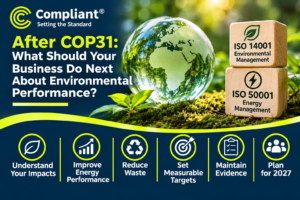
After COP31: What Should Your Business Do Next About Environmental Performance?

 The climate conference headlines may be getting attention, but there is a question every business should be asking.
What are we actually going to do differently?
It is easy to talk about environmental responsibility.
Reducing waste sounds sensible.
Using less energy sounds good for business.
Cutting emissions and making better use of resources are goals many organisations support.
But turning those intentions into measurable improvements is not always straightforward.
Perhaps your business has already made environmental commitments.
You may have introduced recycling arrangements, switched to more efficient lighting or encouraged employees to reduce unnecessary energy use.
You might even have environmental targets written into your business plan.
But can you show whether those changes are working?
Do you know how much energy your organisation uses?
Can you explain which activities have the greatest environmental impact?
Are your targets realistic?
And if a customer asked for evidence of your environmental performance tomorrow, would you know where to find it?
These are the questions that matter beyond the headlines.
COP31 provides an opportunity to reflect on climate action and the direction of environmental policy.
However, international discussions do not automatically tell an individual business what changes it needs to make.
Nor does every announcement made at a climate conference create an immediate legal requirement for UK organisations.
Businesses need to understand which developments are relevant to their activities, what requirements already apply and where practical improvements could provide value.
This is where ISO 14001 and ISO 50001 can help.
Both standards provide internationally recognised management system frameworks.
ISO 14001 focuses on environmental management.
ISO 50001 focuses specifically on energy management and improving energy performance.
Together, they can support organisations that want a more structured approach to managing environmental responsibilities and energy use.
At Compliant Ltd, we support businesses working towards ISO certification and those looking to improve their existing management systems.
As organisations prepare their priorities and budgets for 2027, now is a useful time to consider whether environmental and energy performance should receive greater attention.
COP31: Turning International Discussions Into Business Action
The United Nations Climate Change Conference, known as COP31, is part of the international process through which countries discuss and negotiate responses to climate change.
These discussions can influence future policy, investment priorities and expectations around environmental performance.
But businesses should distinguish between international agreements, national policy announcements, proposed changes and requirements that have actually entered into force.
A decision made at an international conference does not automatically become a new obligation for every UK business.
Any legal requirements will depend on the relevant legislation, the organisation’s activities and how international commitments are implemented.
That distinction matters.
Businesses should not rush into expensive changes because of a headline without understanding whether the information is relevant.
Equally, they should not ignore environmental performance simply because a particular announcement does not create an immediate legal duty.
There are already practical reasons to understand environmental impacts.
Customers may request environmental information during supplier assessments.
Tender applications may include questions about waste, energy use and emissions.
Energy costs can affect operating budgets.
And businesses may identify opportunities to reduce waste and improve how resources are used.
The most useful response to COP31 is therefore not necessarily a dramatic announcement.
It may be a careful review of what your organisation already does, what evidence it holds and what improvements it can realistically achieve.
What Is ISO 14001?
ISO 14001 is the international standard for environmental management systems.
It provides a framework for organisations to identify and manage the environmental aspects of their activities, meet relevant compliance obligations and continually improve their environmental management systems.
An environmental aspect is something an organisation does that can interact with the environment.
This could involve energy use, waste generation, transport, water consumption or the use of materials.
Different businesses will have different environmental aspects.
A manufacturer may need to consider production waste, raw materials and energy-intensive equipment.
A construction contractor may focus on waste handling, fuel use, site activities and the environmental effects of its work.
An office-based business may identify electricity use, travel, purchasing and waste as relevant areas.
ISO 14001 helps organisations establish a structured approach to understanding these activities.
It includes requirements relating to environmental policy, leadership, planning, operational controls, performance evaluation and continual improvement.
The standard does not require every business to achieve the same environmental results.
Instead, organisations need to understand their own circumstances and establish appropriate arrangements.
For businesses considering environmental performance after COP31, ISO 14001 can provide a practical framework for turning broad commitments into managed activities.
What Is ISO 50001?
ISO 50001 is the international standard for energy management systems.
It focuses specifically on improving energy performance, including energy efficiency, energy use and energy consumption.
For many organisations, energy is a significant operating cost.
Electricity, gas, heating, fuel and other energy sources may be essential to delivering products and services.
However, businesses do not always have a clear understanding of where energy is being used.
They may know the total cost of their monthly bills but have limited information about which activities are responsible.
ISO 50001 encourages organisations to review their energy use, identify significant energy uses and establish suitable energy performance indicators.
It also supports setting objectives, monitoring results and continually improving energy performance.
For example, a manufacturer might discover that certain equipment uses substantial energy when left running outside production hours.
A warehouse may identify opportunities to improve heating or lighting controls.
An organisation with several premises may find that energy consumption varies significantly between sites.
Understanding these patterns can help businesses make more informed decisions.
ISO 50001 does not guarantee that every organisation will reduce its energy bills.
Costs can be affected by energy prices, production levels, weather and other factors.
However, the standard provides a structured way to understand energy performance and identify opportunities for improvement.
ISO 14001 and ISO 50001: What Is the Difference?
Although ISO 14001 and ISO 50001 are closely related, they have different purposes.
ISO 14001 considers the wider environmental aspects of an organisation’s activities.
This may include waste, emissions, resource use, pollution prevention and other relevant environmental matters.
ISO 50001 concentrates on energy performance.
It requires a more detailed approach to understanding energy use, establishing energy baselines and measuring improvements.
For example, an organisation using ISO 14001 might identify electricity consumption as an important environmental aspect.
It could set an objective to reduce unnecessary energy use.
An organisation using ISO 50001 would take a more detailed approach to reviewing energy performance, identifying significant energy uses and establishing appropriate measures.
The standards can complement each other.
A business may use ISO 14001 to manage its wider environmental responsibilities while using ISO 50001 to strengthen energy management.
However, holding one certification does not automatically mean the organisation meets the requirements of the other.
Each standard has its own requirements and assessment process.
At Compliant Ltd, we help businesses understand which standards are relevant to their activities and certification objectives.
Why Environmental Performance Should Be Part of Your 2027 Budget
When organisations prepare annual budgets, environmental improvement can sometimes be treated as an additional expense.
Managers may focus on equipment, staffing, technology and business growth.
Environmental projects are then considered only if money remains available.
But this approach can overlook the connection between environmental performance and everyday operations.
Waste costs money to manage.
Energy is an operating expense.
Poorly maintained equipment may use more resources than necessary.
Unclear processes can lead to unnecessary purchasing, material waste or repeated work.
These issues can affect both environmental performance and business efficiency.
For example, a company may discover that equipment is regularly left running when it is not needed.
Another may identify that poor stock control causes materials to expire before they can be used.
A construction contractor might find opportunities to improve how waste is separated and managed.
Not every improvement requires a large investment.
Some involve better information, clearer responsibilities or changes to existing processes.
Other improvements may require equipment upgrades or specialist support.
Including environmental performance in the 2027 budget allows businesses to consider these opportunities alongside other priorities.
It also provides time to assess potential costs and benefits before making decisions.
Do You Know Where Your Energy Is Going?
Most businesses receive energy bills.
But knowing how much you pay is not the same as understanding how energy is used.
Imagine a manufacturing company receives a large electricity bill every month.
Managers assume the cost is unavoidable because production equipment requires substantial power.
However, the business has never reviewed energy consumption across different activities.
A closer examination might reveal that certain machines remain running during periods when they are not needed.
It may also show that heating and ventilation systems operate outside normal working hours.
These findings could provide opportunities for improvement.
But without suitable information, the organisation may never identify them.
ISO 50001 encourages businesses to establish an energy review.
This involves analysing energy use and consumption, identifying significant energy uses and considering opportunities to improve energy performance.
The organisation can then establish relevant measures and objectives.
For some businesses, this may involve reviewing meter readings.
Others may benefit from more detailed monitoring.
The right approach depends on the nature and scale of energy use.
The important thing is moving from assumptions towards reliable information.
Why Measuring Environmental Performance Matters
It is difficult to demonstrate improvement without knowing where you started.
Imagine a business announces that it wants to reduce waste.
Employees are encouraged to recycle more.
New bins are introduced.
Posters appear around the workplace.
Six months later, management wants to know whether the changes have worked.
But nobody recorded how much waste the business produced before the project began.
There is no clear starting point for comparison.
The organisation may have made improvements, but it cannot demonstrate them reliably.
This is why measurement matters.
ISO 14001 requires organisations to determine what needs to be monitored and measured, and how performance will be evaluated.
ISO 50001 includes more detailed requirements for monitoring and evaluating energy performance.
Businesses should select measures that reflect their activities and objectives.
These might include waste quantities, water use, energy consumption or other relevant indicators.
It is also important to consider changes in business activity.
A manufacturer producing more goods may use more total energy even if its energy efficiency improves.
Looking only at the total bill could give a misleading impression.
Suitable performance indicators can help organisations understand what is actually changing.
Set Environmental Targets You Can Achieve and Measure
Environmental targets can be useful.
But they need to be realistic and supported by suitable plans.
A business might announce an ambitious reduction in energy consumption without understanding its current use.
Another may set a waste reduction target but have no reliable information about the amount of waste it produces.
These targets can become difficult to manage.
ISO 14001 and ISO 50001 both encourage structured planning around relevant objectives.
Businesses need to consider what they want to achieve, the resources required and how results will be evaluated.
For example, an organisation might identify that unnecessary lighting is contributing to energy use.
It could introduce improved controls and monitor consumption over an appropriate period.
Another business may focus on reducing avoidable material waste.
It could review purchasing, storage and production processes before setting a suitable improvement objective.
The aim is to establish targets that reflect actual opportunities.
A modest improvement supported by reliable evidence may be more valuable than an ambitious promise that cannot be demonstrated.
Environmental progress should be measured by what your business can show, not simply what it hopes to achieve.
Environmental Evidence: Could You Answer a Customer’s Questions?
Environmental questions are increasingly relevant in some supplier assessments and tender processes.
A potential customer may ask whether your organisation has an environmental policy.
They might request information about waste management, energy use or environmental objectives.
Some may ask for ISO 14001 certification or evidence of environmental performance.
The exact requirements will depend on the buyer and the contract.
But businesses can benefit from having clear, reliable information available.
Imagine a contractor preparing a tender.
The company has introduced several environmental improvements.
It has reduced unnecessary travel, improved waste handling and reviewed its purchasing arrangements.
However, the evidence is scattered across emails and spreadsheets.
When the buyer requests information, preparing a response becomes difficult.
A structured environmental management system can help organisations maintain relevant records and review their performance.
ISO 14001 certification may provide useful evidence that the organisation’s environmental management system has been independently assessed.
However, certification does not automatically prove that every environmental claim is accurate.
Businesses still need suitable evidence to support specific statements.
Certification also does not guarantee tender success.
Why Environmental Claims Need Careful Attention
Customers want to understand what businesses are doing to manage their environmental impact.
But there is a difference between making a positive statement and providing reliable evidence.
A business might describe itself as environmentally friendly.
Another may claim that its operations are sustainable.
These phrases can sound reassuring, but they may be too broad to explain what the organisation is actually doing.
More specific information can be useful.
For example, a company might explain that it monitors electricity consumption and has introduced measures to reduce unnecessary use.
Another could describe how it manages particular waste streams and records relevant quantities.
These statements are clearer because they relate to identifiable activities.
Businesses should avoid making environmental claims that are misleading, exaggerated or unsupported.
Relevant UK consumer protection and advertising rules may apply, depending on the claim and how it is communicated.
ISO 14001 can help organisations establish processes for managing environmental information.
However, certification does not automatically verify every public statement made by the business.
For organisations reviewing environmental performance after COP31, improving the quality of environmental evidence is a practical priority.
A Practical Example: The Manufacturer Reviewing Energy Costs
Consider a fictional manufacturing business preparing its 2027 budget.
Energy is one of its larger operating expenses.
Managers want to reduce costs but are unsure where improvements would provide the greatest benefit.
The company begins reviewing its energy use.
It identifies that several pieces of equipment consume substantial energy.
It also discovers that some systems continue operating when production has stopped.
The organisation considers suitable changes.
These may include reviewing operating schedules, improving maintenance arrangements and introducing better monitoring.
It establishes energy performance measures to understand whether the changes are effective.
This reflects the type of structured approach supported by ISO 50001.
The business is not simply asking employees to use less energy.
It is examining how energy is used and identifying opportunities based on evidence.
Actual financial savings would depend on energy prices, operating conditions and the effectiveness of the changes.
However, the process gives management better information for future decisions.
A Practical Example: The Construction Contractor Preparing for Tenders
Now consider a fictional construction contractor.
The business is hoping to compete for larger projects in 2027.
During tender preparation, it notices that several buyers request environmental information.
The contractor has an environmental policy and some waste management arrangements.
However, it has limited evidence of how performance is reviewed.
The business decides to assess its existing processes against relevant ISO 14001 requirements.
It identifies important environmental aspects associated with its activities.
It reviews responsibilities, operational controls and record keeping.
The organisation also considers suitable environmental objectives and how progress will be measured.
These improvements can help the contractor manage environmental matters more consistently.
They may also make it easier to respond to relevant tender questions.
However, the contractor must still check each buyer’s requirements.
ISO 14001 certification does not guarantee that it will win a contract or meet every procurement condition.
A Practical Example: The Office Business Reducing Waste
Environmental improvement is not limited to manufacturers and construction companies.
Office-based organisations also use energy and resources.
Consider a fictional professional services company.
The business wants to improve its environmental performance but has a limited budget.
It begins by reviewing everyday activities.
The company examines electricity use, purchasing, waste and business travel.
It identifies several areas where changes may be practical.
Employees receive clearer guidance about equipment use.
Purchasing processes are reviewed to reduce unnecessary orders.
The business also improves how waste information is recorded.
These actions may appear small.
But they provide a starting point for understanding environmental performance.
The company can then review the results and decide whether further improvements are appropriate.
ISO 14001 can help organisations manage this process in a structured way.
The focus is on identifying relevant impacts and making suitable improvements, rather than assuming every business needs the same environmental programme.
Why Employee Involvement Makes a Difference
Environmental management is not simply the responsibility of one manager.
Employees often have useful knowledge about how resources are used.
They may notice equipment running unnecessarily.
They might identify wasteful processes.
Or they may have ideas for reducing material use.
However, those opportunities can be missed if employees are not involved.
ISO 14001 includes requirements relating to awareness, competence and communication.
ISO 50001 also recognises the importance of people understanding their role in energy performance.
For example, a business may introduce new energy-saving procedures.
If employees do not understand why the changes matter or how to follow them, the expected improvements may not happen.
Clear communication can help.
Training may also be needed where employees have responsibilities affecting environmental or energy performance.
Businesses should encourage people to raise concerns and suggest improvements.
The aim is to make environmental management part of normal operations rather than something discussed only during an annual review.
Internal Audits: Are Your Environmental Processes Working?
A business may have an environmental policy and several objectives.
But how does it know whether its management system is working?
Internal audits can provide useful information.
ISO 14001 and ISO 50001 both include requirements for internal audits at planned intervals.
These audits help organisations evaluate whether their management systems meet applicable requirements and are being implemented effectively.
For example, an internal audit might identify that waste records are incomplete.
It could reveal that an energy monitoring process is not being followed.
Or it may show that responsibilities are unclear.
These findings provide opportunities for improvement.
The business can investigate the issue, determine suitable action and review whether the changes have worked.
Internal audits should not be treated simply as preparation for an external certification visit.
They can help businesses understand weaknesses in everyday processes.
For organisations planning improvements in 2027, audit findings can also provide useful information about where resources may be needed.
Management Reviews: Turning Environmental Information Into Decisions
Environmental information is most useful when management acts on it.
A business may collect energy data, record waste quantities and complete internal audits.
But if nobody reviews the findings, opportunities for improvement may be missed.
Management reviews provide an opportunity to consider performance and determine whether changes are needed.
ISO 14001 and ISO 50001 require top management to review the relevant management systems at planned intervals.
These reviews can consider progress against objectives, audit findings, changes affecting the organisation and opportunities for improvement.
For example, a management review may identify that energy consumption has increased.
The business can investigate whether this is linked to higher production, equipment performance or another factor.
It can then consider whether additional action is appropriate.
Management reviews can also support budgeting.
If an improvement requires new equipment, training or consultancy support, the organisation can consider the resources needed.
For businesses planning 2027, this helps connect environmental objectives with wider business decisions.
Could ISO 14001 and ISO 50001 Work Together?
Some organisations may benefit from implementing both standards.
ISO 14001 provides a wider environmental management framework.
ISO 50001 provides detailed requirements for energy management.
Where both are relevant, businesses may be able to coordinate certain management system activities.
For example, they may align aspects of leadership, documented information, internal audits and management reviews.
This can help reduce unnecessary duplication.
However, the specific requirements of each standard still need to be met.
ISO 50001 includes energy-related requirements that go beyond the general environmental management framework of ISO 14001.
Businesses should therefore consider their activities and objectives before deciding which standards to pursue.
A small office-based organisation may initially focus on ISO 14001.
An energy-intensive manufacturer may see particular value in ISO 50001.
Another organisation may decide that both are appropriate.
At Compliant Ltd, we can help businesses understand their options and prepare suitable management system arrangements.
Five Environmental Priorities for Your 2027 Business Plan
If your organisation wants to take practical action following COP31, consider these five priorities.
1. Understand Your Current Environmental Impact
Review the activities that interact with the environment.
Consider energy, waste, materials, water and other relevant areas.
Identify which aspects are significant for your organisation.
2. Review Your Energy Use
Look beyond the total cost of energy bills.
Consider where energy is used, which activities consume the most and whether suitable monitoring arrangements are in place.
3. Set Realistic Improvement Objectives
Choose targets that reflect your organisation’s activities and available resources.
Establish how progress will be measured and reviewed.
4. Improve Your Environmental Evidence
Make sure relevant records are reliable, current and accessible.
Review whether your business can support the environmental claims it makes to customers and other interested parties.
5. Consider ISO Certification Support
Review whether ISO 14001, ISO 50001 or both could support your business objectives.
If certification is part of your plans, allow sufficient time to understand the requirements and prepare your management system.
These steps can help turn broad environmental intentions into a more structured improvement programme.
How Compliant Ltd Can Support Your Environmental and Energy Management Plans
Environmental management can feel complicated.
Businesses may face questions from customers, changing expectations and pressure to manage operating costs.
At the same time, managers need to keep everyday operations running.
You may know that environmental improvement deserves attention but be unsure where to begin.
Perhaps your organisation already has an environmental management system that needs reviewing.
Or you may be considering ISO 14001 or ISO 50001 certification for the first time.
At Compliant Ltd, we provide practical ISO consultancy support to help organisations understand management system requirements and prepare for certification.
ISO 14001 Consultancy Support
Our consultants can help your business understand ISO 14001 requirements and develop suitable environmental management arrangements.
This may include reviewing environmental aspects, responsibilities, objectives, operational controls and performance monitoring.
We aim to help businesses establish management systems that reflect their actual activities.
ISO 50001 Consultancy Support
If your organisation wants to develop a more structured approach to energy management, Compliant Ltd can support your ISO 50001 certification preparation.
Our consultancy can help you understand the standard’s requirements and how they relate to energy reviews, performance indicators, objectives and management system processes.
The aim is to support a practical approach to energy management and continual improvement.
Internal Audits and Management Reviews
Internal audits and management reviews are important parts of maintaining effective management systems.
Compliant Ltd can provide support to help organisations understand these requirements and prepare suitable arrangements.
This can help businesses review performance, identify weaknesses and plan improvements.
Preparing for Certification
Working towards ISO certification involves understanding the relevant requirements, developing suitable processes and preparing for independent assessment.
Our consultants can support your organisation through the preparation process.
Certification decisions are made by the independent certification body.
Compliant Ltd provides consultancy guidance to help businesses work towards meeting the requirements.
Ongoing Management System Support
Environmental and energy management systems need to remain suitable as businesses change.
New equipment, activities, suppliers or customer requirements may affect existing arrangements.
Compliant Ltd can provide ongoing support to help organisations maintain and improve their management systems.
This can be particularly valuable for businesses planning changes during 2027.
After COP31, What Should Your Business Do Differently?
International climate discussions can encourage organisations to think about their environmental responsibilities.
But meaningful improvement happens through everyday decisions.
It happens when a business understands where energy is being used.
When managers review environmental performance rather than relying on assumptions.
When employees understand their responsibilities.
And when improvement targets are supported by suitable plans and evidence.
ISO 14001 and ISO 50001 provide recognised frameworks for managing these activities.
They can help organisations establish clearer processes, monitor performance and continually improve.
However, certification does not guarantee that a business will eliminate its environmental impact, achieve particular energy savings or meet every future requirement.
The value comes from applying the standards in a way that reflects the organisation’s needs.
As businesses prepare for 2027, environmental performance deserves consideration alongside other priorities.
Not because every organisation must make the same changes.
But because understanding environmental impacts and energy use can support better-informed business decisions.
The most useful environmental commitment is one your business understands, manages and can demonstrate through reliable evidence.
Make Environmental Performance Part of Your 2027 Plans
COP31 provides an opportunity to review the direction of environmental action.
But your business does not need to wait for another international conference before making practical improvements.
You can start by understanding your current environmental performance.
You can review energy use and identify opportunities for improvement.
You can establish suitable objectives and monitor progress.
And you can consider whether ISO 14001 or ISO 50001 certification would support your organisation’s plans.
At Compliant Ltd, we support businesses working towards ISO certification and developing practical management systems.
Our consultants can help you understand the requirements, identify gaps and prepare for external assessment.
Whether you are considering your first environmental management system or reviewing existing energy management arrangements, our team is here to help.
Don’t let environmental improvement remain another item on your 2027 wish list. Turn it into a practical plan.
Speak to Compliant Ltd about your ISO 14001 and ISO 50001 certification plans and discover how our consultancy support can help your business strengthen its environmental and energy management arrangements.