Skip to main content
Skip to footer
Skip to main content
Skip to footer

Competence Matters: What Professional Membership Tells Your Customers
Competence Matters: What Professional Membership Tells Your Customers
Primary keyword: Professional competence in business
Secondary keyword: Benefits of professional qualifications and memberships
A certificate on the wall does not automatically make someone competent.
Neither do a few letters after a name.
That might sound strange in a blog about professional qualifications and memberships, but it is an important place to start.
Customers want confidence.
They want to know that the people advising them understand their subject. They want to know that decisions are being made by people with suitable knowledge and experience.
They also want reassurance that the business they are trusting takes professional development seriously.
Qualifications, professional memberships and auditor credentials can help provide that reassurance.
But they are only part of the picture.
Real competence comes from combining knowledge with experience and being able to apply both in the real world.
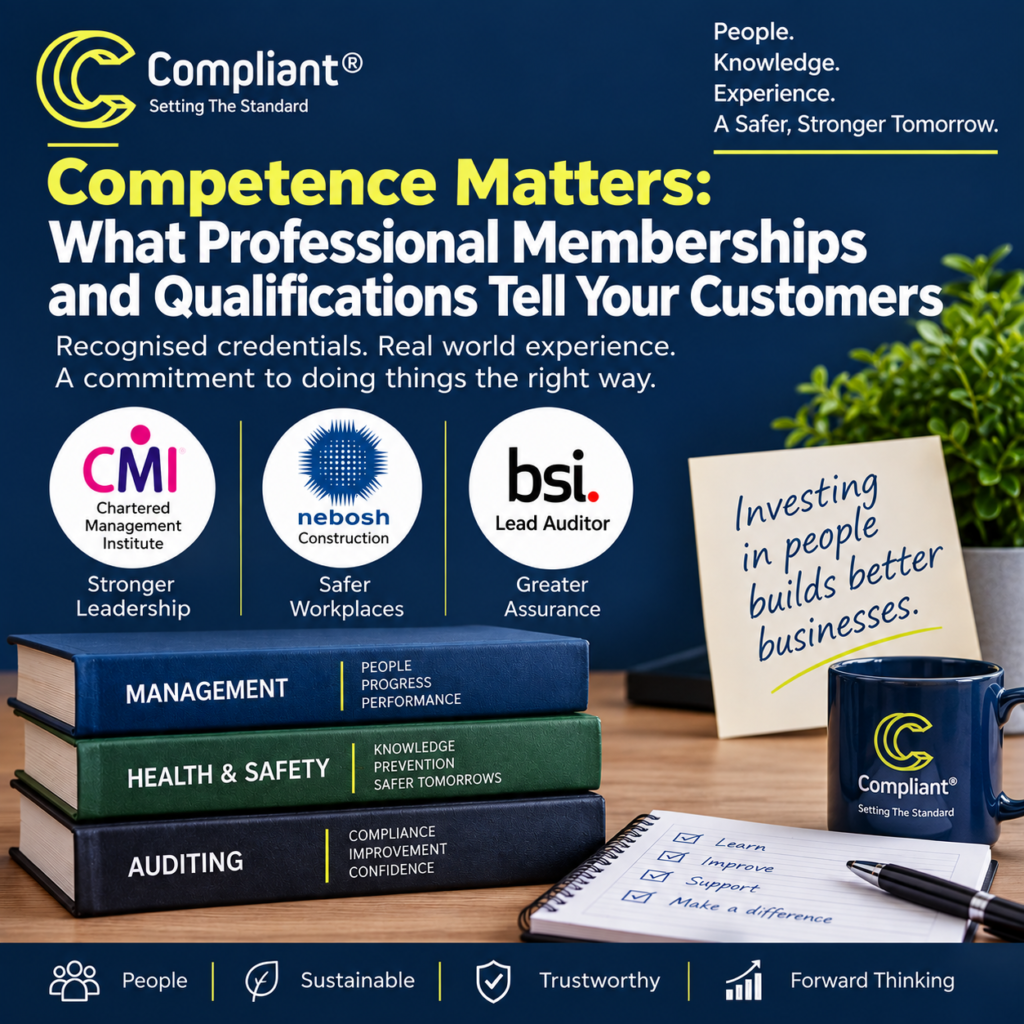
At Compliant Ltd, professional development is something we value. Within our team, we have competence supported by credentials including CMI, NEBOSH Construction and BSI Lead Auditor.
These credentials cover different areas. They should not all be described as professional memberships because they are not the same thing.
What they do have in common is that they can help demonstrate investment in knowledge and professional development.
And for customers, that matters.
Because when you ask someone for advice that could affect your management system, health and safety, audit preparation or wider business processes, there is one question worth asking:
How do I know this person understands what they are talking about?
Competence can be difficult for customers to judge
Imagine you need support in an area you do not fully understand.
Perhaps your business is working towards an ISO standard.
Maybe you need help with your health and safety management.
You could be preparing for an audit.
You might need guidance because something within your existing management system is not working.
You search online.
Several businesses appear.
They all say they are experienced.
They all say they provide excellent support.
They all say their team knows what it is doing.
How do you know?
That is the difficulty customers face.
A business can write almost anything on its website.
Words such as “expert”, “specialist” and “professional” are easy to use.
Proving the knowledge behind those words is different.
Professional qualifications, memberships and recognised training can provide part of that evidence.
They give customers something more than a claim.
They show that an individual has invested time in developing their knowledge in a particular area.
But customers should still look deeper.
What does competence actually mean?
Competence is not simply about passing an exam.
Think about someone learning to drive.
They need knowledge.
They need to understand road signs and rules.
But reading a book does not make them a competent driver.
They also need practical skills.
They need experience behind the wheel.
They need to know how to respond when another driver does something unexpected.
The same principle applies in business.
Knowledge matters.
Qualifications matter.
Training matters.
Experience matters.
But the real value comes from being able to use them together.
A competent person should understand what needs to be done and be able to apply that understanding appropriately.
That last word matters.
Appropriately.
Two businesses may face the same general requirement but need very different solutions.
A process that works for a large manufacturer may make no sense for a small office-based company.
Competence includes recognising that difference.
Qualifications can provide evidence of knowledge
Professional qualifications can help demonstrate that somebody has studied a particular subject and met certain requirements.
That provides a useful starting point.
If you are receiving health and safety advice, for example, it is reasonable to want reassurance that the person providing that advice has relevant knowledge.
If somebody is supporting an audit, you may want to understand their auditor training and experience.
If they are helping managers improve how the business operates, knowledge of management principles can be valuable.
Qualifications provide evidence.
They can help customers understand the areas in which someone has developed their knowledge.
But they should never become a substitute for asking whether that knowledge can be used effectively.
A person can know a standard extremely well and still struggle to explain it clearly.
They may understand theory but have limited experience applying it.
That is why competence needs a wider view.
What can professional membership tell a customer?
Professional membership can demonstrate a connection to a recognised professional body.
Depending on the organisation and level of membership, there may be requirements relating to experience, qualifications, professional conduct or continued development.
The exact meaning varies.
That is important.
Customers should not assume every membership means the same thing.
Some professional bodies have several membership levels.
Some require evidence of experience.
Others may require qualifications.
Certain memberships may expect people to maintain their knowledge.
So rather than simply seeing letters after somebody’s name and assuming what they mean, look at the professional body and the level held.
The value comes from understanding what sits behind the credential.
CMI and management competence
CMI stands for the Chartered Management Institute.
Management skills can sometimes be overlooked when discussing compliance.
People naturally focus on the technical parts.
What does the standard require?
Which documents are needed?
What will the auditor ask?
But management systems depend heavily on people.
Someone needs to set responsibilities.
Someone needs to make decisions.
Resources need to be provided.
Changes need to be managed.
People need to communicate.
Problems need to be followed through.
A technically strong management system can still struggle if the people responsible for it cannot manage effectively.
That is why management knowledge has value.
It helps connect the technical requirements of a management system with the way an organisation actually operates.
For customers, management competence can provide reassurance that support is not being viewed purely as a paperwork exercise.
The aim should be to create processes that people can actually manage.
Why management skills matter in ISO
Think about ISO 9001.
Quality management is not simply about documents.
Managers need to understand customers, processes, responsibilities and performance.
ISO 14001 requires businesses to manage environmental matters as part of normal operations.
ISO 45001 involves leadership, worker involvement and managing workplace health and safety risks.
ISO 27001 requires information security to be understood across the organisation rather than left entirely to IT.
In each case, management matters.
The standard can provide a framework.
People make it work.
This is why professional development in management can complement technical knowledge.
It provides another piece of the competence picture.
NEBOSH Construction and health and safety knowledge
NEBOSH is widely associated with health and safety qualifications.
Construction brings its own safety challenges.
Work can change quickly.
Different contractors may be involved.
People may work at height.
Vehicles and equipment may be moving.
Conditions can change from one location to another.
There can be several activities happening at the same time.
That means health and safety knowledge needs to connect with what actually happens on site.
Having someone within the Compliant Ltd team with NEBOSH Construction competence adds relevant knowledge in this area.
Again, the qualification itself is not the whole story.
Its value increases when that knowledge is combined with experience and an understanding of management systems.
For customers, it can provide additional evidence that health and safety is being considered by somebody with relevant learning behind them.
Health and safety should never become a form-filling exercise
One of the dangers in health and safety management is focusing too heavily on documents.
A risk assessment exists.
A box has been ticked.
A form has been signed.
Job done?
Not necessarily.
Does the risk assessment reflect the real task?
Do employees understand it?
Are controls actually being followed?
Has anything changed since it was written?
Could someone explain why the control is there?
Competence helps move the conversation away from:
“Do we have the document?”
towards:
“Is this actually controlling the risk?”
That is a much more valuable question.
A good adviser should not simply tell a customer to create another form.
They should help the customer understand why something is needed and how it can work in practice.
What does Lead Auditor training tell a customer?
Auditing is another area where competence matters.
A management system can look very different when you move from writing it to auditing it.
An auditor needs to ask questions.
They need to gather evidence.
They need to listen.
They need to understand whether a process is working.
They also need to recognise the difference between a genuine problem and simply doing something differently from how they personally might do it.
Lead Auditor training can develop understanding of the audit process and the skills involved in planning and carrying out audits.
Within Compliant Ltd, we have competence supported by BSI Lead Auditor credentials.
This can be particularly valuable when helping customers understand how their management system may be examined.
It does not mean trying to teach people how to “pass” by saying the right thing.
That would miss the point.
The value comes from understanding how evidence, processes and real working practices connect.
An audit should test the system, not someone’s memory
People can become nervous before an audit.
They worry that an auditor will ask a difficult question.
They try to remember exact wording.
They may even rehearse answers.
A well-embedded management system should reduce that fear.
Employees should be able to talk about what they normally do.
Managers should understand their responsibilities.
Records should already exist because they are part of normal work.
The system should not suddenly appear when an audit date is booked.
Someone with auditing knowledge can help businesses look at their management system from another angle.
Does the process say one thing while employees do another?
Can you demonstrate that checks happen?
Do people understand their responsibilities?
Are actions followed through?
These questions can identify weaknesses before the external audit.
More importantly, they can identify weaknesses before those weaknesses affect the business.
Customers need more than technical knowledge
Being technically correct is important.
But customers also need to understand the advice they receive.
This is where another part of competence becomes important.
Communication.
Imagine a consultant understands ISO 9001 perfectly but explains everything using complex terms the customer has never heard before.
The customer leaves the meeting more confused than when it started.
Has that expertise really helped?
Technical knowledge has to be translated into something useful.
A good adviser should be able to explain:
What needs to happen.
Why it matters.
Who needs to be involved.
What evidence may be useful.
And what the organisation needs to do next.
Customers should not need to become ISO experts just to understand their own management system.
The consultant should make the subject clearer, not more complicated.
Experience gives knowledge context
Qualifications can teach principles.
Experience shows how those principles work when real businesses get involved.
Real businesses are messy.
People leave.
Processes change.
Customers ask for unexpected things.
Documents go missing.
Software changes.
Someone has been doing a task differently for five years.
Two departments think the other one is responsible.
The process described on paper turns out to bear very little resemblance to what employees actually do.
Experience helps someone deal with those situations.
It allows them to recognise common problems.
It also teaches an important lesson:
There is rarely one perfect system for every business.
A competent consultant needs to understand the requirements while also understanding the organisation.
One size rarely fits all
Imagine two companies want to implement ISO 9001.
One employs 12 people.
The other employs 500.
Should their management systems look identical?
Of course not.
Their responsibilities may be different.
Their communication methods will differ.
The number of processes will vary.
Their risks may be very different.
A system that is simple and effective for one could be completely unsuitable for the other.
This is where competence becomes practical.
Knowing a standard is one thing.
Knowing how to apply it without creating unnecessary work is another.
Customers should feel that the advice fits their business.
Not that their business is being forced into somebody else’s template.
Professional development should not stop when a certificate arrives
Another important part of competence is staying current.
Businesses change.
Standards change.
Guidance changes.
Working practices change.
Technology changes.
A qualification gained years ago can still be valuable, but people need to keep developing.
This is one of the wider benefits associated with professional development and, depending on the body and membership, continued learning.
A professional should remain curious.
They should read.
Learn.
Ask questions.
Attend training where needed.
Review changes.
Challenge their own understanding.
Competence is not a finish line.
It needs maintaining.
Knowing what you do not know is part of competence
There is another sign of a competent professional that customers may not immediately think about.
They know their limits.
Nobody is an expert in everything.
A trustworthy adviser should be comfortable saying:
“This needs specialist advice.”
That does not weaken their credibility.
It can strengthen it.
Problems begin when someone gives confident advice outside their area of competence simply because they do not want to admit they do not know.
Customers need accurate support.
Sometimes the most professional answer is to bring in somebody with different expertise.
Good competence includes knowing when that is necessary.
Why a mix of competence can benefit customers
Businesses rarely have problems that fit neatly into one box.
A quality issue may involve management.
A health and safety problem may involve training.
An audit finding may uncover a communication problem.
A process weakness could affect quality, safety and environmental performance at the same time.
That is why having different areas of competence within a team can be useful.
At Compliant Ltd, competence supported by CMI, NEBOSH Construction and BSI Lead Auditor credentials brings together different areas of knowledge.
Management.
Health and safety.
Auditing.
These areas can support each other.
A management system does not operate separately from the business.
It needs leadership.
It needs people.
It needs controls.
It needs review.
And it needs improvement.
Having knowledge across different areas can help create a more rounded understanding of what the customer is trying to achieve.
But credentials should never be used to impress people with letters
There is a danger with professional qualifications.
Businesses can turn them into a wall of letters and logos.
The customer is expected to be impressed.
But if they do not understand what those credentials mean, the information provides little value.
Explain them.
Why is the qualification relevant?
What knowledge does it support?
How does that knowledge help the customer?
This turns a credential into useful evidence rather than decoration.
The same applies when choosing a consultant or adviser.
Do not be afraid to ask what qualifications mean.
Ask about experience.
Ask how knowledge is kept current.
Ask how the person has applied it.
A good professional should be comfortable answering.
Competence can help customers feel more confident asking questions
Working with ISO standards or other compliance requirements can feel intimidating.
Customers sometimes worry about asking a “stupid question”.
There should not be one.
If a customer does not understand why something is required, they should be able to ask.
If a process does not make sense, challenge it.
If advice seems too complicated, ask for a simpler explanation.
Competent support should build the customer’s knowledge.
It should not make them dependent on the consultant.
This is important.
The management system belongs to the organisation.
Its employees and managers need to use it after the consultant leaves.
If nobody inside the business understands the system, something has gone wrong.
Competence should make things clearer
There is sometimes a belief that expertise needs to sound complicated.
It does not.
In many cases, real expertise makes complicated things easier to understand.
A competent professional should be able to look at a requirement and explain what it means for the customer.
Not recite pages of technical wording.
Not create paperwork for the sake of it.
Explain the purpose.
Look at what the business already does.
Identify the gap.
Agree what needs to change.
Help people understand why.
That is where professional knowledge becomes practical value.
What should customers look for?
There is no single certificate that proves somebody is the perfect adviser.
Instead, customers can look at the wider picture.
Does the person have relevant qualifications or professional credentials?
What experience do they have?
Can they explain things clearly?
Do they understand your type of organisation?
Are they comfortable saying when something sits outside their expertise?
Do they listen before giving advice?
Can they explain why they are recommending something?
Does their advice make sense for your business?
These questions can tell you far more than a list of letters after someone’s name.
Competence should be visible in the work
Ultimately, customers experience competence through the service they receive.
Are meetings organised?
Is advice clear?
Are questions answered?
Are actions followed up?
Does the person understand the business?
Do they spot problems?
Can they explain solutions?
Does the customer leave with a better understanding than they had before?
That is where qualifications, experience and professional development come together.
Credentials provide evidence of learning.
The work shows whether that learning can be applied.
Both matter.
Why competence matters when things go wrong
It is easy to look capable when everything is going to plan.
Competence becomes particularly important when something unexpected happens.
An audit identifies a problem.
A process fails.
A customer complains.
A safety concern is raised.
A deadline moves.
A requirement is misunderstood.
A competent adviser needs to remain calm and work through the issue.
What happened?
What is the immediate priority?
What evidence is available?
What needs correcting?
Why did the problem occur?
How can the organisation reduce the chance of it happening again?
That structured thinking is valuable.
It turns a problem into something that can be understood and managed.
Professional competence can support trust
Customers cannot watch every piece of work a consultant does.
At some point, there has to be trust.
Qualifications and professional credentials can support that trust by providing evidence that somebody has invested in developing relevant knowledge.
Experience can strengthen it.
Good communication builds it further.
Consistent delivery maintains it.
None of these elements should stand alone.
A qualification without practical ability has limits.
Experience without keeping knowledge current can also create problems.
Confidence without knowledge can be dangerous.
The strongest position is a combination.
Knowledge.
Experience.
Professional development.
Communication.
And the judgement to apply them appropriately.
What does this mean at Compliant Ltd?
At Compliant Ltd, we believe competence should mean more than saying we know what we are doing.
It should be supported by knowledge, experience and continued development.
Within the team, we have professional competence supported by credentials including CMI, NEBOSH Construction and BSI Lead Auditor.
Each brings something different.
CMI supports management knowledge.
NEBOSH Construction brings relevant health and safety learning.
BSI Lead Auditor credentials support auditing knowledge and understanding.
Together with practical experience, these areas help support a wider understanding of how management systems work inside real organisations.
The important part is not displaying the letters.
It is using the knowledge behind them.
A useful question before choosing professional support
When choosing somebody to support your organisation, do not simply ask:
“Are you qualified?”
Go a little further.
Ask:
“What does your experience and professional development allow you to help us understand or improve?”
That opens a much more useful conversation.
Ask about the qualifications.
Ask about professional memberships.
Ask about auditor training.
Ask about practical experience.
Ask how the person keeps their knowledge current.
Most importantly, listen to how they explain their answers.
Do they make the subject clearer?
Do they understand your business?
Are they asking you questions too?
Competence is not about having an answer ready before understanding the problem.
Sometimes the most important skill is knowing which questions to ask first.
Competence is more than a certificate
Professional qualifications and memberships matter.
They can provide evidence of knowledge, learning and professional development.
They can help customers make more informed decisions about the people they trust.
But they are not the whole story.
Real professional competence in business comes from bringing several things together.
Knowledge.
Experience.
Practical skills.
Communication.
Continued learning.
Good judgement.
And the ability to recognise when specialist help is needed.
For customers, that is the real value.
You are not simply looking for somebody who has collected certificates.
You are looking for somebody who can use their knowledge to help you understand a problem, make better decisions and build processes that work.
So the next time you see professional credentials listed on a website, proposal or email signature, do not just look at the letters.
Ask what sits behind them.
Because competence is not proved by the letters after someone’s name alone.
It is demonstrated by what they know, how they apply it and the value that knowledge brings to the people they support.