Skip to main content
Skip to footer
Skip to main content
Skip to footer

Creating a Safer Workplace Starts With Leadership
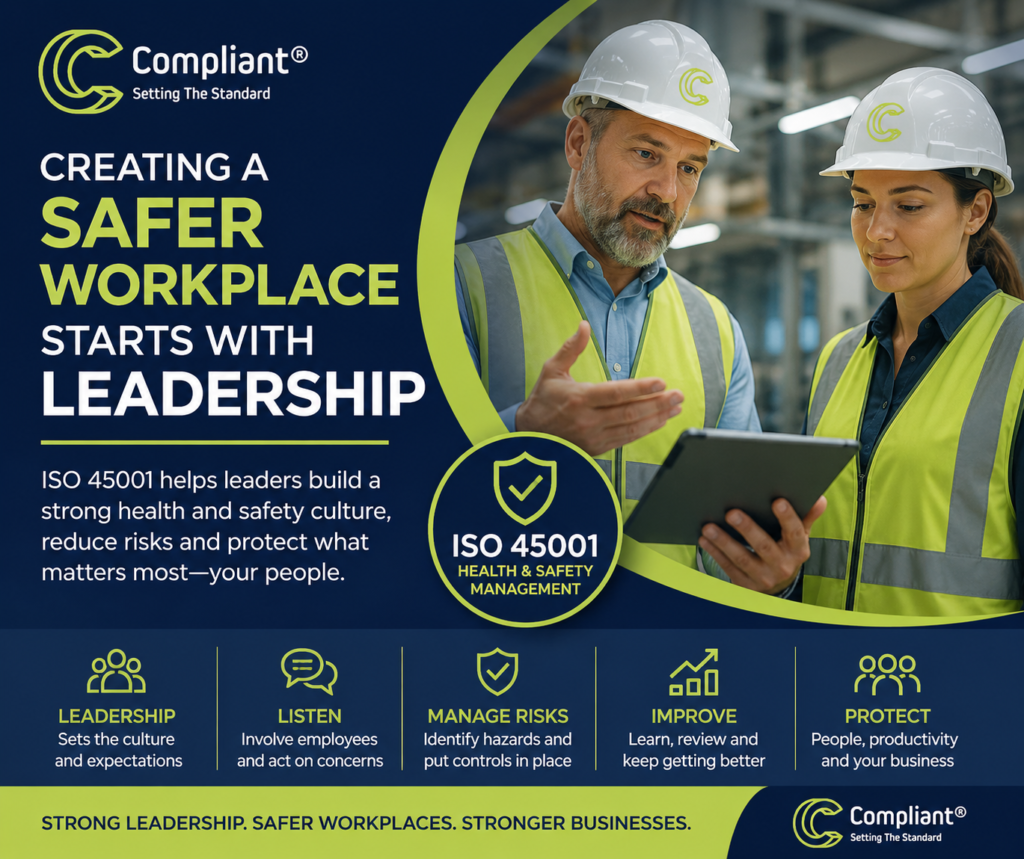

Creating a Safer Workplace Starts With Leadership
Primary keyword: ISO 45001
Secondary keyword: the benefits of an ISO consultant’s support for ISO 45001
A workplace can have safety signs on every wall.
It can have rules, training records, risk assessments and protective equipment.
It can tell employees that health and safety matters.
But if the people leading the business do not take safety seriously, employees will notice.
They notice when managers walk past unsafe behaviour.
They notice when getting the job finished is more important than doing it safely.
They notice when damaged equipment stays in use because replacing it costs money.
They notice when they raise a concern and nothing happens.
And they certainly notice when leaders talk about safety in meetings but behave differently when deadlines are tight.
This is where workplace safety can begin to fall apart.
Because creating a safer workplace is not simply about having enough rules.
It starts with leadership.
That principle sits at the heart of ISO 45001.
ISO 45001 helps organisations build a structured approach to occupational health and safety. But it also makes something very clear: senior leaders cannot simply hand health and safety to somebody else and forget about it.
Leadership needs to be involved.
Not just when an accident happens.
Every day.
Your Employees Watch What Leaders Do
Imagine a manager walks through a work area and sees an employee taking a shortcut.
The shortcut saves a few minutes.
It also creates an unnecessary risk.
The manager sees it but says nothing.
What has the employee learned?
They may have learned that the rule does not really matter.
They may have learned that speed matters more.
Other employees may see the same thing.
Soon, the shortcut becomes normal.
Nothing goes wrong for a while, so people become more confident.
Then one day, somebody gets hurt.
At that point, the business may ask:
“Why wasn’t the procedure followed?”
But there is a more important question.
What behaviour had leadership allowed to become normal?
This is why leadership has such a powerful effect on workplace safety.
People do not only follow written procedures.
They follow examples.
What Is ISO 45001?
ISO 45001 is an international standard for occupational health and safety management.
In simple terms, it helps organisations create a structured way to reduce workplace risks and improve health and safety.
It can help businesses consider:
- Workplace hazards
- Health and safety risks
- Employee involvement
- Responsibilities
- Training
- Emergency planning
- Incidents
- Performance
- Continual improvement
But ISO 45001 is not simply about creating documents.
And it is not a collection of health and safety rules that can be handed to employees.
The aim is to build health and safety into the way the organisation is managed.
That means leadership matters from the very beginning.
“Health and Safety Is Someone Else’s Job”
This belief can cause serious problems.
A business may have a health and safety manager.
It might have an external adviser.
Perhaps somebody in HR looks after certain records.
These people can provide important knowledge and support.
But they cannot carry the responsibility for creating a safe workplace alone.
Managers make decisions every day that can affect health and safety.
They decide how much work needs to be completed.
They decide how many people are available.
They approve spending.
They set deadlines.
They choose equipment.
They manage teams.
They respond when employees raise concerns.
Senior leaders make even bigger decisions about priorities, resources and the direction of the business.
All of these decisions can affect workplace safety.
That is why ISO 45001 places such importance on leadership.
Safety cannot sit in one department.
It has to be part of how the business is run.
Leadership Sets the Standard
Every workplace develops habits.
Some are good.
Some are not.
Leadership has a huge influence over which habits survive.
Imagine two businesses.
In the first, an employee reports damaged equipment.
Their manager thanks them, stops the equipment from being used and arranges for the problem to be dealt with.
Other employees see what happens.
They learn that reporting problems leads to action.
Now imagine the second business.
An employee reports damaged equipment.
The manager says:
“We’re too busy today. Just be careful with it.”
What does that teach people?
Next time, the employee may not bother reporting the problem.
They already know what the answer will be.
This is how culture is built.
Not through posters.
Through repeated actions.
A Safety Policy Is Only the Beginning
Many businesses have a health and safety policy.
That is important.
But a document cannot make decisions.
It cannot walk around your workplace.
It cannot listen to employees.
It cannot stop unsafe work.
It cannot approve money for improvements.
It cannot challenge a manager who is putting speed before safety.
People have to make those things happen.
ISO 45001 encourages organisations to move beyond simply having a policy.
Leaders need to make sure health and safety is considered within normal business activities.
That includes setting clear responsibilities.
It means providing suitable resources.
It means supporting people who contribute to safer working.
And it means making sure health and safety aims support the wider direction of the organisation.
In other words, safety should not be something added to the business afterwards.
It should be part of the business.
Employees Need to Be Heard
Your employees often know more about day-to-day workplace risks than anybody else.
They use the equipment.
They follow the processes.
They move around the workplace.
They deal with customers.
They notice when something is becoming difficult.
They know which shortcuts people take.
They may spot a problem long before it appears in a management report.
Ignoring this knowledge is a wasted opportunity.
ISO 45001 places importance on consultation and participation.
In plain language, businesses should listen to their workers and give them meaningful ways to be involved in health and safety.
That does not mean asking for opinions and then ignoring them.
People need to feel that speaking up is worthwhile.
Would Your Employees Report a Near Miss?
An accident happens and everybody pays attention.
But what about an accident that nearly happened?
Someone slips but catches themselves.
A box falls from a shelf but misses the person underneath.
A vehicle almost hits somebody.
A piece of equipment fails, but nobody is injured.
It is tempting to think:
“No harm done.”
That can be a dangerous response.
A near miss is information.
It is a warning.
Something happened that could have caused harm.
If the business understands why it happened, it may be able to prevent the next incident.
But employees will only report these events if they believe something useful will happen.
If people fear blame, they may stay quiet.
If previous reports disappeared into a drawer, they may see no point.
Leadership needs to create an environment where concerns can be raised and taken seriously.
Safety Cannot Disappear When Work Gets Busy
Most businesses care about safety when everything is running normally.
The real test comes when pressure arrives.
A large order needs completing.
A customer wants something urgently.
Several employees are absent.
A machine stops working.
A project is falling behind.
Suddenly, the pressure to “just get it done” becomes stronger.
This is where leadership matters most.
If managers allow unsafe shortcuts whenever the business is busy, the real message is clear.
Safety matters only when it is convenient.
A strong health and safety management system helps prevent this.
Processes are understood.
Responsibilities are clear.
Risks have been considered.
People know when work needs to stop.
And leaders support them when they make that decision.
Finding Hazards Before Someone Gets Hurt
Waiting for an accident to show you where your risks are is not a good safety strategy.
ISO 45001 encourages organisations to identify hazards before they cause harm.
Some hazards are obvious.
A damaged cable.
An unguarded machine.
A wet floor.
Heavy items stored badly.
Others can be less visible.
Long working hours.
Poorly designed tasks.
Repeated movements.
Excessive workloads.
Changes to equipment or processes.
People working alone.
The key is to look at how work is actually carried out.
Not simply how a procedure says it should happen.
There can be a big difference.
Employees are often valuable here because they understand the reality of the job.
Risk Assessments Need to Live in the Real World
A risk assessment should help people work more safely.
It should not exist simply because somebody believes the business needs a folder full of them.
Think about the risks in your organisation.
When were they last reviewed?
Does the assessment still match what employees actually do?
Has new equipment been introduced?
Has the workplace changed?
Are there new employees?
Has the workload increased?
Has an incident shown that something was missed?
If the answer to these questions is yes, old information may no longer be enough.
Leadership needs to make sure risk management remains useful.
That means giving people time to review risks and acting when improvements are needed.
Training Is More Than Getting a Signature
Training records can show that somebody attended a session.
They cannot automatically prove that the person understood it.
There is an important difference.
Employees need to know how to do their work safely.
Managers need to understand their own responsibilities.
People with specialist tasks may need additional knowledge.
New employees need support.
Employees moving into different roles may need new training.
And sometimes people simply need a reminder.
Leaders should ask:
Can our people actually do this safely?
That question is far more useful than:
Do we have a training record?
ISO 45001 is about effective management.
The result matters more than the paperwork.
When Something Goes Wrong, Blame Is Not Enough
Imagine an employee gets hurt.
The quickest explanation might be:
“They didn’t follow the procedure.”
Perhaps they didn’t.
But stopping there could mean missing the real problem.
Why did they not follow it?
Was the procedure practical?
Had they been trained?
Were they rushing?
Was there pressure from a manager?
Was the correct equipment available?
Had the same shortcut been used for months?
Had anyone noticed it before?
Had concerns already been raised?
Good incident investigation looks beyond the immediate event.
The aim should be to understand what happened and reduce the chance of it happening again.
Simply blaming one person may feel like an answer.
It rarely provides the whole one.
Leadership needs to encourage learning rather than searching for the quickest person to blame.
Leaders Need Information They Can Use
Senior managers do not need to know every tiny detail of every safety activity.
But they do need enough information to understand whether the system is working.
For example:
Are incidents increasing?
Are employees reporting near misses?
Are actions being completed?
Are inspections identifying repeated problems?
Are people receiving the training they need?
Are health and safety objectives being achieved?
Have important risks changed?
Are employees raising concerns?
This information helps leadership make better decisions.
Without it, senior managers may believe everything is fine simply because nobody has told them otherwise.
No news does not always mean good news.
Sometimes it means people have stopped speaking.
ISO 45001 Helps Turn Good Intentions Into a System
Most business leaders do not want employees to get hurt.
The intention is usually there.
But good intentions alone do not manage risk.
You need a system.
ISO 45001 provides a framework that helps organisations turn their intentions into clear actions.
Who is responsible?
What are the main risks?
What needs to be done?
What resources are required?
How will employees be involved?
How will performance be checked?
What happens when something goes wrong?
How will improvements be made?
These questions create structure.
And structure makes good practice easier to repeat.
Where Can an ISO Consultant Help?
Implementing ISO 45001 can feel like a large task, particularly for organisations that have never worked with an ISO management system before.
You may already have many health and safety processes in place.
You may have risk assessments, training, policies, inspections and incident reporting.
But are they working together?
Are there gaps?
Are responsibilities clear?
Does leadership understand its role?
Are employees genuinely involved?
This is where the benefits of an ISO consultant’s support for ISO 45001 can become valuable.
An experienced ISO consultant can help you understand the requirements in plain language and relate them to your actual workplace.
That is important because ISO 45001 should fit your organisation.
Your management system should reflect your risks, your employees, your activities and the way you operate.
It should not feel like somebody else’s system copied into your business.
An ISO Consultant Can Help You See What You Already Have
Starting ISO 45001 does not always mean starting from nothing.
Many organisations already have useful health and safety processes.
The problem is that they may be disconnected.
One manager does things one way.
Another team does something different.
Some activities happen but are not recorded.
Other processes were created years ago and have not been reviewed.
An ISO consultant can help you look at what is already working.
Then you can identify what needs improving.
This can save a great deal of unnecessary work.
The aim is not to create paperwork for the sake of paperwork.
The aim is to create a management system that helps your organisation manage health and safety better.
Good ISO Consultant Support Should Educate Your Team
There is little value in having a consultant build a system that nobody inside your organisation understands.
What happens when the consultant leaves?
Your people need to be able to manage it.
That is why good ISO consultant support should involve education.
Managers should understand why they have certain responsibilities.
Employees should understand how they contribute.
Senior leaders should understand what information they need to review.
People responsible for the management system should understand how to maintain it.
An ISO consultant can guide.
They can explain.
They can challenge.
They can help you identify gaps.
But ownership should remain inside your organisation.
That is how the system becomes sustainable.
Leadership Cannot Be Outsourced
This is particularly important with ISO 45001.
An ISO consultant can provide support.
A health and safety adviser can provide specialist knowledge.
An internal manager can coordinate the system.
But none of them can replace leadership.
Senior leaders still need to demonstrate that health and safety matters.
They need to provide resources.
They need to support employees.
They need to make sure responsibilities are clear.
They need to review performance.
And they need to act when something is not working.
You can outsource advice.
You cannot outsource leadership.
A Safer Workplace Can Support a Stronger Business
Good health and safety management is about protecting people.
That should always be the main reason it matters.
But safer workplaces can also support the wider business.
Fewer incidents can mean less disruption.
Clear processes can help employees understand what is expected.
Better communication can identify problems sooner.
Employee involvement can reveal improvements management had not considered.
Strong leadership can help build trust.
Customers and other organisations may also want confidence that businesses in their supply chain take health and safety seriously.
ISO 45001 gives organisations a recognised framework for managing these responsibilities.
But the certificate should never become the only goal.
The real value is in what happens every day.
Ask Yourself What Your Leadership Really Says About Safety
Take a look at your organisation.
Not the policy.
Not the certificate on the wall.
Not the training spreadsheet.
Look at what actually happens.
What happens when an employee reports a hazard?
What happens when fixing something costs money?
What happens when a deadline is at risk?
What happens when a manager sees unsafe behaviour?
What happens after a near miss?
What happens when an employee says they do not feel safe completing a task?
Those moments tell you far more about your safety culture than any slogan.
Because leadership becomes visible when decisions become difficult.
Creating a Safer Workplace Starts at the Top
ISO 45001 can provide the framework.
Risk assessments can identify hazards.
Training can build knowledge.
Procedures can explain what needs to happen.
Inspections can identify problems.
Employees can raise concerns.
An ISO consultant can provide guidance and help you understand how the pieces fit together.
But leadership gives all of those things meaning.
When leaders take health and safety seriously, people notice.
When managers listen, people speak.
When concerns lead to action, people keep reporting them.
When leaders refuse to trade safety for speed, expectations become clear.
And when mistakes are used as opportunities to learn, the organisation can become stronger.
That is why creating a safer workplace starts with leadership.
A Useful Next Step
You do not need to wait until your next management meeting or ISO 45001 assessment to learn something useful about your workplace.
This week, ask your employees one simple question:
“What is one thing that would make your job safer?”
Then listen.
Do not defend the current process.
Do not immediately explain why something cannot be changed.
Do not treat the question as a box to tick.
Listen to the answer.
Then look at what can be done.
If several people raise the same concern, pay particular attention.
If you are working towards ISO 45001, consider how your current leadership approach supports the management system you are trying to build. If you are using an ISO consultant, ask them to help your leadership team understand its role rather than simply concentrating on the documents needed for assessment.
Because ISO 45001 should not be about proving that your organisation cares about health and safety once a year.
It should help you demonstrate it every working day.
A safer workplace is not created by a policy sitting in a folder.
It is created when leaders listen, act, provide the right support and make it clear through their decisions that protecting people is never an afterthought.