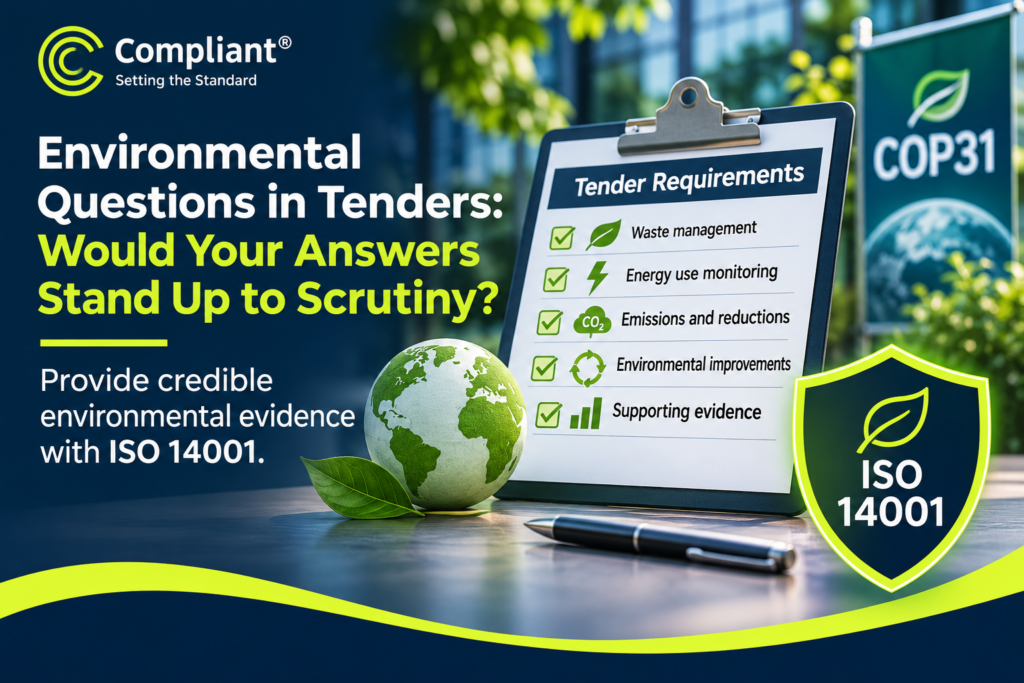
Environmental Questions in Tenders: Would Your Answers Stand Up to Scrutiny?
 Imagine spending weeks preparing a tender for a contract your business really wants.
You have worked through the pricing, explained your experience and demonstrated why your team is capable of delivering the work.
Everything is looking promising.
Then you reach the environmental section.
The questions seem straightforward at first.
What is your business doing to reduce its environmental impact?
How do you manage waste?
Do you monitor energy use?
Can you provide evidence of environmental improvements?
And how do you make sure your environmental commitments are being followed?
You know your business takes these matters seriously.
Your team recycles. You try to reduce waste. You have made changes to lower energy costs.
But when it comes to providing evidence, things become more difficult.
There are no clear records showing what has improved.
Nobody is quite sure who manages environmental performance.
And the environmental policy you prepared a few years ago has not been reviewed since.
Suddenly, a section of the tender that looked simple becomes one of the hardest to complete.
Because saying your business cares about the environment is one thing. Proving what you are doing is another.
As environmental expectations develop, businesses may find themselves facing more detailed questions from customers, suppliers and tendering organisations.
This is where ISO 14001 can help.
ISO 14001 is an internationally recognised standard for environmental management systems.
It provides a framework that helps businesses understand their environmental impacts, manage relevant responsibilities and continually improve their environmental performance.
For organisations competing for contracts, it can also help establish the processes and records needed to support credible environmental claims.
And with COP31 bringing renewed attention to climate action, now is a useful time for businesses to consider whether their environmental commitments are supported by evidence.
Why Environmental Questions Are Becoming Important in Tenders
For many years, tender applications focused heavily on price, experience and technical ability.
These remain important.
However, environmental considerations are also part of many procurement decisions.
A potential customer may want to understand how its suppliers manage waste, energy use, emissions and other environmental impacts.
This can be particularly relevant when organisations have their own environmental objectives or reporting requirements.
For example, a construction company bidding for a major project may be asked to explain how it will manage waste materials.
A transport business might need to provide information about fuel consumption and vehicle emissions.
A manufacturer could be asked about energy use, packaging and resource efficiency.
An office-based service provider may need to explain how it manages electricity use, business travel and purchased services.
The questions will vary depending on the contract, industry and buyer.
Some tender applications may request an environmental policy.
Others may ask for supporting records, performance information or evidence of recognised environmental management systems.
The important point is that a good environmental statement may not be enough on its own.
Businesses need to understand what the buyer is asking and whether they can provide suitable evidence.
This is where having a structured environmental management system can make a difference.
COP31: Why Climate Action Matters to Businesses
COP31, the 31st United Nations Climate Change Conference, is part of the international process through which countries discuss climate change and action to address it.
These discussions focus attention on matters such as greenhouse gas emissions, climate risks, adaptation and the transition towards lower-carbon economies.
While international climate agreements do not automatically create the same obligations for every business, they form part of the wider environment in which governments, customers and organisations make decisions.
For businesses, this can mean increased attention to environmental performance.
Customers may review their supply chains.
Larger organisations may ask suppliers for environmental information to support their own reporting and improvement plans.
Tendering bodies may include environmental requirements within procurement decisions.
And businesses may face questions about whether their environmental commitments are being put into practice.
However, it is important not to assume that COP31 itself requires every organisation to hold ISO 14001 certification.
It does not.
The relevance of certification will depend on customer expectations, contractual requirements and the organisation’s circumstances.
What COP31 does provide is another opportunity to consider how environmental issues affect business decisions.
For organisations hoping to grow, win contracts or strengthen supplier relationships, understanding environmental performance can be increasingly valuable.
The question is whether the business has reliable information to support what it says.
The Difference Between Environmental Promises and Environmental Evidence
Many businesses make positive statements about sustainability.
They may describe themselves as environmentally responsible.
They might explain that they are committed to reducing waste or improving energy efficiency.
These statements can reflect genuine intentions.
But intentions and evidence are not the same thing.
Imagine a business includes the following statement in a tender:
“We are committed to reducing our environmental impact.”
That sounds positive.
But what does it actually tell the buyer?
It does not explain which environmental impacts the business has identified.
It does not show what action has been taken.
And it does not provide information about whether improvements have been achieved.
Now imagine the business explains that it has reviewed its main sources of waste, introduced a new waste management process and monitored the results over the previous year.
It provides relevant records and explains its next improvement objective.
That gives the buyer something more useful.
It shows that the organisation has considered its environmental impact and can explain how it manages it.
Credible environmental claims should be clear, accurate and supported by suitable evidence.
This does not mean every business needs to produce large reports.
The evidence should reflect the organisation’s activities and the claims being made.
A small office-based business may need different records from a large manufacturing company.
The important thing is being able to demonstrate what has been done.
What Is ISO 14001?
ISO 14001 is an international standard that sets out requirements for an environmental management system, often called an EMS.
An environmental management system helps an organisation manage the environmental aspects of its activities, products and services.
In simple terms, it encourages businesses to understand how their operations affect the environment and establish processes to manage those impacts.
ISO 14001 includes requirements relating to:
- Understanding the organisation and its environmental responsibilities.
- Identifying relevant environmental aspects and impacts.
- Considering compliance obligations.
- Establishing environmental policies and objectives.
- Assigning responsibilities.
- Planning and controlling relevant activities.
- Monitoring and evaluating environmental performance.
- Carrying out internal audits.
- Reviewing the management system.
- Continually improving environmental performance.
The standard can be applied by organisations of different sizes and sectors.
It is not limited to businesses with large factories or complex industrial operations.
Office-based organisations, service providers, contractors and other businesses can also have environmental impacts that need managing.
The exact arrangements will depend on the nature of the organisation.
For businesses responding to tenders, ISO 14001 can help establish a structured approach to environmental management and provide records that support relevant claims.
Do You Know Your Business’s Main Environmental Impacts?
Before a business can explain how it manages its environmental impact, it needs to understand what those impacts are.
This may sound obvious.
But many organisations focus on the environmental activities that are easiest to see.
For example, an office might concentrate on recycling paper.
That can be useful.
However, the business may have other environmental impacts that are more significant.
These could involve electricity use, heating, travel, purchasing or waste from equipment.
A manufacturing business may need to consider energy consumption, raw materials, emissions, waste and the handling of substances.
A construction contractor might need to consider site waste, fuel use, noise, dust and the impact of its activities on surrounding areas.
ISO 14001 requires organisations to determine the environmental aspects of their activities, products and services that they can control or influence, taking a life cycle perspective.
This helps businesses identify which environmental issues need attention.
The aim is not to assume that every activity has the same impact.
It is to understand what matters most in the context of the organisation.
For tender applications, this can be valuable.
Rather than making broad statements about sustainability, the business can explain which environmental issues it has identified and how it manages them.
Could You Prove That Your Business Is Reducing Waste?
Waste management is a common area of environmental concern.
Many businesses have arrangements for recycling or disposing of waste.
But can they explain how those arrangements are managed?
Imagine a contractor states that it is committed to reducing waste.
A tender asks for evidence.
The contractor may need to explain how waste is separated, how disposal arrangements are controlled and what records are available.
It might also be asked whether waste reduction objectives have been established.
A structured environmental management system can help businesses identify relevant waste streams and establish suitable controls.
For example, a company might review the amount of packaging waste it produces.
It could identify opportunities to reduce unnecessary packaging, improve material use or work with suppliers on alternative arrangements.
The organisation could then monitor relevant information to understand whether the changes are effective.
This provides a clearer basis for reporting improvements.
However, businesses should avoid making claims they cannot support.
If waste has not been measured, it may not be possible to state accurately that it has fallen by a particular percentage.
ISO 14001 encourages organisations to monitor relevant environmental performance and evaluate progress towards objectives.
This helps turn improvement plans into activities that can be reviewed and assessed.
Energy Use: Are You Measuring What You Want to Improve?
Energy is another area that can affect environmental performance and business costs.
Many organisations want to reduce electricity or fuel consumption.
But without suitable information, it can be difficult to know whether changes are working.
Imagine a business introduces new lighting across its premises.
The company expects the change to reduce electricity use.
That may be a reasonable expectation.
But if it wants to claim a specific reduction, it needs reliable evidence.
This might involve reviewing energy consumption before and after the change, while considering other factors that could affect the figures.
For example, a business that has expanded its premises may use more electricity overall, even if individual areas have become more efficient.
ISO 14001 supports the establishment of environmental objectives and the monitoring of relevant performance.
For businesses where energy use is a significant environmental aspect, this can encourage more structured arrangements.
A company might monitor electricity consumption, fuel use or other relevant measures.
It can then use that information to identify opportunities for improvement.
For tender applications, having suitable records can make it easier to explain what the organisation is doing and what results have been achieved.
Environmental Policies: Are They More Than Words on a Page?
Many businesses have an environmental policy.
It might explain the organisation’s commitment to protecting the environment, meeting relevant requirements and improving performance.
But when was it last reviewed?
Do employees understand it?
And does it reflect what the business actually does?
An environmental policy should not simply be a document prepared for a tender and forgotten afterwards.
Under ISO 14001, top management must establish, implement and maintain an environmental policy that meets the standard’s requirements.
The policy should provide a framework for environmental objectives and include relevant commitments.
It should also be communicated within the organisation and made available to interested parties.
For businesses, this means the policy should connect with everyday activities.
If a company says it is committed to reducing waste, there should be suitable arrangements supporting that commitment.
If it identifies energy use as a significant environmental issue, its objectives and processes should reflect that.
A policy that is supported by practical action is more useful than one that exists only to satisfy a tender question.
Who Is Responsible for Environmental Performance?
One of the challenges businesses face as they grow is making sure responsibilities remain clear.
In a small organisation, the business owner may oversee most activities.
As the company expands, environmental responsibilities may become spread across different departments.
Operations teams may manage waste.
Facilities staff may monitor energy use.
Purchasing teams may work with suppliers.
Managers may be responsible for reviewing performance.
But who makes sure these activities are coordinated?
ISO 14001 requires relevant roles, responsibilities and authorities to be assigned and communicated.
This helps employees understand what they are expected to do.
It also supports accountability.
For example, a business might assign responsibility for monitoring waste records to an operations manager.
Another employee might maintain relevant environmental documentation.
Senior management would still need to demonstrate leadership and commitment to the environmental management system.
Clear responsibilities can make it easier to maintain records, review progress and respond to customer questions.
They also help prevent environmental management from becoming something that only receives attention when a tender deadline approaches.
Are Your Environmental Claims Accurate?
Environmental claims can influence how customers view a business.
But they need to be handled carefully.
Words such as “green”, “sustainable” and “environmentally friendly” can be difficult to support when they are used without explanation.
A business might genuinely be making improvements in one area while still having significant impacts elsewhere.
For example, a company may have reduced its use of plastic packaging.
That is a positive change.
But it does not automatically mean that all its products or activities are environmentally friendly.
Claims should reflect the actual improvement being made.
Businesses should also be careful when using terms such as “carbon neutral” or “net zero”.
These claims may require specific evidence, clear explanations and appropriate consideration of the emissions and activities covered.
In the UK, environmental marketing claims are subject to consumer protection rules, and the Competition and Markets Authority has published guidance through its Green Claims Code.
For businesses, the key message is simple.
Do not make environmental claims that are broader than the evidence available to support them.
ISO 14001 can help organisations establish processes for managing environmental information and reviewing performance.
However, certification does not automatically prove that every environmental claim made by a business is accurate.
Each claim still needs to be considered on its own merits.
Why Suppliers Matter to Your Environmental Performance
Many businesses depend on suppliers to deliver products or services.
Those relationships can also affect environmental performance.
A construction business may purchase materials from several suppliers.
A manufacturer may rely on external companies for components and packaging.
An office-based organisation may purchase equipment, cleaning services and other products.
ISO 14001 requires organisations to consider relevant environmental aspects across a life cycle perspective and establish appropriate operational controls.
This can include considering environmental requirements when purchasing products and services.
For example, a business might review how packaging is supplied or whether alternative materials could reduce waste.
It may also communicate relevant environmental requirements to contractors and suppliers.
The level of control or influence will depend on the relationship and the organisation’s activities.
Businesses are not expected to control every action taken by every supplier.
But they should consider where their purchasing decisions and supplier relationships create relevant environmental impacts.
For tender applications, this can be particularly important when buyers want to understand how environmental responsibilities are managed across the supply chain.
What Environmental Evidence Might a Tender Ask For?
Tender requirements vary.
Some buyers may ask relatively simple questions about environmental policies.
Others may request more detailed information.
Depending on the contract, businesses could be asked to provide evidence such as:
- An environmental policy.
- ISO 14001 certification, where relevant.
- Environmental objectives and improvement plans.
- Waste management arrangements.
- Energy or fuel consumption records.
- Information about greenhouse gas emissions.
- Environmental training records.
- Evidence of relevant legal compliance arrangements.
- Details of environmental responsibilities.
- Information about supplier or contractor controls.
- Records of environmental performance reviews.
Not every tender will ask for all these documents.
And not every organisation will need the same information.
The important thing is understanding the buyer’s requirements and providing accurate, relevant evidence.
Businesses should also check whether the tender requires certification from a particular type of certification body or accepts equivalent evidence.
Where certification is requested, the scope and validity of the certificate may matter.
Having an environmental management system can make it easier to organise relevant information.
Instead of searching through different departments for records, the organisation can establish clearer arrangements for maintaining and reviewing them.
ISO 14001 Certification: What Does It Demonstrate?
ISO 14001 certification involves an independent certification body assessing an organisation’s environmental management system against the standard.
Where certification is achieved, it provides evidence that the management system has been assessed as meeting the relevant requirements within the stated scope.
For businesses, this can support discussions with customers and tendering organisations.
It may also be useful where buyers specifically request ISO 14001 certification.
However, certification should not be misunderstood.
It does not mean a business has no environmental impact.
It does not guarantee that all emissions have been eliminated.
It does not automatically prove that every environmental claim is correct.
And it does not guarantee that an organisation will win a contract.
What certification can demonstrate is that the organisation has established an environmental management system that has been independently assessed against ISO 14001.
The real value comes from using that system to manage environmental responsibilities and drive improvement.
Could Weak Environmental Records Cost You a Tender Opportunity?
Imagine two businesses competing for the same contract.
Both have suitable experience.
Both offer competitive pricing.
Both say they take environmental responsibility seriously.
The tender asks how each organisation manages waste and monitors environmental performance.
The first business provides a general statement about recycling and sustainability.
The second explains its environmental management processes, identifies relevant objectives and provides records showing how performance is monitored.
The buyer still needs to assess both submissions against the tender criteria.
But the second business has provided more information to support its claims.
This illustrates why environmental evidence matters.
It is not enough to assume that a buyer will accept broad promises.
Where environmental performance forms part of the assessment, businesses need to understand what evidence is required.
ISO 14001 can help organisations establish the processes needed to collect and maintain relevant information.
It can also support a more consistent approach to responding to environmental questions.
However, the quality of a tender response will still depend on how well it addresses the specific requirements.
Certification alone cannot replace a clear and accurate submission.
Internal Audits: Checking Whether Your Environmental System Works
An environmental management system should not exist only on paper.
Businesses need to understand whether their processes are being followed.
For example, a company might have a procedure for managing waste.
But are employees using it?
Are relevant records being maintained?
Are contractors following the requirements that apply to their work?
Internal audits can help answer these questions.
ISO 14001 requires organisations to conduct internal audits at planned intervals.
These audits help determine whether the environmental management system meets relevant requirements and is effectively implemented and maintained.
An audit might identify that environmental records are incomplete.
It could reveal that employees need additional training.
Or it might show that a process has changed but the supporting documentation has not been updated.
These findings provide opportunities for improvement.
For businesses preparing tender responses, internal audits can also help identify weaknesses in the evidence available.
It is better to discover that a record is missing during an internal review than when a potential customer requests it.
Continual Improvement: Showing That Your Business Is Moving Forward
Environmental management is not about making one change and assuming the job is complete.
Businesses change.
New equipment is introduced.
Operations expand.
Suppliers change.
Customer expectations develop.
Environmental management systems need to respond to those changes.
ISO 14001 includes a requirement for continual improvement.
This encourages organisations to review their performance and identify opportunities to improve the suitability, adequacy and effectiveness of their environmental management systems.
For example, a business may initially focus on improving waste separation.
Once that process is working well, it might review opportunities to reduce the amount of waste created in the first place.
Another organisation might begin by monitoring energy use.
Over time, it may identify opportunities to improve efficiency or change how equipment is operated.
Not every improvement needs to be large.
Small changes can still provide value when they are relevant and properly managed.
The important thing is that the organisation understands what it is trying to achieve and can review whether its actions are effective.
For tender applications, this can help demonstrate that environmental management is an ongoing activity rather than a one-off statement.
Five Questions to Ask Before Your Next Tender
Before submitting another tender, it is worth reviewing how your business would answer these questions.
1. Do We Understand Our Main Environmental Impacts?
Can you explain which activities have the greatest environmental relevance to your business?
Have these been reviewed as your organisation has changed?
2. Can We Support Our Environmental Claims?
If you say your business has reduced waste or energy use, do you have reliable information to support that statement?
Are your claims clear about what has been measured?
3. Are Our Environmental Responsibilities Clear?
Do employees understand what they need to do?
Is someone responsible for maintaining relevant records and reviewing performance?
4. Are We Monitoring Improvement?
Have you established suitable environmental objectives?
Can you explain what action has been taken and whether it has worked?
5. Would Our Evidence Meet a Buyer’s Requirements?
Are your policies and records up to date?
Can you provide the information requested?
And does your evidence support the statements made in your tender response?
If you struggle to answer these questions, it may be time to review your environmental management arrangements.
How Compliant Ltd Can Support Your ISO 14001 Journey
Environmental management can feel complicated, particularly when businesses are already managing customers, employees, suppliers and everyday operations.
You may understand that environmental performance matters but be unsure how to demonstrate it.
Perhaps your organisation has an environmental policy but lacks the processes needed to support it.
Or you may be preparing for a tender and have discovered that your environmental records need attention.
At Compliant Ltd, we help businesses understand ISO requirements and develop practical management systems that suit their operations.
Our consultants can support organisations working towards ISO 14001 certification, helping them establish a structured approach to environmental management.
Understanding Your Current Environmental Arrangements
Many businesses already carry out activities that support environmental improvement.
They may manage waste responsibly, monitor energy use or have procedures for controlling environmental risks.
The challenge is often bringing these activities together into a clear management system.
Compliant Ltd can help you review your existing arrangements and identify areas where improvements may be needed.
This can provide a practical starting point for your ISO 14001 journey.
Developing an Environmental Management System
Your environmental management system should reflect the nature and scale of your organisation.
A small office-based business will have different needs from a large manufacturer or construction contractor.
We can help you understand the requirements of ISO 14001 and develop relevant processes and documentation.
This may include support with environmental aspects, objectives, responsibilities, operational controls and monitoring arrangements.
The aim is to make environmental management a useful part of everyday business activity.
Preparing for ISO 14001 Certification
If your organisation is working towards ISO 14001 certification, Compliant Ltd can provide support throughout your preparation.
Our consultants can help you understand the standard, identify gaps and prepare for an external certification audit.
Certification decisions are made by the independent certification body.
Our role is to provide clear advice and practical support as you develop your environmental management system.
Supporting Ongoing Improvement
Environmental management does not end when certification is achieved.
Businesses need to continue reviewing their systems as circumstances change.
Compliant Ltd can provide ongoing consultancy support to help organisations maintain and improve their management systems.
This can help businesses keep environmental responsibilities under review and ensure their processes remain relevant.
COP31 Is a Reminder That Environmental Evidence Matters
International discussions about climate change can feel distant from everyday business activities.
But the issues being discussed are connected to decisions organisations make about energy, waste, resources and environmental responsibility.
For businesses, these matters can also influence customer expectations and procurement requirements.
A tender may ask about environmental objectives.
A customer may want information about emissions.
A supplier assessment may request evidence of an environmental management system.
These questions are easier to answer when the business already understands its environmental impacts and maintains suitable records.
COP31 provides a useful opportunity to review whether environmental commitments are supported by action.
It is also a reminder that environmental management should not begin only when a customer asks for evidence.
Businesses can benefit from understanding their impacts, establishing suitable controls and reviewing performance as part of normal operations.
ISO 14001 provides a recognised framework to support that approach.
Would Your Environmental Answers Stand Up to Scrutiny?
Winning new contracts can create exciting opportunities.
But preparing a successful tender often involves more than demonstrating technical ability and offering a competitive price.
Where environmental requirements form part of the assessment, businesses need to provide information that is accurate, relevant and supported by evidence.
A statement about caring for the environment may reflect good intentions.
But buyers may want to know what that commitment means in practice.
What environmental impacts have you identified?
What controls are in place?
What improvements are you working towards?
And what evidence can you provide?
ISO 14001 can help businesses develop a more structured approach to answering these questions.
It supports environmental management, clearer responsibilities, monitoring and continual improvement.
It can also help organisations prepare for customer enquiries and tender requirements without relying entirely on last-minute document gathering.
Your environmental commitments should be more than words in a tender application. They should reflect what your business does every day.
Ready to Strengthen Your Environmental Management?
If your business is facing more detailed environmental questions from customers or tendering organisations, now could be the right time to review your arrangements.
You do not need to wait until an important tender highlights gaps in your records.
Taking action early can help you understand your environmental responsibilities, improve your processes and establish stronger evidence of your activities.
Whether you are considering ISO 14001 certification for the first time, reviewing an existing environmental management system or preparing for future opportunities, Compliant Ltd can help.
Our consultants provide practical guidance to support businesses through their ISO certification journey.
We help organisations understand the requirements, develop suitable management systems and prepare for external audits.
The next time a tender asks what your business is doing for the environment, make sure you have more than a promise. Make sure you have evidence.
Speak to Compliant Ltd about your ISO 14001 certification plans and discover how our environmental management consultancy support can help your business prepare for future opportunities.