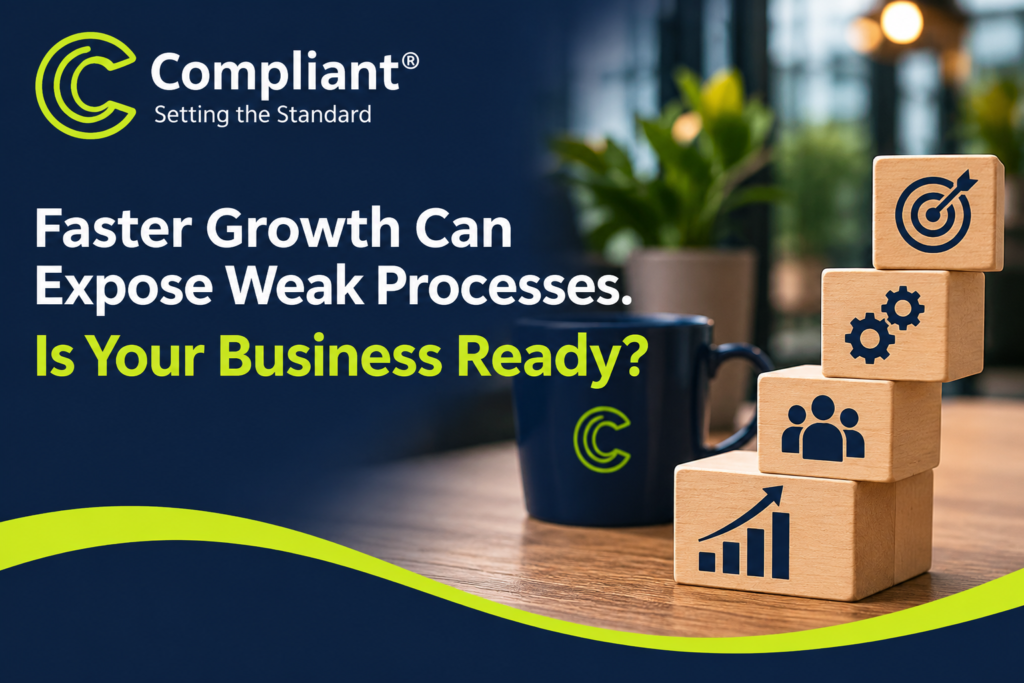
Growth is exciting, but it can also put pressure on the way your business works. As teams expand, workloads increase and customer demands change, processes that once worked well can start to struggle. Discover how ISO 9001 and effective quality management can help growing businesses improve consistency, reduce costly mistakes and build stronger foundations for future success. Faster Growth Can Expose Weak Processes. Is Your Business Ready?
Winning new customers, taking on larger contracts and growing your team are all signs that your business is moving in the right direction.
But what happens when your business starts growing faster than your processes can keep up?
The systems that worked when you had five employees might not work quite so well when you have twenty. The way you managed customer enquiries when you had a handful of clients might become difficult when that number doubles.
Suddenly, things that were once simple start taking longer.
Information gets missed. Jobs are delayed. Customers ask questions that nobody seems able to answer. Employees become frustrated because they are unsure who is responsible for what.
And the business owner?
They are often the person everyone turns to when something goes wrong.
Growth should create opportunities, not a growing list of problems.
Yet many businesses only discover weaknesses in their processes when they begin to expand.
This is where ISO 9001 can make a real difference.
ISO 9001 is an internationally recognised standard for quality management systems. It provides a framework that helps businesses manage their processes, meet customer requirements and continually improve the way they work.
For growing businesses, it can provide something particularly valuable.
Structure, consistency and greater confidence that the business can cope with increasing demand.
Why Business Growth Can Reveal Problems You Didn’t Know Existed
When a business is small, people often find ways to make things work.
The owner knows every customer. Employees understand their responsibilities because they work closely together. Problems are discussed quickly, sometimes over a cup of coffee.
There might not be a written process for every task, but everyone generally knows what needs to happen.
Then the business grows.
New employees join. More customers arrive. The number of suppliers increases. Different departments begin handling different parts of the same job.
Those informal ways of working become harder to manage.
Imagine a business that started with three employees.
Everyone knew how to prepare a customer quote, arrange a delivery and deal with a complaint.
Five years later, the business employs thirty people.
Some employees follow the original process. Others have developed their own methods. New starters learn from whoever happens to be available.
The result?
Customers receive different levels of service depending on who handles their enquiry.
Mistakes become more common because information is not always shared correctly.
Managers spend increasing amounts of time fixing problems rather than focusing on growth.
This does not necessarily mean the business is badly managed.
It often means the business has outgrown the systems that helped it succeed in the first place.
The real challenge is recognising when your processes need to grow alongside your business.
The Hidden Cost of Weak Business Processes
When businesses think about growth, they often focus on revenue.
More customers should mean more sales. More contracts should create more opportunities. Expanding the team should increase the amount of work the business can complete.
But growth does not automatically mean better profits.
If your processes are inefficient, increasing the amount of work can also increase the number of mistakes.
And those mistakes cost money.
Repeating Work That Should Have Been Right the First Time
Imagine completing a customer order only to discover that important information was missing.
The team has to stop what it is doing, contact the customer, correct the paperwork and repeat part of the job.
One mistake might seem small.
But what happens when similar problems occur several times each week?
Employees spend valuable time putting things right. Deadlines become harder to meet. Customers become frustrated.
The business is busy, but not necessarily productive.
ISO 9001 encourages businesses to identify where mistakes happen and understand why.
Instead of repeatedly fixing the same problem, businesses can improve the process that caused it.
Poor Communication Between Teams
As businesses grow, communication becomes more important.
Sales teams need to share accurate customer requirements. Operations teams need to understand what has been promised. Managers need reliable information to make decisions.
When communication breaks down, problems follow.
A salesperson might agree to a deadline without checking whether the operations team can meet it.
An employee might use an outdated document because nobody told them a newer version existed.
A customer complaint might be passed between departments without anyone taking responsibility.
These situations create delays and frustration.
A quality management system helps businesses establish clearer ways of sharing information, managing responsibilities and keeping important records.
Losing Customers Through Inconsistent Service
Customers want to know they can rely on your business.
They expect the same level of care whether they are dealing with your newest employee or someone who has worked for you for ten years.
But when processes are unclear, service can become inconsistent.
One customer receives a quick response. Another waits several days.
One order is checked carefully. Another is rushed.
One complaint is resolved promptly. Another gets forgotten.
Over time, these differences can damage customer confidence.
ISO 9001 places a strong focus on understanding customer requirements, monitoring satisfaction and improving service.
For growing businesses, this can help make sure that increasing customer numbers do not lead to falling standards.
ISO 9001: Building Stronger Foundations for Growth
One of the biggest misunderstandings about ISO 9001 is that it is simply about gaining a certificate.
Certification can be valuable, particularly when customers or tender requirements ask for it.
However, the real value of ISO 9001 comes from how the management system works within your business.
A well-designed quality management system helps you understand how your business operates, where improvements are needed and how different activities connect.
It is not about creating paperwork for the sake of paperwork.
It is about making the business easier to manage.
For a growing organisation, this can include:
- Establishing clear responsibilities across teams.
- Creating consistent processes for important activities.
- Improving communication between departments.
- Identifying risks before they become larger problems.
- Monitoring customer satisfaction and complaints.
- Reviewing performance and making improvements.
- Helping employees understand what is expected of them.
- Keeping records that support informed decisions.
These are not just quality management activities.
They are important parts of running a successful business.
And as your business grows, their value often becomes even greater.
Are Your Employees Working From the Same Processes?
Think about how your business handles everyday tasks.
If you asked three employees to explain how they complete the same activity, would they give you similar answers?
Or would each person describe a completely different approach?
Some flexibility is normal. Different situations may require different actions.
However, important activities should be carried out consistently, particularly when they affect customer requirements, safety, delivery times or the quality of your products and services.
Without clear processes, businesses can become too dependent on individual employees.
For example, imagine one experienced employee knows exactly how to manage a particular customer account.
They understand the customer’s requirements, preferred delivery arrangements and common problems.
But very little of that information is recorded.
What happens when that employee takes annual leave?
Or decides to leave the business?
Suddenly, important knowledge disappears.
Other employees struggle to understand what needs to happen.
The customer notices the difference.
A business should not depend entirely on one person’s memory to deliver a consistent service.
ISO 9001 encourages organisations to identify the knowledge they need and make sure it remains available.
This might involve written procedures, training records, shared information systems or clear handover arrangements.
The aim is not to remove individual experience.
It is to make sure valuable knowledge can support the wider business.
Clear Responsibilities Become More Important as Teams Grow
In a small business, employees often take on several responsibilities.
The person answering the telephone might also prepare invoices, arrange deliveries and deal with customer enquiries.
As the organisation expands, those responsibilities usually become more specialised.
But problems can arise when nobody clearly explains who is responsible for each activity.
Two employees might assume the other person has completed an important task.
A customer complaint might remain unresolved because nobody has been given responsibility for handling it.
A manager might believe a process is being followed correctly without knowing who is checking it.
ISO 9001 requires businesses to assign and communicate relevant responsibilities and authorities.
This helps employees understand their roles and how their work contributes to the wider business.
For growing organisations, clear responsibilities can also support better delegation.
Business owners and senior managers do not need to personally oversee every small decision.
Instead, employees can take responsibility for their work within agreed processes.
That can free up valuable management time for planning, customer relationships and future opportunities.
Quality Management for Growing Businesses: Why Consistency Matters
Growth often means introducing new people, new services or new locations.
Each change brings opportunities.
It can also create differences in how work is completed.
Imagine a business opening a second office.
The original office has established ways of handling enquiries, managing customer records and checking completed work.
The new office begins developing its own methods.
At first, those differences might seem harmless.
But as both locations become busier, customers may begin receiving different levels of service.
Reports might contain different information. Problems might be recorded differently. Managers may struggle to compare performance.
A consistent quality management system helps businesses establish shared expectations.
This does not mean every team must work in exactly the same way.
Different activities may require different processes.
However, the organisation should have clear controls that help ensure customer requirements are met.
For growing businesses, this provides a more reliable foundation for expansion.
It also makes it easier to identify where changes are working well and where additional support may be needed.
Can Your Business Keep Quality High When Demand Increases?
Winning a large contract can be an exciting moment.
It might provide financial security, create new jobs and open doors to further opportunities.
But it can also place significant pressure on your business.
Can your team manage the additional workload?
Do you have enough trained employees?
Can your suppliers deliver what you need?
Are your existing processes suitable for a larger volume of work?
These are important questions to answer before problems appear.
ISO 9001 encourages businesses to plan how they will meet customer requirements and manage the resources needed to deliver products or services.
For example, a growing manufacturing business might need to review production capacity, staff competence, equipment maintenance and supplier performance before accepting a major new order.
A service-based business might need to consider employee availability, customer communication, training and how work will be checked.
The aim is to understand what is required and put suitable arrangements in place.
Because accepting more work is only beneficial when your business can deliver it effectively.
The Importance of Training When Your Business Expands
Recruiting new employees is often one of the first steps businesses take when workloads increase.
But bringing new people into a growing organisation can create challenges.
Experienced employees may have limited time to provide training.
New starters might receive different instructions depending on who supports them.
Important information can be missed because everyone assumes someone else has explained it.
Before long, employees are working in different ways.
ISO 9001 requires organisations to determine the competence needed for work affecting the quality management system and to ensure people are competent.
Where necessary, businesses must take action to develop competence and evaluate whether those actions have worked.
For growing businesses, this can encourage a more structured approach to training.
It might involve identifying the skills required for each role, providing suitable induction training and reviewing whether employees understand their responsibilities.
It can also help managers recognise where additional support is needed.
Training should not simply be something that happens during an employee’s first week.
As processes change, employees may need to learn new ways of working.
When businesses invest in competence, they give their teams a better chance of delivering consistent results.
Why Growing Businesses Need Better Information
Making decisions becomes harder when a business grows.
When you have a small number of customers and employees, it may be possible to keep track of most activities through regular conversations.
But as the organisation expands, relying on memory and informal updates becomes less reliable.
Managers need information they can trust.
For example:
Are customer complaints increasing?
Are orders being delivered on time?
Which processes are causing delays?
Are suppliers meeting agreed requirements?
Are employees having to repeat work?
Without reliable information, managers may not recognise problems until they become serious.
ISO 9001 encourages businesses to monitor, measure, analyse and evaluate relevant aspects of their quality management system.
This helps organisations understand how well their processes are working.
The information collected should be useful to the business.
There is little value in producing reports that nobody reads or understands.
Instead, businesses should focus on measures that help them make better decisions.
For one organisation, that might mean monitoring delivery performance.
For another, it could involve reviewing customer complaints or the number of jobs completed correctly the first time.
The important thing is using the information to identify opportunities for improvement.
Customer Complaints Can Tell You More Than You Think
Nobody enjoys receiving a customer complaint.
But complaints can provide valuable information about how your business is performing.
A customer who reports a problem is giving you an opportunity to understand what went wrong.
The challenge is making sure that information leads to meaningful action.
Imagine several customers complain about receiving incorrect order information.
Your team apologises, corrects the details and moves on.
A few weeks later, the same problem happens again.
The business is dealing with each complaint, but it has not addressed the reason the mistakes keep occurring.
ISO 9001 encourages businesses to respond to problems, assess their causes and take suitable corrective action where needed.
That might involve reviewing how orders are recorded, improving communication or introducing an additional check.
The goal is to reduce the chance of the same issue happening again.
For growing businesses, this approach becomes increasingly important.
When customer numbers rise, small weaknesses can affect more people.
Recognising patterns early can help protect customer relationships and reduce unnecessary costs.
Could Weak Processes Be Holding Back Your Next Opportunity?
Many businesses begin considering ISO 9001 when a customer asks whether they hold certification.
Perhaps they are preparing to tender for a larger contract.
Maybe a potential client wants evidence of a structured quality management system.
Or they are looking to work with organisations that have more formal supplier requirements.
ISO 9001 certification can help businesses demonstrate that their quality management system has been assessed against an internationally recognised standard.
This can be particularly relevant when competing for contracts where certification is required or preferred.
However, certification does not automatically guarantee new business or successful tender outcomes.
Customers will still consider factors such as price, experience, capability and service.
The value of ISO 9001 is that it can help businesses demonstrate a structured approach to quality management.
For growing organisations, that can be an important part of preparing for new opportunities.
Rather than waiting until a tender deadline is approaching, businesses can begin improving their systems in advance.
This allows more time to understand the requirements, make changes and build processes that genuinely support the organisation.
Why Leadership Matters More Than Paperwork
A quality management system cannot succeed through documents alone.
It needs support from the people leading the business.
ISO 9001 places responsibility on top management to demonstrate leadership and commitment to the quality management system.
This includes making sure quality objectives support the direction of the organisation, providing suitable resources and promoting continual improvement.
For a growing business, leadership is especially important.
Employees need to understand why processes are changing.
They need clear expectations and opportunities to raise concerns.
They also need to see that managers follow the same standards they expect from everyone else.
Imagine introducing a new process for recording customer complaints.
If managers ignore it or continue using informal methods, employees may question why they should follow it.
But when leaders use the process, review the information and act on the findings, it becomes part of everyday business activity.
Good quality management is not about creating extra work for employees.
It is about helping everyone understand how their work contributes to the organisation’s success.
Internal Audits: Finding Weaknesses Before Customers Do
The word ‘audit’ can make people nervous.
Some imagine someone arriving with a clipboard, looking for mistakes.
But internal audits should be a useful part of improving your business.
Under ISO 9001, organisations carry out internal audits to check whether their quality management system meets relevant requirements and is being effectively implemented and maintained.
For growing businesses, this provides an opportunity to examine how processes work in practice.
For example, an internal audit might identify that employees are using different versions of a document.
It might reveal that training records are incomplete.
Or it could show that a process described in a procedure no longer reflects how the team actually works.
These findings are not automatically signs of failure.
They are opportunities to understand what needs attention.
An effective internal audit programme can help businesses recognise weaknesses before they lead to larger problems.
It can also highlight processes that are working particularly well.
That information can then support improvement across the organisation.
Continual Improvement: Making Growth More Manageable
One of the key principles behind ISO 9001 is continual improvement.
This does not mean changing everything at once.
It means regularly reviewing how the business works and identifying ways to make it better.
Sometimes improvement involves a major change.
Perhaps the organisation needs a new system for managing customer orders.
Or it might need to redesign a process that has become too complicated.
Other improvements can be much smaller.
A clearer form might reduce missing information.
A short team meeting might improve communication between departments.
A better handover process might prevent delays when employees are absent.
These changes may appear simple, but they can make a real difference when repeated across a busy organisation.
For growing businesses, continual improvement helps processes remain suitable as circumstances change.
A system that works well today may need adjusting when customer numbers increase or new services are introduced.
Regular reviews help businesses recognise when those changes are needed.
The aim is not to create a perfect business. It is to build a business that keeps learning and improving.
When Should a Growing Business Consider ISO 9001?
There is no single point at which every business needs ISO 9001 certification.
Some organisations begin developing a quality management system while they are relatively small.
Others consider certification when they start working with larger customers or entering new markets.
However, there are signs that your business may benefit from a more structured approach to quality management.
You might notice that:
- Employees are unclear about responsibilities.
- Customer complaints are becoming more frequent.
- Work is regularly delayed or repeated.
- Different teams follow different processes.
- Important knowledge is held by only one or two employees.
- Managers spend too much time solving the same problems.
- New starters struggle to understand how work should be completed.
- Customers are asking about ISO 9001 certification.
- Your business is preparing to expand into new markets.
- Existing processes are struggling to cope with increased demand.
Not every business experiencing these challenges will need immediate certification.
But they are good reasons to review how your organisation operates.
The earlier you identify weaknesses, the more opportunity you have to address them before growth places additional pressure on the business.
How Compliant Ltd Can Support Your Growing Business
Developing a quality management system can feel like a significant task, particularly when your business is already busy.
You may understand the benefits of ISO 9001 but be unsure where to begin.
Perhaps you already have processes in place but do not know whether they meet the standard.
Or your business may have grown quickly, leaving you with documents and procedures that no longer reflect how people actually work.
At Compliant Ltd, we understand that every business operates differently.
A small service provider will not have the same needs as a large manufacturing organisation.
A business with one office may face different challenges from an organisation working across several locations.
That is why quality management support should reflect the way your business operates.
Our consultants can help you understand the requirements of ISO 9001 and identify how they apply to your organisation.
Understanding Your Existing Processes
You may already be doing more than you realise.
Many businesses have useful processes in place before they begin their ISO 9001 journey.
The challenge is often bringing those activities together into a clear, consistent management system.
Compliant Ltd can help you review your existing arrangements and identify areas where improvements may be needed.
This can provide a practical starting point without making unnecessary changes to processes that already work well.
Developing a Quality Management System That Fits
Your quality management system should support your business, not create avoidable work.
We can help you develop processes and documentation that are suitable for your organisation.
The aim is to make responsibilities clearer, improve consistency and establish practical ways to manage quality.
As your business grows, those processes can be reviewed and updated to reflect changing needs.
Preparing for ISO 9001 Certification
If your business is working towards ISO 9001 certification, understanding what to expect can make the process feel more manageable.
Compliant Ltd can provide guidance on the standard’s requirements, support your preparation and help you identify areas that need attention before your external certification audit.
Certification decisions are made by the independent certification body, but having suitable support can help your team approach the process with greater understanding and confidence.
Supporting Ongoing Improvement
Achieving certification is not the end of quality management.
Your business will continue to change.
Employees will join, customers will have new expectations and processes may need to adapt.
Compliant Ltd can provide ongoing support to help you maintain and improve your quality management system as your organisation develops.
The focus is on making quality management a useful part of running your business, rather than something that only receives attention before an audit.
Growth Is an Opportunity to Build a Better Business
Business growth is something to celebrate.
It reflects the effort, commitment and decisions that have helped your organisation move forward.
But growth also brings responsibility.
More customers mean more expectations.
More employees mean a greater need for clear communication.
Larger contracts can mean more complex requirements and less room for mistakes.
The processes that helped your business succeed in the early days may not be enough to support its next stage.
And that is not unusual.
Businesses change. Their systems need to change with them.
ISO 9001 provides a recognised framework for managing quality, improving processes and supporting consistent performance.
It can help businesses move away from relying on individual knowledge and informal arrangements towards clearer, more reliable ways of working.
For growing organisations, that can make a meaningful difference.
Employees have a better understanding of their responsibilities.
Managers have more useful information.
Problems can be identified and addressed more effectively.
Customers can benefit from a more consistent service.
Most importantly, the business is better placed to manage change without allowing quality to become an afterthought.
Is Your Business Ready for Its Next Stage of Growth?
If your business is expanding, now could be the right time to review whether your processes are keeping up.
You do not need to wait until mistakes become expensive or customers begin raising concerns.
Taking action early can help you understand where improvements are needed and put stronger foundations in place.
Whether you are considering ISO 9001 certification for the first time, reviewing an existing quality management system or preparing for further expansion, Compliant Ltd can help.
Our approach is practical, supportive and focused on your business needs.
We help organisations understand ISO requirements, improve their processes and prepare for certification without making quality management more complicated than it needs to be.
Your business is growing. Make sure your processes are ready to grow with it.
Speak to Compliant Ltd about your ISO 9001 certification plans and discover how our quality management support could help your business prepare for the future.