How Much Is Rework Really Costing Your Business?
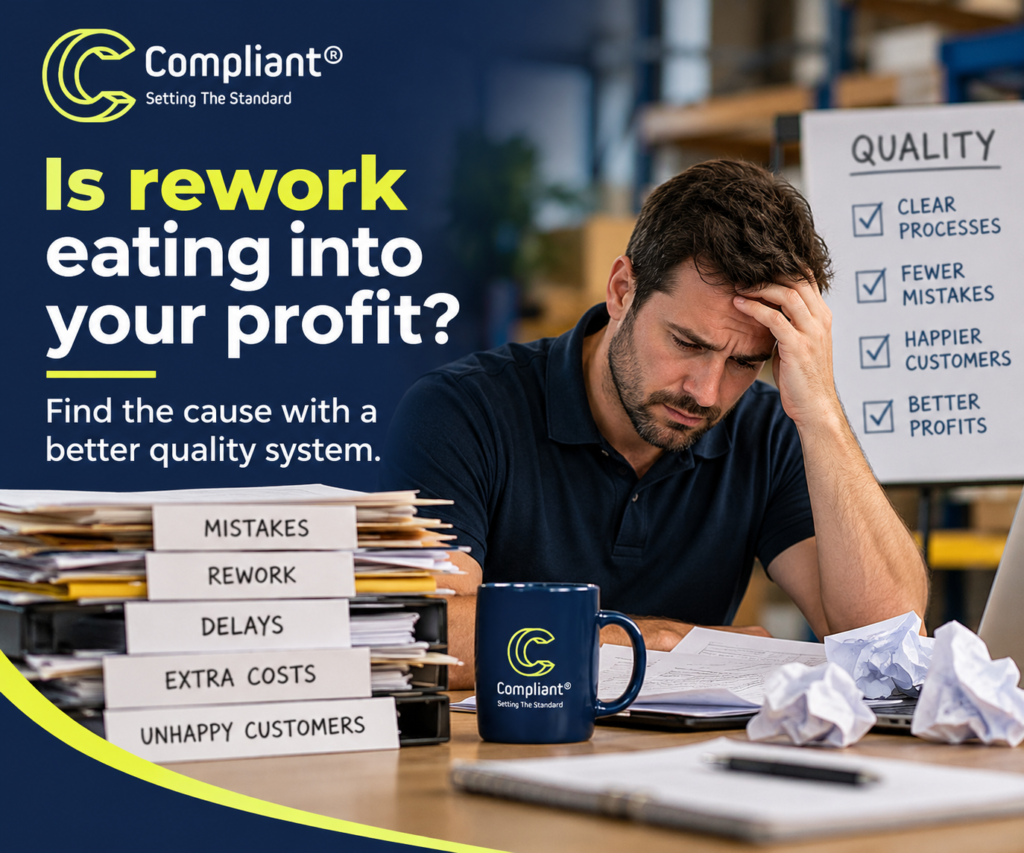
 How Much Is Rework Really Costing Your Business?
You have completed a job. Your team has worked hard, the customer is expecting delivery, and everything should be ready to go.
Then someone spots a problem.
Something has been missed. A product is not quite right. A document contains the wrong information. Perhaps the customer has received something different from what they ordered.
Now the work needs to be done again.
Your team must find time to fix the problem. Other jobs may need to wait, materials could be wasted, and someone must explain the delay to the customer.
The business has already paid for the work once.
Now it is paying for it again.
That is the hidden cost of rework, and it could be taking more money from your business than you realise.
For many business owners and managers, rework has become such a normal part of the working day that nobody questions it.
People say things like:
-
“These things happen.”
-
“We will get it right next time.”
-
“It was just a small mistake.”
-
“We have always done it this way.”
-
“We were too busy to check everything.”
But what happens when the same mistakes keep happening?
What if those small problems are costing your business hundreds or even thousands of pounds over the year?
And what if the real problem is not the person doing the work, but the way the work is being managed?
This is where an ISO 9001 quality management system can make a real difference.
ISO 9001 helps businesses understand how their work is carried out, where problems happen and what needs to change to stop mistakes from returning.
It is not simply about getting a certificate to display on your website.
It is about making your business work better.
And when your business works better, there is a real opportunity to protect your profits.
The Real Cost of Rework Goes Beyond Fixing a Mistake
When people think about rework, they often think about the cost of putting something right.
A faulty product needs replacing. A report needs correcting. A job needs another visit.
That is the obvious cost.
But there are other costs that can be much harder to see.
Think about a business that completes 100 jobs each month.
If 10 of those jobs need some form of correction, the business is spending extra time fixing work that should already have been completed.
That time could have been used to serve another customer, complete a new order or improve another part of the business.
Instead, it is being spent putting things right.
The cost of your team’s time
Your employees are one of your biggest business costs.
When they need to repeat work, you are paying for their time without receiving the full value of a new job.
A task that should take two hours might end up taking four.
A customer order that should be completed in one day might take three.
Your team is still busy, but that does not mean the business is making more money.
In fact, it could be losing money while everyone works harder.
The cost of wasted materials
For businesses that make, install or repair products, mistakes can also mean wasted materials.
Something may need to be replaced, repaired or made again.
Even small amounts of waste can become expensive when they happen regularly.
There may also be extra costs for delivery, storage and disposal.
The cost of customer complaints
Customers expect businesses to deliver what they promise.
When something goes wrong, they may be understanding the first time.
But repeated mistakes can damage their trust.
They may begin to question whether your business can meet their needs.
Some may ask for refunds or discounts. Others may decide to use another supplier.
A customer who leaves because of poor quality can represent much more than one lost sale.
You may also lose future orders and recommendations.
The cost of missed opportunities
Imagine your business is preparing to take on a large new contract.
Your team has the skills. Your prices are competitive. The customer is interested.
But your employees are already spending hours correcting old work.
Can you really take on more?
If repeated mistakes are using up valuable time, your business may struggle to grow.
This is one of the reasons why reducing rework should be seen as a business priority rather than just a quality issue.
What Would Rework Cost Your Business Over a Year?
Sometimes the best way to understand a problem is to put a figure against it.
Consider a simple example.
A business completes 200 jobs each month.
Around 5% of those jobs need extra work because something was missed or completed incorrectly.
That means 10 jobs need correcting every month.
If each correction costs the business £150 in staff time, materials and other costs, the figures look like this:
Illustrative cost of repeated rework
Monthly cost
£1,500
Annual cost
£18,000
£0£5,000£10,000£15,000£20,0001 month3 months6 months12 months
Example only: 10 corrections per month at £150 each.
That is £18,000 spent correcting mistakes in a single year.
And this example does not include the possible cost of lost customers, damaged relationships or missed contracts.
Now imagine reducing those mistakes by half.
That could mean £9,000 less spent on rework over the year, assuming the same number of jobs and the same cost per correction.
For a small or medium-sized business, that could make a meaningful difference.
The figures are only an example, but the question is worth asking.
Do you know how much rework is costing your business?
If the answer is no, that may be the first problem you need to solve.
Why Do the Same Mistakes Keep Happening?
Most businesses do not set out to make mistakes.
Employees want to do a good job. Managers want work completed on time. Business owners want happy customers.
So why do problems keep returning?
Often, it is because the business is fixing the mistake without finding out why it happened.
A customer receives the wrong item.
Someone sends a replacement.
The customer is happy, and the problem is considered solved.
But nobody asks why the wrong item was sent in the first place.
Was the order recorded incorrectly?
Were the instructions unclear?
Did two people use different versions of the same document?
Was the final check missed because the team was rushing?
Without finding the cause, the same problem can happen again.
And again.
When quick fixes become normal
A quick fix can be useful when a customer needs help immediately.
But it should not be the only response.
If your business spends every week putting out the same fires, there is probably something that needs to change in the way work is managed.
This does not mean you need more rules for the sake of having rules.
It means you need to understand what is going wrong and find a practical way to stop it.
When staff rely on memory
In some businesses, important tasks depend on what certain employees know.
One person understands how a job should be completed.
Another knows which documents must be checked.
Someone else remembers the special requirements of a major customer.
Everything works well until that person is absent, leaves the company or becomes too busy.
Then mistakes start to happen.
A business should not have to rely on one person’s memory to deliver good work.
Clear instructions, agreed ways of working and simple checks can help everyone understand what is expected.
When teams do not communicate
Poor communication is another common cause of rework.
The sales team promises something that the delivery team does not know about.
A manager changes a customer’s requirements but forgets to tell the people completing the work.
The office updates a document, but the team on site continues using an old version.
Nobody intends to make a mistake.
But the result can still be expensive.
An ISO 9001 quality management system can help businesses find these gaps and build better communication between teams.
How ISO 9001 Helps Businesses Reduce Rework
ISO 9001 is an internationally recognised standard for quality management.
It provides a way for businesses to manage their work, meet customer requirements and keep improving.
It can be used by organisations of different sizes and across many sectors.
You do not need to manufacture products to benefit from it.
Service providers, construction businesses, professional firms, technology companies and many other organisations can use ISO 9001 to improve how they work.
The main aim is simple.
Help your business deliver what customers expect, as consistently as possible.
When applied properly, ISO 9001 can also help reduce the mistakes that lead to rework.
1. Understand how work moves through your business
Before you can improve a process, you need to understand it.
Think about what happens when a customer places an order.
Who receives it?
Who checks the details?
Who passes the information to the next person?
Who completes the work?
And who checks that everything is correct before it reaches the customer?
If nobody has looked at the full journey, there may be gaps that cause problems.
ISO 9001 encourages businesses to understand how their activities connect.
This can make it easier to see where work is being delayed, repeated or completed incorrectly.
Sometimes a small change can make a big difference.
For example, adding a simple check before an order moves to production could prevent hours of rework later.
2. Make sure everyone knows what is expected
People are more likely to make mistakes when instructions are unclear.
Two employees might complete the same task in different ways because nobody has agreed on the best approach.
One method may work well.
The other may lead to repeated errors.
ISO 9001 helps businesses put clear ways of working in place where they are needed.
This does not mean creating long documents that nobody reads.
It means giving people the information they need to complete their work correctly.
That could include a short checklist, a clear instruction or a simple process that everyone follows.
The right solution will depend on the business.
3. Check quality before mistakes reach the customer
Finding a mistake before work reaches the customer is usually better than discovering it afterwards.
A final check may catch a missing document, incorrect measurement or wrong order.
But checks can also be useful earlier in the process.
For example, a business might review customer requirements before work begins.
This can help prevent problems caused by missing or unclear information.
ISO 9001 encourages businesses to decide what needs checking, when those checks should happen and how they will know the work meets requirements.
The aim is not to check everything twice.
It is to place useful checks where they can prevent costly mistakes.
4. Learn from problems rather than simply fixing them
Mistakes will still happen.
Even businesses with strong quality systems cannot promise that nothing will ever go wrong.
What matters is how they respond.
ISO 9001 requires businesses to deal with problems and, where needed, take action to stop them happening again.
This means looking beyond the immediate fix.
For example, if a customer repeatedly receives incorrect invoices, correcting each invoice is not enough.
The business should look at why the errors keep happening.
Perhaps information is being entered by hand when it could be transferred automatically.
Perhaps the person preparing the invoice does not have the latest customer details.
Finding the cause gives the business a better chance of preventing the next mistake.
5. Measure whether changes are working
Making a change is only part of the job.
You also need to know whether it has helped.
If your business introduces a new order-checking process, does the number of incorrect orders fall?
If employees receive additional training, are fewer mistakes being made?
If customer complaints increase, what is causing them?
ISO 9001 encourages businesses to use information to understand how well their systems are working.
You do not need complicated reports.
A simple record of errors, complaints and repeated work may be enough to show where attention is needed.
The important thing is to use that information to make decisions.
Quality Management Should Save Time, Not Create More Work
One concern we often hear from businesses considering ISO 9001 is that certification will mean more paperwork.
Managers worry that employees will spend more time filling in forms than doing their jobs.
Business owners may fear that a quality management system will slow everything down.
These concerns are understandable.
Nobody wants to introduce extra work without seeing a benefit.
But a well-designed ISO 9001 quality management system should support the way your business operates.
It should not become a separate activity that employees only think about when an audit is due.
The best systems are built around the work that is already happening.
If a business already has an effective way to check customer orders, it may not need to replace it.
If employees are already recording useful information, the business may simply need to make better use of those records.
The aim is to improve what works and address what does not.
Keep things simple
A small business does not need the same level of detail as a large organisation with several sites and hundreds of employees.
The system should suit the size, needs and risks of the business.
A short, clear instruction can often be more useful than a long document.
A simple checklist may prevent a mistake that would otherwise take hours to correct.
And a quick review of recurring problems could save more time than another meeting about why targets were missed.
Good quality management is about making work easier to get right.
That is where businesses can begin to see real value.
How to Find the True Cause of Rework
If your business is dealing with repeated mistakes, you do not have to wait until you achieve ISO 9001 certification to start making improvements.
You can begin by looking at one problem.
Choose something that happens regularly and costs your business time or money.
Perhaps orders are often incorrect.
Maybe jobs are being returned for changes.
Or your team is spending too much time answering customer complaints.
Then work through a few simple questions.
What keeps going wrong?
Be specific.
Saying “we have quality problems” is not enough.
Instead, identify exactly what is happening.
For example, “customer orders are being sent out with missing items.”
This gives you something clear to investigate.
How often does it happen?
Look at the information you already have.
You might find details in customer emails, job records, complaints or staff feedback.
Try to understand whether the problem happens once a month, once a week or every day.
The more often it happens, the more important it may be to address.
Why is it happening?
Speak to the people involved in the work.
They may already know where things are going wrong.
Ask questions without looking for someone to blame.
A mistake might be caused by unclear instructions, poor communication, missing information or a process that no longer suits the business.
If employees feel they will be blamed, they may be less willing to explain what is really happening.
That makes it harder to find a lasting solution.
What can you change?
Once you understand the cause, decide what action could prevent the problem.
This might involve updating an instruction, improving training or adding a check at an important stage.
Keep the action practical.
Make sure someone is responsible for putting it in place.
Did the change work?
After a suitable period, review the results.
Has the number of mistakes fallen?
Are employees finding the new approach easier?
Are customers receiving better service?
If the problem continues, you may need to look again.
Improvement is not always immediate.
But taking the time to understand what works can help your business avoid repeating the same expensive mistakes.
The Benefits of an ISO Consultant’s Support
Introducing or improving a quality management system can feel like another large task for an already busy business.
You may understand that mistakes are costing money but struggle to find the time to review how everything works.
Your managers may be focused on meeting deadlines.
Employees may already be dealing with customer demands.
And the person responsible for quality might have several other jobs to manage.
This is where the benefits of an ISO consultant’s support can become clear.
An experienced consultant can help you look at your existing ways of working, identify areas that need attention and understand what ISO 9001 requires.
Rather than starting from scratch, they can help you build on the processes you already have.
A fresh look at familiar problems
When you work in the same business every day, it can be difficult to notice problems that have become normal.
You may accept repeated checks, delays or corrections because they have always been part of the process.
An ISO consultant can bring an outside view.
They can ask questions that help your team see where time and money may be wasted.
Sometimes the answer is not a major change.
It may be a small improvement that nobody had considered.
Support that fits your business
Every business is different.
A quality system that works for a manufacturer may not suit a professional service provider.
A small company with 10 employees will have different needs from a business with several departments.
A good consultant should take time to understand how your business operates.
The aim should be to create a system that supports your employees rather than making their jobs harder.
Help understanding ISO 9001 requirements
ISO standards can seem difficult to understand when you first read them.
You may be unsure what information you need, which records to keep or how to prepare for an audit.
A consultant can explain the requirements in plain English.
They can help your team understand what needs to happen and why it matters.
This can reduce confusion and help everyone feel more confident.
Support beyond certification
Achieving ISO 9001 certification can be an important milestone.
But the real value should continue after the certificate has been issued.
Your business still needs to review its processes, learn from mistakes and look for ways to improve.
An ISO consultant can support these activities and help your business keep its quality system useful as things change.
At Compliant Ltd, our approach is to help businesses understand their responsibilities and build practical management systems that work for them.
Certification is important.
But so is what happens every day between audits.
Can ISO 9001 Help Your Business Win More Work?
Reducing rework is one reason to consider ISO 9001.
But there can be wider benefits.
Customers want confidence that the businesses they work with can deliver what they promise.
They want products and services that meet their needs.
They also want to know that problems will be handled properly.
For some buyers, ISO 9001 certification is an important part of deciding which suppliers to use.
It may be requested during tender applications or supplier approval checks.
Certification does not guarantee that your business will win a contract.
But it can help show that you have a recognised quality management system in place.
This may be particularly useful when competing for work with larger organisations or customers that have strict supplier requirements.
Better quality can support stronger customer relationships
When customers receive consistent service, they have more reason to trust your business.
They are less likely to spend time raising complaints or chasing corrections.
Your team can focus on delivering the work rather than repairing the relationship.
Over time, that can support customer satisfaction and repeat business.
Better processes can support growth
As a business grows, informal ways of working can become harder to manage.
What worked when five people shared an office may not work when the team grows to 30.
More employees, customers and orders can create more opportunities for mistakes.
ISO 9001 can help businesses develop clear processes that support growth.
This does not mean removing flexibility.
It means making sure people understand their responsibilities and have the right information to do their jobs.
Why Waiting to Fix Quality Problems Could Cost More
It is easy to put quality improvements off until things are quieter.
There is always another deadline.
Another customer needs attention.
Another urgent job has appeared.
But if the same problems keep happening, waiting may simply allow the costs to grow.
Think about a mistake that costs £100 each time it happens.
If it happens twice a week, that is £200 being spent on corrections.
Over 50 working weeks, the total reaches £10,000.
That is money your business could potentially put towards training, equipment, new employees or growth.
Of course, not every mistake can be prevented.
And the cost of making improvements needs to be considered.
But ignoring a repeated problem does not make it disappear.
The first step is understanding what is happening.
The next is deciding what needs to change.
ISO 9001 provides a recognised approach to doing both.
Make Quality Part of Your Business, Not Just Your Audit
One of the biggest mistakes a business can make is treating ISO 9001 as something that only matters when an auditor visits.
Documents are reviewed.
Records are checked.
Employees are reminded of procedures.
Everyone works hard to prepare for the assessment.
Then, once the audit is complete, attention moves elsewhere.
But the purpose of a quality management system is not simply to pass an audit.
It is to help your business manage quality throughout the year.
That means checking whether processes are working.
It means listening when employees raise concerns.
It means taking customer feedback seriously.
And it means learning from mistakes rather than accepting them as part of the job.
When quality becomes part of everyday work, businesses have a better opportunity to reduce waste, protect their profits and improve customer satisfaction.
Your employees should understand how the system helps them.
Your managers should use the information it provides.
And your leadership team should see quality as part of running a successful business.
Not just another certificate on the wall.
Stop Paying Twice for Work That Should Be Right the First Time
Rework can become an expensive habit.
A mistake here.
A correction there.
An extra delivery.
Another unhappy customer.
Each problem might seem small on its own, but the costs can build over time.
And while your employees are busy fixing yesterday’s mistakes, they have less time to focus on tomorrow’s opportunities.
The question is not whether your business will ever make another mistake.
Every business faces problems.
The question is whether you have the right systems in place to understand those problems and reduce the chance of them happening again.
An ISO 9001 quality management system can help you do that.
It can provide clearer processes, better checks, improved communication and a more consistent way of working.
It can also help you see where time, materials and money are being wasted.
The benefits of an ISO consultant’s support can make the process easier to understand and manage, especially when your team is already busy.
At Compliant Ltd, we understand that business owners and managers do not want more paperwork for the sake of it.
They want practical support.
They want to know what needs improving.
And they want a quality management system that adds real value to their business.
Ready to Find Out Where Rework Is Costing Your Business?
If your team is spending too much time correcting mistakes, dealing with repeated complaints or fixing problems that should have been prevented, it may be time to review your approach to quality management.
Whether you are considering ISO 9001 for the first time, preparing for certification or looking to improve an existing system, Compliant Ltd can help you understand the next steps.
We can support you in identifying gaps, reviewing your processes and developing a quality management system that suits your business.
Speak to Compliant Ltd about your certification plans.
Visit compliantltd.com to find out more about our ISO consultancy and certification support.
Supporting businesses through compliance with confidence.