Skip to main content
Skip to footer
Skip to main content
Skip to footer

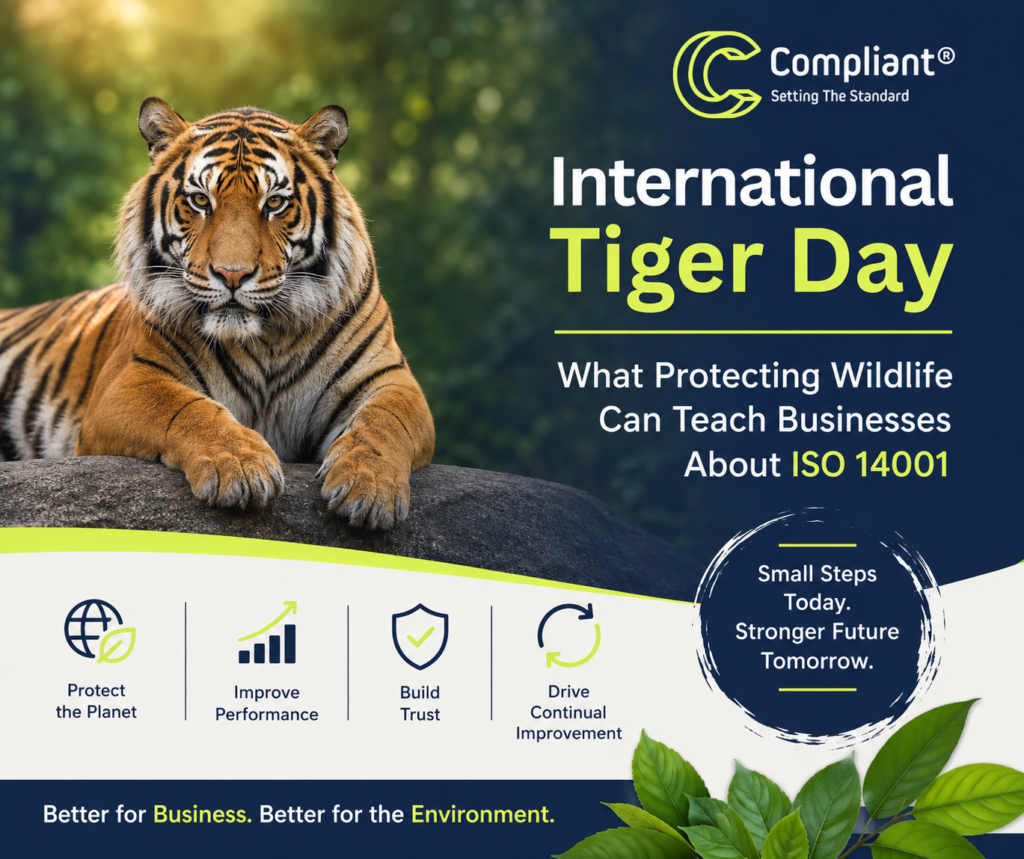
International Tiger Day: What Protecting Wildlife Can Teach Businesses About ISO 14001
International Tiger Day: What Protecting Wildlife Can Teach Businesses About ISO 14001
Every Business Leaves a Footprint. The Question Is, What Kind?
Tigers are one of the world’s most powerful animals. Yet despite their strength, they remain endangered because of habitat loss, pollution, climate change, and human activity.
That should make every business stop and think.
Many organisations believe environmental problems only belong to governments or conservation groups. They assume their own impact is too small to matter. Unfortunately, that way of thinking is exactly why environmental issues grow over time.
Every business uses energy. Every business creates waste. Every business affects the environment in some way.
The good news is that every business also has the power to make a positive difference.
International Tiger Day, celebrated each year on 29 July, reminds us why protecting nature matters. While your business may never work directly with wildlife conservation, the same principles that help protect endangered species can help protect your business too.
This is where ISO 14001 becomes incredibly valuable.
ISO 14001 is not simply about recycling bins or reducing paper use. It is an internationally recognised environmental management standard that helps organisations understand their environmental impact, reduce waste, improve efficiency, and continually improve the way they operate.
Businesses that embrace ISO 14001 often discover that protecting the environment also protects profits, reputation, and future growth.
Let’s explore what International Tiger Day can teach us about better environmental management.
Why International Tiger Day Matters
Wild tigers once roamed across much of Asia.
Today, they occupy only a small part of their historic range.
Over many years, forests have disappeared. Habitats have become smaller. Pollution has increased. Illegal hunting has taken its toll.
The lesson is simple.
Small actions repeated over many years create huge consequences.
The same is true for businesses.
One unnecessary delivery may seem harmless.
One overflowing waste bin doesn’t feel like a problem.
One machine left running overnight feels insignificant.
But repeat these actions every day across hundreds of businesses and the environmental impact becomes enormous.
ISO 14001 encourages organisations to notice these small actions before they become much bigger problems.
Environmental Responsibility Is Now a Business Expectation
Customers have changed.
Investors have changed.
Governments have changed.
Employees have changed too.
People increasingly want to work with businesses that care about the environment.
Many tenders now ask suppliers to demonstrate environmental responsibility.
Large organisations often expect their supply chains to reduce emissions and improve sustainability.
Even consumers who are not experts in environmental policy notice businesses making positive changes.
Ignoring environmental responsibility no longer carries the same low risk it once did.
Businesses that fail to improve may find themselves losing opportunities to competitors that can clearly demonstrate responsible environmental management.
ISO 14001 provides a recognised framework that helps organisations prove they are taking meaningful action.
What Is ISO 14001?
ISO 14001 is the international standard for Environmental Management Systems.
Rather than telling organisations exactly what to do, it provides a structured framework that helps businesses:
- Understand their environmental impact
- Meet environmental legal requirements
- Reduce waste
- Improve energy efficiency
- Prevent pollution
- Set environmental objectives
- Monitor performance
- Continually improve
It works for organisations of every size.
Whether you employ five people or five thousand, ISO 14001 can be adapted to suit your operations.
It isn’t about becoming perfect overnight.
It is about becoming better every year.
What Businesses Can Learn from Wildlife Conservation
Wildlife conservation is built on planning.
Experts collect information.
They monitor progress.
They identify risks.
They measure results.
Then they improve what they are doing.
Sound familiar?
These are exactly the same principles found throughout ISO 14001.
Businesses often think environmental management is about reacting when something goes wrong.
ISO 14001 encourages organisations to think ahead instead.
Instead of cleaning up pollution, businesses learn how to prevent it.
Instead of responding to waste, they reduce waste before it is created.
Instead of paying higher energy bills, they improve efficiency before costs rise.
Prevention almost always costs less than correction.
The Hidden Costs of Poor Environmental Management
Many organisations only think about direct costs.
Electricity.
Fuel.
Waste disposal.
Water.
But environmental performance affects far more than utility bills.
Poor environmental management can lead to:
- Lost contracts
- Higher insurance costs
- Damaged reputation
- Regulatory penalties
- Increased operating costs
- Lost customer trust
- Reduced staff morale
These costs are often much greater than businesses expect.
ISO 14001 helps identify these risks early before they become expensive problems.
Better Environmental Management Often Means Better Business
Many organisations worry that becoming environmentally responsible will increase costs.
In reality, the opposite is often true.
Businesses that improve environmental performance frequently discover they also become more efficient.
They waste fewer materials.
They reduce energy consumption.
Processes become simpler.
Resources are used more effectively.
Employees become more engaged because they understand the organisation’s environmental goals.
Small improvements made consistently create significant long-term savings.
Environmental management should not be viewed as another expense.
It should be viewed as an investment in efficiency.
ISO 14001 Helps Build Trust
Trust is difficult to earn.
Easy to lose.
Customers want confidence that suppliers will act responsibly.
Investors increasingly examine environmental performance before making decisions.
Large procurement teams regularly assess environmental credentials during supplier selection.
Holding ISO 14001 certification demonstrates that environmental management is not simply discussed within the business.
It is managed.
Measured.
Reviewed.
Improved.
That independent reassurance often provides confidence that marketing claims alone cannot achieve.
Continual Improvement Is the Heart of ISO 14001
One of the strongest principles within ISO 14001 is continual improvement.
Businesses do not need to solve every environmental challenge immediately.
Instead, they commit to improving year after year.
This creates realistic progress.
One year may focus on reducing electricity use.
The next may improve waste management.
Later, the business may introduce more sustainable purchasing.
Each improvement builds on the last.
The result is long-term environmental performance that keeps getting stronger.
Just as wildlife conservation requires ongoing effort, environmental management within a business never truly stops.
Every Employee Has a Role
Environmental responsibility is not just the job of senior management.
Everyone contributes.
Simple daily actions matter.
Turning equipment off.
Reducing unnecessary printing.
Sorting waste correctly.
Reporting environmental issues.
Using resources carefully.
When every employee understands their role, environmental improvements happen naturally.
ISO 14001 encourages organisations to build this shared responsibility across the business.
Why Many Businesses Choose Support During ISO 14001 Implementation
Although ISO 14001 is designed to be practical, many organisations find implementation challenging without expert guidance.
Understanding the requirements.
Preparing documentation.
Identifying environmental aspects.
Creating objectives.
Training staff.
Preparing for certification.
All require time and experience.
This is where the benefits of a PAS consultant’s support become valuable.
An experienced consultant understands how management systems work across multiple standards and industries. They can help businesses avoid common mistakes, simplify implementation, and build a system that works in everyday operations rather than one that only exists on paper.
Good support keeps the process focused, practical, and proportionate to your organisation.
Rather than wasting time second-guessing requirements, your team can concentrate on improving environmental performance while the consultant provides guidance throughout the journey.
For many organisations, this means reaching certification more efficiently and with greater confidence.
ISO 14001 Supports Long-Term Growth
Businesses often focus on today’s challenges.
Today’s workload.
Today’s deadlines.
Today’s costs.
Successful organisations also prepare for tomorrow.
Environmental expectations will continue to grow.
Customers will continue asking more questions.
Supply chains will continue demanding higher standards.
Regulations will continue evolving.
Businesses that prepare now are likely to find these future changes far easier to manage.
ISO 14001 helps organisations build resilience by embedding environmental thinking into everyday decision-making.
International Tiger Day Is About More Than Tigers
It is easy to see International Tiger Day as simply another awareness campaign.
It is much more than that.
It reminds us that protecting the environment begins long before problems become impossible to solve.
Businesses face the same challenge.
Waiting until regulations tighten, customers complain, or costs increase usually means acting too late.
Organisations that take responsibility today place themselves in a far stronger position tomorrow.
The principles behind wildlife conservation and ISO 14001 are remarkably similar.
Understand your impact.
Manage your risks.
Measure your progress.
Keep improving.
Those lessons help protect endangered wildlife.
They also help build stronger, more sustainable businesses.
Conclusion
International Tiger Day reminds us that every action matters.
Protecting wildlife is not achieved through one large project. It happens because thousands of small, consistent improvements are made over time.
The same applies to business.
ISO 14001 gives organisations a clear framework for understanding their environmental impact, reducing waste, improving efficiency, and building trust with customers and stakeholders. It transforms environmental responsibility from a challenge into an opportunity for continual improvement and long-term success.
Whether your organisation is beginning its environmental journey or looking to strengthen an existing management system, adopting ISO 14001 is an investment in a more resilient future.
Businesses that act today will be better prepared for tomorrow’s expectations while contributing to a healthier planet for future generations.
Continue Learning
International Tiger Day encourages us to think about the legacy we leave behind. Your business has that same opportunity every day.
Take time to review your current environmental practices. Identify where waste can be reduced, resources can be used more efficiently, and risks can be better managed. Learning more about ISO 14001 is the first step towards building a business that supports both commercial success and environmental responsibility.
The journey towards continual improvement starts with one informed decision.