Skip to main content
Skip to footer
Skip to main content
Skip to footer

IOSH, IEMA and NEBOSH: What Does Competence Really Look Like?
IOSH, IEMA and NEBOSH: What Does Competence Really Look Like?
A certificate can prove that somebody completed a course.
It cannot automatically prove that they can do the job well.
That distinction matters.
Businesses invest significant amounts of time and money in training. Employees gain qualifications. Certificates are stored. Training records are updated. Expiry dates are monitored.
On paper, everything can look excellent.
But then ask a different question:
Can that person take what they have learned and use it confidently in a real workplace?
That is where competence becomes much more important.
Qualifications and professional development connected with organisations such as IOSH, IEMA and NEBOSH can provide valuable knowledge and help people develop their understanding of health, safety and environmental management.
But competence cannot be reduced to a collection of certificates.
Someone can understand a subject in a classroom and still struggle when faced with a real problem.
They may know what a risk assessment is but struggle to recognise a poorly controlled risk.
They might understand environmental impacts but fail to notice waste happening throughout an everyday process.
They could know how an incident should be investigated but stop at the first obvious explanation rather than finding out why it really happened.
Knowledge matters.
Training matters.
Qualifications matter.
But so do experience, judgement, confidence, behaviour and the ability to apply knowledge when circumstances are not perfect.
So when your organisation says somebody is competent, what does that really mean?
If your answer is simply, “They have a certificate,” it may be time to look deeper.
Competence Is More Than a Training Record
Training records are useful.
They help organisations understand what training employees have completed and when.
They can highlight when refresher training may be required.
They can provide evidence during an audit.
But a training record tells you one thing:
Training took place.
It does not necessarily tell you what happened afterwards.
Imagine two employees attend exactly the same course.
They sit in the same room.
They hear the same information.
They complete the same assessment.
They both receive a certificate.
Six months later, one employee regularly uses what they learned.
They identify problems.
They ask good questions.
They recognise risks.
They know when they need more information.
They explain issues clearly to colleagues.
The other employee remembers very little and struggles to apply the learning.
Both people have the same certificate.
Are they equally competent?
Not necessarily.
This is why businesses need to think beyond training completion.
Competence is about what somebody can actually do with their knowledge.
What Does Workplace Competence Mean?
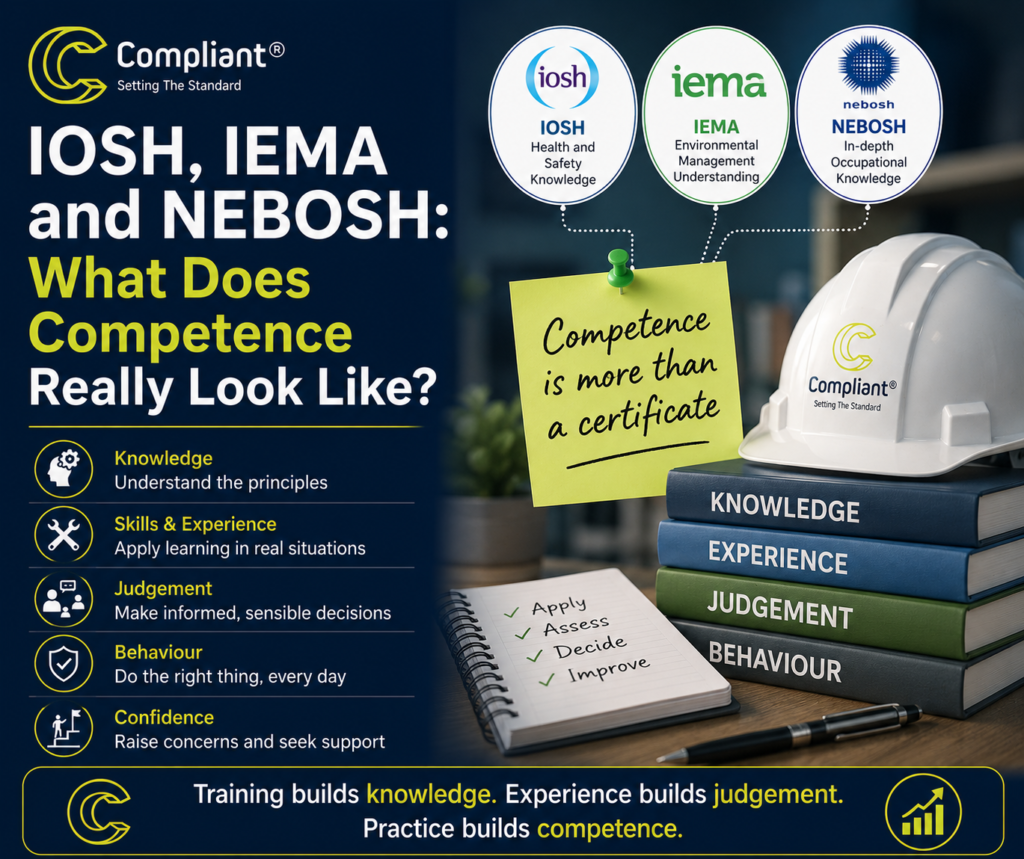
Competence can involve several things working together.
Knowledge.
Does the person understand the subject?
Skills.
Can they carry out the required task?
Experience.
Have they dealt with similar situations before?
Judgement.
Can they recognise when something is wrong or when more support is needed?
Behaviour.
Do they actually follow good practice?
Confidence.
Can they raise concerns and make sensible decisions?
The exact mix will depend on the role.
Someone responsible for a simple workplace check will need a different level of competence from somebody managing complex health and safety risks across several sites.
An environmental manager will require different knowledge from a production supervisor.
A senior manager does not necessarily need the same technical knowledge as a specialist adviser.
Competence needs to match responsibility.
That is one of the most important principles businesses can apply.
Do not simply ask whether somebody is competent.
Ask:
Competent to do what?
IOSH Can Support Health and Safety Knowledge
IOSH, the Institution of Occupational Safety and Health, is widely recognised within workplace health and safety.
IOSH training and professional development can help people build understanding around managing health and safety.
For organisations, this knowledge can be valuable.
Managers influence working practices every day.
They make decisions.
They allocate resources.
They supervise people.
They respond when something goes wrong.
They influence whether employees believe health and safety really matters.
Giving managers appropriate knowledge can help them understand the consequences of those decisions.
But completing training should not be where development ends.
Managers need opportunities to use what they have learned.
Can they identify risks within their own team?
Can they have a sensible safety conversation with an employee?
Do they understand why a near miss matters?
Would they challenge unsafe behaviour?
Would they recognise when specialist advice is required?
That is where knowledge begins turning into competence.
NEBOSH Qualifications Can Build Deeper Understanding
NEBOSH, the National Examination Board in Occupational Safety and Health, provides qualifications covering health, safety and related areas.
These qualifications can give people valuable knowledge and a structured understanding of important subjects.
For somebody developing a career in health and safety, that learning can create a strong foundation.
But again, qualification and competence are not exactly the same thing.
Imagine somebody has excellent technical knowledge.
They understand risk.
They understand incident investigation.
They know how management systems work.
But they cannot communicate with employees.
Every conversation becomes a lecture.
People stop asking questions.
Managers avoid involving them because the answer always feels too complicated.
Technical knowledge is important.
But workplace competence can also require communication.
A competent person often needs to take a complicated subject and explain it simply.
They need to listen.
They need to understand how work actually happens.
They need to recognise that the safest solution must also work in the real world.
A qualification can help provide knowledge.
Experience helps teach people how to apply it.
IEMA Brings Environmental Knowledge Into the Picture
Health and safety is only one area where competence matters.
Environmental responsibilities are becoming increasingly important for organisations.
IEMA, the Institute of Environmental Management and Assessment, supports environmental and sustainability professionals and those developing knowledge in these areas.
Environmental management can involve many different issues.
Waste.
Energy.
Water.
Materials.
Pollution prevention.
Environmental risks.
Legal duties.
Supply chains.
Objectives.
Continual improvement.
Someone responsible for environmental management needs more than an environmental policy and a list of good intentions.
They need to understand how the organisation interacts with the environment.
More importantly, they need to be able to turn that understanding into practical action.
Can they identify where significant waste is occurring?
Can they help managers understand environmental risks?
Can they review information and identify patterns?
Can they communicate environmental responsibilities to employees?
Can they recognise when specialist advice is needed?
Again, competence is visible in what happens after the learning.
Qualifications Provide Foundations, Not Finish Lines
There is a danger in treating a qualification as the final destination.
An employee completes training.
The certificate arrives.
The training matrix is updated.
Everyone moves on.
But businesses change.
Rules can change.
Standards change.
Technology changes.
Equipment changes.
Responsibilities change.
Employees move into new roles.
Knowledge that was suitable three years ago may need updating.
Competence therefore needs ongoing attention.
Professional development matters because learning should continue throughout someone’s career.
This does not always mean attending another long course.
People can learn through experience.
Mentoring.
Reading.
Short training sessions.
Professional events.
Internal discussions.
Reviewing incidents.
Taking part in audits.
Working alongside more experienced colleagues.
The important thing is that development continues.
Competence should grow with responsibility.
Experience Matters, but Experience Alone Is Not Enough
There is another side to this discussion.
Somebody might say:
“I’ve been doing this for 25 years. I don’t need training.”
Experience is extremely valuable.
A person who has spent decades working within an industry may recognise problems immediately that somebody new would miss.
They may understand equipment.
They know how work changes when pressure increases.
They have seen things go wrong.
That knowledge deserves respect.
But time served does not automatically equal competence either.
People can spend 25 years repeating the same poor practice.
Requirements may have changed.
Better methods may have become available.
Old habits can become difficult to question.
The strongest competence often combines experience with current knowledge.
Experienced employees can learn from newer information.
Less experienced employees can learn from people who have dealt with real situations.
Both sides have something valuable to offer.
Competent People Know What They Do Not Know
One of the strongest signs of competence is surprisingly simple.
Someone knows when to stop.
They recognise the limits of their knowledge.
An inexperienced person may believe they can deal with everything.
A genuinely competent person is often more willing to say:
“I need to check that.”
“I haven’t dealt with this before.”
“We need specialist advice.”
“I’m not comfortable making that decision without more information.”
That is not weakness.
It is good judgement.
Businesses can create serious risks when employees feel they must always have an answer.
Managers should create an environment where asking for help is acceptable.
No qualification makes somebody an expert in every situation.
Knowing your limits is part of competence.
Communication Is a Core Part of Competence
You can have excellent technical knowledge and still struggle to create improvement.
Why?
Because businesses operate through people.
Imagine a health and safety professional identifies a serious problem.
They write a 20-page report filled with difficult language.
Senior managers struggle to understand it.
Employees never read it.
Nothing changes.
Was the technical knowledge correct?
Possibly.
Did it improve the workplace?
No.
A competent professional needs to communicate information in a way the audience can understand.
A director may need to understand the business risk and what decision is required.
A supervisor may need practical instructions.
An employee may simply need to know what they should do differently.
The message can change without changing the facts.
This applies to health and safety.
It applies to environmental management.
It applies to quality.
Good communication turns knowledge into action.
Competence Should Be Seen in Everyday Behaviour
Imagine an employee has completed all required health and safety training.
Yet they regularly ignore procedures.
Are they competent?
Knowledge without appropriate behaviour creates a problem.
Competence should be visible.
People use the correct equipment.
They follow important controls.
They recognise problems.
They report concerns.
They understand their responsibilities.
They ask questions when unsure.
Managers demonstrate the behaviour they expect from others.
This is particularly important when nobody is watching.
Passing an assessment can show that someone knew the correct answer on that day.
Everyday behaviour shows whether that understanding has become part of how they work.
Managers Need Competence Too
Businesses often focus heavily on the competence of employees completing physical or technical work.
But management decisions can create just as much risk.
A manager decides staffing levels.
They approve deadlines.
They decide whether equipment is replaced.
They respond to reported concerns.
They decide whether work stops when a problem is found.
They influence whether employees feel able to speak up.
A manager does not need to become a health and safety or environmental specialist.
But they need enough understanding to make responsible decisions.
This is one reason training associated with organisations such as IOSH can be useful for managers.
The goal is not to turn every manager into an expert.
It is to help them recognise how their decisions affect other people and the organisation.
Senior Leadership Cannot Outsource All Competence
Hiring a health and safety professional does not remove leadership responsibility.
Neither does employing an environmental manager.
Specialists provide knowledge and advice.
Leadership still needs to understand enough to make decisions.
Imagine a safety adviser recommends replacing unsafe equipment.
Management refuses because of cost.
Who made the final decision?
The adviser can explain the risk.
Leadership must act.
The same principle applies to environmental management.
A specialist may identify an environmental risk or improvement opportunity.
Senior management needs to decide what resources are required.
Competence therefore needs to exist at different levels.
Not everyone needs the same knowledge.
Everyone needs the knowledge appropriate to their responsibilities.
How Do You Know Someone Is Competent?
This is where organisations can struggle.
A certificate is easy to check.
Competence is more complex.
Start with the role.
What does this person need to do?
What could happen if they get it wrong?
What knowledge is required?
What skills are needed?
What experience would be useful?
Does the role require a specific qualification?
Then look at the individual.
Have they completed relevant training?
Have they demonstrated the task?
Have they worked under supervision?
Can they explain what they are doing and why?
Do they know what to do when something goes wrong?
Do they understand the limits of their authority?
Do they know when to ask for help?
The level of checking should match the risk.
A low-risk task may need a simple check.
A high-risk or specialist responsibility may require much stronger evidence.
The aim is not to create unnecessary administration.
It is to have confidence that people can do what the business expects them to do.
Observation Can Tell You More Than a Certificate
Sometimes the best way to understand competence is to watch.
Observe somebody completing the task.
Do they follow the process?
Do they use equipment correctly?
Do they recognise problems?
Can they adapt when something unexpected happens?
Can they explain why important controls exist?
Observation connects paperwork with reality.
This can be particularly valuable after training.
Instead of assuming a course created competence, give employees an opportunity to demonstrate what they learned.
Where gaps appear, provide support.
This turns competence management into development rather than simply checking whether somebody passes or fails.
Mentoring Can Turn Knowledge Into Practical Skill
Training provides information.
Mentoring can help people understand how to use it.
Pairing less experienced employees with competent, experienced colleagues can be extremely valuable.
The experienced person can explain situations that are difficult to recreate in a classroom.
They can discuss mistakes.
Share examples.
Explain how they make decisions.
Show what warning signs they look for.
The newer employee can also bring fresh knowledge and questions.
Good mentoring works both ways.
It helps businesses retain knowledge while developing the next group of competent people.
This becomes particularly important when experienced employees approach retirement or move into different roles.
If knowledge leaves with them, the organisation loses more than one employee.
Competence Needs Reviewing When Roles Change
An employee is promoted.
Suddenly, they have new responsibilities.
Perhaps they now supervise people.
Approve work.
Complete investigations.
Review environmental performance.
Lead meetings.
Their previous competence may have been perfect for their old role.
That does not automatically make them competent for the new one.
Promotion should trigger a simple question:
What does this person need to know now that they did not need to know before?
The same applies when someone moves departments or begins using new equipment.
Competence is connected to the work.
When the work changes, competence may need reviewing.
Audits Can Help Test Competence
Audits should not simply look for training certificates.
Talk to people.
Ask employees to explain their responsibilities.
Ask what they would do if something went wrong.
Ask managers how they deal with reported concerns.
Ask environmental teams how they identify significant impacts.
Ask supervisors how they know employees are competent.
The aim is not to catch people out.
It is to understand whether knowledge exists where it is needed.
An employee who cannot answer a question may have identified a useful training need.
That is valuable information.
Finding the gap during an internal audit is much better than discovering it after an incident.
Do Not Create a Training Matrix Nobody Uses
Training matrices can be useful.
They can also become huge spreadsheets that somebody updates purely because an auditor might ask to see them.
A good training or competence system should answer useful questions.
Who needs what?
Who has completed it?
What is missing?
When does something need reviewing or renewing?
Has competence been demonstrated where necessary?
What happens next?
If the system cannot answer those questions easily, simplify it.
Administration should support competence.
It should not become the goal.
What IOSH, IEMA and NEBOSH Can Represent
IOSH, IEMA and NEBOSH each have different roles within professional learning and development.
They should not simply be treated as names to place on a CV or training record.
Learning connected with respected professional organisations and awarding bodies can provide people with valuable foundations.
It can improve knowledge.
Build confidence.
Support career development.
Expose people to better ways of thinking.
Help managers understand responsibilities.
Develop specialists.
But the real value appears when learning changes behaviour.
When someone spots a risk they previously would have missed.
When a manager asks a better question.
When an environmental problem is identified earlier.
When an incident investigation goes beyond blame.
When an employee has the confidence to say, “Something isn’t right.”
That is where competence becomes visible.
Five Questions to Ask About Competence in Your Business
If you want to understand whether your competence system is actually working, ask these five questions.
1. Are we checking competence or only collecting certificates?
Training is important, but look at what happens afterwards.
2. Does competence match responsibility?
The greater the responsibility and risk, the stronger the knowledge and skills may need to be.
3. Do employees know when to ask for help?
Recognising limits is part of good judgement.
4. Are we developing people after their training?
Use mentoring, observation, experience and ongoing learning.
5. Do we review competence when jobs change?
Promotions, new equipment and new responsibilities can all create new learning needs.
These questions can reveal whether competence is genuinely being managed or simply recorded.
A Qualified Workforce and a Competent Workforce Are Not Always the Same Thing
Qualifications have value.
Training has value.
Professional development has value.
Businesses should invest in all three where appropriate.
But do not confuse evidence of learning with evidence of competence.
The goal is not to have the largest collection of certificates.
It is to have people who can make good decisions.
People who understand the risks connected with their work.
People who recognise when something is wrong.
People who communicate clearly.
People who know when they need support.
People who keep learning.
Organisations such as IOSH, IEMA and NEBOSH can form an important part of that development journey.
The business then needs to create opportunities for people to apply what they have learned.
Give them experience.
Support them.
Observe them.
Mentor them.
Challenge them.
Listen to them.
And review their competence as their responsibilities grow.
Because the certificate proves somebody completed the learning.
What they do afterwards shows whether that learning has become valuable.
Competence Is Something You Demonstrate
The strongest evidence of competence is rarely hanging on a wall.
It is happening in the workplace.
A manager notices a risk and acts.
An employee stops because they are unsure.
A health and safety professional explains a difficult problem in a way everyone understands.
An environmental professional identifies unnecessary waste and helps a team reduce it.
A supervisor recognises that somebody needs more training before completing a task alone.
An experienced employee shares knowledge with someone new.
A senior leader listens to professional advice and makes a responsible decision.
These actions demonstrate competence.
They combine knowledge with judgement and behaviour.
And that is what businesses should be trying to develop.
Not simply people who can prove they attended training.
People who can use what they know to make the organisation safer, stronger and better prepared.
Educational CTA
Choose one role in your organisation this week.
Not the person. The role.
Ask what someone in that position genuinely needs to know and be able to do.
Then look at the person currently carrying out that work.
Do you only have evidence that they completed training?
Or can you also demonstrate that they understand the role, apply their knowledge, recognise problems and know when to ask for help?
If there is a gap, do not immediately look for another certificate.
First ask what development would genuinely help.
It could be training.
It could be mentoring.
It could be supervised experience.
It could simply be a conversation with somebody who has dealt with the situation before.
Because workplace competence is not about collecting qualifications.
It is about giving people the knowledge, skills, experience and confidence to make good decisions when those decisions really matter.