Skip to main content
Skip to footer
Skip to main content
Skip to footer

ISO 22301: Could Your Business Keep Operating When the Unexpected Happens?
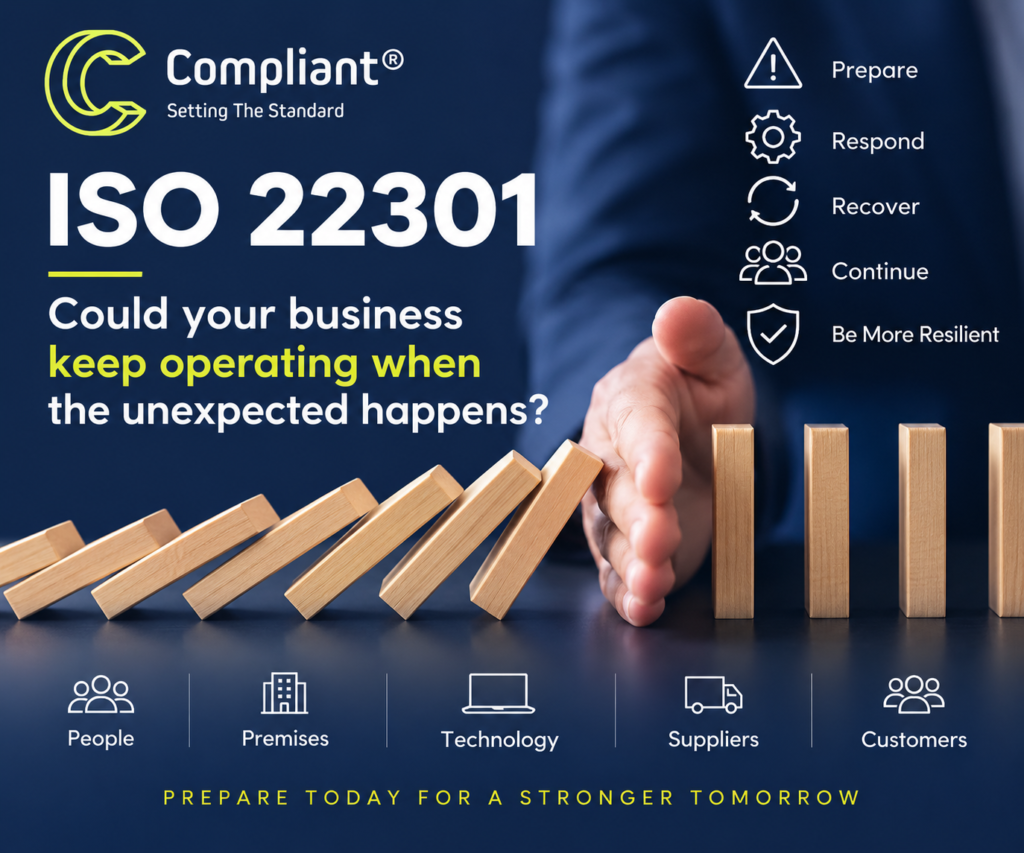

ISO 22301: Could Your Business Keep Operating When the Unexpected Happens?
Most businesses have a plan for tomorrow.
People know what work needs to be done. Orders are booked. Customers are waiting. Staff have jobs to complete. Systems hold the information everyone needs.
Then something unexpected happens.
Your main IT system stops working.
A key supplier cannot deliver.
Your building cannot be used.
A power cut brings work to a halt.
Important data becomes unavailable.
Several key members of staff are suddenly absent.
Or a cyber attack locks you out of the systems your business depends on.
What happens next?
That is where the difference between having a business and having a resilient business becomes very clear.
ISO 22301 is designed to help organisations prepare for disruption before it happens. It provides a clear approach to business continuity management, helping businesses understand what they rely on, what could go wrong and how they can keep important activities running.
Because the worst time to work out how your business will cope with an emergency is when the emergency has already started.
The Unexpected Rarely Arrives at a Convenient Time
Business disruption does not wait until everyone is ready.
It does not check that your management team is in the office.
It does not wait until your busiest project has finished.
And it certainly does not care whether you have a major customer deadline tomorrow morning.
Problems happen.
Some are small and can be dealt with quickly. Others can affect the whole business.
The important question is not whether you can stop every problem from happening.
You cannot.
The important question is:
How quickly can your business respond, recover and continue?
Imagine that your main computer system becomes unavailable at 9am tomorrow.
How long could your team continue working?
An hour?
Half a day?
A full day?
What happens after that?
Would staff know what to do?
Could customers still contact you?
Could you access important records?
Could you continue taking orders?
Could you pay suppliers and staff?
Could you meet contractual deadlines?
Would someone have the authority to make quick decisions?
These questions can feel uncomfortable. That is exactly why they need to be asked before something goes wrong.
ISO 22301 helps businesses ask them in a controlled way.
What Is ISO 22301?
ISO 22301 is an international standard for business continuity management.
In simple terms, it helps an organisation prepare for serious disruption.
The aim is not to create a huge folder containing plans that nobody reads.
It is about understanding your business.
What must keep working?
What can stop for a short time?
How long could different parts of the business be unavailable before there is a serious impact?
What resources do you need?
Who needs to make decisions?
How will you communicate?
How will you recover?
ISO 22301 brings these questions together within a structured management system.
That matters because business continuity should not depend on one person remembering what to do.
It needs to become part of the way the organisation operates.
“We Will Deal With It If It Happens” Is Not a Continuity Plan
Many businesses are very good at solving problems.
That can create confidence.
Perhaps your team has dealt with power cuts, staff shortages or supplier problems before. Someone always finds a solution.
That is useful.
But it can also hide a risk.
If your continuity plan is effectively, “Dave knows what to do,” what happens when Dave is on holiday?
If your backup process relies on one member of the IT team, what happens when that person cannot be contacted?
If your alternative supplier has not been used for three years, are you certain they can still provide what you need?
If everyone works from home when the office cannot be used, have you checked whether all staff can actually access the systems they require?
Assumptions are easy to make.
ISO 22301 encourages businesses to replace assumptions with plans that have been considered and tested.
That can make an enormous difference when time matters.
Start With What Your Business Cannot Afford to Lose
Not every business activity has the same importance.
If one internal meeting is cancelled, the impact may be very small.
If your customer service system disappears for three days, the impact could be much greater.
Business continuity management therefore starts by understanding which activities matter most.
Think about your organisation.
What needs to happen every day?
Which products or services are most important?
What would happen if those activities stopped?
Who would be affected?
How quickly would the impact become serious?
This could include financial loss, unhappy customers, missed contractual requirements, safety concerns or damage to your reputation.
Once you understand what matters most, you can begin deciding what needs to be protected and recovered first.
This helps businesses avoid a common mistake: trying to treat everything as equally urgent.
During a serious disruption, resources may be limited.
You need to know where to use them first.
Look at What Those Important Activities Depend On
Once you know which parts of your business are critical, the next step is understanding what keeps them running.
That may include:
People.
Buildings.
IT systems.
Equipment.
Information.
Suppliers.
Power.
Internet connections.
Transport.
Communication systems.
External services.
The answers are different for every organisation.
A manufacturer may be heavily dependent on machinery, raw materials and electricity.
A technology business may be much more dependent on servers, data and internet access.
A consultancy may rely heavily on its people, documents and communication systems.
This is one reason copying another company’s business continuity plan rarely works.
Their priorities are not necessarily your priorities.
Their risks are not necessarily your risks.
ISO 22301 encourages you to build arrangements around your own organisation.
What Could Actually Stop You?
This is where businesses need to challenge themselves.
What could interrupt the activities you have identified?
A cyber attack is an obvious example, but disruption can come from many directions.
You might lose access to a building because of fire or flooding.
A major piece of equipment could fail.
A key supplier could suddenly stop trading.
There could be a long power outage.
A transport problem could prevent materials reaching you.
A serious weather event could stop staff travelling.
Your phone or internet service could fail.
A key person could become unavailable.
There could even be several problems at the same time.
The purpose is not to create an enormous list of every bad thing that could possibly happen.
That would quickly become unhelpful.
Instead, think about realistic events that could prevent important activities from continuing.
Then consider what you would do.
Recovery Needs More Than a Backup
One of the biggest mistakes businesses make is thinking business continuity simply means backing up their data.
Backups are important.
But they are only one part of the picture.
Imagine all your data is safely backed up, but your office cannot be used.
Where will people work?
Or perhaps your systems are restored quickly, but your main supplier cannot provide the materials needed to complete customer orders.
What then?
Maybe your systems, building and suppliers are fine, but the people with the knowledge needed to perform a key task are unavailable.
Again, what happens?
Good business continuity planning considers the whole activity.
Technology is part of it.
So are people, suppliers, facilities, communication and leadership.
ISO 22301 helps businesses look at the wider picture.
Your People Need to Know the Plan
A continuity plan that only senior management understands has a weakness.
During disruption, people need clear information.
Who is responsible for declaring an incident?
Who contacts employees?
Who communicates with customers?
Who speaks to suppliers?
Who decides which work takes priority?
Where can staff find instructions if normal systems are unavailable?
People should understand the parts of the plan that affect them.
They do not necessarily need to remember every detail.
They do need to know what is expected of them.
Communication is particularly important.
When something serious happens, uncertainty spreads quickly.
Staff start asking questions.
Customers want updates.
Suppliers need decisions.
If communication is slow or confused, a manageable problem can become much harder.
Planning communication before an incident can remove some of that pressure.
A Plan You Have Never Tested Is Still an Assumption
You have written your business continuity plan.
It looks excellent.
Everyone has approved it.
You put it in a folder.
Job done?
Not quite.
You need to know whether it works.
Testing is one of the most valuable parts of business continuity management.
You do not need to shut your entire company down for a day just to see what happens.
Testing can be controlled.
For example, you might give your management team a scenario:
It is 8:30am on Monday. Your main IT system is unavailable and the provider says it may not return for 24 hours. What do you do?
Work through it.
Who needs to know?
Which activities are affected?
What can continue?
What alternative arrangements exist?
Who contacts customers?
What information do people need?
You may discover gaps very quickly.
Perhaps an emergency contact list is out of date.
Maybe an alternative process relies on a document stored on the system you cannot access.
Perhaps two managers both believe the other person is responsible for contacting customers.
Finding these problems during an exercise is useful.
Finding them during a real emergency is much more painful.
Business Continuity Is Not Something You Write Once
Businesses change.
New employees join.
Others leave.
Suppliers change.
New systems are introduced.
Customers have different requirements.
Buildings change.
Processes improve.
New risks appear.
A business continuity plan created three years ago may describe a business that no longer exists.
That is why ISO 22301 takes a management system approach.
Business continuity needs to be reviewed.
Plans need updating.
Exercises need repeating.
Problems found during testing need correcting.
Changes within the business need considering.
This creates a cycle of improvement.
The goal is not perfection.
It is to make your organisation better prepared today than it was yesterday.
Leadership Matters More Than the Document
ISO 22301 cannot work properly if business continuity is treated as an admin task.
Senior leaders need to be involved.
Why?
Because difficult decisions may need to be made during disruption.
Resources may need to be moved.
Money may need to be spent.
Priorities may change.
Customers may need honest conversations.
Staff may need clear direction.
Leadership sets the tone.
If management treats continuity planning as something that only matters before an audit, employees are likely to see it the same way.
But when leaders ask questions, take part in exercises and act on weaknesses, continuity becomes part of the organisation.
That is when the system starts providing real value.
ISO 22301 Can Help Protect Customer Confidence
Imagine two suppliers suffer similar disruption.
The first supplier goes quiet.
Customers cannot get clear answers.
Nobody knows when services will return.
Different employees give different information.
The second supplier responds quickly.
Customers are told what has happened, what services are affected and what arrangements are being put in place.
Updates continue until normal service returns.
Neither organisation wanted the disruption.
But their response may leave customers with very different impressions.
Business continuity is therefore not only about keeping the lights on.
It can also protect trust.
Customers understand that unexpected events happen.
What matters is how your business responds when they do.
What About Your Supply Chain?
Your business may be prepared.
But what about the organisations you depend on?
Modern businesses rarely operate alone.
They depend on suppliers, contractors, software providers, delivery companies, utilities and many other external organisations.
That creates dependencies outside your direct control.
Suppose a key supplier cannot operate for two weeks.
Could you buy elsewhere?
Has another supplier already been approved?
How quickly could they deliver?
Would the product meet your requirements?
What if your cloud software provider experiences a major outage?
Do you know what support arrangements are available?
Do you have access to important information elsewhere?
Business continuity planning should look beyond your own front door.
Your resilience can only be as strong as some of the relationships you rely upon.
Why ISO Consultant Support Can Make a Difference
ISO 22301 can appear straightforward when you first read about it.
Prepare for disruption.
Create plans.
Test them.
Review them.
But applying those ideas properly across a real business can be much harder.
This is where support from an experienced ISO consultant can be valuable.
A consultant can bring an outside view.
That matters because people who work within a business every day naturally become used to the way things are done.
“We’ve always done it that way.”
“That system never goes down.”
“Sarah deals with that.”
“Our supplier would sort it.”
Those statements may be true.
They may also be assumptions that have never been tested.
A good consultant asks questions.
What happens if Sarah is unavailable?
How long could you work without that system?
Has the supplier confirmed what support they can provide?
Where is that information recorded?
What happens next?
The purpose is not to make the process difficult.
It is to help the organisation see gaps before those gaps become real problems.
Consultant Support Can Make ISO 22301 Easier to Understand
ISO standards can sometimes feel difficult when you first approach them.
There are requirements to understand and evidence to gather.
The danger is that businesses become too focused on the wording of the standard and lose sight of what it is actually trying to achieve.
An experienced ISO consultant can help turn those requirements into practical questions.
Instead of asking:
“Have we satisfied this clause?”
The conversation becomes:
“What could stop this process?”
“How quickly do we need it back?”
“Who is responsible?”
“What is our alternative?”
“Have we tested it?”
That is much easier for people across the business to understand.
More importantly, it keeps the focus on improving the organisation rather than simply producing paperwork.
Support Can Also Save Time
Building an ISO 22301 management system requires input from the business.
There is no way around that.
A consultant cannot know your organisation better than the people who work within it.
But they can help make better use of your time.
They can provide structure.
They can explain what information is needed.
They can help identify gaps.
They can keep the project moving.
They can help avoid unnecessary documents.
And they can challenge work that looks good on paper but may not work during a real disruption.
This can be particularly helpful for managers who are trying to implement ISO 22301 while also doing their normal jobs.
The goal should never be to create paperwork for the sake of paperwork.
Every part of the system should have a purpose.
Certification Is Not the Finish Line
Achieving ISO 22301 certification can be an important milestone.
But the certificate itself will not keep your business operating during a crisis.
Your preparation will.
Your people will.
Your planning will.
Your testing will.
Your ability to learn from weaknesses will.
That is why the greatest benefit of ISO 22301 is not simply being able to say your organisation meets an international standard.
The real benefit is knowing that difficult questions have already been asked.
You know what matters most.
You understand your main dependencies.
You have thought about what could interrupt them.
People understand their responsibilities.
Plans exist.
Those plans are tested.
And when something changes, the system changes with it.
Could Your Business Keep Operating Tomorrow?
Hopefully, tomorrow will be completely normal.
Your staff will arrive.
Systems will work.
Suppliers will deliver.
Customers will receive what they expect.
But resilience is not built for normal days.
It is built for the day that is not normal.
Ask yourself a few simple questions.
What are the activities our business absolutely needs to continue?
What would happen if we lost them tomorrow?
How quickly would we need to recover them?
Who would make the important decisions?
How would we communicate?
What would we do differently?
And perhaps most importantly:
Have we ever actually tested our answers?
If those questions are difficult to answer, that does not automatically mean your business is badly managed.
It does show you where there may be work to do.
ISO 22301 gives organisations a structured way to do that work.
Experienced ISO consultant support can make the process clearer by helping you understand the requirements, question assumptions, identify gaps and build arrangements that fit the way your organisation really operates.
Because business continuity is not about predicting exactly what will go wrong.
Nobody can do that.
It is about building an organisation that is ready to respond when something does.
The unexpected may be outside your control.
How prepared you are for it does not have to be.