Skip to main content
Skip to footer
Skip to main content
Skip to footer

ISO 45001: Good Health and Safety Starts Long Before an Incident Happens
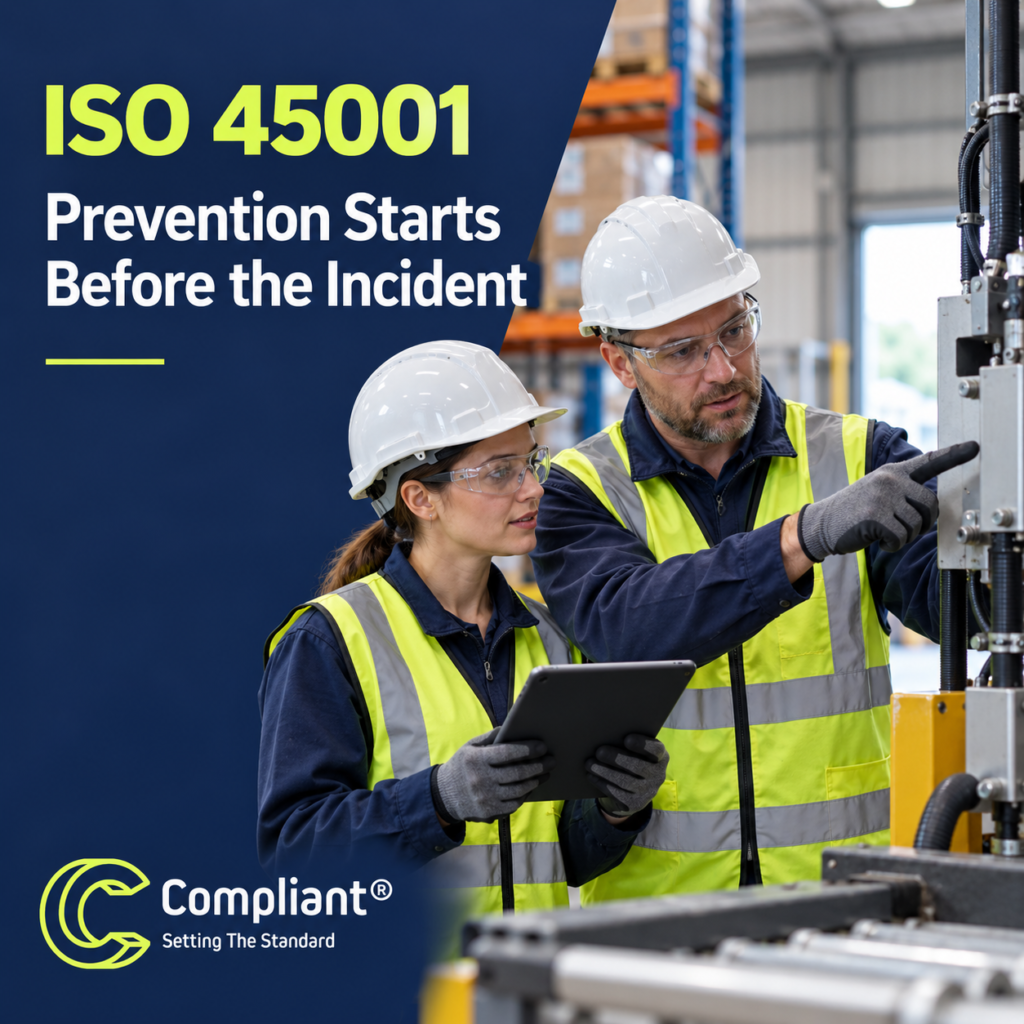
ISO 45001: Good Health and Safety Starts Long Before an Incident Happens
The accident happens in seconds.
The warning signs may have been there for weeks.
A damaged guard was noticed but not reported.
An employee was unsure how to complete a task but did not want to ask.
A risk assessment no longer matched the work being carried out.
A manager saw somebody take a shortcut and said nothing because the job was already behind schedule.
Then something went wrong.
Once an incident happens, businesses usually act quickly. Work stops. Managers investigate. Documents are reviewed. Employees are reminded of the rules.
But by that point, somebody may already be hurt.
Good health and safety cannot begin after an accident.
It must start much earlier.
It begins when work is planned. It continues when people are trained, equipment is checked and employees feel able to raise concerns. It depends on leaders making safe decisions even when the business is under pressure.
This is where ISO 45001 can help.
ISO 45001 provides a clear framework for managing workplace health and safety risks and improving performance. It supports a planned approach built around prevention, employee involvement, leadership and ongoing improvement. ISO: ISO 45001 overview
The aim is not simply to respond well when something goes wrong.
It is to reduce the chance of that incident happening in the first place.
Reaction is not prevention
Every business needs to know how to respond to an accident or emergency.
First aid must be available.
People need to know how to raise the alarm.
Incidents should be reported and investigated.
These controls matter.
But they are only part of good health and safety.
If most of your safety activity begins after somebody is injured, your system is too reactive.
Prevention asks different questions.
What could hurt someone?
Why could it happen?
Who could be affected?
What controls are already in place?
Are those controls working?
What else can we do to remove or reduce the risk?
These questions need to be asked before the work begins.
They also need to be asked again when the work, workplace or people change.
A risk assessment written three years ago may no longer reflect today’s business.
New equipment may have been introduced.
The team may be larger.
Employees may work from different sites.
Production demands may have increased.
Old controls can become weak when the organisation changes around them.
A lack of accidents does not prove that work is safe
“We have never had an accident.”
It sounds reassuring.
It can also create false confidence.
Perhaps the business has controlled its risks very well.
Or perhaps it has simply been lucky.
People may have taken unsafe shortcuts without being hurt.
Near misses may have happened but gone unreported.
Equipment may be wearing out.
Employees may be quietly fixing problems without managers knowing.
The absence of an accident does not prove the absence of risk.
ISO 45001 encourages organisations to look for evidence before something goes wrong.
That evidence can come from workplace inspections, employee conversations, equipment checks, near-miss reports, training reviews and internal audits.
These activities help make risk visible.
Once it is visible, the business can act.
Waiting for an injury to prove a problem exists is not an acceptable way to manage health and safety.
Look at how work really happens
A procedure may describe the safest way to complete a task.
That does not mean the task is being completed that way.
Employees may have found that the process takes too long.
Equipment may not be available when it is needed.
The workplace layout may make the agreed method difficult.
A customer deadline may put the team under pressure.
The only way to understand this is to look at the real work.
Speak to the people doing it.
Ask them to explain each step.
Watch what happens during busy periods, not only when a manager is present.
Compare the written process with the task in practice.
If there is a difference, do not immediately assume the employee is careless.
Find out why.
A repeated shortcut may show that a process is poorly designed.
A missing check may mean responsibility is unclear.
Incorrect equipment may be used because the correct item is difficult to obtain.
Good health and safety needs to work in the real world.
ISO 45001 should support the way people work while ensuring risks are properly controlled.
Risk assessments must be useful
A risk assessment should help prevent harm.
It should not exist simply because the business believes it needs a signed form.
Poor risk assessments often have familiar problems.
They are copied from another organisation.
They use general wording.
They do not involve the people completing the task.
They remain unchanged for years.
Employees sign them without reading them.
Managers store them in a folder and only look at them before an audit.
A useful assessment is based on the actual activity.
It considers who could be harmed and how.
It reviews the controls that already exist.
It identifies whether further action is needed.
Most importantly, its findings are shared with the people who need to know.
Keep the language clear.
An employee should be able to understand the hazard, the control and what is expected of them.
If the assessment is so complicated that nobody can follow it, it is not helping.
Remove the hazard where possible
Personal protective equipment is often highly visible.
Helmets, gloves, safety glasses and high-visibility clothing all have an important place.
But they should not always be the first answer.
Good risk control begins by asking whether the hazard can be removed.
For example, could a dangerous task be designed out?
Could a harmful material be replaced with a safer one?
Could work be completed at ground level instead of at height?
Could people be separated from moving equipment?
Could a machine guard prevent access to a dangerous part?
Controls that remove or reduce the hazard are usually stronger than those that depend entirely on a person remembering to act correctly.
Training and protective equipment still matter.
However, people make mistakes.
Equipment should be selected, tasks should be planned and workplaces should be arranged with that fact in mind.
Prevention becomes stronger when the system does not depend on perfect behaviour every minute of the day.
Near misses are early warnings
A heavy item falls from a shelf.
It lands beside an employee but does not hit them.
Nobody is injured.
It is tempting to put the item back, remind people to be careful and continue working.
That would waste valuable information.
The outcome could easily have been different.
A near miss is an opportunity to learn without somebody first having to suffer harm.
Ask what caused it.
Was the item stored incorrectly?
Was the shelf overloaded?
Was the racking damaged?
Had the problem been reported before?
Did employees know how materials should be stored?
The answers may reveal a wider weakness.
Businesses should make near misses easy to report.
The process should be simple, and employees should know that honest reports are useful.
If people believe they will be blamed or criticised, they may stay silent.
Hidden near misses allow the same conditions to remain until the next event has a more serious outcome.
Reporting should be simple
Imagine an employee notices a loose handrail.
They are busy and do not know who to tell.
The reporting form is on a system they rarely use.
They decide to mention it later.
Then they forget.
This is not only an employee problem.
It is also a process problem.
The organisation needs a clear and easy way to report hazards, near misses and concerns.
Employees should know:
- what needs to be reported
- who should be told
- how to report it
- what to do if there is an immediate danger
- what happens after a report is made.
A verbal report may be suitable for an urgent issue, but important information should still be recorded and followed up.
Employees also need feedback.
If people keep reporting problems but never hear what happened, they may stop raising them.
Even a short update can help:
“The damaged guard has been replaced.”
“The walkway will be changed next week.”
“We have reviewed the task and introduced a new lifting aid.”
This shows that speaking up leads to action.
Employees understand risks managers may miss
Workers experience the job in a way senior leaders cannot.
They know which steps are difficult.
They notice when equipment is starting to fail.
They understand where pressure causes shortcuts.
They see the small problems that may never appear in a formal report.
ISO 45001 places importance on worker consultation and participation because employees can provide essential information about risk.
Involvement should mean more than asking people to sign a document.
Talk to employees when risk assessments are created.
Ask for their ideas when controls are reviewed.
Include them when incidents and near misses are investigated.
Make sure they can raise concerns without fear.
The people closest to the work are often closest to the solution.
A manager may suggest a control that looks sensible on paper.
An employee may immediately explain why it will not work in practice.
That conversation can prevent a weak control from being introduced.
Training must lead to understanding
A training record shows that a person attended a course.
It does not always prove that they understood it or can apply what they learned.
Before allowing someone to complete a task, ask:
Do they understand the risks?
Can they use the equipment correctly?
Do they know the agreed safe method?
Can they recognise when something is wrong?
Do they know when to stop and ask for help?
For some roles, formal qualifications may be required.
For others, instruction, supervision and practical experience may be more suitable.
The level of training should reflect the risk and difficulty of the task.
Training also needs to be reviewed.
A person’s role may change.
New equipment may be introduced.
Knowledge can fade when a task is rarely completed.
Competence should be managed throughout employment, not only during an employee’s first week.
New employees may be at greater risk
New employees often want to make a good impression.
They may be afraid to admit that they do not understand something.
They might copy experienced workers, including their unsafe habits.
They may not yet recognise the dangers within the workplace.
A rushed introduction is not enough.
New starters need clear information about the risks connected to their role, the controls they must follow and how to report concerns.
They may also need extra supervision while they gain experience.
Check their understanding.
Do not simply ask, “Do you understand?”
Many people will say yes because they do not want to appear difficult.
Ask them to explain the task or demonstrate the safe method.
This helps identify gaps before the person works alone.
Pressure changes behaviour
Even a well-trained employee can make an unsafe decision when they are tired, rushed or worried about missing a deadline.
Production pressure matters.
Staff shortages matter.
Long working hours matter.
Unclear instructions matter.
If the organisation only looks at the employee’s final action, it may miss the conditions that encouraged it.
Imagine a worker removes a machine guard to finish a job faster.
That action is unsafe.
But the investigation should also ask why they felt the need to do it.
Was the target unrealistic?
Was the correct process much slower?
Had managers accepted the shortcut before?
Did the employee believe stopping work would lead to criticism?
This does not remove individual responsibility.
It helps the organisation understand the full cause.
Prevention requires honest questions, even when the answers are uncomfortable.
Health matters as much as immediate safety
Health and safety is not limited to sudden accidents.
Work can also cause harm over time.
Noise may damage hearing.
Repeated lifting can affect the body.
Dust and harmful substances can cause illness.
Poorly designed workstations can create pain.
Stress and heavy workloads can affect mental health.
These risks may be easier to ignore because the harm is not always immediate.
An employee may complete the same task for years before the effect becomes clear.
ISO 45001 supports a wider view of workplace health and safety.
Businesses need to consider both injuries and work-related ill health.
Look at the full task.
How often is it completed?
How long are people exposed?
Does the risk build over time?
Are suitable controls in place?
Are employees showing early signs of a problem?
Preventing long-term harm is just as important as preventing a visible accident.
Contractors need proper control
A contractor may only be on site for one day.
They can still create risk for themselves and others.
Businesses need a sensible process for selecting, briefing and monitoring contractors.
Before work begins, consider:
- whether the contractor is competent
- what evidence is needed
- the risks created by their work
- the risks already present on site
- who will supervise or manage the activity
- what emergency arrangements apply
- how problems will be reported.
Both sides need clear information.
A contractor cannot follow site rules they have not been told about.
Your employees also need to understand what work the contractor is carrying out and how it may affect them.
A certificate or insurance document alone does not prove that work will be completed safely.
The controls need to continue while the contractor is on site.
Change can create new risks
Businesses change constantly.
They buy equipment.
Move work areas.
Change shifts.
Introduce new materials.
Take on different contracts.
Allow more remote working.
Employ new people.
Each change can affect health and safety.
A machine may be safer in many ways but create a new maintenance risk.
A revised layout may improve production while blocking a walkway.
A new product may require a substance employees have not used before.
A larger order may lead to more overtime and fatigue.
Risk should be considered before the change is introduced.
Ask what will be different, who may be affected and what controls are needed.
This is much easier than discovering the risk after an incident.
Maintenance prevents hidden failure
Equipment rarely fails at a convenient time.
Signs of wear may appear first.
A cable becomes damaged.
A guard loosens.
A vehicle develops a fault.
An alarm stops working.
If these signs are ignored, the chance of harm increases.
Planned checks and maintenance help identify problems early.
The level of attention should reflect the equipment and the risk.
Some items may need a quick check before each use.
Others may require planned inspection, testing or servicing by a competent person.
Records should show that important work was completed.
Employees also need to know what to do when they find a fault.
Can they remove the equipment from use?
Who should they tell?
How is the item marked so nobody else uses it?
A maintenance schedule means little if faulty equipment remains in service.
Emergency plans must work in practice
Prevention reduces risk, but it cannot remove every possibility.
Businesses still need to prepare for emergencies.
The plan should consider events that could realistically happen.
This may include fire, serious injury, chemical spills, loss of power or other events connected to the organisation’s work.
Employees need to know what to do.
Emergency equipment should be available and maintained.
Important contact details must be current.
Plans should also be tested.
A written procedure may look complete but fail when people try to use it.
An exercise can reveal that an exit is unclear, an alarm cannot be heard or employees do not know where to gather.
Finding these problems during a test is far better than finding them during a real emergency.
Leadership behaviour sets the real standard
A health and safety policy may promise that safety comes first.
Employees judge that promise through management behaviour.
What happens when a deadline is at risk?
Does the manager stop unsafe work?
Or do they tell the team to finish quickly and fix the paperwork later?
Are reported hazards taken seriously?
Is money provided for repairs and training?
Do leaders follow site rules themselves?
Employees notice these choices.
If managers walk past unsafe behaviour, they show that it is acceptable.
If a director ignores protective equipment requirements during a site visit, people may wonder why the rules matter.
ISO 45001 expects leadership to take an active role.
Health and safety cannot be passed entirely to one manager or adviser.
Leaders decide priorities, provide resources and shape the culture in which people work.
Measuring only accidents is not enough
Accident figures are important.
They show what has happened.
They do not always show what might happen next.
A business with no recorded accidents could still have damaged equipment, overdue training and unreported near misses.
Use measures that provide an earlier warning.
These could include:
- hazards reported
- near misses
- overdue actions
- completed workplace inspections
- training and competence gaps
- maintenance completed on time
- employee safety concerns
- repeated issues
- progress against health and safety goals.
The right measures depend on the organisation.
Avoid collecting numbers simply because they are easy to count.
Ask what the information tells you and whether it helps prevent harm.
Investigate causes, not just blame
When an incident happens, businesses naturally want to know who made the mistake.
That may be part of the investigation.
It should not be the end of it.
Suppose an employee slips on a wet floor.
The immediate cause may seem obvious.
But why was the floor wet?
Was there a leak?
Was cleaning taking place without suitable signs?
Had the problem been reported?
Was the walkway poorly designed?
Was the employee carrying something that blocked their view?
A useful investigation looks beyond the final event.
It considers the work, equipment, environment, training, supervision and management decisions around it.
The aim is to stop the same conditions from causing another incident.
Telling employees to “take more care” rarely creates lasting change.
Internal audits should test reality
An internal audit should not be limited to checking whether documents have a date and signature.
It should help the business understand whether its health and safety system works.
Visit the workplace.
Speak to employees.
Review a sample of tasks.
Check whether agreed controls are being followed.
Look at how hazards are reported and actions are closed.
Compare risk assessments with current work.
Review whether employees understand their responsibilities.
An audit finding is useful information.
It shows where the system may need attention.
Treating findings as an embarrassment can encourage people to hide problems.
A healthy business wants to find weakness before that weakness causes harm.
How an ISO consultant can support prevention
Understanding the general aim of ISO 45001 may be straightforward.
Applying it across a real business can be more challenging.
This is where the benefits of an ISO consultant’s support can be valuable.
A good consultant can help you review how health and safety is currently managed and identify where the system needs strengthening.
They may support the business with:
- identifying hazards and risks
- setting clear responsibilities
- involving employees
- reviewing competence and training
- controlling contractors
- planning internal audits
- investigating problems
- setting useful goals
- preparing for certification.
An experienced consultant also provides an outside view.
People can become used to their workplace.
A blocked route, unsafe habit or unclear process may stop attracting attention because it has existed for so long.
Someone looking from outside may question it.
However, the consultant should not create a system that only they understand.
Documents and processes must fit the organisation.
Employees and managers need to use them after the consultant leaves.
The goal is not to produce more paperwork.
It is to build a practical system that helps prevent harm.
ISO 45001 is not about expecting perfection
People will make mistakes.
Equipment will fail.
Plans will change.
Unexpected events will happen.
A strong health and safety management system recognises this.
It provides several layers of protection so that one mistake is less likely to become an injury.
Work is planned.
Hazards are identified.
Risks are controlled.
People are trained.
Equipment is maintained.
Concerns are reported.
Performance is checked.
Lessons lead to improvement.
The current published version, ISO 45001:2018, remains current following its 2024 review, while a future edition is under development. The core purpose remains clear: helping organisations manage occupational health and safety risks and improve performance. ISO: ISO 45001:2018
Good health and safety happens every day
The strongest health and safety systems are not only visible during an audit or after an accident.
They can be seen in ordinary decisions.
An employee checks equipment before using it.
A supervisor listens when somebody raises a concern.
A manager refuses to rush unsafe work.
A risk assessment is reviewed because the task has changed.
A near miss leads to a practical improvement.
A leader provides the time and money needed to fix a problem.
These actions happen before an incident.
That is why they matter.
Good health and safety is built quietly, one decision at a time.
Prevention is the real measure of success
An incident investigation may be excellent.
The emergency response may be quick.
The paperwork may be complete.
But the better outcome is still the incident that never happens.
ISO 45001 helps businesses focus on prevention by making health and safety part of planning, leadership and daily work.
It encourages organisations to find hazards early, involve employees, check whether controls are working and learn before somebody is harmed.
A safe workplace does not appear by luck.
It is created through hundreds of choices made long before an accident could occur.
Value-focused CTA
Choose one routine task in your business this week.
Do not begin by reading the old risk assessment.
Start by watching how the task is completed today.
Speak to the employee doing the work and ask:
What could hurt you?
Which part of this task causes the most concern?
What makes the safe way difficult?
What could we change before something goes wrong?
Compare what you learn with the existing controls.
Then make one practical improvement and check whether it works.
Because good health and safety does not begin with an incident report.
It begins with noticing the warning signs and acting while there is still time to prevent harm.