Skip to main content
Skip to footer
Skip to main content
Skip to footer

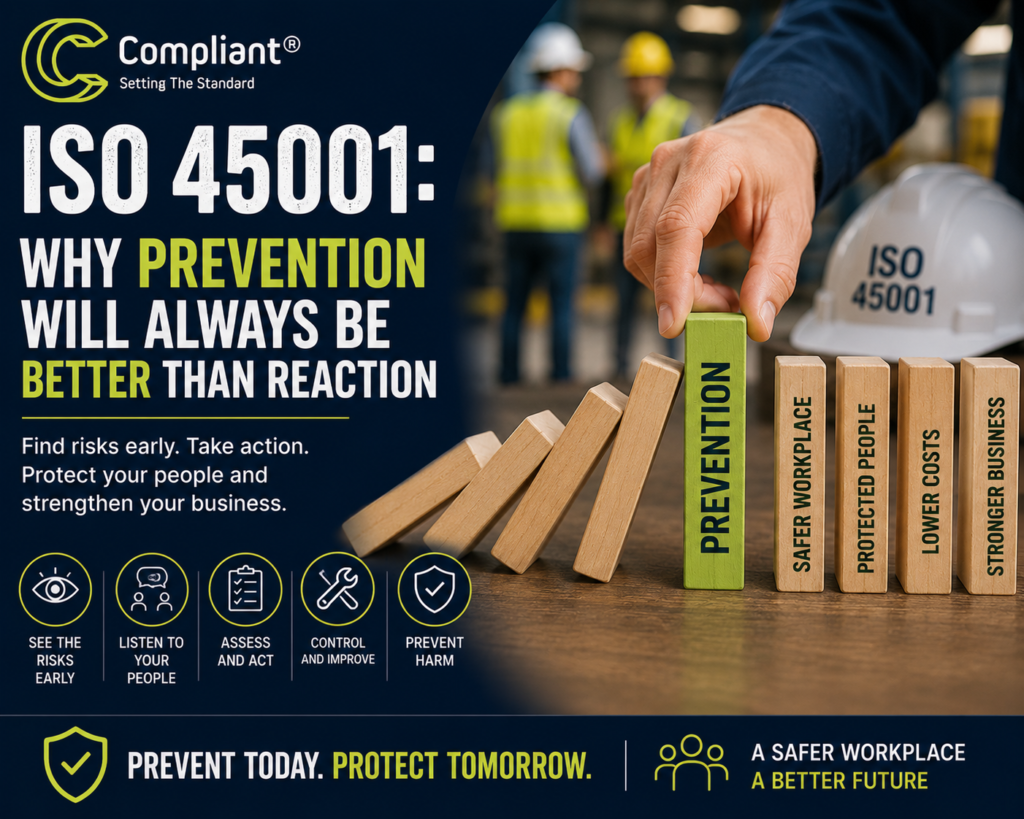
ISO 45001: Why Prevention Will Always Be Better Than Reaction
ISO 45001: Why Prevention Will Always Be Better Than Reaction
Nobody plans for someone to get hurt at work.
Nobody starts the day expecting an accident, an injury or an emergency.
Yet when something goes wrong, businesses often discover that the warning signs were already there.
A damaged piece of equipment had been reported but not repaired.
Someone had mentioned that a task did not feel safe.
A near miss happened but nobody recorded it.
Training had not been refreshed.
A risk assessment had not been reviewed since the way the job changed.
The problem was visible.
It simply did not look serious enough to demand immediate attention.
Until it was.
This is why prevention matters.
Reacting after an accident can help stop the same thing happening again. But by that point, somebody may already have been hurt.
ISO 45001 encourages businesses to take a different approach.
Instead of waiting for an incident to show where weaknesses exist, it helps organisations identify risks, involve employees, review how work is carried out and make improvements before something goes wrong.
Because when it comes to workplace health and safety, preventing the problem will always be better than dealing with the consequences.
“Nothing Has Happened Yet” Does Not Mean Everything Is Safe
One of the most dangerous sentences in workplace safety is:
“We’ve always done it this way and nothing has happened.”
It sounds reassuring.
It is not.
A lack of accidents does not automatically mean a process is safe.
Sometimes it means the business has been lucky.
Imagine an employee regularly climbs onto an unsuitable chair to reach something on a high shelf.
They have done it fifty times.
They have never fallen.
Does that make the activity safe?
No.
The risk existed every time.
The fact that nobody has been injured yet does not remove it.
This way of thinking applies across a business.
Unsafe equipment does not become safe because nobody has been injured.
Poor lifting methods do not become safe because employees have avoided injury so far.
Blocked walkways do not become safe because nobody has tripped.
Weak processes can exist for months or years without causing an obvious problem.
Prevention means finding them before they do.
ISO 45001 Helps You Look for Problems Before They Become Incidents
ISO 45001 provides a structured approach to occupational health and safety management.
That might sound complicated.
The basic idea is much simpler.
Understand what could cause harm.
Decide what needs to be done about it.
Make sure people understand their responsibilities.
Check whether your actions are working.
Learn from what happens.
Then keep improving.
This moves safety away from being something the business thinks about only after an accident.
It becomes part of everyday management.
That difference matters.
A reactive business asks:
“What happened?”
A preventative business also asks:
“What could happen?”
Both questions are useful.
But the second gives you an opportunity to act before somebody gets hurt.
Start With the Work People Actually Do
Health and safety management should reflect reality.
Not what somebody thinks happens.
Not what an old procedure says happens.
What actually happens.
Processes change.
Employees find quicker ways to complete tasks.
New equipment is introduced.
Teams become busier.
Customers make different demands.
Temporary solutions quietly become permanent.
Over time, the difference between the written process and the real process can grow.
That creates risk.
ISO 45001 encourages businesses to identify hazards connected with their actual activities.
One of the best ways to do this is to involve the people carrying out the work.
Ask them.
What worries you about this task?
Where do things nearly go wrong?
What equipment causes problems?
What is difficult to do safely?
When are you under the most pressure?
Which instructions do not match what happens in practice?
Employees often know where risks are hiding because they experience them every day.
The challenge is making sure someone listens.
Near Misses Are Warnings You Should Not Waste
An employee slips but catches themselves.
A box falls from a shelf but misses someone.
A vehicle almost hits something.
A piece of equipment fails without causing injury.
Nothing serious happened.
It can be tempting to forget about it and continue working.
That wastes valuable information.
A near miss can be a warning.
The outcome may have been harmless this time.
Next time it could be different.
Instead of thinking:
“No one was hurt, so everything is fine.”
Ask:
“Why did that happen?”
Was the walkway unsuitable?
Was the item stored incorrectly?
Was visibility poor?
Was equipment faulty?
Was somebody rushing?
Were instructions unclear?
Could the same situation happen again?
Near misses give businesses an opportunity to investigate without first paying the price of an injury.
That makes them valuable.
ISO 45001 supports this type of learning.
The aim is not to create a culture where employees are blamed for reporting every small issue.
Quite the opposite.
People should feel comfortable raising concerns because those concerns can help prevent accidents.
Reporting Problems Needs to Be Easy
A safety reporting process can look excellent on paper.
But if employees find it difficult to use, problems may remain hidden.
Imagine somebody spots damaged equipment.
To report it, they need to find a form, complete several boxes, send it to a manager and wait for a response.
They are busy.
The damage does not look too serious.
They decide to mention it later.
Then they forget.
A simpler system could have captured that information immediately.
The right process depends on the business, but the principle should remain the same.
Make it easy for people to raise concerns.
Then respond.
That second part is important.
If employees repeatedly report problems and nothing happens, they may stop reporting them.
Why bother if nobody listens?
Closing the loop matters.
Tell employees what happened after they raised a concern.
Even if the business cannot make the requested change, explain why.
People need to know their voice matters.
Risk Assessments Should Not Gather Dust
Risk assessments are an important part of workplace safety.
But simply having them is not enough.
A risk assessment written three years ago may no longer describe today’s workplace.
Ask what has changed.
Has new equipment been introduced?
Has the team grown?
Are different materials being used?
Has the layout changed?
Are people working different hours?
Has a new process been introduced?
Has an incident or near miss happened?
Have employees raised concerns?
If the work changes, the risks may change too.
ISO 45001 encourages organisations to keep their health and safety arrangements relevant.
A risk assessment should be a working tool.
It should help people make safer decisions.
If it exists only because somebody believes an auditor might ask to see it, its real value has been lost.
Small Problems Deserve Attention
Not every safety issue requires a major project.
Sometimes prevention is very simple.
A damaged cable is replaced.
A walkway is cleared.
Lighting is improved.
A shelf is moved.
An instruction is made clearer.
A piece of equipment is serviced.
Someone receives additional training.
A task is planned differently.
The improvement may take ten minutes.
But those ten minutes could prevent an injury that affects an employee for weeks, months or longer.
Small problems are often easier and cheaper to fix before they grow.
Waiting rarely makes them better.
Training Is Part of Prevention, But It Is Not the Whole Answer
Training matters.
Employees need the knowledge and skills required to carry out their work safely.
But training should not be used as the answer to every problem.
If a process is badly designed, telling employees to “be more careful” will not necessarily make it safe.
If equipment is unsuitable, another training course will not fix the equipment.
If workloads are unrealistic, reminding people not to rush may not remove the pressure causing them to rush.
Good prevention looks at the whole problem.
Ask why the risk exists.
Then decide on the best way to reduce it.
Sometimes training will be part of the answer.
Sometimes the better answer is changing the task itself.
Employees Need to Understand Why
Safety rules are easier to follow when people understand their purpose.
“Do this because the procedure says so” is not always enough.
Explain the risk.
Explain what the control is trying to prevent.
People make better decisions when they understand the reason behind an action.
This becomes particularly important when something unexpected happens.
A procedure cannot describe every possible situation.
An employee who understands the risk can use better judgement when circumstances change.
ISO 45001 places importance on awareness and communication because health and safety depends on people understanding their role.
Good safety is not created by documents alone.
It happens through decisions made throughout the working day.
Managers Need to Make Prevention Possible
It is easy to tell employees that safety comes first.
The real test is what happens when safety conflicts with time, cost or customer pressure.
A job is running late.
An employee raises a concern.
Stopping work could delay completion.
What happens next?
If the message becomes:
“Just get it finished.”
Employees quickly learn the real priority.
Leadership behaviour shapes workplace culture.
If managers take concerns seriously, employees are more likely to raise them.
If managers investigate near misses, people see their value.
If managers provide time for training and maintenance, prevention becomes possible.
If leaders ignore problems until an accident occurs, the organisation becomes reactive.
ISO 45001 requires leadership involvement for a reason.
Health and safety cannot simply be handed to one person and forgotten.
Managers make decisions that affect risk every day.
Pressure Can Change the Way People Work
Many unsafe decisions are not made because employees do not care.
They are made because people are under pressure.
A deadline is approaching.
A customer is waiting.
The team is short-staffed.
Someone wants to finish before going home.
The correct equipment is somewhere else.
A shortcut suddenly looks attractive.
Understanding these situations is important.
Simply writing “employees must follow the procedure” may not address the real problem.
Why are people taking shortcuts?
Is the process unrealistic?
Is suitable equipment available?
Are staffing levels appropriate?
Are managers sending mixed messages?
Are employees rewarded for speed while being told safety comes first?
Prevention means looking beyond individual actions and understanding what influences them.
Maintenance Is Prevention Too
Equipment rarely becomes unsafe overnight without warning.
There may be signs.
Unusual noises.
Wear.
Damage.
Repeated small faults.
Poor performance.
Employees may notice these things long before a complete failure.
Businesses need ways to capture that information.
Planned maintenance can also help identify problems before equipment fails.
This can protect employees while delivering another business benefit.
Unexpected breakdowns can cause delays and costs.
Preventative maintenance can therefore support safety and operational performance at the same time.
This is a useful reminder that good health and safety management is not separate from good business management.
Often, they support each other.
Contractors and Visitors Need Consideration
Your own employees may understand the workplace well.
Someone visiting for the first time does not.
Contractors may also bring different risks into the organisation.
They may use equipment, carry out unfamiliar work or operate in areas employees normally avoid.
Prevention means thinking about these people before they arrive.
What do they need to know?
Are there areas they should avoid?
What emergencies could occur?
Who is responsible for them?
Does the contractor understand your expectations?
What risks could their work create for your employees?
Clear communication before work begins is far easier than dealing with confusion after something goes wrong.
Changes Should Trigger Questions
Change creates opportunity.
It can also create risk.
New equipment.
New employees.
New buildings.
Different shifts.
New suppliers.
Changes to processes.
New products.
Different working arrangements.
Whenever something significant changes, ask:
Could this affect health and safety?
Do not wait for an incident to answer the question.
Suppose new equipment makes a process faster.
Great.
But does it create different risks?
Do employees need training?
Does the maintenance plan need updating?
Do existing instructions still make sense?
Does the risk assessment need reviewing?
A short review before the change is introduced may prevent problems later.
Health Is Just as Important as Safety
Workplace health and safety is not only about sudden accidents.
Some harm develops slowly.
Poor working positions.
Repeated movements.
Noise.
Stress.
Exposure to harmful substances.
Heavy lifting.
Fatigue.
The effects may not be immediately visible.
That makes prevention even more important.
If someone trips, the problem may be obvious.
If an employee slowly develops pain because of the way they work every day, the warning signs can be easier to miss.
Talk to people.
Ask how work affects them.
Pay attention to repeated complaints.
Look at absence patterns where appropriate.
Consider both immediate and longer-term harm when reviewing workplace risks.
ISO 45001 covers occupational health as well as safety.
Both deserve attention.
The Benefits of an ISO Consultant’s Support
For businesses working towards or maintaining ISO 45001, it can be difficult to judge whether existing health and safety processes are truly preventative.
The paperwork may be there.
Risk assessments exist.
Training records are current.
Policies have been written.
Everything can look organised.
But does it work?
This is where the benefits of an ISO consultant’s support can be valuable.
An experienced consultant can provide an outside view.
They can ask questions that people inside the business may no longer think to ask.
When was this risk assessment last reviewed?
How do employees report concerns?
What happens after a near miss?
How do you know this control is working?
What happens when a process changes?
Do employees understand the procedures?
What evidence shows that managers are involved?
Why does this problem keep happening?
A good consultant should not simply create more documents.
They should help the business understand what ISO 45001 requires and how those requirements fit the organisation’s real activities.
Your employees understand the work.
Your managers understand the business.
The consultant understands ISO 45001.
Bringing those areas of knowledge together can help create a system that works in practice.
Internal Audits Can Help You Find Problems Early
An internal audit should not feel like a rehearsal for the certification audit.
Its real value is finding weaknesses before they cause bigger problems.
Go beyond checking documents.
Visit the workplace.
Speak to employees.
Look at equipment.
Ask how concerns are reported.
Choose a recent near miss and find out what happened afterwards.
Look at a risk assessment and compare it with the actual task.
Does the written process match reality?
Have actions from previous reviews been completed?
Internal audits can reveal small gaps that are easy to correct now.
That is prevention in action.
Learn From What Almost Happened
Businesses naturally investigate serious incidents.
The challenge is showing the same curiosity when the outcome was less serious.
A near miss.
A small equipment fault.
A minor injury.
An employee concern.
A repeated mistake.
Each can provide information.
Look for patterns.
If several employees raise similar concerns, pay attention.
If the same near miss keeps happening, investigate.
If one area repeatedly creates minor injuries, ask why.
Individual events can look unimportant.
Together, they may show a larger problem developing.
Do not wait for the serious incident to connect the dots.
Prevention Can Save More Than Money
Accidents can be expensive.
There may be lost working time.
Repairs.
Delays.
Investigation costs.
Higher insurance costs.
Customer concerns.
Legal consequences in some situations.
But money is only part of the impact.
There is a person at the centre of an injury.
They may experience pain.
They may be unable to work.
Their home life can be affected.
Colleagues can also be affected by seeing someone injured.
Managers may carry the knowledge that something could perhaps have been prevented.
This is why prevention matters beyond business performance.
People should be able to go home from work safely.
That should never depend on luck.
ISO 45001 Should Become Part of Everyday Work
The strongest health and safety systems do not suddenly appear when an audit is approaching.
They are visible throughout the year.
Employees report concerns.
Managers respond.
Risk assessments are reviewed when things change.
Near misses are investigated.
Training needs are identified.
Equipment is maintained.
Internal audits find improvements.
Leadership reviews performance.
The system becomes part of the way the organisation works.
That is where ISO 45001 provides real value.
Not as a certificate on the wall.
As a framework for preventing harm.
Ask What Could Go Wrong Tomorrow
You do not need to wait for an incident to test your health and safety system.
Choose one everyday activity.
Watch how it happens.
Speak to the person doing it.
Then ask:
What could go wrong here tomorrow?
Do not stop at the first answer.
What could cause someone harm?
What warning signs would appear first?
Has anything nearly happened before?
Are current controls working?
Has the task changed?
What would make it safer?
You may discover that everything is well controlled.
Good.
Or you may find a small weakness.
That is also good information, because you have found it before somebody was hurt.
Take action while the problem is still small.
Prevention Will Always Beat Reaction
You cannot predict every accident.
You cannot remove every risk.
No health and safety management system can promise that nothing will ever go wrong.
But businesses can improve the odds.
They can listen before concerns become incidents.
They can investigate near misses before they become injuries.
They can maintain equipment before it fails.
They can review changes before new risks appear.
They can train people before knowledge gaps cause problems.
They can fix small issues before they become large ones.
That is the real value of prevention.
ISO 45001 gives organisations a structured way to make that thinking part of everyday business.
So do not measure your safety performance only by the number of accidents you had last year.
Ask what you prevented.
Ask what you learned.
Ask what almost happened.
Ask what your employees are telling you.
And ask what could go wrong tomorrow if nothing changes today.
Then use those answers.
Because the best workplace incident is not the one you respond to perfectly.
It is the one that never happens in the first place.