ISO 45001: Why Your People Should Have a Voice in Workplace Safety
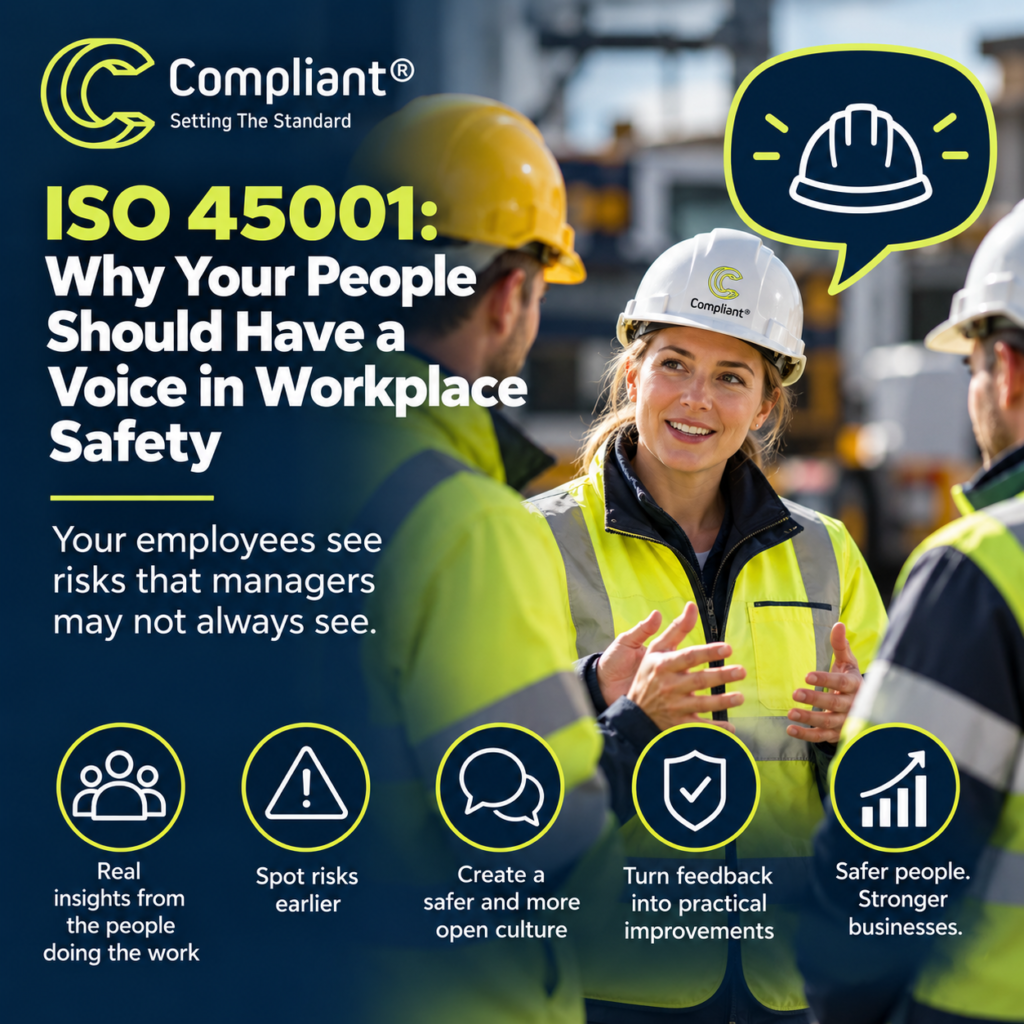
ISO 45001: Why Your People Should Have a Voice in Workplace Safety
Primary keyword: ISO 45001 workplace safety
Secondary keyword: Benefits of an ISO consultant’s support
The person most likely to spot a workplace safety problem may not be sitting in the management meeting.
They could be driving the forklift.
Using the machine.
Working on the production line.
Visiting customer sites.
Loading the van.
Working in the warehouse.
Or carrying out the same task every day.
Your employees see things that managers cannot always see.
They know which task feels awkward. They know which piece of equipment regularly causes trouble. They know where people take shortcuts because the proper process does not work well in practice.
They often notice the near misses too.
The box that nearly fell.
The vehicle that came around the corner too quickly.
The cable somebody almost tripped over.
The machine that made a strange noise.
The task that was completed safely, but only because somebody noticed a problem at the last moment.
The question is: do they tell you?
And if they do, what happens next?
A workplace can have detailed risk assessments, safety procedures and training records. But if employees do not feel able to raise concerns, valuable information can remain hidden.
That is why worker consultation and participation are important within ISO 45001 workplace safety.
Good health and safety management should not simply tell employees what to do.
It should listen to them too.
Because the people closest to the work can often see a risk long before it becomes an incident.
Safety cannot be managed from a desk alone
Managers have an important role in workplace safety.
They make decisions.
They provide resources.
They set expectations.
They make sure responsibilities are clear.
But managers cannot be everywhere.
A manager might see a process during an inspection once a month.
An employee could carry out that process several times every day.
Who is more likely to notice that something has changed?
The employee may know that a piece of equipment is becoming harder to use.
They may notice that a new layout has created a blind spot.
Perhaps materials are now being stored somewhere that makes a task harder.
Maybe a process looks perfectly safe when followed exactly as written, but it is difficult to follow during a busy shift.
These details matter.
They may never appear in a report unless somebody asks.
That is why employee involvement should not be treated as an optional extra.
It provides information.
And better information can support better safety decisions.
The people doing the job understand the reality of the job
There can be a big difference between how a task is imagined and how it actually happens.
Imagine somebody writes a process for moving a heavy item.
On paper, everything looks fine.
The equipment is available.
The route is clear.
The task has been assessed.
Then you speak to the employee who actually moves the item.
They tell you the equipment does not fit properly in one part of the building.
So people have to move the item differently for the final few metres.
That small detail changes the picture.
The original process was not necessarily poor.
It was simply missing information.
Employee involvement can fill those gaps.
Before creating or changing a process, ask the people who use it.
What actually happens?
What is difficult?
What could go wrong?
What would make the task safer?
You might not be able to act on every suggestion.
But asking the questions can reveal risks that are difficult to see from an office.
Consultation is more than telling people what has already been decided
There is a difference between communication and consultation.
Communication might mean telling employees:
“This is our new process.”
Consultation goes further.
It gives people an opportunity to contribute before decisions are final where appropriate.
For example, a business may be introducing a new piece of equipment.
Employees who will use that equipment could have useful questions.
Is it easy to operate?
Will it fit in the available space?
Does it create a new risk?
Will people need training?
Could it make another task more difficult?
These questions are much more useful before the equipment is fully introduced than afterwards.
Consultation does not mean every employee gets the final decision on everything.
Management still has responsibilities.
But decisions can be better when they include information from the people affected by them.
Why employees sometimes stay quiet
Having a suggestion box or a safety meeting does not automatically mean employees feel comfortable speaking.
There are many reasons someone might keep quiet.
They may think nothing will change.
Perhaps they raised something before and never heard what happened.
They might worry about being seen as difficult.
They may not want to get a colleague into trouble.
Perhaps the unsafe practice has been happening for so long that everybody now sees it as normal.
Or they might believe management only wants to hear about serious problems.
This can create a dangerous gap.
Management thinks:
“Nobody has raised any concerns, so everything must be fine.”
Employees think:
“Management already knows, so there is no point saying anything.”
Meanwhile, the risk remains.
Creating a voice in workplace safety means dealing with that gap.
Employees need to know that raising a genuine concern is useful.
And management needs to show that concerns are taken seriously.
What happens after someone speaks matters
Imagine an employee reports a safety concern.
Then nothing happens.
They do not receive a reply.
They do not know whether anyone investigated.
The problem appears to continue.
How likely are they to report the next concern?
Probably less likely.
This is why feedback matters.
Not every concern will result in a change.
Sometimes the organisation may investigate and decide that the existing controls are suitable.
That is fine.
Explain it.
Perhaps a change is planned but will take time.
Tell people.
Maybe the employee has identified something that needs immediate action.
Act and communicate.
The important point is closing the loop.
“Thank you. We looked at this. Here is what we found. Here is what happens next.”
That simple approach can help build confidence in the process.
Employees can see that speaking up has a purpose.
Near misses are free warnings
Nobody was injured.
Nothing was damaged.
Work continued.
It is tempting to move on.
But a near miss can provide extremely useful information.
Imagine an employee slips but manages to catch themselves.
No injury.
No lost time.
No accident report, perhaps.
But why did they slip?
Was the floor wet?
Was there a leak?
Was something being stored incorrectly?
Was the surface damaged?
Could the next person be less fortunate?
Near misses give businesses an opportunity to learn without somebody first having to be hurt.
But management can only learn from them if people report them.
That means employees need to understand what should be reported and why.
The process should also be straightforward.
If reporting a small concern requires a long form and several approvals, people may decide it is easier not to bother.
Make it easy to share useful information.
Then use it.
Stop asking “Who did it?” before asking “Why did it happen?”
When something goes wrong, the first reaction can be to find the person responsible.
Sometimes an individual has ignored a clear process.
That may need addressing.
But stopping there can mean missing the bigger problem.
Suppose an employee removes a machine guard because it gets in the way.
That sounds like an employee behaviour problem.
But keep asking questions.
Why was the guard getting in the way?
Was the machine being used for the correct task?
Was the guard suitable?
Had employees reported the problem previously?
Were production targets making people feel pressured to work faster?
Did the employee understand the risk?
Could the work have been planned differently?
None of these questions excuse unsafe behaviour.
They help the organisation understand it.
If another employee could face exactly the same pressure tomorrow, simply telling one person off has not necessarily removed the risk.
ISO 45001 encourages a structured approach to identifying hazards, controlling risks and improving the management system.
Learning needs to be part of that.
Employees should be involved in risk assessment
Risk assessments should reflect real work.
That becomes difficult if the people doing the work are never involved.
Someone can observe a task.
They can read instructions.
They can look at equipment.
But the employee carrying out that task may know things that are not immediately obvious.
Perhaps the task changes when demand is high.
Maybe a piece of equipment behaves differently after running for several hours.
There might be an issue that only occurs during a night shift.
A particular part of the job could be physically difficult.
Perhaps customers or members of the public create unexpected risks.
Employees can help bring these details into the assessment.
Again, this does not mean asking employees to take responsibility for the whole health and safety system.
It means using their knowledge.
A risk assessment should not simply describe how managers think work happens.
It should reflect how work really happens.
Change is a good time to listen
Workplace changes can create new risks.
New equipment.
A different building layout.
A change in shift patterns.
New materials.
Different software.
A new supplier.
A change in staffing.
A new product or service.
Even changes intended to improve the business can create unexpected effects.
Employees may notice these effects first.
A new storage system might save space but make items harder to reach.
A new machine could reduce one risk while creating another.
A new process might work well during normal conditions but become difficult during busy periods.
Consulting employees before and during change can help identify these issues earlier.
Then keep listening after the change.
Plans do not always work exactly as expected.
That does not mean the change was a failure.
It means the organisation needs to review how it works in practice.
Safety meetings need to be useful
A meeting does not automatically create participation.
People can sit around a table for an hour and say very little.
If safety meetings are going to be useful, people need to know why they are there.
Look at real information.
What concerns have been raised?
Have there been incidents or near misses?
What did internal checks find?
Are previous actions complete?
Have working conditions changed?
Is there anything employees are struggling with?
What improvements have been suggested?
Most importantly, record actions clearly.
Who is doing what?
By when?
Then review those actions later.
Employees will quickly notice if every meeting discusses the same problems without anything changing.
A short meeting that leads to action can be more valuable than a long meeting that produces another set of minutes nobody reads.
Managers need to make it safe to talk about safety
Culture is created by behaviour.
Imagine an employee tells their manager:
“I don’t think this is safe.”
The manager responds:
“We’ve always done it this way. Just get on with it.”
That employee has learned something.
Not about the task.
About the organisation.
They have learned that raising concerns is unwelcome.
The next time they spot a risk, they may stay quiet.
Now imagine a different response:
“Show me what you’re concerned about.”
That does not mean the employee is automatically right.
It means the concern will be considered.
That difference matters.
Leaders and managers set the tone through everyday reactions.
If people are mocked, ignored or treated as a problem for raising safety concerns, no written policy will create an open culture.
People watch what happens.
They learn very quickly whether their voice is genuinely valued.
Listening does not mean agreeing with everything
Employee participation needs balance.
Not every suggestion will be practical.
Some changes may create other risks.
Others could be too costly compared with the level of risk involved.
There may already be suitable controls in place.
The important part is giving genuine concerns proper consideration.
Ask questions.
Understand the issue.
Explain decisions.
If a suggestion cannot be used, say why.
This can be far more valuable than simply saying no.
It helps employees understand the wider picture.
It can also lead to another idea that works better.
Consultation is a conversation.
Not a promise that every suggestion will be accepted.
Training should encourage questions
Health and safety training can easily become a one-way process.
Someone delivers information.
Employees listen.
A record is signed.
Everyone goes back to work.
But training can also be an opportunity to listen.
Ask employees whether the process makes sense.
Have they seen the risk before?
Is anything different in practice?
Do they understand what to do when conditions change?
Do they know how to report a concern?
Questions can uncover misunderstandings before they become incidents.
Training should also help employees understand why controls exist.
People are more likely to follow a process when they understand the reason behind it.
“Wear this because the rules say so” is less useful than explaining the hazard the control is intended to reduce.
Understanding supports better decisions.
Contractors and temporary workers need a voice too
Workplace safety does not only involve permanent employees.
Contractors, agency workers, temporary employees and others carrying out work may also see risks.
In some cases, they may notice something permanent staff have stopped seeing because they are used to it.
These workers still need suitable ways to raise concerns.
Do they know who to speak to?
Are they included in relevant briefings?
Do they understand reporting processes?
Would they feel comfortable stopping and asking a question?
A contractor may be reluctant to challenge a client.
A temporary worker may worry about looking inexperienced.
That makes clear communication particularly important.
Everyone affected by workplace risks should understand how to raise concerns.
Internal audits should include conversations
An internal audit should not only involve looking at documents.
Talk to people.
Ask them to explain what they do.
Do they understand the safety process?
Do they know how to report an incident?
Can they explain the main risks connected with their work?
Do they know what to do if something changes?
Have they ever raised a concern?
What happened?
These conversations can provide valuable insight.
A procedure might look perfect.
But if employees do not understand it, something is missing.
Equally, employees may have developed an excellent working practice that has never been added to the formal process.
An internal audit can identify both weaknesses and opportunities.
The aim should be to understand whether the system works in practice.
The benefits of an ISO consultant’s support
It can be difficult for organisations to judge their own safety culture.
Managers may genuinely believe employees feel comfortable speaking up.
Employees may have a very different view.
This is one of the benefits of an ISO consultant’s support.
An experienced consultant can bring an outside perspective.
They can review the management system, but they can also ask how it works in practice.
How are employees consulted?
How can people raise concerns?
Are workers involved in risk assessments?
What happens after something is reported?
Are safety meetings producing actions?
Do employees understand their responsibilities?
Are there barriers that make participation difficult?
A consultant can also help an organisation understand the requirements of ISO 45001 in practical terms.
The answer should not be to create endless forms or meetings simply to prove that consultation happens.
The process needs to suit the organisation.
A small business may communicate very differently from a large organisation spread across several locations.
What matters is that participation is meaningful.
People need suitable opportunities to contribute.
The organisation then needs to consider that information and act where appropriate.
Good consultant support should also help build understanding within the business.
The consultant should not become the only person who understands ISO 45001.
Managers need to understand their responsibilities.
Employees need to understand how they contribute.
The management system needs to belong to the organisation.
That is what helps it continue working after certification.
Employee voice can help find problems earlier
The earlier a safety issue is identified, the more opportunity there is to control it.
That is one of the strongest reasons to listen to employees.
Imagine a machine begins making an unusual noise.
An operator notices immediately.
They use it every day.
If they feel comfortable reporting it, the machine can be checked.
Perhaps nothing serious is wrong.
Or perhaps a failure has been prevented.
Now imagine the operator thinks management will tell them to keep working.
They say nothing.
The opportunity to investigate early disappears.
The same principle applies to working practices.
An employee notices people regularly stepping into a vehicle route because materials are stored in the wrong place.
Nobody has been hit.
Yet.
That observation is useful information.
You do not need to wait for an accident to justify reviewing the layout.
Data matters, but stories can tell you more
Businesses often monitor health and safety information.
Incidents.
Near misses.
Absence.
Inspection results.
Audit findings.
Training.
These figures can be useful.
But numbers do not always explain what is happening.
Suppose near-miss reports suddenly fall.
Is that good news?
Perhaps.
Maybe controls have improved.
But it could also mean employees have stopped reporting them.
You need context.
Talk to people.
Ask what they are seeing.
Combine records with real conversations.
A healthy safety system needs both.
Information tells you where to look.
People can often help explain what you find.
Senior management needs to hear the employee voice
ISO 45001 places importance on leadership.
That matters because workplace safety decisions often require management support.
A hazard may need investment.
A process may need changing.
Employees may need additional time or training.
Equipment might need replacing.
These decisions cannot always be made by the person responsible for health and safety alone.
Senior management needs useful information.
That includes information coming from workers.
What concerns are being raised?
Are there patterns?
Are actions being completed?
Do employees have the resources they need?
Are there barriers preventing people from participating?
Management review can provide an opportunity to consider this wider picture.
It should not simply be a review of numbers.
It should help leaders understand how the safety management system feels and works across the organisation.
Good safety ideas should not disappear in an inbox
One of the fastest ways to stop employee involvement is to collect ideas and do nothing with them.
If you ask people to contribute, create a process for reviewing what they tell you.
It does not need to be complicated.
Record the issue.
Decide who needs to review it.
Assess what action is needed.
Set a sensible timescale.
Communicate the result.
Then check whether the action worked.
This creates a clear path from employee voice to business improvement.
Without that path, consultation risks becoming a box-ticking exercise.
People are asked.
People answer.
Nothing changes.
That is not meaningful participation.
Workplace safety is something you do with people, not to them
There is a big difference between these two approaches.
In one organisation, management creates every safety process and tells employees to follow it.
In another, management provides leadership and clear expectations but also uses employee knowledge when identifying risks and improving processes.
Which one is more likely to understand what really happens during the working day?
ISO 45001 provides a framework for managing occupational health and safety risks, but the system still has to work in the real world.
That means involving the people who live with those risks.
Employees do not replace competent advice.
They do not remove management responsibility.
They provide another valuable source of knowledge.
Ignore that knowledge and you may be ignoring some of the earliest warning signs available to you.
A useful question for your next safety conversation
Instead of asking employees:
“Is everything safe?”
Try asking:
“What is the part of your job where you think something could go wrong?”
It is a very different question.
Then listen.
Do not interrupt immediately with the reason the existing process is fine.
Ask them to explain.
What have they seen?
How often does it happen?
What makes the task difficult?
Has anything nearly gone wrong?
What do they think would help?
You might discover that the controls are already suitable.
You might uncover a small issue that can be fixed quickly.
Or you might identify a risk management did not know existed.
All three outcomes are useful.
Your people can be one of your strongest safety controls
Procedures matter.
Training matters.
Risk assessments matter.
Equipment matters.
Inspections matter.
But none of them remove the value of listening to people.
Employees see how work changes throughout the day.
They experience the pressures.
They notice the awkward tasks.
They see the shortcuts.
They witness the near misses.
And sometimes they know something is wrong before any report, inspection or audit shows it.
The challenge for businesses is creating an environment where that information can travel upwards.
People need to know how to speak.
They need to feel able to speak.
Management needs to listen.
And concerns need to lead to suitable action.
That is not about giving away management responsibility.
It is about making better use of the knowledge already inside the organisation.
So, if you are reviewing your approach to ISO 45001 workplace safety, do not only look at the policies, risk assessments and records.
Talk to the people doing the work.
Ask what they see.
Ask what worries them.
Ask what they would change.
Then show them that their contribution matters.
Because the person who can help prevent your next workplace incident may already know where the problem is.
You just need to give them a voice and be prepared to listen.