Skip to main content
Skip to footer
Skip to main content
Skip to footer

ISO 45001: Your Employees Often See Workplace Risks Before Management Does
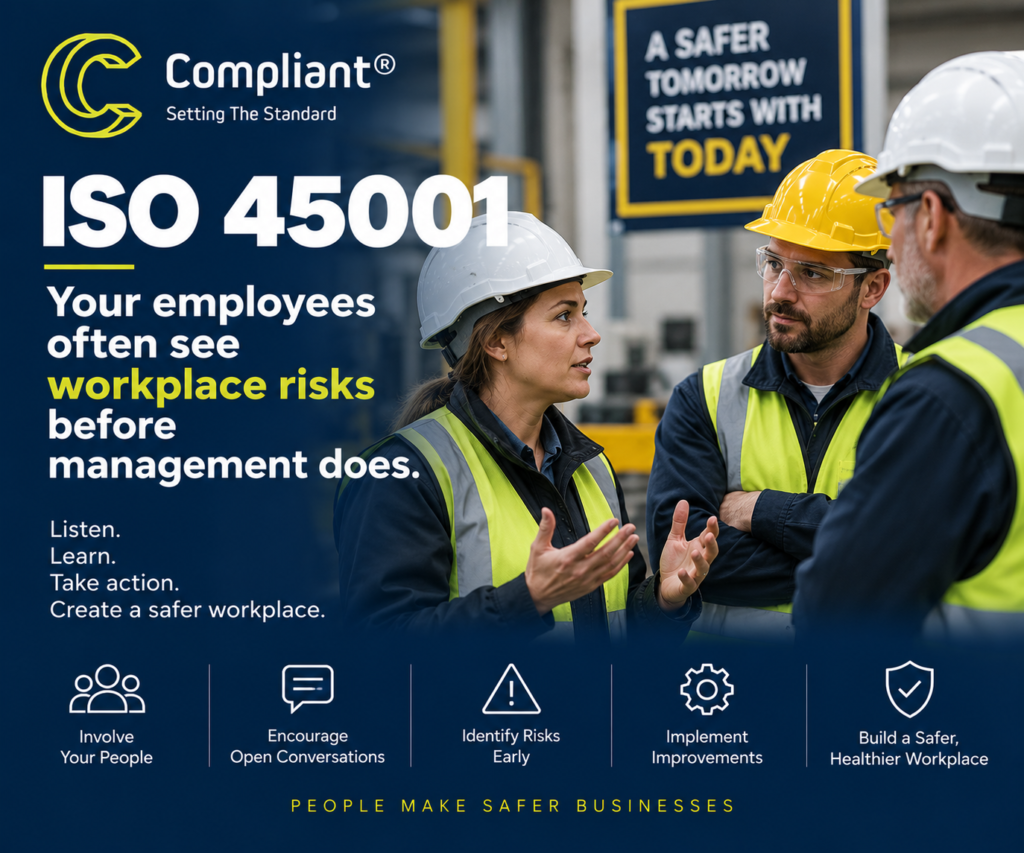
ISO 45001: Your Employees Often See Workplace Risks Before Management Does
A manager can walk through a workplace and see everything looking exactly as it should.
The floor is clear.
People are wearing the right protective equipment.
Equipment appears to be working.
Procedures are available.
Nothing looks particularly worrying.
Then you speak to the person who works there every day.
They tell you the machine sometimes makes a strange noise.
They know a particular walkway becomes slippery when it rains.
They have seen people taking a shortcut because the correct process takes too long.
They know deliveries sometimes block an emergency route.
They have noticed employees struggling to lift something safely.
They may even tell you there have been three occasions where someone nearly had an accident.
None of those things appeared during the manager’s ten-minute walk around the workplace.
But employees see them.
Every day.
That is one of the important principles behind ISO 45001.
Good health and safety management cannot depend only on managers identifying risks and telling employees what to do.
The people carrying out the work have valuable knowledge.
They see what really happens when things are busy, equipment causes problems, deadlines are tight or the written process does not quite work in practice.
If businesses are serious about preventing workplace injuries, they need to listen to the people closest to the risks.
Because sometimes the person who can tell you where your next accident could happen is already standing right beside it.
Managers Cannot Be Everywhere
Even the most involved manager cannot see everything happening within a business.
They attend meetings.
Speak to customers.
Review reports.
Plan work.
Manage employees.
Deal with problems.
They may regularly visit operational areas, but they are unlikely to spend every working hour there.
Employees do.
Someone operating the same equipment every day knows how it normally feels.
They notice when something changes.
Someone working in a warehouse knows which areas become congested at particular times.
An employee carrying out installations knows which tasks are difficult to complete using the agreed method.
Someone loading vehicles knows when a process creates unnecessary manual handling.
This knowledge is incredibly useful.
But only if the business has a way to hear it.
What Does ISO 45001 Say About Employee Involvement?
ISO 45001 is an international standard for occupational health and safety management systems.
Its purpose is to help organisations provide safer and healthier workplaces by managing health and safety risks and improving performance.
An important part of that is worker consultation and participation.
In simple terms, businesses should not treat employees as people who merely receive health and safety instructions.
They should be involved.
Employees can provide information.
They can raise concerns.
They can contribute to decisions that affect their health and safety.
They can help identify hazards.
They can support investigations.
They can suggest improvements.
This matters because the people performing the work often understand its practical risks in a way that somebody sitting away from the process cannot.
Management brings one perspective.
Employees bring another.
Good health and safety management needs both.
The Written Process and the Real Process Can Be Different
Imagine a procedure says an employee must complete five steps to carry out a task safely.
On paper, it makes perfect sense.
But when you watch the task being completed, employees regularly miss step three.
The immediate reaction might be:
“They need to follow the procedure.”
Perhaps they do.
But before stopping there, ask why.
Maybe step three is difficult to complete because of where equipment is positioned.
Perhaps employees have never been properly shown why the step matters.
Maybe the procedure was written several years ago and the equipment has changed since then.
Perhaps the workload makes the process unrealistic.
Or employees may simply have developed a bad habit.
You need to know which.
Telling people to follow a process without understanding why they are not following it may leave the real problem untouched.
Employees can help explain the gap between what is supposed to happen and what actually happens.
Risk Assessments Need Real-World Knowledge
Risk assessments are important.
But they should not become forms completed by one manager sitting at a desk.
To understand risk properly, you need to understand the work.
Who understands that better than the people doing it?
Employees can tell you which parts of a task are difficult.
Where mistakes tend to happen.
Which tools cause problems.
When the environment changes.
Where shortcuts are being taken.
What happens when the business gets busy.
What other activities happen nearby.
They may also suggest controls that management had not considered.
Involving employees can therefore make risk assessments more realistic.
Instead of assessing how management thinks a job is carried out, you assess how it actually happens.
That difference can be important.
Familiar Risks Can Become Invisible
There is a strange thing about risk.
The longer people work around something, the more normal it can start to feel.
A cable runs across a walkway.
Everyone steps over it.
Nobody falls.
Eventually, people stop noticing the cable.
A heavy item is awkward to lift.
Employees have always managed.
So nobody questions it.
A machine guard is difficult to use.
People have developed a workaround.
It becomes normal.
These situations can continue for months or even years without an incident.
That does not make them safe.
It means the business has been fortunate so far.
ISO 45001 encourages organisations to identify hazards before somebody gets hurt.
Employee involvement can help bring familiar risks back into view.
Near Misses Are Warnings
Someone slips but catches themselves.
A tool falls but misses the person below.
A vehicle reverses and almost hits something.
An employee nearly traps their hand.
Nothing serious happens.
Everyone carries on.
That is a missed opportunity.
A near miss is information.
Something happened that could have resulted in an injury.
The fact nobody was hurt does not mean the event should be ignored.
Ask:
What happened?
Why?
Could it happen again?
What stopped it becoming an accident this time?
What needs to change?
Employees are often aware of near misses long before management hears about them.
Sometimes they do not report them because nothing happened.
Other times they may worry about getting someone into trouble.
Or perhaps reporting is difficult and they do not believe anything will change.
A good health and safety system needs to address those barriers.
People Need to Feel Safe Raising Concerns
You can have the best reporting process in the world.
It means very little if employees are afraid to use it.
Imagine an employee spots a problem.
They consider reporting it.
Then they think:
Will my manager think I’m complaining?
Will someone blame me?
Will I make extra work for everyone?
Will anything actually happen?
If those thoughts stop them speaking, the business loses valuable information.
Health and safety culture matters.
Employees should feel able to say:
“I don’t think this is safe.”
They should be able to ask questions.
They should be able to report mistakes and near misses.
They should be able to suggest improvements.
That does not mean every concern will result in a major change.
It means every genuine concern deserves to be considered.
What Happens After Someone Reports a Risk?
This is where businesses can accidentally damage employee involvement.
An employee raises a concern.
Nothing happens.
They mention it again.
Still nothing.
Three months later, management asks everyone to report more hazards.
What do you think that employee will do?
Probably very little.
If you want people to speak up, they need to see that speaking up has value.
That does not mean every suggestion must be accepted.
Sometimes there may be a good reason why something cannot be changed.
But communicate.
Tell the employee what happened.
If action is being taken, explain it.
If the issue needs further review, say so.
If a different solution is chosen, explain why.
Closing the loop builds trust.
Ignoring concerns destroys it.
Small Concerns Can Prevent Big Accidents
Not every reported issue will sound serious.
“The floor gets slippery near that door.”
“That shelf is difficult to reach.”
“People keep leaving boxes there.”
“The lighting isn’t very good in that corner.”
“That trolley is difficult to steer.”
None of those statements sounds dramatic.
That is exactly why they can be ignored.
But think about what could happen.
A slip.
A fall.
A manual handling injury.
A collision.
A falling object.
Often, preventing an accident does not require a huge health and safety project.
It requires somebody noticing a small problem and the business doing something about it.
Employees Can Spot Changes Quickly
Risk assessments are sometimes reviewed on a set date.
But workplaces do not wait for the review date before changing.
New equipment arrives.
A layout changes.
A new product is introduced.
Staff numbers increase.
A new supplier starts delivering.
Workloads change.
Temporary workers join.
A process changes.
Employees are often the first people to experience the effects.
That makes them an important source of information.
If a change creates a new problem, they may notice it immediately.
Businesses need ways for that information to reach the people responsible for managing health and safety.
Waiting until the next formal review may be too late.
Consultation Should Not Be a Tick-Box Exercise
“We asked the employees.”
That sentence alone does not demonstrate meaningful involvement.
How were they asked?
Did they understand what was being discussed?
Did they have enough information?
Were they given a genuine opportunity to contribute?
Was their feedback considered?
Did anything happen as a result?
Consultation should have a purpose.
For example, employees could contribute when reviewing a risk assessment.
They might be involved before new equipment is introduced.
They could provide feedback on protective equipment.
They might help investigate an incident.
They could discuss proposed changes to a work area.
The aim is to use their knowledge.
Not simply to collect a signature showing consultation took place.
Health and Safety Meetings Need Useful Conversations
Some businesses hold regular health and safety meetings.
That can be valuable.
But only if the meetings achieve something.
Reading last month’s minutes and confirming there were no accidents is not enough.
Talk about what people are seeing.
Have there been near misses?
Has anything changed?
Are there recurring problems?
Have employees raised concerns?
Are previous actions complete?
Is new equipment being introduced?
Are workloads creating new risks?
What lessons have been learned?
A useful meeting should help the business understand its current health and safety position.
Employees or suitable worker representatives can bring valuable information into those conversations.
Managers Need to Listen Without Becoming Defensive
Imagine an employee tells a manager:
“That process isn’t safe when we’re busy.”
There are two possible responses.
The first:
“We’ve always done it that way. Just follow the procedure.”
Conversation finished.
Or:
“Show me what happens when you’re busy.”
Very different outcome.
The second response does not automatically mean the employee is right.
But it creates an opportunity to understand.
Maybe the process is safe and additional training is needed.
Perhaps the employee has misunderstood something.
Or perhaps they have identified a genuine weakness.
You cannot know until you listen.
Managers who respond defensively can unintentionally train employees to stay quiet.
Leadership Sets the Culture
ISO 45001 places importance on leadership for a reason.
Employees watch what managers do.
If management talks about safety but regularly ignores the rules when deadlines are tight, people notice.
If production always wins when safety raises a concern, people notice.
If near misses are dismissed because nobody was injured, people notice.
If employees who raise problems are treated as difficult, everyone else notices too.
Culture is not built by a poster saying:
“Safety First.”
It is built through everyday decisions.
Leaders need to demonstrate that health and safety genuinely matters.
That includes listening.
Do Not Assume Silence Means Everything Is Fine
No reported concerns this month.
Great news?
Maybe.
Or maybe people are not reporting them.
A workplace with zero near-miss reports is not automatically safer than one with ten.
The second organisation may simply have a stronger reporting culture.
This is why numbers need context.
Ask employees whether they know how to report concerns.
Ask whether they feel comfortable doing it.
Ask whether they believe something will happen when they do.
Those answers may tell you more than the number on a monthly report.
Contractors and Temporary Workers Can See Risks Too
Employee involvement should not make businesses forget other people affected by the work.
Contractors may spot hazards.
Temporary workers may notice something permanent employees have stopped seeing.
New starters can also provide a fresh perspective.
Someone who has been in the workplace for ten years may walk past an issue without noticing it.
A person on their first day might immediately ask:
“Why is that there?”
That question can be useful.
Encourage people to ask it.
Training Should Encourage Thinking
Health and safety training should not simply teach employees rules.
It should help them understand risks.
Why does this control exist?
What could happen if it is ignored?
What should you do if the situation changes?
Who should you tell if something looks wrong?
When people understand why, they are better equipped to recognise risks that are not written on a checklist.
That matters because no procedure can predict every possible situation.
Employees sometimes need to stop, think and make a safe decision.
Good training supports that.
Incident Investigations Need Employee Input
When an accident happens, the people involved in the work may hold important information.
What was happening beforehand?
Was anything unusual?
Had the problem happened before?
Were there previous near misses?
Was the procedure realistic?
Was the equipment working normally?
Was there time pressure?
Were enough people available?
These questions help businesses move beyond blaming the person closest to the incident.
Human error may be involved.
But why did the error happen?
A useful investigation looks deeper.
The aim should be to understand what needs to change so the incident is less likely to happen again.
Stop Looking for Someone to Blame
Blame can damage reporting.
If every incident investigation begins with:
“Who did this?”
employees quickly learn that admitting mistakes is dangerous.
A better starting point is:
“What happened and why?”
That does not mean ignoring deliberate unsafe behaviour.
People still have responsibilities.
But many incidents involve several factors.
Poor instructions.
Lack of training.
Equipment problems.
Work pressure.
Communication failures.
Unclear responsibilities.
Weak supervision.
A badly designed process.
Understanding those factors creates opportunities for real improvement.
Simply blaming one employee may leave every underlying problem untouched.
Why ISO Consultant Support Can Help
One of the challenges businesses face with health and safety is familiarity.
Managers and employees become used to their workplace.
Certain risks start to look normal.
An experienced ISO consultant can provide an outside perspective.
They can ask questions that may no longer be asked internally.
How are employees involved in risk assessments?
What happens when someone raises a concern?
How do you know people feel comfortable reporting near misses?
Can you show what changed because of employee feedback?
How are workers involved when processes change?
What happens after an incident?
Do your written arrangements match what people actually do?
These questions can reveal gaps.
Not to create unnecessary work.
To help the organisation understand whether its health and safety management system is working in practice.
A Consultant Can Help Turn ISO 45001 Into Everyday Practice
There is always a danger that management systems become too focused on documents.
The policy exists.
Risk assessments are filed.
Meeting minutes are available.
Training records are current.
Everything looks organised.
But what happens on the shop floor?
What do employees think?
Would they stop work if they believed something was unsafe?
Do they report near misses?
Do managers listen?
Do risk assessments reflect reality?
An experienced ISO consultant can help connect the formal system with everyday work.
That is where ISO 45001 provides real value.
A management system should not only look good during an audit.
It should help people go home safely at the end of the working day.
Internal Audits Should Include Conversations
If your internal audit consists entirely of reviewing documents, you may be missing valuable information.
Talk to employees.
Ask simple questions.
What risks do you deal with?
What would you do if you spotted something unsafe?
Have you ever reported a concern?
What happened?
Are the procedures easy to follow?
Is there anything that makes your job harder or less safe than it needs to be?
You may discover something no document could have shown you.
That is not an audit failure.
That is an audit providing value.
Finding a weakness gives the business an opportunity to improve it.
Employee Ideas Can Improve More Than Safety
A safer way of working can sometimes be a better way of working too.
An employee may suggest changing the layout of a work area to reduce manual handling.
That could also save time.
A different storage method might reduce the risk of falling objects while making stock easier to find.
A process change could reduce vehicle movements and improve efficiency.
Better equipment could reduce physical strain and improve the quality of work.
Health and safety improvement does not always mean adding restrictions.
Sometimes it means designing work better.
The people doing that work are often well placed to suggest how.
What If Employees Stop Reporting?
Pay attention if reporting suddenly drops.
It could mean risks have reduced.
But check.
Have people become too busy?
Did someone receive a negative response after raising an issue?
Is the reporting system difficult?
Do employees think management will not act?
Has a new manager changed the culture?
Talking to people can help you understand what the numbers cannot.
A healthy reporting culture should make it easy to raise genuine concerns.
Recognition Can Encourage Involvement
When an employee identifies a risk that leads to an improvement, acknowledge it.
This does not need to mean prizes or complicated schemes.
Sometimes a simple:
“Thank you. That was a useful spot.”
is enough.
Better still, tell the wider team what changed.
“An employee raised this concern. We reviewed it and made this improvement.”
That sends a powerful message.
Speaking up makes a difference.
Other employees are then more likely to do the same.
Ask the People Who Know
If you want to understand a process, look at the documents.
Then talk to the person doing it.
Both matter.
Your procedures tell you how the work is intended to happen.
Your employees can tell you how it actually happens at 4pm on a busy Friday when three things have gone wrong at once.
That is valuable knowledge.
ISO 45001 provides a framework for businesses to make better use of it.
Your Employees Often See Workplace Risks Before Management Does
The people closest to the work are often closest to the risk.
They hear the unusual noise.
They notice the damaged equipment.
They see the shortcut.
They experience the awkward lift.
They know which area becomes congested.
They see the near miss.
They know when the written process does not quite match reality.
The question is whether your organisation hears about it.
ISO 45001 encourages businesses to create a health and safety management system where worker consultation and participation are meaningful parts of how risks are managed.
That requires more than asking employees to sign a form.
It requires listening.
Responding.
Learning.
Explaining.
Improving.
And building enough trust for somebody to say:
“I don’t think this is safe.”
An experienced ISO consultant can help businesses review how employee involvement works in practice, identify gaps between procedures and everyday work, and build an ISO 45001 system that supports meaningful health and safety improvement.
But you can start without creating another form.
Choose one area of your business today.
Speak to the people working there.
Ask:
“What worries you about this job?”
Then ask:
“What nearly goes wrong?”
And finally:
“If you could change one thing to make this safer, what would it be?”
Listen carefully.
The answer might reveal a risk that no management report has mentioned.
Because preventing the next workplace incident may not begin with another policy.
It may begin by listening to the person who has already seen the warning signs.