ISO 9001: Customer Complaints Can Be Your Greatest Improvement Tool
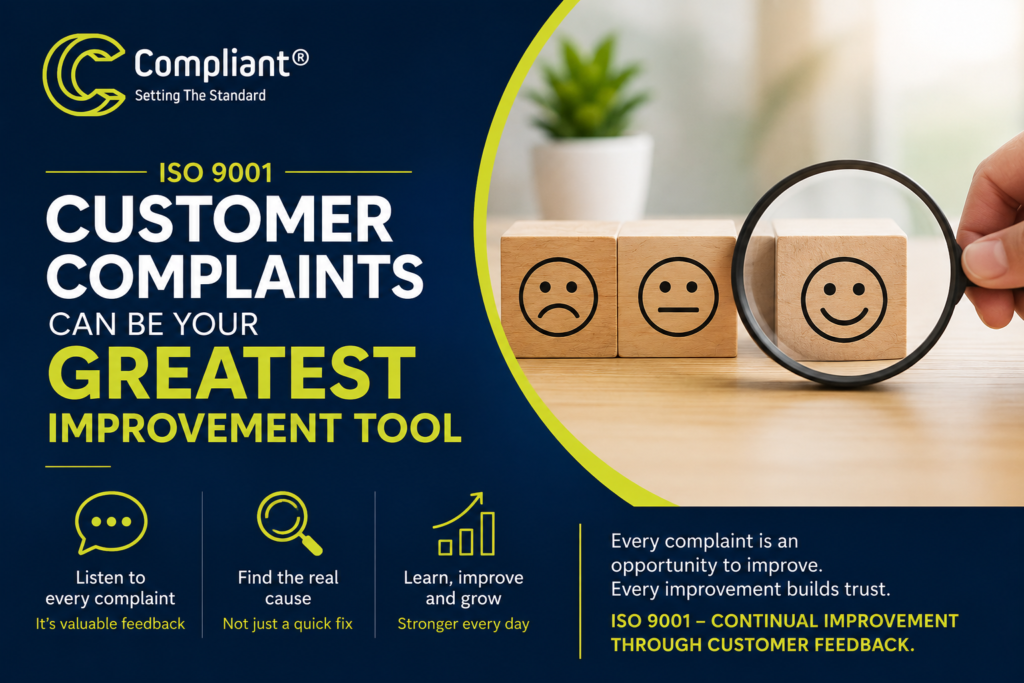

ISO 9001: Customer Complaints Can Be Your Greatest Improvement Tool
No one enjoys receiving a customer complaint.
It can feel personal.
It can feel frustrating.
Sometimes it feels unfair.
Many organisations spend more time trying to explain complaints than they do understanding them.
That is often the biggest mistake.
Every complaint tells a story.
Sometimes it highlights a small mistake.
Sometimes it uncovers a much bigger problem that has been hidden for months, or even years.
The organisations that grow the fastest are rarely the ones with no complaints.
They are the ones that learn from every complaint they receive.
This is one of the reasons ISO 9001 continues to be recognised around the world as the leading standard for quality management.
It encourages organisations to see customer feedback differently.
Not as criticism.
As opportunity.
If your organisation treats complaints as something to avoid, you could be missing one of your greatest tools for continual improvement.
Why Many Organisations Fear Complaints
Think about the last complaint your organisation received.
How did people react?
Did someone immediately become defensive?
Did the team focus on proving they were right?
Was the complaint quietly filed away after replying to the customer?
These reactions are common.
People work hard.
Nobody enjoys hearing that something has gone wrong.
Yet customers usually complain because something mattered enough for them to speak up.
Many more customers never complain at all.
Instead, they simply leave.
Research consistently shows that many unhappy customers never tell a business there is a problem. They simply choose another supplier the next time they need a product or service.
That makes the complaints you do receive incredibly valuable.
They provide information you might never have discovered otherwise.
ISO 9001 encourages organisations to value this information rather than fear it.
Every Complaint Is Free Advice
Imagine paying someone thousands of pounds to inspect your business.
They watch your processes.
They review your service.
They identify weak points.
Then they provide a report explaining exactly where improvements can be made.
Most organisations would see that as valuable.
Customers often do exactly the same thing.
The difference is they do it for free.
A complaint may reveal:
- Poor communication
- Delays
- Confusing information
- Product faults
- Inconsistent service
- Missing instructions
- Staff training needs
- Process failures
Each complaint shines a light on something that can be improved.
Without that feedback, the issue may continue affecting many more customers.
ISO 9001 Is Built Around Listening
One of the biggest strengths of ISO 9001 is that it encourages organisations to understand customer needs.
Listening is not something that happens once a year.
It should happen every day.
Customer feedback helps organisations answer important questions.
What are customers expecting?
Where are we falling short?
What do we do well?
What can we improve?
Without listening, organisations often make decisions based on assumptions.
Assumptions rarely improve quality.
Evidence does.
Complaints provide evidence.
The Real Cost of Ignoring Complaints
Some organisations believe dealing with complaints takes too much time.
Ignoring them usually costs much more.
One unhappy customer may tell friends and colleagues about their experience.
Negative online reviews remain visible for years.
Poor service can damage a reputation that took decades to build.
There are financial costs too.
Lost customers.
Lost contracts.
Lost opportunities.
Recruiting new customers is often far more expensive than keeping existing ones.
By treating complaints as learning opportunities, organisations reduce the chance of the same problem happening again.
That protects both reputation and future growth.
Looking Beyond the Complaint
A complaint should never be viewed on its own.
The real question is this.
Why did it happen?
If a customer receives the wrong product, replacing it solves today’s problem.
It does not solve tomorrow’s.
The organisation needs to understand why the mistake happened.
Was information unclear?
Was training missing?
Did the process fail?
Was communication poor?
Did technology contribute?
ISO 9001 encourages organisations to find the root cause instead of simply fixing the immediate issue.
This approach prevents problems from returning.
Good Organisations Welcome Honest Feedback
Nobody wants constant complaints.
But organisations should always welcome honest feedback.
Customers who complain are often giving you another chance.
They have not walked away yet.
They still believe the organisation can make things right.
Responding well builds trust.
Ignoring feedback destroys it.
Customers remember how organisations react when something goes wrong.
Sometimes they remember that even more than when everything goes well.
Continual Improvement Starts With Small Changes
Many people think improvement requires large projects.
It rarely does.
Small improvements often create the biggest long-term benefits.
Perhaps customer emails need clearer wording.
Perhaps delivery updates need improving.
Perhaps staff need extra guidance.
One small improvement may prevent hundreds of future complaints.
This is the heart of continual improvement.
Small steps.
Taken consistently.
Over time those small changes transform an organisation.
That is exactly what ISO 9001 promotes.
Complaints Help Leaders Make Better Decisions
Leadership teams make important decisions every day.
Those decisions become much stronger when based on real information.
Customer complaints provide valuable trends.
Perhaps complaints increase during busy periods.
Maybe one product creates more issues than others.
Perhaps one stage of the customer journey causes confusion.
Patterns begin to appear.
Those patterns help leaders decide where investment, training or process improvements will have the greatest impact.
Without data, organisations guess.
ISO 9001 encourages informed decision making.
Employees Benefit Too
Customer complaints are often viewed as something that only affects customers.
They affect employees as well.
Repeated problems create stress.
Staff become frustrated when they deal with the same issues every week.
Improving processes removes those frustrations.
Employees gain confidence because they have better systems to work with.
Clear processes also reduce uncertainty.
People know what is expected.
They understand how problems should be handled.
Everyone benefits.
Building a Positive Complaint Culture
Culture matters.
If employees fear blame, they are less likely to report problems.
If complaints are viewed as learning opportunities, people become more open.
They share ideas.
They identify risks earlier.
They suggest improvements.
The focus shifts.
Instead of asking,
“Who made the mistake?”
The organisation asks,
“How can we stop this happening again?”
That simple change creates a culture of continual improvement.
Measuring Improvement
Receiving fewer complaints is only one measure of success.
Organisations should also look at:
- Response times
- Customer satisfaction
- Repeat business
- Resolution times
- Staff feedback
- Process improvements
- Customer retention
ISO 9001 encourages organisations to monitor performance regularly.
What gets measured is much easier to improve.
Learning From Positive Feedback Too
Improvement is not only about complaints.
Positive feedback matters.
If customers consistently praise one area of the business, ask why.
What works well?
Can that success be repeated elsewhere?
Understanding success is just as valuable as understanding failure.
The goal is continual learning.
Why Expert Support Makes the Journey Easier
Implementing ISO 9001 can seem challenging at first.
Many organisations worry about paperwork or complicated requirements.
In reality, the standard is designed to improve the way organisations work.
Experienced consultants help organisations focus on practical improvements rather than unnecessary documents.
Good support helps businesses:
- Understand the requirements clearly
- Build systems that work every day
- Improve complaint handling
- Reduce wasted time
- Prepare confidently for certification
- Create lasting improvements
The aim is not simply achieving certification.
It is building better ways of working.
Customer Complaints Are an Investment in Your Future
The organisations that continue improving share one important habit.
They listen.
They do not ignore problems.
They investigate them.
They learn from them.
They improve because of them.
Every complaint provides information.
Every piece of feedback creates an opportunity.
Every improvement builds stronger customer relationships.
ISO 9001 provides the framework that helps organisations turn those opportunities into lasting success.
Final Thoughts
Customer complaints are often seen as something negative.
They should not be.
Handled well, they become one of the most valuable resources an organisation has.
They reveal weaknesses before they become larger problems.
They highlight opportunities to improve.
They strengthen customer relationships.
Most importantly, they help organisations build a culture where learning never stops.
That is the real purpose of ISO 9001.
Not simply achieving certification.
Creating an organisation that improves every single day.
The businesses that embrace customer feedback do more than solve today’s problems.
They prepare themselves for tomorrow’s success.
Continue Learning
The next time your organisation receives a customer complaint, pause before looking for a quick answer. Instead, ask what the complaint is really telling you. Review your process, involve your team, and identify one improvement that could stop the issue happening again.
Small improvements made consistently are the foundation of ISO 9001, and they are often the reason organisations earn stronger customer trust over time.