Skip to main content
Skip to footer
Skip to main content
Skip to footer

NHSS: Competence Is More Than Having the Right Certificate
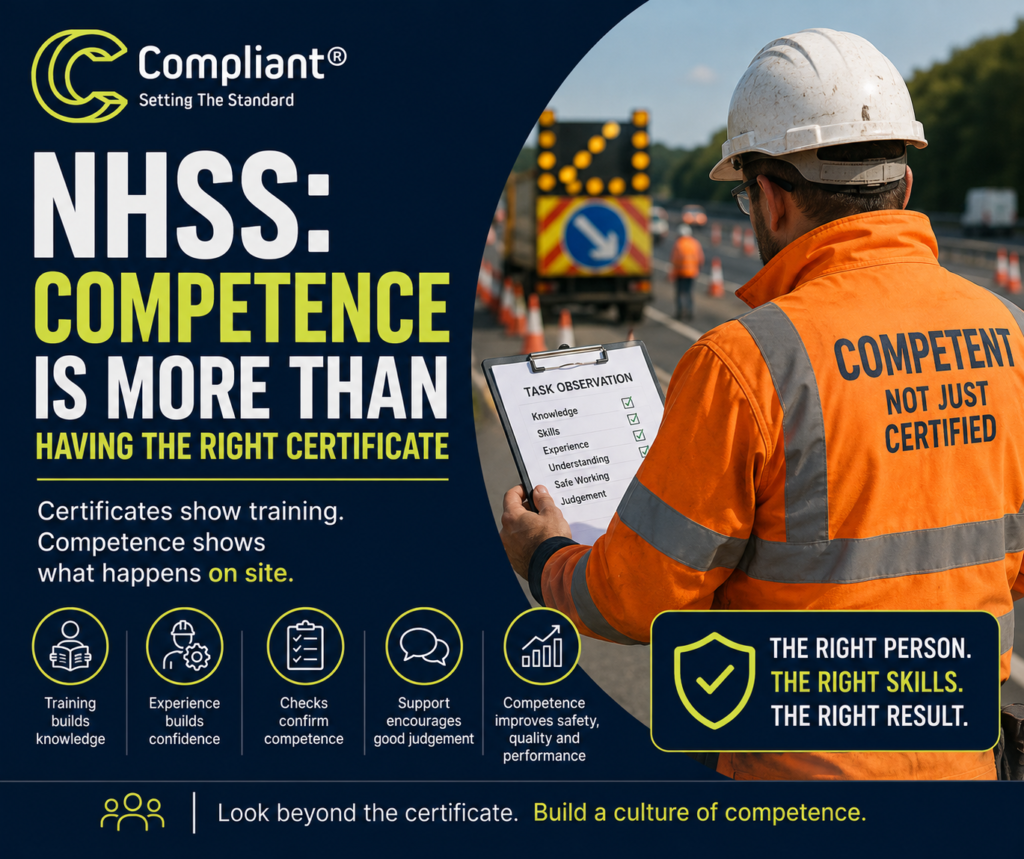
NHSS: Competence Is More Than Having the Right Certificate
A certificate can prove that someone completed training.
It cannot always prove they can do the job well.
That difference matters.
For businesses working under NHSS, having trained people is important. But competence goes further than sending someone on a course, placing a certificate in a file and assuming the job is done.
A person may have completed training months or even years ago. Have they used those skills since? Do they understand the work they are carrying out today? Can they spot when something is wrong? Do they know when to stop and ask for help?
Most importantly, can they carry out their role safely and correctly when nobody is standing beside them?
These questions matter because mistakes in highways work can have serious consequences.
A certificate is part of the evidence.
Competence is what happens when that knowledge is put into practice.
For organisations working with National Highways Sector Schemes, understanding that difference can help protect workers, road users, customers and the business itself.
What Does Competence Actually Mean?
Competence can sound complicated.
It does not need to be.
In simple terms, a competent person needs the right knowledge, skills, experience and understanding to carry out their work properly.
Training can help provide knowledge.
Experience helps people understand how that knowledge works in real situations.
Regular checks can show whether they are still working correctly.
Ongoing learning helps keep their knowledge up to date.
Put those things together and you begin to build a much clearer picture of competence.
This is important because two people can hold the same certificate and still have very different levels of ability.
One may have carried out the work every week for five years.
Another may have completed their training but had very little chance to use it.
The certificate may look similar.
Their experience is not.
An effective NHSS management system needs to recognise this.
The Certificate Should Be the Beginning, Not the End
Training records are important.
Businesses need to know that employees have received the training required for their roles.
The problem starts when the certificate becomes the only thing anyone checks.
Imagine an employee completes training.
Their certificate is copied and saved.
A date is entered into a spreadsheet.
The business moves on.
Three years later, somebody checks the spreadsheet and sees that the certificate is still valid.
Everything appears fine.
But what happened during those three years?
Has the employee regularly carried out the work?
Have working methods changed?
Has equipment changed?
Have requirements changed?
Have they developed bad habits?
Have they struggled with any part of the role?
Has anybody actually watched them work?
A certificate cannot answer those questions.
Your competence process should.
Competence Is About the Person Doing the Job Today
Businesses can become focused on expiry dates.
When does this certificate run out?
When does that card need renewing?
When is refresher training due?
These dates matter.
But they should not become the whole system.
A certificate could have another two years left to run while the person holding it is struggling today.
Perhaps they have moved into a different role.
Maybe they have returned after a long period away from the work.
They may be using new equipment.
They might be carrying out a task they have not done for months.
Waiting for a certificate to expire before checking competence makes little sense.
The better question is:
Can this person carry out this task correctly today?
That shifts the focus away from paperwork and back towards the work itself.
Experience Matters
Training can teach someone what should happen.
Experience teaches them what can happen.
That is an important difference.
Real work does not always follow the perfect example used during training.
Weather changes.
Sites are different.
Equipment behaves differently.
Plans change.
Unexpected problems appear.
Experienced people often become better at recognising when something does not look right.
They know when to stop.
They know when something falls outside their own level of knowledge.
That last point is especially important.
Being competent does not mean knowing everything.
A competent person should understand the limits of their own ability.
Sometimes the safest and most professional decision is:
“I need help with this.”
Businesses should create an environment where people feel able to say that.
If employees think asking for help makes them look weak, they may continue with work they are unsure about.
That creates risk.
Competence Needs to Be Checked
How do you know somebody is competent?
You need evidence.
Again, this does not have to mean creating mountains of paperwork.
Evidence could include training records.
It could include experience.
You might observe someone carrying out their role.
A supervisor could complete a practical check.
You may review the quality of completed work.
Customer feedback could provide useful information.
Problems and mistakes may show where more support is needed.
Toolbox talks or short knowledge checks could help.
The right approach will depend on the person’s role and the risks involved.
A low-risk office task will not necessarily need the same level of checking as work carried out on or near a live road.
The important thing is that the business can explain how it knows someone is able to do the work they have been given.
Not simply how it knows they attended a course.
Competence Can Change
Someone who was competent five years ago will not automatically remain competent forever.
Skills can fade when they are not used.
Requirements can change.
Technology develops.
New equipment arrives.
People change roles.
New risks appear.
This is why competence needs to be reviewed.
Consider someone who was trained to carry out a task but has not performed it for two years.
Their certificate might still be valid.
Would you immediately send them out alone?
Or would it make sense to check their knowledge and perhaps allow them to work alongside someone experienced first?
Common sense matters.
NHSS should support sensible business decisions, not replace them.
A good competence system helps managers understand when additional training, supervision or support may be needed.
Do Not Forget New Starters
A new employee can arrive with an impressive collection of certificates.
That is useful.
But they are still new to your business.
They may not know your processes.
They may not know your equipment.
They may not understand how you communicate information.
They will not know your customers.
They may not know who to speak to when something goes wrong.
This is why induction matters.
Checking certificates should form part of bringing someone into the business, but it should not be the only part.
Help new employees understand how your organisation works.
Show them what good work looks like.
Explain responsibilities clearly.
Make sure they know what they are allowed to do and what they are not yet ready to do.
Give them someone to ask.
Then check how they are getting on.
A person can be highly experienced and still need time to understand a new workplace.
Supervisors Need to Be Competent Too
Competence does not stop with the person carrying out the physical work.
Supervisors need the knowledge and skills required for their responsibilities.
Managers do too.
Think about the decisions these people make.
Who is allowed to carry out a task?
Who needs additional training?
Who needs supervision?
When should work stop?
What happens when requirements change?
Who reviews performance?
A manager who does not understand the work may struggle to recognise when somebody needs support.
That does not mean every manager must be able to carry out every task personally.
They do need enough understanding to make sensible decisions within their role.
Competence needs to exist throughout the organisation.
People Need Clear Responsibilities
Confusion creates mistakes.
If two people both think the other person is responsible for a check, the check may not happen.
If nobody knows who should update training records, they become outdated.
If supervisors are unsure who is approved to carry out certain work, the wrong person could be assigned.
Clear responsibilities help prevent this.
Employees should understand what they are responsible for.
Supervisors should know what they need to check.
Managers should understand what needs reviewing.
The person responsible for the management system should know how competence is being recorded and monitored.
Keep it simple.
People are far more likely to follow a process they understand.
A Training Matrix Can Help, But It Is Not the Whole Answer
Many organisations use a training or competence matrix.
This can be a useful tool.
It can show employees, roles, training requirements and renewal dates in one place.
It helps businesses see where certificates are approaching expiry.
It may also highlight gaps.
But a spreadsheet does not make someone competent.
It records information.
That distinction is worth remembering.
If every box on your training matrix is green, that does not automatically mean every employee is working correctly.
The matrix should support your competence process.
It should not replace it.
Look beyond the boxes.
Talk to supervisors.
Observe work.
Review problems.
Check whether people actually understand what they have been trained to do.
Watch What Happens on Site
One of the strongest ways to understand competence is to look at the work.
Not during a special demonstration.
During normal work.
Does the person follow the correct process?
Do they use equipment properly?
Do they understand the risks?
Can they explain what they are doing?
What happens when something unexpected occurs?
Do they know when to ask for help?
This gives you a much richer picture than looking at a certificate.
It can also identify training needs before they become serious problems.
Perhaps someone understands most of their role but is unsure about one area.
That does not necessarily mean sending them back through an entire training programme.
A conversation, additional instruction or supervised practice may solve the problem.
Competence management should help people improve.
It should not be about catching them out.
Mistakes Can Reveal Training Needs
When something goes wrong, businesses naturally want to fix it quickly.
That is understandable.
But do not stop at fixing the immediate problem.
Ask why it happened.
Was the employee properly trained?
Did they understand the instructions?
Had they carried out the task before?
Was supervision suitable?
Were the instructions clear?
Did something change?
Was the employee expected to do something outside their normal role?
These questions help separate a one-off mistake from a wider weakness.
Sometimes a problem that looks like an employee mistake is actually a process problem.
Perhaps the person was never given the information they needed.
Maybe responsibilities were unclear.
Perhaps training records said they were competent when nobody had actually checked.
Looking deeper helps prevent the same problem happening again.
Changes Should Trigger a Competence Review
Businesses change all the time.
New equipment arrives.
New processes are introduced.
Contracts bring different requirements.
People move roles.
Standards and scheme requirements can change.
Each change should make you ask:
Does anyone need new knowledge or skills because of this?
Suppose you introduce new equipment.
Giving someone the instruction book may not be enough.
Do they need training?
Do they need supervised practice?
Does their supervisor understand the new equipment too?
Should your existing work instructions be updated?
This kind of thinking helps competence keep pace with the business.
Otherwise, employees can end up working with yesterday’s knowledge in today’s workplace.
Temporary and Subcontracted Workers Still Matter
Competence requirements do not disappear because someone is not a permanent employee.
If a subcontractor carries out work on behalf of your business, you still need confidence that they are able to perform the work properly.
Do not assume another company has checked everything.
Understand what evidence you require.
Check it.
Make sure the person arriving on site is the person whose competence has been confirmed.
Explain any information they need about your own processes and requirements.
The same principle applies to temporary workers.
A short period of employment does not make the risks smaller.
In some cases, it can make clear induction and supervision even more important.
Internal Audits Should Look Beyond Expiry Dates
An internal audit can provide a valuable opportunity to test your competence process.
It should not simply involve opening the training matrix and checking whether certificates are in date.
Go further.
Choose a role.
What competence does that role require?
How was this decided?
Look at an employee carrying out that role.
What evidence shows they are competent?
Has their competence been reviewed?
Have there been any changes since they were trained?
Speak to the employee.
Do they understand their responsibilities?
Do they know what to do if they are unsure?
Then compare what you have found with the process the business says it follows.
This is where internal audits become useful.
They help you understand whether the system works in real life.
The Benefits of an ISO Consultant’s Support
NHSS requirements can feel difficult when a business is trying to understand what evidence it needs and how its existing systems fit together.
This is where the benefits of an ISO consultant’s support can become useful.
An experienced consultant can provide an outside view.
Businesses naturally become used to their own processes.
A training matrix may have been used for years without anyone asking whether it actually tells the business enough about competence.
A consultant can ask those questions.
How do you know this person is competent?
Who checks them?
What happens when somebody changes role?
How do you manage subcontractors?
What happens when a certificate expires?
What happens if somebody has a valid certificate but has not performed the task for a long time?
How do supervisors know who can do what?
These are not questions designed to create more paperwork.
They are designed to find weaknesses.
A good consultant should also help explain NHSS requirements in clear language.
The aim should be to help the organisation understand what it needs to do and why.
Not simply produce documents for an audit.
Your Team Should Understand the System
There is little value in having a perfect competence procedure that nobody understands.
The people using the system need to know how it works.
Employees should understand what is expected from them.
Supervisors should know how competence is checked.
Managers should understand how decisions are made.
The person maintaining training records should know when updates are required.
If everything depends on one person, that can create another problem.
What happens when they are away?
Good systems should be understood by the people who rely on them.
That makes them stronger.
It also makes audit preparation much less stressful because the business is not trying to rebuild months of evidence at the last minute.
Do Not Wait for the Audit to Check Competence
An approaching audit has a wonderful ability to make businesses look closely at their records.
Suddenly certificates are checked.
Training matrices are updated.
Missing evidence is chased.
People start asking whether everything is current.
But competence should matter every day.
Not just during audit week.
If someone is carrying out work today, you need confidence in their ability today.
Finding a missing certificate during an audit may be inconvenient.
Finding out someone was not competent after something has gone wrong can be far more serious.
Build simple checks into normal business activity.
Review upcoming training dates regularly.
Talk about competence during employee reviews.
Include it when people change roles.
Consider it when new work is introduced.
Review it after problems.
Make it part of everyday management.
Create a Culture Where People Can Say “I’m Not Sure”
This may be one of the most valuable signs of a competent workforce.
People know when to ask.
A workplace where everyone pretends to know everything can be dangerous.
Employees need to feel comfortable saying:
“I haven’t done this before.”
“I need someone to show me.”
“I’m not sure this is right.”
“My training is out of date.”
“Can you check this?”
Managers should welcome these conversations.
They provide an opportunity to act before a mistake happens.
Competence includes knowing your own limits.
A person who stops and asks for help may be demonstrating better judgement than someone who continues while unsure.
Competence Is an Ongoing Process
There is no single document that proves competence forever.
Certificates matter.
Training matters.
Experience matters.
Supervision matters.
Observation matters.
Ongoing learning matters.
Together, they give businesses confidence that people have the knowledge and ability needed for their roles.
NHSS provides structure around this.
But the purpose is not to fill folders.
It is to help ensure that work is carried out by people who understand what they are doing.
That protects quality.
It protects safety.
It protects customers.
It protects the organisation.
And importantly, it protects the people carrying out the work.
Start With One Role
You do not need to review every employee tomorrow.
Choose one important role.
Ask what that person needs to know to carry it out correctly.
Then choose someone currently doing that job.
Check their training.
Look at their experience.
Speak to their supervisor.
Observe their work if appropriate.
Ask the employee how confident they feel.
Find out whether anything has changed since they were trained.
Then ask:
If we removed the certificate from the file, what other evidence would give us confidence that this person is competent?
If you have several good answers, your competence process is probably looking beyond paperwork.
If the certificate is your only answer, there may be more work to do.
NHSS competence should never become a race to collect certificates.
Certificates provide useful evidence that training has taken place.
But people carry out the work.
And people need more than a piece of paper.
They need knowledge, experience, clear instructions, suitable supervision and opportunities to keep learning.
So the next time you look at your training records, do not stop when you see a valid date.
Look beyond it.
Ask whether the person behind that certificate can confidently and correctly carry out the work you are asking them to do.
Because when it comes to NHSS, the most important evidence of competence is not simply what is sitting in the training file.
It is what happens when the work begins.