Skip to main content
Skip to footer
Skip to main content
Skip to footer

NHSS: Why Evidence of Competence Matters When Working on UK Highways
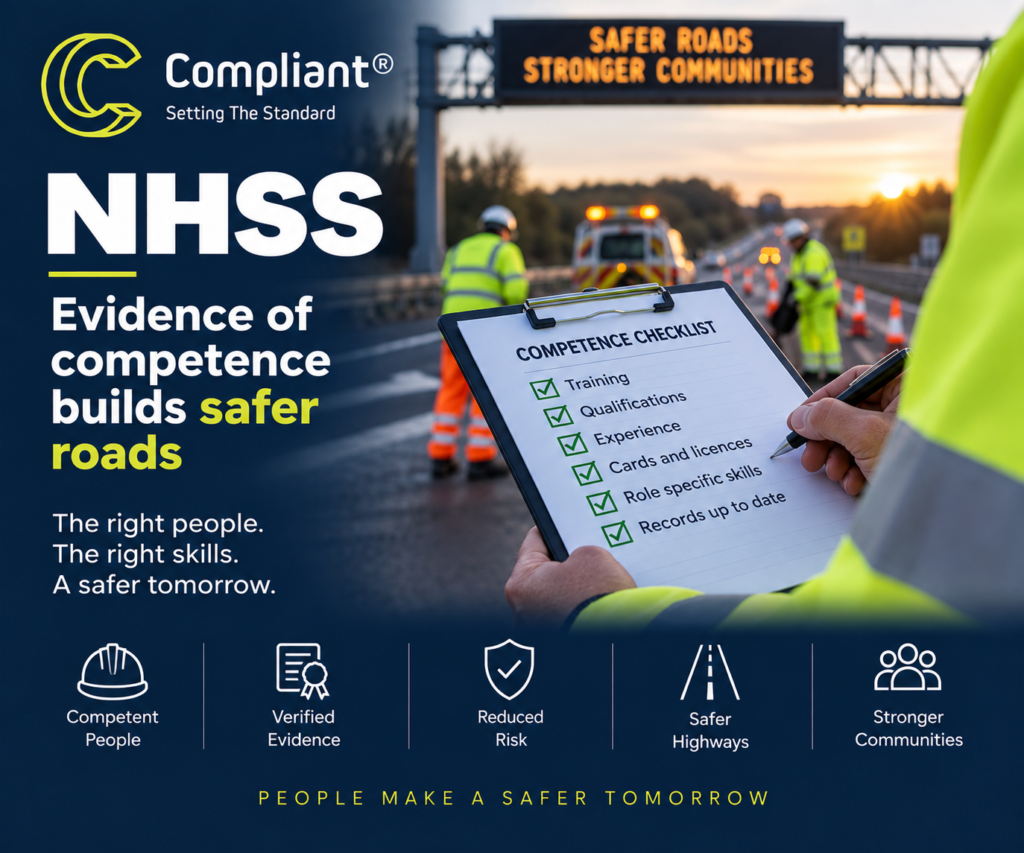
NHSS: Why Evidence of Competence Matters When Working on UK Highways
A certificate in a folder does not automatically make someone competent.
Neither does saying, “They’ve been doing the job for years.”
When people are working on UK highways, competence matters. The work can affect employees, contractors, road users and members of the public.
Mistakes can have serious consequences.
Yet one of the problems businesses can face is not necessarily that their people lack skills.
It is that they cannot clearly prove those skills.
Training may have taken place but the record cannot be found.
A qualification may have expired.
Someone may have moved into a different role without their competence being reviewed.
A subcontractor may have been accepted because they have worked for the business for years, but nobody has checked whether their evidence is still current.
Or a company may have plenty of certificates but very little evidence that people can actually perform the work they have been given.
This is where NHSS, or National Highways Sector Schemes, places an important focus on competence.
It is not enough to assume the right person is doing the right job.
Organisations need a structured way to determine what competence is needed, make sure people have it and keep suitable evidence.
Because when somebody asks:
“How do you know this person is competent to carry out this work?”
“We know they’re good at their job” is not enough.
Competence Is More Than a Training Certificate
Training matters.
Qualifications matter.
Certificates matter.
But competence can involve much more.
Think about two people who have completed the same training course.
Both have certificates.
One has carried out the task regularly for several years and has shown they can do it safely and correctly.
The other completed the course but has had very little practical experience since.
On paper, they may initially look similar.
In practice, their level of competence may not be the same.
This is why businesses need to look beyond simply asking:
“Do they have a certificate?”
A better question is:
“Do we have enough evidence to show this person is able to carry out this particular role correctly?”
Depending on the work and the relevant NHSS requirements, evidence may include qualifications, training, experience, cards, licences, assessments, authorisations and other suitable records.
The important point is that competence needs to match the work being carried out.
Why Does Competence Matter So Much on Highways?
Highways are not ordinary workplaces.
People may be working close to moving traffic.
Heavy machinery may be operating.
Traffic management could be in place.
Weather can affect conditions.
Work may happen at night.
Different contractors may be working alongside one another.
Members of the public can be nearby.
A small mistake can create a much bigger risk.
That is why businesses operating within the highways supply chain need confidence that people understand their jobs and are capable of carrying them out.
Competence is therefore not simply something to think about before an audit.
It affects everyday work.
If someone does not understand the task they have been given, the consequences can affect quality, safety, time, cost and the wider project.
Good competence management helps reduce that risk.
What Is NHSS?
National Highways Sector Schemes are quality management arrangements used for particular activities connected with highways.
Different schemes apply to different types of work.
The exact requirements therefore depend on the activities an organisation carries out and the scheme that applies.
NHSS works alongside ISO 9001, adding requirements relevant to specific highways activities.
This is important because a general quality management system alone cannot always cover the detailed needs of specialist highways work.
The sector scheme helps organisations demonstrate that they have appropriate processes and controls in place for the work they undertake.
Competence is an important part of this.
After all, even the best written procedure has limited value if the person carrying out the task does not have the right knowledge or ability.
Start With the Role, Not the Person
One useful way to manage competence is to start by looking at the role.
What does this person need to do?
What knowledge is required?
What training is needed?
Are specific qualifications required?
Does the person need practical experience?
Are there particular cards or licences associated with the work?
Does anything need renewing?
Does the relevant NHSS scheme set specific requirements?
Only after answering those questions should you look at the person.
Do they meet those requirements?
This helps remove assumptions.
Without a clear understanding of what each role requires, competence can become difficult to manage.
One manager may believe a particular qualification is enough.
Another may expect additional experience.
A third may not know that something needs renewing.
Clear requirements create consistency.
Build a Simple Competence Matrix
One practical way to manage evidence of competence is through a competence or training matrix.
It does not need to be complicated.
The aim is to give the organisation a clear picture of:
Who does what.
What competence each role requires.
What evidence is held.
When training took place.
When qualifications or cards expire.
What refresher training may be needed.
Where there are gaps.
This can make a major difference.
Without a central view, evidence often becomes scattered.
One certificate is in an employee file.
Another is attached to an email.
A manager has a copy of something on their laptop.
Another document is with HR.
Someone knows a card was renewed, but nobody updated the record.
Everything may exist somewhere.
But when the business needs it, finding it becomes difficult.
A good system makes competence visible.
“We’ve Got the Certificate Somewhere” Is a Warning Sign
Audits have a habit of exposing weak record keeping.
You know an employee completed the training.
They remember attending.
Their manager remembers approving it.
But where is the evidence?
Someone searches emails.
Another person checks a folder.
HR gets involved.
Eventually, somebody finds an old copy.
That is not an ideal way to manage something as important as competence.
Evidence should be controlled and accessible.
That does not mean every manager needs access to every employee record.
It means the business needs a reliable process for storing and retrieving the evidence it requires.
When records are organised, audit preparation becomes easier.
More importantly, operational decisions become easier too.
Before allocating somebody to a task, managers can check whether the person has the necessary competence.
Expiry Dates Can Create Hidden Gaps
A certificate can be valid today and no longer valid next month.
That creates another challenge.
If your business only checks competence once a year, something may expire between reviews.
Depending on the role and requirements, this could include cards, licences, training or other evidence.
A strong system should therefore help the organisation look ahead.
What expires in the next month?
What about the next three months?
Does training need booking?
Is refresher training required?
Will the employee still be able to carry out their role if renewal is delayed?
Waiting until something has expired can create avoidable problems.
You may suddenly discover that the person you intended to send to a project no longer has current evidence required for that work.
Planning ahead is much easier.
Experience Needs Evidence Too
Businesses sometimes rely heavily on experience.
And experience is valuable.
Someone who has worked in highways for twenty years may have a huge amount of practical knowledge.
But simply writing “20 years’ experience” may not tell the whole story.
Experience needs to be relevant.
Twenty years in one type of work does not automatically make somebody competent in every other highways activity.
Think about what evidence can support the person’s experience.
Employment history.
Records of previous work.
Assessments.
Supervisor observations.
Authorisations.
Project records.
Relevant training.
The evidence will depend on the role and applicable requirements.
The purpose is not to create paperwork for the sake of it.
It is to provide confidence that the person’s claimed experience supports the work they are being asked to carry out.
New Starters Need More Than an Induction
A new employee joins.
They have qualifications.
They have experience.
They have worked for another highways company.
Excellent.
But they are still new to your organisation.
They may not know your processes.
Your reporting arrangements.
Your equipment.
Your customer requirements.
Your emergency arrangements.
Your quality controls.
Your health and safety expectations.
Competence from a previous role is valuable, but businesses still need to make sure new employees understand how work is carried out within their organisation.
An induction can help.
But again, think beyond attendance.
Has the person understood what they have been told?
Do they need supervision initially?
Is there anything specific to their new role?
When will their progress be reviewed?
Good competence management supports people as they enter the organisation rather than simply collecting their certificates on day one.
Moving Roles Can Change Competence Requirements
People develop.
They get promoted.
They take on more responsibility.
They start supervising others.
They move between departments.
They begin using different equipment.
These changes can affect competence requirements.
An employee may have been completely competent in their previous role.
That does not automatically mean they have everything required for the new one.
When responsibilities change, review competence.
What new knowledge is needed?
Is additional training required?
Does the person need experience under supervision?
Are there new qualifications or authorisations?
Who will decide when they are ready?
This is particularly important where somebody has gradually taken on additional responsibilities.
Sometimes a person’s job changes over several years without anyone formally reviewing whether their competence records still match what they actually do.
Do Not Forget Supervisors and Managers
Competence is not only about people carrying out physical work.
Supervisors and managers need appropriate competence too.
Someone may be excellent at carrying out a task.
That does not automatically mean they are ready to manage a team performing it.
Supervision can require different skills.
Planning.
Communication.
Monitoring.
Decision-making.
Understanding responsibilities.
Recognising when something is wrong.
Managers may also need knowledge relevant to the NHSS requirements affecting their area.
When reviewing competence, look across the whole organisation.
Do not focus only on the people physically carrying out the work.
Subcontractors Need Attention Too
Subcontracting does not remove responsibility for having suitable controls.
Businesses need confidence that the subcontractors they use are suitable for the work they are being asked to undertake.
Competence should form part of that process where relevant.
What evidence is required?
Has it been checked?
Is it current?
Does it cover the activity the person will actually perform?
Who is responsible for checking it?
How often is it reviewed?
Long-standing relationships can sometimes create a risk here.
“We’ve used them for years.”
That may be true.
But competence evidence still needs appropriate management.
People change.
Qualifications expire.
Roles change.
Subcontractors may bring in different employees.
A strong relationship is valuable, but it should not replace suitable checks.
Competence Is Not Permanent
Passing an assessment once does not mean somebody remains competent forever.
Things change.
Requirements can change.
Processes change.
Equipment changes.
Technology changes.
People may stop carrying out a particular activity for a long period.
Bad habits can develop.
This is why competence needs ongoing attention.
Ask:
Is the person still carrying out the task regularly?
Has anything changed?
Have there been problems with their work?
Do they need refresher training?
Have audits identified concerns?
Has a supervisor raised anything?
Has a customer provided feedback?
Does evidence need renewing?
Competence should be maintained, not simply achieved.
What Happens When Someone Is Not Yet Competent?
Finding a gap does not always mean somebody has done something wrong.
Perhaps a new starter needs more experience.
Maybe an employee has moved into a new role.
Someone might need refresher training.
A qualification may be booked but not yet completed.
The important part is managing the situation.
Should the person work under supervision?
Are there tasks they should not perform yet?
Who is responsible for supporting them?
What needs to happen before they can work independently?
When will competence be reviewed again?
A clear development plan can turn a gap into progress.
Ignoring the gap creates risk.
Training Records Should Tell a Story
Imagine an auditor chooses one employee and asks you to demonstrate their competence.
Could your records tell a clear story?
What is their role?
What competence does the role require?
What training have they completed?
What qualifications do they hold?
Are they current?
What relevant experience do they have?
Have they been assessed where required?
Are there any restrictions?
Has refresher training been identified?
The auditor should not need to piece the answer together from six unrelated systems.
Your evidence should make sense.
That is one of the benefits of having a structured approach.
Internal Audits Can Test Competence Management
Internal audits are a useful opportunity to test whether the system works.
Do not simply check that a training matrix exists.
Choose some people.
Look at their roles.
Check the requirements.
Review the evidence.
Check expiry dates.
Talk to managers.
Ask employees about their responsibilities.
Review subcontractor evidence.
Look at people who recently changed roles.
Check new starters.
This can expose gaps before an external audit.
More importantly, it can expose gaps before they affect work.
If you discover that a qualification expires next month, you can act.
If you discover that an employee has been given duties outside their recorded competence, you can review the situation.
That is useful internal auditing.
Evidence Should Support Reality
There is another side to competence management.
You can have perfect records and still have a problem.
A spreadsheet says everything is current.
Every certificate is filed correctly.
All boxes are green.
But can the person actually do the job?
Evidence should support reality.
Managers and supervisors need to pay attention to performance.
Are instructions being followed?
Is work meeting requirements?
Are mistakes happening repeatedly?
Does the person understand why tasks are performed in a certain way?
Do they know what to do when something goes wrong?
Competence cannot become a paperwork exercise.
The record supports the decision.
It does not replace good management.
What Happens When Something Goes Wrong?
Problems can provide important information about competence.
Suppose work does not meet requirements.
Do not automatically assume somebody needs retraining.
Investigate.
Was the instruction clear?
Was suitable equipment available?
Was the employee given enough time?
Did they understand the task?
Were they properly supervised?
Was the process itself wrong?
Was competence actually the issue?
If it was, decide what needs to change.
Training may be part of the answer.
But sometimes the solution is clearer instructions, better supervision or a different process.
The aim is to understand the cause rather than simply sending somebody on another course.
Why NHSS Consultant Support Can Help
NHSS requirements can feel difficult when an organisation first approaches them.
Different sector schemes apply to different activities, and businesses need to understand what is relevant to the work they undertake.
Competence is one area where an experienced NHSS consultant can provide useful support.
A consultant can help businesses ask the right questions.
Which competence requirements apply?
Which roles are affected?
What evidence should be maintained?
Are current records enough?
How will expiry dates be monitored?
How are subcontractors checked?
What happens when someone changes roles?
How is ongoing competence reviewed?
This can turn a collection of certificates into a practical competence management system.
A Fresh Pair of Eyes Can Find Gaps
Businesses become familiar with their own processes.
That is natural.
“We know Steve is competent.”
“Sarah has done that job for years.”
“Our subcontractor always sends qualified people.”
“The certificates are all in HR.”
These statements may be completely correct.
But a consultant may ask the next question:
“Can you show me?”
That is often where gaps become visible.
Perhaps Steve’s evidence does not cover one part of his current role.
Sarah’s responsibilities may have changed.
The subcontractor’s process may not confirm which individual is attending site.
HR may have certificates, but managers cannot see when something is due to expire.
An outside perspective can help identify these weaknesses before they become audit findings or operational problems.
Consultant Support Should Simplify, Not Complicate
A competence management system does not need endless forms.
The aim is clarity.
Who needs what?
Who has it?
Where is the evidence?
When does anything need renewing?
Are there gaps?
What action is needed?
A good NHSS consultant should help businesses create a system that people can actually maintain.
That matters.
A beautiful spreadsheet that is too complicated to update will quickly become useless.
A simple system that managers understand and regularly use is far more valuable.
Leadership Needs to Take Competence Seriously
Competence cannot be left entirely to HR or the quality manager.
Managers allocate work.
Supervisors see performance.
Employees know when they need support.
Senior leaders decide whether resources are available for training and development.
Everyone has a part to play.
Leadership also sets expectations.
If expired training is ignored because a project is busy, people notice.
If competence is only checked when an audit is approaching, people notice that too.
The strongest systems make competence part of everyday planning.
Before someone is given work, ask whether they are suitable for it.
That should become normal.
Evidence Protects More Than Your Audit Result
It can be tempting to think about evidence mainly in terms of audits.
An auditor asks.
You show the certificate.
Box ticked.
But evidence of competence provides wider value.
It helps managers allocate work confidently.
It highlights training needs.
It helps plan renewals.
It supports employee development.
It can identify where the business depends too heavily on one skilled person.
It helps manage subcontractors.
It provides confidence to customers.
Most importantly, it supports the organisation in making sure the right people are carrying out the right work.
That is much more valuable than simply passing an audit.
Ask One Simple Question
Choose one person in your organisation today.
Not the easiest example.
Pick someone at random.
Look at the work they carry out.
Then ask:
“Could we clearly demonstrate why we believe this person is competent to do this job?”
Can you identify the requirements?
Can you find the evidence?
Is everything current?
Does the evidence match their actual responsibilities?
Is there anything due to expire?
Has their competence been reviewed when their role changed?
If you can answer those questions clearly, your system is doing something useful.
If you cannot, you have identified an opportunity to improve it.
Then choose another employee.
And another.
Do the same with a subcontractor.
That simple exercise can tell you a great deal about how well competence is being managed.
Why Evidence of Competence Matters When Working on UK Highways
People are at the centre of highways work.
Processes matter.
Equipment matters.
Planning matters.
But ultimately, people need to understand what they are doing and be capable of doing it correctly.
NHSS helps businesses put structure around that responsibility.
The aim should not be to collect certificates simply because an auditor might ask for them.
The aim is to create confidence.
Confidence that employees have the right knowledge.
Confidence that training is current.
Confidence that experience is relevant.
Confidence that subcontractors have been appropriately checked.
Confidence that people are supported when their roles change.
Confidence that gaps are identified before work is allocated.
And confidence that when somebody asks why you believe a person is competent, you have a clear answer supported by evidence.
Experienced NHSS consultant support can help organisations understand the requirements, organise evidence, identify gaps and create practical systems that can be maintained throughout the year.
But the most important thing to remember is simple:
A certificate can form part of the evidence. It should never become the whole definition of competence.
Competence is about having the right knowledge, skills, experience and ability for the work being carried out.
Evidence helps you prove it.
And when work is taking place on UK highways, being able to demonstrate that competence is not paperwork for paperwork’s sake.
It is part of making sure the right people are trusted with the right work.