Skip to main content
Skip to footer
Skip to main content
Skip to footer

NHSS: Why Highways Supply Chain Standards Matter More Than You Think
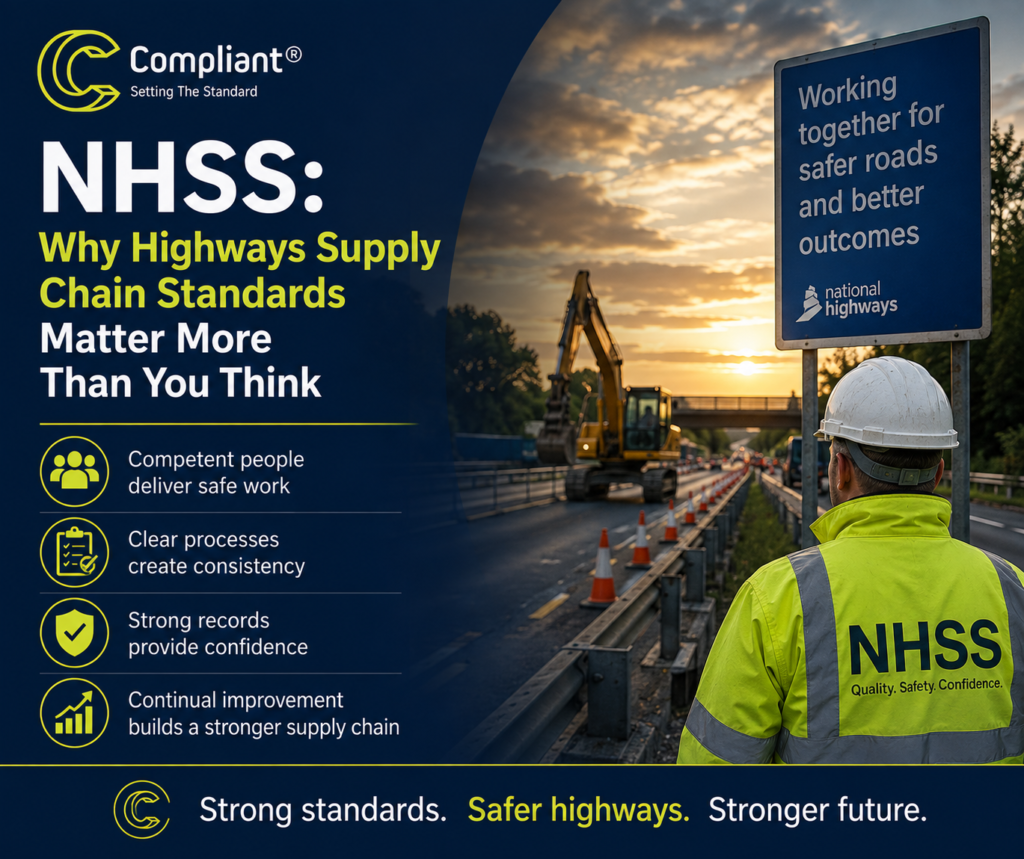
Working within the highways supply chain comes with a level of responsibility that many other industries simply do not face.
A small mistake does not always stay small.
Poor workmanship can create delays.
Weak processes can lead to work being repeated.
Missing records can cause problems during an audit.
Poor planning can put workers at risk.
And when work takes place on or around a live highway, failures can affect far more than your own business.
They can affect other contractors, road users and the wider project.
That is why National Highways Sector Schemes, commonly known as NHSS, matter.
Yet businesses can sometimes look at NHSS as another hurdle they need to get through.
Another certificate.
Another audit.
Another set of documents.
Another cost.
Another requirement standing between them and the work they want to win.
That way of thinking can mean businesses miss the real value.
NHSS is not simply about proving that your company can pass an assessment.
It is about demonstrating that your organisation has the right processes, people and controls for the work it carries out within the highways supply chain.
When those things work properly, they do much more than support certification.
They can help create safer work, clearer responsibilities, stronger records and greater confidence throughout the supply chain.
And in an industry where one weak link can affect an entire project, that matters more than you might think.
What Is NHSS?
National Highways Sector Schemes are quality management schemes created for organisations working within specific parts of the highways industry.
There are different schemes covering different types of work.
This is important because highways work is not all the same.
The risks, skills, equipment and controls required for one activity may be very different from those required for another.
NHSS recognises this.
Rather than taking a general approach to quality and assuming it will cover every specialist activity, relevant schemes introduce requirements linked to particular areas of highways work.
For businesses within the supply chain, this means the management system needs to reflect the work they actually carry out.
It is not enough to have a good-looking quality manual.
Your processes need to work in practice.
Your people need to understand their roles.
Competence needs to be managed.
Records need to be available.
Equipment needs appropriate control.
Problems need to be identified.
And the organisation needs to show that the way it works can consistently meet the requirements relevant to its activities.
That is why NHSS should not be treated as paperwork sitting beside the real business.
It needs to connect directly with the real business.
The Highways Supply Chain Depends on Consistency
Imagine a large highways project.
There may be many organisations involved.
Main contractors.
Subcontractors.
Specialist installers.
Suppliers.
Traffic management teams.
Inspectors.
Designers.
Maintenance teams.
Each business may only control one part of the work.
But those individual parts need to fit together.
If one company does not deliver what was expected, the effects can spread.
A delay may prevent another team starting.
Poor-quality work may need to be corrected.
Missing information can hold up approval.
Incorrect materials can affect the next stage.
A failure to follow an agreed process can create safety concerns.
This is one reason standards within the supply chain matter.
They create agreed expectations.
Businesses know what is required.
Customers have a clearer way to assess suppliers.
Employees have processes to follow.
Auditors can check whether the organisation is operating as expected.
The goal is greater consistency.
In highways work, consistency is not boring.
It is valuable.
You want the correct process followed on Monday morning and Friday afternoon.
You want the same level of control whether a senior manager is watching or nobody from management is on site.
You want good practice to remain good practice when workloads increase.
That is what a strong management system helps create.
A Certificate Cannot Make Your Business Competent
This is one of the most important points to understand about NHSS.
A certificate does not magically improve a business.
The work behind it should.
If your only objective is to get through an audit, it becomes very easy to focus on evidence rather than performance.
Do we have the document?
Has the form been completed?
Can we show the auditor something?
Those questions have their place.
But they are not enough.
A better question is:
Does this process actually help us control the work?
A training record is useful.
But is the person genuinely competent to complete the task?
An equipment register is useful.
But is the equipment actually being checked when required?
A procedure may exist.
But do employees follow it?
An internal audit may have been completed.
But did it find anything useful?
The strength of NHSS should come from what happens every day, not from what can be produced when an auditor asks.
Competence Matters Because Highways Work Has Consequences
One of the biggest themes within highways work is competence.
And for good reason.
You would not want somebody completing specialist work simply because they watched another employee do it once.
You need confidence that the person understands the task.
They need appropriate knowledge.
They may need training.
They may need experience.
They may need specific qualifications or cards depending on the work and scheme involved.
Most importantly, the organisation needs a way to manage and understand competence.
This is different from simply keeping copies of certificates.
Imagine an employee has completed training.
That tells you something.
But when was the training completed?
Does it need renewing?
Does it cover the work they are currently doing?
Has their ability been checked in practice?
Have requirements changed?
Are there any gaps?
Competence needs active management.
A spreadsheet full of expiry dates can be useful, but only if somebody reviews it and takes action.
A strong NHSS system helps make sure competence does not become something the business thinks about only when a card is about to expire or an audit is approaching.
The Problem With Knowledge Living in One Person’s Head
Smaller businesses can be particularly vulnerable to this.
One person knows everything.
They know which records are needed.
They understand the customer’s requirements.
They know when training expires.
They know how equipment is managed.
They understand what happens when there is a problem.
They know where every document is stored.
That can work surprisingly well.
Until that person is unavailable.
Then people start asking questions.
Where is that record?
Who was supposed to check this?
Has that employee completed the right training?
Which version of the process should we be following?
Good management systems reduce this dependence.
They create clearer responsibilities and make important information easier to find.
That does not mean every piece of knowledge needs to become a 20-page procedure.
It means critical business information should not disappear because one employee goes on holiday.
NHSS can help organisations build stronger ways of working that do not rely entirely on individual memory.
Traceability Protects Everyone
Records can sometimes feel like an administrative burden.
But consider why records matter.
Something goes wrong six months after work is completed.
A question is raised.
Who carried out the work?
When?
What materials were used?
Which equipment was involved?
Was the person competent?
Were checks completed?
Was a problem identified?
What happened next?
Without records, businesses are left relying on memory.
And memory is not a strong management system.
Good traceability helps organisations demonstrate what happened.
It can help investigations.
It can protect the business.
It can provide confidence to customers.
It can also help identify where processes need improvement.
The answer is not to record absolutely everything.
That creates another problem.
The aim should be useful records that provide evidence of important activities and controls.
Poor Records Can Hide Good Work
There is a frustrating situation businesses sometimes face.
The work itself may have been completed correctly.
But the evidence is missing.
From the organisation’s point of view, the job was done properly.
From an auditor’s or customer’s point of view, there may be no reliable way to prove it.
This is why documentation and records matter.
Not because paperwork is more important than the work.
It is not.
But certain records provide evidence that required steps took place.
If a check is important enough to require completion, the record needs to show that it happened.
Businesses can make this easier by building record keeping into the process rather than trying to recreate evidence afterwards.
Trying to remember what happened three months ago is difficult.
Recording important information at the right time is much easier.
Equipment Control Is Part of Quality
The quality of highways work is not only affected by people.
Equipment matters too.
If equipment is damaged, unsuitable or not properly maintained, it can affect the work being carried out.
Depending on the activity, some equipment may also need checks or calibration.
The important point is control.
Does the business know what equipment it has?
Does it know what needs checking?
Does somebody have responsibility?
Are problems reported?
What happens when equipment is found to be unsuitable?
Is it removed from use?
These questions may sound basic.
But basic controls prevent avoidable problems.
A good system makes the correct action normal rather than something employees need to remember during a busy day.
Supplier Problems Can Become Your Problems
Your own processes may be excellent.
But what about the businesses supplying you?
Materials.
Products.
Equipment.
Subcontracted services.
Specialist support.
Your organisation may depend on other businesses to complete its work successfully.
If a supplier lets you down, your customer may still hold you responsible for the result.
That is why supplier management matters.
Businesses need to think about what they are buying and how important it is.
Not every supplier requires the same level of attention.
A company supplying office stationery presents a very different risk from a supplier providing a product that directly affects the quality of highways work.
Your controls should reflect that difference.
How do you approve important suppliers?
How do you monitor performance?
What happens if quality falls?
Are repeated problems being noticed?
Supplier management should help you identify weaknesses before they affect a major project.
Internal Audits Should Not Be a Paper Exercise
Internal audits are one of the best opportunities a business has to find problems before somebody else does.
Yet they are often underused.
An internal audit can become a quick annual exercise.
A few questions are asked.
Some boxes are ticked.
Everything looks fine.
The audit is filed.
Job done.
But was anything learned?
A strong internal audit should test whether processes are actually working.
Look at real jobs.
Talk to employees.
Review records.
Check competence.
Look at equipment controls.
Review problems.
Ask why something is done in a particular way.
Compare the written process with what actually happens.
You may find that employees have developed a better method.
Or you may discover that a written process has not been followed for months.
Both findings are useful.
The purpose of an internal audit should not be to prove your business is perfect.
No business is perfect.
Its value comes from finding opportunities to improve before those weaknesses create bigger problems.
Problems Are Valuable When You Learn From Them
Something goes wrong.
The immediate reaction is often:
Fix it.
That is necessary.
But what happens next?
If the same problem appears again three months later, the first fix may not have gone far enough.
A strong management system should encourage you to understand why something happened.
Imagine the wrong material arrives on site.
The easy answer is:
“The supplier made a mistake.”
Maybe they did.
But why was the problem not identified earlier?
Was the order correct?
Was the specification clear?
Was the delivery checked?
Has the supplier made similar mistakes before?
Was there an opportunity to catch the issue before work was affected?
Finding the real cause allows you to make a better improvement.
Problems should create learning.
Otherwise, businesses spend their time repeatedly fixing the same issues.
Leadership Cannot Hand NHSS to One Person
Another common weakness is treating NHSS as the responsibility of one employee.
The “quality person.”
They manage the documents.
Prepare for audits.
Chase records.
Update spreadsheets.
Remind everyone about training.
This may keep the system moving.
But it creates a serious weakness.
Quality and compliance become one person’s job rather than part of the business.
Leadership needs to be involved.
Managers should understand the key risks.
They should know whether objectives are being achieved.
They need to understand problems and recurring issues.
They should know whether resources are needed.
They need to support competence.
They should understand what internal audits are finding.
The person coordinating the system can provide structure.
They cannot create a strong quality culture alone.
Your Management Review Should Tell You Something
Management reviews can become meetings held because a requirement says they need to happen.
That wastes an opportunity.
A useful management review brings important information together.
Audit results.
Customer feedback.
Problems.
Supplier performance.
Training and competence.
Objectives.
Changes.
Improvement opportunities.
Looking at these things together can reveal patterns.
Perhaps customer complaints have increased while workloads have also risen.
Maybe equipment problems are becoming more frequent.
Perhaps training gaps are appearing because the business has grown quickly.
One piece of information may not look serious.
Several pieces together may show a larger problem.
Management review gives leaders a chance to see that wider picture and decide what needs to happen next.
NHSS Can Support Better Tender Readiness
For many organisations, NHSS certification may be connected with access to certain work within the highways supply chain.
This makes certification commercially important.
But there is a wider benefit.
Businesses with well-managed systems are often better prepared when customers ask questions.
Can you demonstrate competence?
Can you provide evidence?
How do you manage suppliers?
How do you control equipment?
How do you deal with problems?
How do you monitor quality?
How do you improve?
If these systems are already part of normal business, answering such questions becomes easier.
You are not suddenly creating processes because a tender has landed.
The information already exists.
The controls already operate.
The evidence is already being created.
That can save a great deal of stress.
NHSS Should Make Audit Preparation Less Painful
The weeks before an audit can reveal a lot about the health of a management system.
If people suddenly start searching for missing records, updating months of information and fixing forgotten processes, the system may not be operating properly throughout the year.
Audit preparation will always require some work.
But it should not require rebuilding the system.
A well-managed NHSS system should mean that much of the evidence is created naturally through everyday work.
Training is already monitored.
Internal audits are already happening.
Problems are already recorded.
Actions are already followed up.
Management reviews already take place.
Equipment is already controlled.
Documents are already kept up to date.
The audit then becomes a review of the system you actually use.
Not a performance created especially for audit day.
Where an ISO Consultant Can Add Value
NHSS requirements can feel complicated, particularly for businesses entering the highways supply chain for the first time.
There may be several questions.
Which scheme applies?
How does it connect with ISO 9001?
What records are required?
What competence requirements need to be considered?
What should internal audits cover?
What will an auditor expect to see?
Where are the gaps in the current system?
This is where the benefits of an ISO consultant’s support can become valuable.
An experienced consultant can help the organisation understand how its existing management system connects with the relevant NHSS requirements.
They can provide an outside view.
That matters.
When you work with the same processes every day, it is easy to stop seeing weaknesses.
A document exists, so everyone assumes it works.
A spreadsheet has always been used, so nobody questions whether it is still useful.
A process is followed because “we’ve always done it that way.”
An outside person can ask why.
Why is this record needed?
Who reviews it?
What happens when a problem is identified?
Does the written process match what happens on site?
How do you know someone is competent?
These questions can uncover gaps before an external assessment does.
Consultant Support Should Make the System Easier to Understand
NHSS should not feel like a secret language understood only by consultants and auditors.
Your employees need to understand the parts that affect their work.
Managers need to understand their responsibilities.
Senior leaders need to understand what the system is telling them.
One of the most important benefits of an ISO consultant’s support is turning requirements into practical actions.
Good support should help your team understand what needs to happen and why.
It should not create unnecessary documents.
It should not make a straightforward process complicated.
And it should not leave your business completely dependent on the consultant.
The aim should be stronger knowledge inside your organisation.
Your consultant may guide the process.
Your business must own the system.
Do Not Copy Another Company’s System
It can be tempting.
Another business has passed its audit.
They have procedures.
Why not copy them?
Because their business is not your business.
They may have different activities.
Different employees.
Different risks.
Different equipment.
Different customers.
Different suppliers.
Different responsibilities.
A management system built for somebody else may look complete while being almost useless for your organisation.
Your NHSS system should reflect how your business actually operates while meeting the requirements relevant to your scheme.
Simple and relevant is usually far stronger than large and generic.
Five Questions to Ask About Your NHSS System
If your organisation already works with NHSS, take a moment to ask these questions.
1. Would our system work if the person who normally manages it was away for a month?
If not, important knowledge may be too dependent on one person.
2. Can we easily prove that the people carrying out important work are competent?
Do not only look for certificates. Look at how competence is managed.
3. Are our internal audits finding useful improvements?
If every audit says everything is perfect, question whether you are looking deeply enough.
4. Are we creating records as work happens?
Trying to recreate evidence before an audit is a warning sign.
5. Do employees understand why the controls exist?
People are more likely to follow a process when they understand its purpose.
The answers can tell you a great deal about the strength of your system.
The Standard Matters Because the Work Matters
It is easy to look at standards as administration.
Documents.
Audits.
Certificates.
Forms.
But behind those requirements is something much more important.
The work.
Highways are used every day.
People depend on them.
Businesses depend on them.
Emergency services depend on them.
Communities depend on them.
The organisations working throughout that supply chain therefore carry significant responsibility.
Standards help create consistency.
They help establish expectations.
They support competence.
They encourage businesses to check whether processes are working.
They provide a way to identify weaknesses and improve them.
That is why NHSS matters more than simply passing an audit.
A Strong Supply Chain Is Built From Strong Individual Businesses
A supply chain is only as reliable as the organisations operating within it.
Every contractor contributes.
Every supplier contributes.
Every employee contributes.
If each organisation controls its work, manages competence, keeps useful records, learns from problems and continually improves, the entire supply chain becomes stronger.
NHSS helps provide the structure for that.
The real value comes from using that structure properly.
Not creating paperwork because an auditor might ask for it.
Not updating the system once a year.
Not leaving everything to one quality manager.
Use it to understand your business.
Use it to control risks.
Use it to improve consistency.
Use it to support your people.
Use it to learn from problems.
And use it to provide customers with confidence that your organisation takes its responsibilities seriously.
Where additional guidance is needed, the benefits of an ISO consultant’s support can include an experienced outside view, clearer understanding of requirements and practical help identifying gaps before they become audit findings or operational problems.
But the strongest systems are always owned by the business itself.
Because ultimately, NHSS is not about having a certificate.
It is about being able to demonstrate that the organisation behind that certificate is capable, controlled and ready to deliver.
Educational CTA
Choose one recent highways project and review it from beginning to end.
Do not start with your procedures.
Start with what actually happened.
Were the right people available?
Could you clearly demonstrate their competence?
Were the correct materials and equipment used?
Were important checks recorded when they happened?
Did anything go wrong or nearly go wrong?
Were lessons captured?
Then compare what happened with your management system.
The gaps you find are not failures to hide.
They are opportunities to strengthen the way your organisation works.
That is where the real value of NHSS begins.