One Convincing Email Could Redirect a Payment. How Strong Are Your Checks?
Imagine arriving at work on a Monday morning.
Your inbox is full. There are invoices waiting to be paid, customers asking for updates and a long list of jobs that need your attention.
Among the emails is a message from one of your regular suppliers.
It looks genuine.
The company name is correct. The email includes familiar details about an outstanding invoice. Even the wording sounds like the person you usually deal with.
There is just one change.
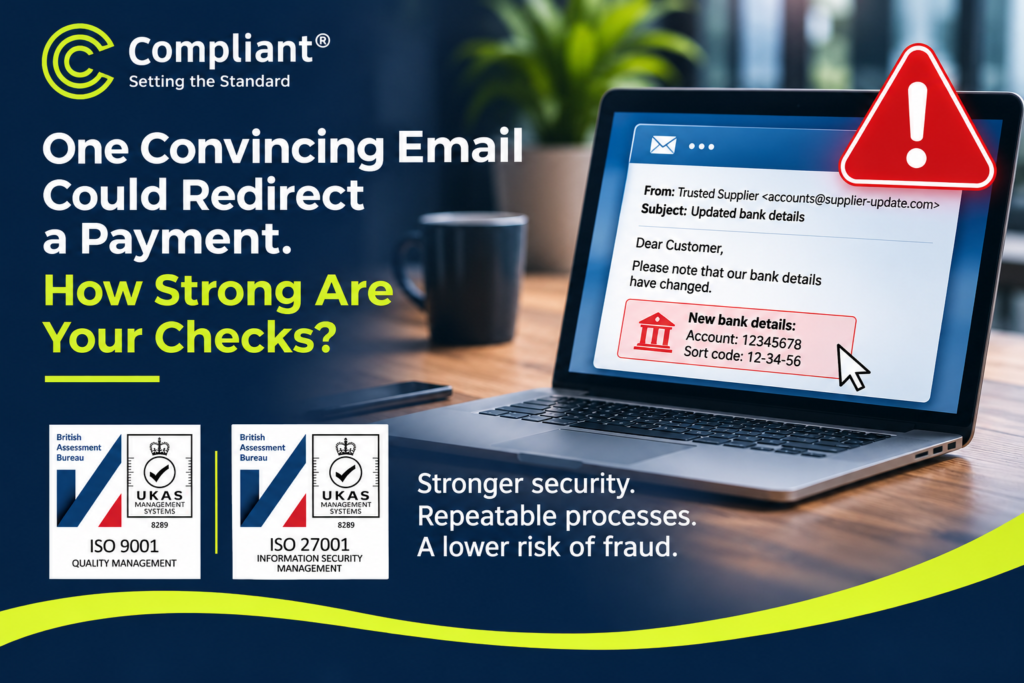
The supplier explains that their bank details have been updated and asks you to use the new account for the next payment.
You have worked with this supplier for years.
Why would you question it?
The invoice is due, the amount is correct and everything appears normal.
So, the payment is made.
A few days later, your supplier contacts you.
They haven’t received the money.
You explain that the invoice was paid using the new bank details they provided.
There is a pause.
Then comes the response nobody wants to hear.
“We haven’t changed our bank details.”
The money has been sent to a fraudster.
And the email that started it all looked completely genuine.
This is the reality of payment diversion fraud, sometimes called invoice fraud or business email compromise.
It can happen to businesses of almost any size.
The consequences can be serious, particularly when large payments are involved.
But the problem is not always a lack of technology.
Sometimes, it is a lack of clear processes.
This is where ISO 27001 and ISO 9001 can work together.
ISO/IEC 27001 focuses on information security management, while ISO 9001 focuses on quality management and consistent processes.
Together, they can help businesses establish stronger controls, improve employee awareness and reduce the likelihood of important checks being missed.
Because protecting your business from fraud is not just about spotting suspicious emails.
It is also about making sure your team knows exactly what to do when one arrives.
Why Payment Diversion Fraud Is Such a Serious Business Risk
Most businesses rely on email to communicate with suppliers, customers and colleagues.
It is quick, convenient and easy to use.
Invoices arrive by email. Payment queries are answered by email. Changes to orders, delivery dates and account information are often discussed through email.
But this convenience also creates opportunities for criminals.
Fraudsters know that businesses make payments every day.
They also know that employees are often working under pressure.
A convincing message sent at the right moment can be enough to encourage someone to act without completing the usual checks.
Payment diversion fraud involves tricking an organisation into sending money to an account controlled by a criminal.
This may happen when someone pretends to be a trusted supplier, customer, senior manager or another person involved in a payment.
The fraudster might use a fake email address that looks similar to a genuine one.
They might gain access to a real email account and send messages from it.
Or they might use information gathered from previous communications to make their request appear believable.
The aim is usually the same.
To convince someone to change payment details or transfer money without recognising that the request is fraudulent.
And once the money has been sent, recovering it can be difficult.
For a small business, losing a significant payment could affect cash flow, supplier relationships and the ability to meet other financial commitments.
For larger organisations, a successful fraud could involve substantial financial losses and create wider operational problems.
The real question is not whether your employees are careful people. It is whether your business has processes that help them make safe decisions, even when they are busy.
Why Fraudulent Emails Can Be So Convincing
Many people imagine fraudulent emails as messages full of spelling mistakes, unusual wording and obvious warning signs.
Some are.
But others are far more difficult to recognise.
A fraudster may spend time learning how a business operates.
They might identify suppliers, review publicly available information or gain access to previous email conversations.
This allows them to create messages that appear relevant and believable.
Imagine receiving an email from a supplier you regularly work with.
The message refers to a genuine invoice.
It includes the correct amount and mentions a recent conversation.
The sender explains that the company has changed banks and provides new payment details.
Nothing about the request seems unusual.
The problem is that familiar information does not prove an email is genuine.
Fraudsters may have obtained those details through a compromised account, stolen information or other sources.
Even a message appearing within an existing email conversation can be fraudulent if an account has been compromised.
This is why businesses should not rely entirely on an employee’s ability to recognise suspicious wording.
They need clear verification processes.
One Small Change Can Lead to a Large Financial Loss
Consider a fictional manufacturing business that purchases materials from several regular suppliers.
One supplier sends an invoice for £18,500.
Shortly before payment is due, the accounts team receives an email requesting a change to the supplier’s bank details.
The email looks genuine.
The employee updates the account information and processes the payment.
A week later, the real supplier asks why the invoice remains unpaid.
The business investigates and discovers that the bank details were changed following a fraudulent request.
The £18,500 has gone to the wrong account.
The company now faces several problems.
The genuine supplier still expects payment.
The accounts team must investigate what happened.
Managers need to contact the bank and report the suspected fraud.
Employees may feel worried or embarrassed.
Other payments may need to be checked in case further fraudulent requests have been received.
The business may also need to consider whether its information security has been compromised.
This example shows why payment fraud can have consequences beyond the original financial loss.
It can disrupt operations, damage relationships and consume valuable management time.
A clear process for verifying changes to bank details could have helped prevent the payment from being redirected.
ISO/IEC 27001: Managing Information Security Risks
ISO/IEC 27001 is an internationally recognised standard for information security management systems.
It provides requirements for establishing, implementing, maintaining and continually improving an information security management system, often called an ISMS.
In simple terms, it helps businesses identify information security risks and establish suitable ways to manage them.
This can include protecting information from unauthorised access, reducing the risk of data loss and making sure important information remains available when needed.
For businesses concerned about email fraud, ISO/IEC 27001 provides a framework for considering relevant risks and controls.
These may include:
- Protecting email accounts from unauthorised access.
- Managing who can access sensitive information.
- Improving employee awareness of security threats.
- Establishing processes for reporting suspicious activity.
- Reviewing supplier-related security risks.
- Monitoring security incidents.
- Managing access when employees change roles or leave.
- Protecting important business records.
The standard does not provide a single solution that prevents every fraudulent email.
Instead, it requires organisations to assess their risks and select appropriate controls.
For example, a business may identify that compromised email accounts could allow criminals to send fraudulent payment instructions.
It might respond by introducing stronger authentication, improving account monitoring and training employees to recognise unusual requests.
Another organisation may identify that too many employees can change supplier payment information.
It might introduce tighter access controls and approval arrangements.
The important point is that security decisions should reflect the risks facing the organisation.
ISO 9001: Why Consistent Processes Matter
ISO 9001 is an internationally recognised standard for quality management systems.
It helps businesses establish processes that support consistent delivery, customer satisfaction and continual improvement.
At first, ISO 9001 might not seem directly connected to payment fraud.
After all, it is a quality management standard rather than a dedicated information security standard.
However, many fraud-related weaknesses involve inconsistent processes, unclear responsibilities or poor communication.
These are areas where quality management principles can provide valuable support.
Imagine a business where different employees follow different procedures when updating supplier records.
One employee checks every change with the supplier.
Another accepts email instructions.
A third asks a manager to approve the change, but only when the payment is particularly large.
The business has no consistent approach.
That creates opportunities for mistakes.
ISO 9001 encourages organisations to define and control relevant processes, assign responsibilities and review how well their arrangements are working.
Where payment administration forms part of the organisation’s managed processes, these principles can support clearer procedures and more reliable checks.
For example, a business might establish a rule that supplier bank details must never be changed based on an email alone.
Employees must independently contact the supplier using a telephone number already held in approved records.
The change must then be recorded and authorised by an appropriate person.
This creates a repeatable process.
It also removes some of the uncertainty employees might otherwise face.
When the process is clear, employees do not have to decide for themselves whether a payment request looks trustworthy enough. They know what checks must happen before any change is made.
How ISO 27001 and ISO 9001 Can Work Together
Information security and quality management are often treated as separate business activities.
But they can support each other.
ISO/IEC 27001 helps organisations identify and manage information security risks.
ISO 9001 helps organisations establish consistent processes, clear responsibilities and continual improvement.
When used together, these approaches can help businesses strengthen the way important activities are managed.
Consider the process for changing supplier bank details.
From an information security perspective, the business needs to consider the risk of fraudulent requests, compromised accounts and unauthorised changes.
From a process management perspective, it needs to make sure employees follow a consistent procedure.
A combined approach might involve identifying the risks, defining the required checks, assigning responsibilities, training employees and reviewing whether the process is working.
The business can also establish arrangements for reporting concerns and investigating problems.
Both standards use a management system approach, which can make it easier for organisations to align relevant activities.
However, neither standard automatically guarantees that a particular payment verification control is in place.
The organisation must identify its needs, assess the risks and establish suitable arrangements.
For businesses seeking certification to both standards, an integrated approach can also help reduce unnecessary duplication.
The Importance of Checking Changes to Bank Details
One of the most useful controls against payment diversion fraud is independent verification.
This means confirming a request through a trusted method that is separate from the message asking for the change.
Imagine receiving an email from a supplier requesting new bank details.
The email includes a telephone number and asks you to call if you have any questions.
It might seem sensible to use that number.
But what if the fraudster has provided it?
You could end up speaking directly to the criminal.
A stronger approach is to use contact information that your business already knows is genuine.
This might be a telephone number held in an approved supplier record or obtained through a previously verified contact route.
The employee should confirm the request with an authorised person before making any changes.
For higher-risk transactions, businesses may also require approval from a second employee.
These checks can be particularly important when a request is unexpected, urgent or involves a significant amount of money.
The process should apply consistently.
Even a long-standing supplier’s account could be compromised.
Trusting a supplier does not remove the need to verify an unusual payment instruction.
Why Urgency Should Never Replace Verification
Fraudsters often try to create pressure.
A message might claim that payment is needed immediately to avoid a delivery delay.
Another might appear to come from a director asking for an urgent transfer.
The sender may insist that the matter is confidential or that there is no time to follow the usual approval process.
These requests are designed to encourage quick action.
In a busy workplace, employees may feel uncomfortable questioning someone who appears to be senior.
They may also worry about causing a delay.
This is why businesses need a culture where employees feel supported when they follow the correct process.
A clear payment policy should explain that verification requirements apply even when a request appears urgent.
Senior managers should support those rules.
If a director asks an employee to bypass the normal checks, it sends the message that the process is optional.
That can weaken the organisation’s controls.
Employees should know that delaying a payment to complete the required verification is preferable to sending money to an unverified account.
Strong leadership is an important part of making security and quality processes work in practice.
Are Your Employees Trained to Recognise Payment Fraud?
A written procedure is only useful if employees understand it.
Businesses should make sure relevant staff know how payment diversion fraud works and what they are expected to do.
This is particularly important for employees working in finance, purchasing, administration and management.
However, other employees may also receive suspicious requests.
For example, a sales employee might receive an email asking them to update customer information.
A manager might receive a message appearing to come from a senior colleague.
A receptionist might be asked to share contact details that help a fraudster target another employee.
Training should reflect the risks associated with each role.
Useful awareness training might explain how fraudulent emails can appear genuine, why changes to payment details need verification and how employees should report concerns.
It should also make clear that employees must not feel embarrassed about asking questions.
People are more likely to report suspicious activity when they know they will be treated fairly.
ISO/IEC 27001 includes requirements relating to competence and awareness.
ISO 9001 also requires organisations to determine and address relevant competence needs within their quality management systems.
Together, these approaches can support structured training arrangements where they are relevant to the organisation’s processes and risks.
Training should not be treated as a one-off activity.
Threats change, employees join and business processes develop.
Regular reviews and suitable refresher training can help keep awareness current.
Who Can Change Supplier Payment Information?
Access to information is another important consideration.
In some businesses, several employees can update supplier records.
That may be necessary for operational reasons.
But organisations should consider whether everyone with access genuinely needs it.
If an employee’s account is compromised, the permissions attached to that account may increase the potential damage.
ISO/IEC 27001 supports the management of access rights as part of information security risk management.
Businesses should consider who can view, change and approve sensitive information.
For example, an organisation might allow certain employees to prepare changes to supplier records while requiring another authorised person to approve them.
It may also maintain records of changes so that unusual activity can be reviewed.
These arrangements should be appropriate to the size and needs of the business.
A small organisation may have fewer employees available to separate responsibilities.
In that situation, management may need to consider alternative checks that provide suitable oversight.
The goal is to reduce the risk of unauthorised or incorrect changes without making everyday work unnecessarily difficult.
Why Email Security Alone Is Not Enough
Technology plays an important role in protecting businesses.
Email filtering, multi-factor authentication, secure account settings and monitoring tools can help reduce information security risks.
But technology cannot replace every business process.
A fraudulent message may still reach an employee.
A genuine supplier account may be compromised.
A criminal may contact the business through another communication channel.
This means employees need reliable processes for handling requests that could affect payments.
Imagine a business invests in advanced email security software.
The system blocks many suspicious messages.
However, the organisation still allows employees to update bank details based solely on emailed instructions.
A fraudulent request that reaches the accounts team could still lead to a loss.
Technology may reduce the likelihood of certain threats, but a clear verification process provides an additional safeguard.
This is one reason why ISO/IEC 27001 and ISO 9001 can complement each other.
Information security controls help manage relevant threats.
Consistent processes help employees respond appropriately when those threats arise.
What Happens When Someone Spots a Suspicious Email?
Businesses should make it easy for employees to report concerns.
Imagine an accounts assistant receives a request to change supplier bank details.
Something about the message does not feel right.
They are unsure whether it is fraudulent, but they decide not to make the change.
What should happen next?
Does the employee know who to contact?
Is there a clear process for reporting the message?
Will the IT team or relevant manager investigate?
Could other employees have received similar requests?
Without a reporting process, the employee might simply delete the message and carry on working.
That could leave other people exposed to the same attempt.
ISO/IEC 27001 supports the establishment of suitable processes for managing information security events and incidents.
These arrangements can help organisations identify concerns, assess what has happened and take appropriate action.
Employees should understand how to report suspicious activity and what information they need to provide.
The business should also consider whether customers, suppliers or other relevant parties need to be informed.
Clear reporting arrangements can help an organisation respond more quickly and consistently.
What If the Payment Has Already Been Sent?
Even businesses with established controls can experience security incidents.
If a payment has been sent to a suspected fraudster, acting quickly is important.
The organisation should contact its bank or payment provider immediately, explain that fraud is suspected and ask what recovery or protective action may be possible.
It should also contact the genuine supplier through a trusted communication method to establish what has happened.
The incident should be reported to the appropriate UK fraud reporting service and, where relevant, the police.
If there is reason to believe an email account or another system has been compromised, the business should take suitable steps to secure it and investigate the incident.
This may involve resetting credentials, reviewing account activity and checking whether other fraudulent messages have been sent.
Businesses should preserve relevant records, including emails, payment details and information about the incident.
They should also assess whether personal data has been affected and whether any data protection reporting duties apply.
The correct response will depend on the circumstances.
Having a documented incident response process can help employees understand what to do during a stressful situation.
ISO/IEC 27001 provides a framework for planning and managing relevant information security incidents.
A well-managed response cannot guarantee that lost money will be recovered.
But it can help the organisation act promptly, coordinate its response and learn from what happened.
Learning From Mistakes Instead of Repeating Them
When something goes wrong, it can be tempting to focus on the person involved.
Who opened the email?
Who changed the bank details?
Who approved the payment?
These questions may help establish what happened, but they should not be the end of the investigation.
Businesses also need to understand why their controls failed.
Was the verification process unclear?
Had the employee received suitable training?
Were responsibilities properly assigned?
Was there pressure to complete payments quickly?
Did the system allow changes without appropriate approval?
ISO 9001 places importance on addressing nonconformities and taking corrective action where necessary.
ISO/IEC 27001 also requires organisations to manage nonconformities and improve their information security management systems.
These principles encourage businesses to look beyond the immediate problem.
The aim is to identify causes and determine what needs to change.
For example, an organisation might discover that its supplier payment procedure is not being followed consistently.
It could respond by simplifying the instructions, providing training and introducing an additional approval step.
The business should then review whether those changes are effective.
Fixing one mistake is useful. Improving the process that allowed it to happen can provide longer-term value.
Why Regular Reviews Matter
Business processes change over time.
New employees join.
Suppliers change.
Payment systems are updated.
Responsibilities move between departments.
A process that worked well two years ago may no longer be suitable.
This is why businesses should regularly review their arrangements.
For payment fraud prevention, a review might consider whether supplier contact details are accurate, whether employees understand verification requirements and whether access permissions remain appropriate.
It could also examine whether incidents or near misses have revealed weaknesses.
Internal audits can help organisations assess whether relevant controls and procedures are being followed.
Under ISO 9001, internal audits examine whether the quality management system meets relevant requirements and is effectively implemented.
Under ISO/IEC 27001, internal audits perform a similar role for the information security management system.
Where the two systems overlap, organisations may be able to coordinate some audit activities.
This can help identify gaps and opportunities for improvement.
The purpose is not simply to prepare for an external certification audit.
It is to understand whether the business’s controls are working in everyday situations.
Strong Processes Can Support Customer and Supplier Confidence
Fraud prevention is often discussed in terms of protecting money.
But reliable processes can also support business relationships.
Customers and suppliers want to work with organisations that manage information and transactions responsibly.
They may expect suitable arrangements for protecting sensitive information, verifying changes and responding to problems.
For businesses competing for larger contracts, information security and quality management may also form part of supplier assessments.
ISO/IEC 27001 certification can help demonstrate that an organisation’s information security management system has been independently assessed against the standard.
ISO 9001 certification can provide similar assurance about the organisation’s quality management system.
However, certification does not guarantee that a business will never experience fraud or that every process will always operate correctly.
Nor does it guarantee a successful tender.
Customers will still consider their own requirements and may carry out additional checks.
The value of these standards is that they provide recognised frameworks for managing risks, processes and continual improvement.
For organisations seeking to demonstrate a structured approach to business management, this can be useful evidence.
Five Questions Every Business Should Ask About Payment Fraud
Before assuming your organisation is protected, consider how your team would answer these questions.
1. What Happens When a Supplier Changes Bank Details?
Is there a clear verification process?
Do employees independently confirm changes using trusted contact information?
Or can someone update the details based on an email alone?
2. Who Can Approve Payment Changes?
Are responsibilities clearly assigned?
Do employees understand which changes require additional approval?
Can sensitive records be updated without suitable oversight?
3. Do Employees Know How to Report Suspicious Requests?
Is there a simple reporting process?
Do employees know who to contact?
Are they encouraged to raise concerns without fear of blame?
4. Are Your Processes Followed Consistently?
Does everyone use the same verification procedure?
Are new employees trained?
Do managers support the rules even when payments are urgent?
5. When Did You Last Review Your Controls?
Have payment processes changed?
Are supplier records up to date?
Have previous incidents or near misses highlighted weaknesses?
These questions can help businesses identify areas that deserve attention.
They also provide a useful starting point for reviewing how information security and quality management processes work together.
How Compliant Ltd Can Support Your ISO 27001 and ISO 9001 Journey
Understanding the requirements of ISO standards can feel challenging, particularly when you are already managing the everyday demands of running a business.
You may recognise that your organisation needs stronger security arrangements but be unsure where to begin.
Perhaps you already have policies and procedures in place, but you do not know whether they meet the requirements of ISO/IEC 27001 or ISO 9001.
Or you may be preparing for certification and want support developing management systems that work in practice.
At Compliant Ltd, we help organisations understand ISO requirements and develop practical management systems suited to their business needs.
Our consultants can support businesses working towards ISO/IEC 27001 and ISO 9001 certification.
Understanding Your Existing Arrangements
Many businesses already have useful security and quality processes in place.
The challenge is often making sure those arrangements are clear, consistent and suitable for the organisation.
Compliant Ltd can help you review your existing management systems and identify areas where improvements may be needed.
This provides a practical starting point without introducing unnecessary changes to processes that already work well.
Developing Clear Policies and Procedures
Strong management systems need processes that employees can understand and follow.
We can help you develop relevant policies, procedures and documented information to support your ISO journey.
For organisations managing information security risks, this may include helping you understand how the standard’s requirements relate to access management, risk assessment, incident handling and employee awareness.
For quality management, support may focus on process consistency, responsibilities, monitoring and continual improvement.
The aim is to establish systems that support your business rather than create paperwork for its own sake.
Preparing for ISO Certification
If your organisation is working towards ISO/IEC 27001 or ISO 9001 certification, Compliant Ltd can help you understand the requirements and prepare for external assessment.
Our consultancy support can help you identify gaps, develop your management systems and approach the certification process with greater confidence.
Certification decisions are made by the independent certification body.
Our role is to provide practical guidance and support throughout your preparation.
Supporting Ongoing Improvement
Achieving certification is not the end of the process.
Your business will continue to change.
New threats may emerge, employees will join and processes may need updating.
Compliant Ltd can provide ongoing management system support to help your organisation review its arrangements and maintain a structured approach to improvement.
One Email Should Not Be Able to Bypass Your Business Controls
Payment diversion fraud can begin with something as ordinary as an email.
A familiar supplier name.
A genuine-looking invoice.
A request to update bank details.
A message that appears to need urgent attention.
In a busy workplace, it can be easy to assume everything is correct.
But when large payments are involved, assumptions can be expensive.
Businesses need more than employees who know how to spot suspicious messages.
They need clear processes that help people verify requests, understand their responsibilities and respond when something does not seem right.
ISO/IEC 27001 provides a framework for managing information security risks.
ISO 9001 provides a framework for establishing consistent processes and improving how an organisation works.
Together, they can support a more structured approach to protecting important information and managing business activities.
They cannot remove every risk.
But they can help businesses identify weaknesses, establish suitable controls and improve how those controls are managed.
And that matters because fraud prevention should not depend on whether one employee happens to notice something unusual.
It should be supported by processes that make the right checks part of everyday business.
Are Your Security and Payment Processes Strong Enough?
If a convincing email arrived in your accounts team’s inbox tomorrow, what would happen?
Would your employees know how to verify the request?
Would they understand who needs to approve a change?
And would your business have a clear process for reporting concerns?
If you are unsure, now could be the right time to review your arrangements.
You do not need to wait until a fraudulent payment or security incident exposes a weakness.
Taking action early can help you identify risks and develop stronger processes.
Whether your organisation is considering ISO/IEC 27001, ISO 9001 or both standards, Compliant Ltd can support you.
Our consultants help businesses understand certification requirements, develop practical management systems and prepare for external audits.
We focus on clear advice and processes that suit the way your business operates.
One convincing email could redirect a payment. Make sure your business has the right checks in place before it happens.
Speak to Compliant Ltd about your ISO 27001 and ISO 9001 certification plans and discover how our consultancy support can help you strengthen information security and improve process consistency.