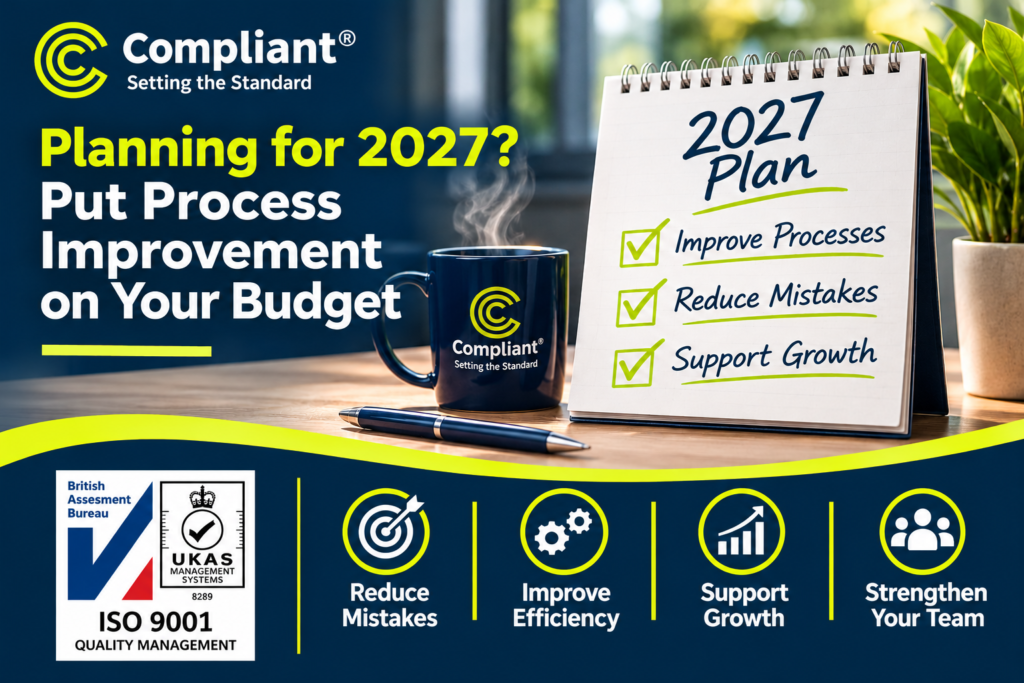
Planning for 2027? Put Process Improvement on Your Budget
 It’s that time of year again.
Businesses are reviewing their finances, setting targets and deciding where to invest in 2027.
Perhaps you’re planning to employ more people.
You might be considering new equipment, updated technology or moving into a larger premises.
Maybe you’re hoping to win bigger contracts, increase sales or expand into new markets.
All these plans are exciting.
But there’s one question that often gets overlooked.
Are the processes behind your business ready to support those plans?
It’s easy to focus on what you want your business to achieve next year.
More customers.
More contracts.
More revenue.
A bigger team.
But what happens if your existing processes are already struggling?
What if employees are spending hours correcting mistakes?
What if customer complaints keep coming back to the same problems?
What if important information is difficult to find, responsibilities are unclear or different employees follow different ways of working?
Growth can make these problems worse.
And the costs are not always obvious.
A mistake might take an employee two hours to correct.
A delayed order could require several phone calls and extra administration.
A customer complaint may involve management time, replacement products or additional work.
Individually, these issues might seem small.
But over a year, they can add up.
If you’re planning to invest in growing your business in 2027, it makes sense to invest in improving how that business operates, too.
This is where ISO 9001 can help.
ISO 9001 is an internationally recognised standard for quality management systems.
It provides a framework for businesses to manage their processes, improve consistency, understand customer requirements and continually improve.
At Compliant Ltd, we support organisations working towards ISO 9001 certification and those looking to improve their existing quality management systems.
And as businesses prepare their plans for 2027, now is a useful time to consider whether process improvement should be part of the budget.
Why Process Improvement Is Often Missing From Business Budgets
When businesses prepare annual budgets, some costs are easy to identify.
Rent needs paying.
Employees need salaries.
Equipment may need replacing.
Marketing needs funding.
Technology subscriptions need renewing.
These expenses are visible and usually have clear amounts attached to them.
Process improvement can be different.
It may not appear as a single invoice or an obvious monthly cost.
Instead, the consequences of poor processes are often spread across the business.
An employee spends extra time searching for information.
A manager repeatedly answers the same questions.
A customer receives an incorrect order.
A supplier issue causes unnecessary delays.
A task has to be completed twice because the instructions were unclear.
Each problem uses time and resources.
But unless the business measures these issues, it may never understand their full impact.
This is why process improvement deserves attention during budget planning.
Rather than simply accepting inefficiencies as part of everyday business, organisations can identify where improvements may provide value.
That does not mean every business needs to spend large amounts of money.
Sometimes, a clearer procedure or better communication can make a meaningful difference.
The important thing is recognising that improving processes requires time, attention and suitable resources.
What Is ISO 9001?
ISO 9001 is the international standard for quality management systems.
It provides requirements for organisations that want to demonstrate their ability to consistently provide products and services that meet customer and applicable legal and regulatory requirements.
It also supports customer satisfaction and continual improvement.
In simple terms, ISO 9001 helps businesses establish more consistent ways of working.
It encourages organisations to understand their processes, assign responsibilities, manage risks and opportunities, monitor performance and address problems.
The standard can be applied to businesses of different sizes and sectors.
A small consultancy may use ISO 9001 to improve how customer enquiries and projects are managed.
A manufacturer may focus on production controls, inspections and reducing defects.
A construction company may use its quality management system to improve project planning, supplier management and record keeping.
Although these businesses operate differently, they can all benefit from understanding how their processes work.
ISO 9001 does not tell every organisation to follow identical procedures.
Instead, it provides a framework that can be applied according to the nature and needs of the business.
For organisations planning process improvement for 2027, this can provide a useful starting point.
The Hidden Cost of Getting Things Wrong
Most businesses know that mistakes cost money.
But how often do they calculate the true cost?
Imagine a manufacturing company produces an order of components.
During final inspection, employees discover that several items do not meet the required specification.
The business now needs to investigate what happened.
Some components may need reworking.
Others may need replacing.
Production time has already been used.
Additional materials may be required.
And the customer may need to be informed about a delay.
The cost is not simply the value of the rejected components.
It may also include employee time, equipment use, administration and disruption to other work.
Now imagine similar problems happen several times throughout the year.
Even relatively small errors can become expensive when repeated.
ISO 9001 encourages organisations to identify nonconformities, take suitable corrective action and evaluate whether those actions have been effective.
This helps businesses look beyond the immediate mistake.
Instead of simply fixing the problem, they can investigate why it happened.
Was the process unclear?
Did employees have the correct information?
Was equipment suitable?
Were responsibilities properly assigned?
Understanding the cause can help reduce the likelihood of the same issue happening again.
The goal is not to create a business where nobody ever makes a mistake. It is to build processes that help prevent avoidable errors and support learning when things go wrong.
How Much Time Is Your Business Losing?
Time is one of the most valuable resources a business has.
But wasted time can be difficult to notice.
Consider an office where employees regularly search for documents.
One person saves files on their computer.
Another uses a shared drive.
Someone else keeps information in emails.
When a customer asks for an update, employees spend time trying to find the correct information.
Perhaps each employee loses only fifteen minutes a day.
That may not seem significant.
But across a team of twenty people, fifteen minutes each represents five hours of working time every day.
Over a working year, that can become a substantial amount of time.
This is an illustrative calculation, not a prediction of savings.
Actual benefits would depend on the organisation and the improvements made.
However, it shows why small inefficiencies deserve attention.
ISO 9001 encourages businesses to understand the information needed to support their processes and establish suitable arrangements for controlling documented information.
For some organisations, this may involve improving document storage.
Others may need clearer responsibilities or better communication between departments.
The aim is to make everyday work more consistent and manageable.
Why Growth Can Expose Weak Processes
A business may operate successfully with a small team and informal arrangements.
Employees know each other.
Information is shared through conversations.
The owner makes most decisions.
Problems are often solved quickly because everyone understands how the business works.
But what happens when the company grows?
New employees join.
Departments expand.
More customers need attention.
The volume of work increases.
Suddenly, informal processes may no longer be enough.
Imagine a business grows from eight employees to thirty.
When the team was small, everyone knew how customer orders were handled.
Now different employees follow different methods.
Some record information in one system.
Others use spreadsheets.
A few rely on emails.
Mistakes become more common because the process is no longer consistent.
This is where ISO 9001 can provide value.
It encourages businesses to identify their processes, understand how they interact and establish suitable controls.
For growing organisations, this can help create a clearer structure.
Employees know what is expected.
Responsibilities become easier to understand.
And managers have better information for reviewing performance.
If business growth is part of your 2027 plan, reviewing your processes before that growth happens could be a sensible investment.
Your 2027 Budget Should Include the Cost of Doing Nothing
When considering process improvement, businesses often focus on the cost of making changes.
How much will consultancy support cost?
Will employees need training?
Do we need new software?
How much time will the project take?
These are reasonable questions.
But there is another cost worth considering.
What happens if nothing changes?
Imagine a business has a recurring problem with customer orders.
Every month, several orders require correction.
Employees have become used to dealing with the issue.
Managers see it as frustrating but unavoidable.
The business is now preparing to increase sales.
If the same error rate continues while order volumes grow, the number of problems may increase.
The company could end up spending more time correcting mistakes rather than serving new customers.
Before investing in growth, it may be worth addressing the process that is causing the problem.
This does not mean every improvement will produce immediate financial savings.
Some benefits may involve better consistency, clearer responsibilities or improved customer satisfaction.
However, understanding the potential cost of leaving a problem unresolved can help businesses make more informed budget decisions.
How ISO 9001 Supports Better Business Efficiency
Efficiency is often described as doing more with less.
But for many businesses, the real opportunity is reducing unnecessary work.
Think about how often tasks are repeated because something was not completed correctly the first time.
A customer has to provide the same information twice.
An employee needs to correct a document.
A manager reviews work that should already have been checked.
A delivery is delayed because information was missing.
These problems can affect productivity.
ISO 9001 encourages organisations to take a process-based approach.
This means understanding the activities needed to deliver products or services and how those activities connect.
For example, a business might review its order management process.
It could identify where information enters the system, who checks it and how it moves between departments.
The organisation may discover that errors often happen when orders are passed from sales to operations.
A clearer handover process could help reduce mistakes.
The business can then monitor whether the change has improved performance.
This is the value of structured process improvement.
Rather than guessing where problems exist, organisations can use information to identify and address them.
Process Improvement Does Not Always Mean New Technology
When businesses think about efficiency, technology is often the first solution that comes to mind.
New software.
Automated systems.
Digital forms.
Updated equipment.
Technology can provide valuable benefits.
But it is not always the answer.
Sometimes, the problem is the process itself.
Imagine a company invests in a new customer management system.
The software is modern and offers several useful features.
However, employees still do not understand who is responsible for updating customer information.
Some records are incomplete.
Others contain duplicate details.
The new technology may make the work faster, but it has not solved the underlying problem.
Before investing in new systems, businesses should understand how their existing processes operate.
ISO 9001 encourages organisations to consider the resources needed to support their quality management systems.
This can include people, infrastructure, the working environment and organisational knowledge.
The right improvement might involve technology.
But it could also involve training, clearer instructions or better communication.
For businesses preparing their 2027 budgets, understanding the problem before choosing the solution can help avoid unnecessary spending.
Why Internal Audits Deserve a Place in Your Improvement Plan
Internal audits are sometimes viewed as something businesses complete because a standard requires them.
But they can provide useful information about how an organisation operates.
ISO 9001 requires businesses to conduct internal audits at planned intervals.
These audits help determine whether the quality management system meets relevant requirements and is effectively implemented and maintained.
For example, an internal audit might identify that employees are following different versions of a procedure.
It could reveal that training records are incomplete.
Or it may show that a process has changed but the supporting documentation has not been updated.
These findings are not simply problems to record.
They provide opportunities for improvement.
A business can investigate why the issue exists and determine what action is needed.
It can then review whether the changes have worked.
For organisations planning process improvement for 2027, internal audit findings can help identify priorities.
Instead of choosing improvement projects based entirely on assumptions, managers can use evidence from their own operations.
This can make budget decisions more focused.
Management Reviews: Are You Using Them to Plan Ahead?
Management reviews are another important part of ISO 9001.
The standard requires top management to review the quality management system at planned intervals.
The purpose is to ensure the system remains suitable, adequate, effective and aligned with the organisation’s strategic direction.
In practical terms, management reviews provide an opportunity to look at how the business is performing.
This may include reviewing customer feedback, quality objectives, audit results, process performance, nonconformities and opportunities for improvement.
For businesses preparing their 2027 plans, this information can be particularly valuable.
Imagine a management review identifies that customer complaints have increased.
The business investigates and discovers that delays are linked to unclear responsibilities between departments.
Rather than simply setting a target to reduce complaints, managers can consider what resources are needed to improve the process.
Perhaps employees need training.
Maybe the handover procedure needs reviewing.
Or the business may need better information about workload and capacity.
The management review can help turn these findings into planned actions.
It also provides an opportunity to consider whether the quality management system needs to change as the business grows.
Customer Complaints Can Reveal Improvement Opportunities
Nobody enjoys receiving a customer complaint.
But complaints can provide valuable information.
A customer may identify a problem that employees have become used to.
Perhaps delivery dates are not being communicated clearly.
Maybe invoices regularly contain incorrect information.
Or customers find it difficult to get updates about their orders.
These issues may appear small from inside the business.
But they can have a significant effect on the customer experience.
ISO 9001 places importance on understanding customer requirements and monitoring customer satisfaction.
Businesses should consider relevant feedback and use it to identify opportunities for improvement.
For example, a company might notice that several customers have complained about delays in responding to enquiries.
It could review how messages are received, assigned and answered.
The business may discover that nobody has clear responsibility for monitoring a shared inbox.
A simple change to responsibilities could improve the process.
For 2027, businesses may benefit from reviewing customer feedback before deciding where to invest.
The most valuable improvement may not always be the most expensive one.
Why Employee Involvement Matters
Employees often understand the problems within business processes better than anyone.
They use the systems every day.
They know where delays occur.
They recognise when instructions are unclear.
And they may already have ideas about how things could work better.
Yet businesses sometimes make improvement decisions without asking the people who carry out the work.
Imagine a company introduces a new procedure to improve efficiency.
Managers believe the process will save time.
But employees quickly discover that it creates additional administration.
If nobody asks for their feedback, the business may continue using a process that is not delivering the expected benefits.
ISO 9001 places importance on competence, awareness and communication.
It also encourages organisations to establish an environment that supports the effective operation of processes.
Involving employees in improvement activities can help businesses understand practical challenges.
It may also make changes easier to introduce.
For organisations planning improvement projects in 2027, employee feedback can be a useful source of information.
Sometimes, the people closest to the work already know where the biggest problems are.
Building Process Improvement Into Your 2027 Budget
Process improvement does not need to be treated as one large project.
Businesses can take a planned approach based on their needs and available resources.
A useful starting point is identifying the areas where problems are most common or where improvements could provide the greatest value.
For example, a business might review:
- Customer complaints and recurring issues.
- Time spent correcting mistakes.
- Delays between departments.
- Training and competence gaps.
- Internal audit findings.
- Supplier performance.
- Management review actions.
- Processes that may struggle as the business grows.
Once priorities have been identified, the organisation can consider what resources are needed.
Some improvements may require consultancy support.
Others may involve employee training, updated equipment or changes to existing procedures.
The business should also consider how progress will be measured.
Without suitable measures, it can be difficult to know whether an improvement has worked.
For example, if the aim is to reduce order errors, the organisation could monitor the number of errors before and after introducing changes.
If the goal is to improve customer response times, it could review how quickly enquiries are handled.
The measures should be relevant and proportionate.
The aim is to understand whether the investment is providing value.
A Practical Example: The Growing Construction Company
Consider a fictional construction company preparing for a busy 2027.
The business has secured several new opportunities and expects to increase its workforce.
However, managers have noticed recurring problems with project documentation.
Different teams use different forms.
Important information is sometimes missing.
And employees spend time correcting records before customer reviews.
The company initially considers purchasing new software.
But before making the investment, it reviews its existing processes.
The review identifies that the main problem is inconsistent documentation requirements.
Employees have not been given clear instructions about which records are needed.
The business decides to standardise its processes, provide training and establish clearer responsibilities.
It also introduces regular checks to identify missing information earlier.
The company may still decide that new software would be useful.
But it now understands what the system needs to support.
This is an example of how planned process improvement can help businesses make more informed decisions.
Rather than investing in a solution before understanding the problem, the organisation uses a structured approach.
A Practical Example: The Manufacturer Losing Time to Rework
Now consider a fictional manufacturer.
The company produces specialist components for several customers.
It has experienced employees and modern equipment.
However, a growing number of products require rework.
Managers initially believe the problem is linked to production speed.
An internal review reveals something different.
Employees are sometimes working from outdated specifications.
Changes are communicated by email, but there is no consistent process for confirming that the latest information has reached production.
The company introduces clearer document control arrangements.
It also establishes responsibilities for reviewing and approving changes.
Employees receive training on the updated process.
The business then monitors rework levels to understand whether the changes are effective.
This type of improvement reflects the principles of ISO 9001.
The focus is not simply on correcting individual mistakes.
It is on improving the process that allowed those mistakes to happen.
For businesses preparing their 2027 budgets, identifying these recurring issues can help highlight where improvement resources may be most useful.
A Practical Example: The Service Business Preparing to Grow
Consider a professional services company planning to recruit several new employees.
The business has grown through strong customer relationships.
However, many of its processes depend on the knowledge of a few experienced team members.
New employees often need to ask the same questions.
Customer information is stored in different locations.
And managers spend time checking routine work.
The company recognises that these arrangements may become more difficult as the team expands.
It decides to review its quality management processes before recruitment begins.
The business establishes clearer procedures, identifies training needs and improves how important information is maintained.
This gives new employees a more consistent starting point.
It also reduces the organisation’s dependence on informal knowledge.
The improvements do not guarantee successful growth.
But they can help the business prepare for increased activity.
Should You Consider ISO 9001 Certification in 2027?
Not every business needs ISO 9001 certification.
However, it may be relevant for organisations that want to establish a recognised quality management system or respond to customer and tender requirements.
Some customers may request ISO 9001 certification as part of their supplier assessment process.
Others may view it as useful evidence of a structured approach to quality management.
For businesses planning to enter new markets or compete for larger contracts, understanding these expectations can be important.
Certification involves an independent certification body assessing the organisation’s quality management system against ISO 9001.
Where certification is achieved, it demonstrates that the management system has been assessed as meeting the relevant requirements within its stated scope.
However, certification does not guarantee that a business will never make mistakes.
It does not automatically lead to higher profits.
And it does not guarantee that an organisation will win a contract.
The value comes from establishing and maintaining a management system that supports the business.
For organisations considering certification in 2027, early planning can help make the process more manageable.
Why Waiting Until the Last Minute Can Create Problems
Imagine a business discovers that an important customer expects ISO 9001 certification.
The contract opportunity is approaching, and the company has limited time to prepare.
Managers begin gathering documents.
Employees need training.
Processes require reviewing.
Internal audits and management reviews must be planned and carried out.
Suddenly, certification preparation becomes another urgent task.
This can create unnecessary pressure.
Businesses may benefit from considering their certification plans well before a deadline.
Early preparation provides time to understand the requirements, review existing arrangements and identify gaps.
It also allows organisations to develop processes that reflect how they operate.
At Compliant Ltd, we support businesses at different stages of their ISO 9001 journey.
Some customers are working towards certification for the first time.
Others already hold certification and want to improve their management systems.
Planning ahead can help organisations make better use of consultancy support and internal resources.
Five Questions to Ask Before Finalising Your 2027 Budget
Before deciding where your business will invest next year, consider these questions.
1. Where Are We Losing the Most Time?
Are employees regularly correcting mistakes?
Do processes involve unnecessary duplication?
Could clearer responsibilities or better information improve efficiency?
2. Which Problems Keep Coming Back?
Have customer complaints revealed recurring issues?
Are internal audits identifying the same weaknesses?
Do managers spend time dealing with problems that should have been resolved?
3. Are Our Processes Ready for Growth?
Will existing arrangements work if customer demand increases?
Can new employees understand how work should be completed?
Are important processes dependent on a small number of people?
4. Are We Using Our Management Reviews Effectively?
Do management reviews help identify priorities?
Are improvement actions assigned and followed up?
Does the information influence business planning?
5. Have We Budgeted for Improvement?
Have you considered the resources needed to review and improve processes?
Could early consultancy support help identify gaps?
And are your ISO certification plans included in your wider business budget?
These questions can help businesses identify where process improvement deserves attention.
How Compliant Ltd Can Support Your 2027 Improvement Plans
Planning business improvements can feel difficult when everyday operations already demand so much attention.
You may know that certain processes need reviewing but struggle to find the time.
Perhaps your business has grown quickly, and existing arrangements no longer work as well as they once did.
Or you may be considering ISO 9001 certification and want to understand what preparation involves.
At Compliant Ltd, we provide ISO certification and management system consultancy support to businesses across different sectors.
Our consultants help organisations understand ISO 9001 requirements and develop practical quality management systems.
Reviewing Your Existing Quality Management System
Many businesses already have useful processes in place.
They may have clear customer communication arrangements, suitable quality checks and established ways of managing work.
The challenge is often understanding whether those processes are consistent and meet the relevant requirements.
Compliant Ltd can help review existing arrangements and identify areas where improvement may be needed.
This provides a starting point for planning practical changes.
Identifying Process Improvement Opportunities
A quality management system should support the way your business operates.
Our consultants can help you understand how ISO 9001 requirements relate to your processes and improvement objectives.
This may include reviewing responsibilities, documented information, performance monitoring and corrective action arrangements.
The aim is to help you develop a management system that provides value beyond the certification audit.
Supporting Internal Audits and Management Reviews
Internal audits and management reviews are important parts of maintaining an effective quality management system.
Compliant Ltd can provide consultancy support to help businesses understand these requirements and prepare suitable arrangements.
This can support more structured reviews of performance and improvement opportunities.
For organisations planning changes in 2027, these activities can also provide useful information for setting priorities.
Preparing for ISO 9001 Certification
If your organisation is considering ISO 9001 certification, Compliant Ltd can support you through the preparation process.
Our consultants can help you understand the requirements, identify gaps and develop suitable management system arrangements.
We can also support your preparation for external certification audits.
Certification decisions are made by the independent certification body.
Our role is to provide practical guidance and support as your organisation works towards meeting the standard.
Ongoing Quality Management Support
Achieving certification is not the end of the process.
Businesses change, and management systems need to remain suitable.
Compliant Ltd can provide ongoing consultancy support to help organisations maintain and improve their quality management systems.
This can be particularly useful for businesses planning growth, introducing new services or reviewing existing processes.
Make Process Improvement Part of Your Business Strategy
It is easy to treat process improvement as something to consider when problems become serious.
A customer complains.
An audit identifies a weakness.
A costly mistake causes disruption.
Only then does the business decide that something needs to change.
But process improvement can be more effective when it forms part of normal business planning.
Rather than waiting for problems to become urgent, organisations can review their processes and identify opportunities for improvement.
ISO 9001 provides a framework to support this approach.
It encourages businesses to monitor performance, address nonconformities and continually improve their quality management systems.
For 2027, this could mean setting aside time to review important processes.
It might involve improving employee training.
Or it could mean investing in consultancy support to help develop a more structured management system.
The right approach will depend on the organisation.
What matters is recognising that process improvement deserves attention alongside other business priorities.
Planning for 2027? Don’t Forget the Processes Behind Your Growth
As you prepare your business budget for 2027, it is natural to focus on the opportunities ahead.
New customers.
New employees.
New equipment.
New contracts.
But those plans depend on the processes that support everyday operations.
If those processes are unclear, inconsistent or inefficient, growth may create additional pressure.
Employees could spend more time correcting mistakes.
Managers may struggle to maintain oversight.
And customers could experience delays or inconsistent service.
Investing in process improvement can help businesses address these challenges.
ISO 9001 provides a recognised framework for understanding processes, managing quality and supporting continual improvement.
It does not promise instant savings or guaranteed growth.
But it can help organisations take a more structured approach to improving how they work.
Your 2027 budget should not only focus on what your business wants to achieve. It should also consider what needs to improve to help you get there.
Ready to Put ISO 9001 and Process Improvement on Your 2027 Agenda?
If your business is planning for growth, reviewing its management systems or considering ISO 9001 certification, now could be the right time to start the conversation.
You do not need to wait until mistakes become expensive or an important tender creates an urgent certification deadline.
Early planning can help you understand your requirements, identify improvement opportunities and make informed decisions about where to invest.
At Compliant Ltd, we support businesses working towards ISO 9001 certification and those looking to improve their existing quality management systems.
Our consultants provide practical advice, helping organisations understand the standard and develop processes suited to their activities.
Whether you are preparing for your first certification, planning an internal review or looking for ongoing quality management support, our team is here to help.
Make 2027 the year you invest not just in growing your business, but in improving the processes that keep it running.
Speak to Compliant Ltd about your ISO 9001 certification and process improvement plans for 2027.
Let’s discuss how our consultancy support can help your business prepare for the year ahead.