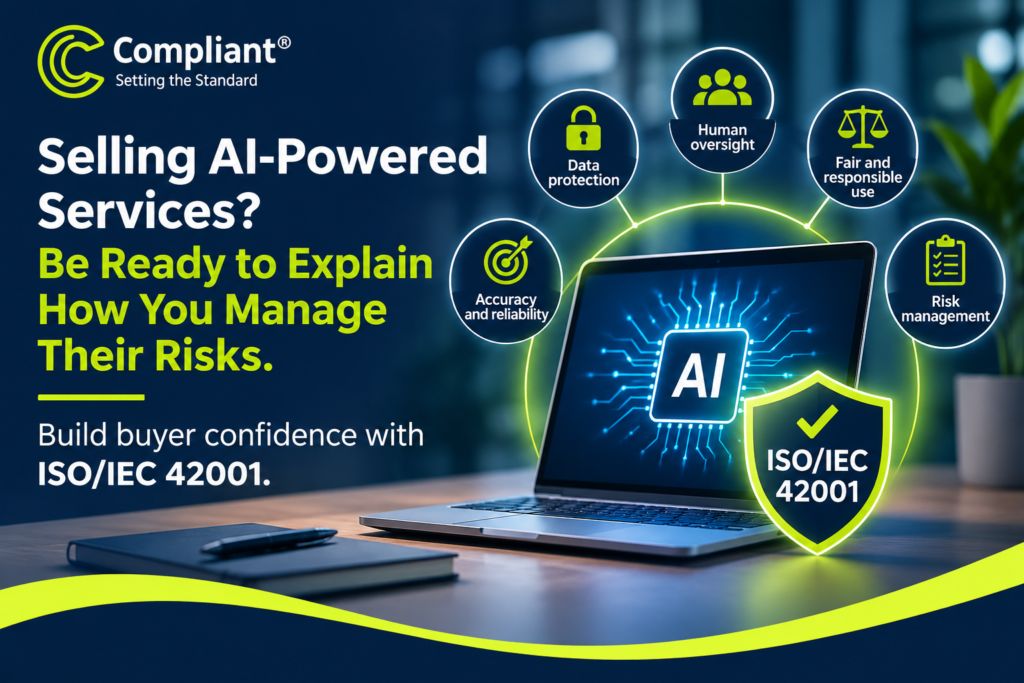
Selling AI-Powered Services? Be Ready to Explain How You Manage Their Risks
 Artificial intelligence is changing the way businesses work.
From customer service chatbots and automated reports to recruitment tools and software that helps businesses make decisions, AI-powered services are becoming part of everyday business life.
For companies developing or selling these services, the opportunities can be exciting.
AI can help reduce repetitive tasks, improve efficiency and create new ways to support customers.
But there is another side to the conversation.
What happens when a potential customer asks how you manage the risks associated with your AI-powered service?
Can you explain what information your AI system uses?
Do you know how its outputs are checked?
Who takes responsibility when something goes wrong?
And what safeguards are in place to protect customers from errors, unfair outcomes or inappropriate use of information?
These are questions businesses should be ready to answer.
A potential customer might be impressed by what your AI-powered service can do. But before signing a contract, they may want reassurance that the technology is being managed responsibly.
This is where ISO/IEC 42001 can help.
ISO/IEC 42001 is an international standard for artificial intelligence management systems. It provides a framework that helps organisations manage AI-related risks and opportunities through clear responsibilities, policies, processes and continual improvement.
For businesses selling AI-powered services, it can also provide a structured way to demonstrate how AI governance is managed.
Because when customers are deciding whether to trust your technology, explaining how you manage its risks can be just as important as explaining its benefits.
AI Is Creating Opportunities, But Buyers Have Questions
It is easy to understand why businesses are interested in AI.
An AI-powered customer service system might help answer common questions more quickly.
A software provider might use AI to analyse large amounts of information.
A recruitment company might introduce AI tools to help organise applications.
A financial services business might use AI to support the review of documents or identify unusual patterns.
These tools can offer real benefits when they are suitable for their intended purpose and managed effectively.
However, customers also need to understand the possible risks.
Imagine a business is considering purchasing an AI-powered recruitment platform.
The supplier explains that the system can review applications and help identify candidates who meet certain requirements.
That sounds useful.
But the customer asks whether the system could produce unfair results.
They want to know how personal information is handled, whether people can review decisions and what happens if the system makes a mistake.
These are reasonable questions.
The supplier may have developed an impressive product, but if it cannot explain how these issues are managed, the buyer may hesitate.
A useful AI product is not automatically a well-governed AI product.
Customers need to understand both what the technology can do and how the organisation manages the risks that come with it.
For businesses selling AI-powered services, this means governance should be part of the conversation from the beginning.
What Is ISO/IEC 42001?
ISO/IEC 42001 is an international standard that sets out requirements for establishing, implementing, maintaining and continually improving an artificial intelligence management system.
In simple terms, it helps organisations put a structured approach around the way they develop, provide or use AI.
The standard recognises that AI can create opportunities, but it can also introduce risks that need careful management.
These risks may involve inaccurate outputs, unfair treatment, privacy concerns, security weaknesses, unclear responsibilities or unintended effects on people.
ISO/IEC 42001 helps organisations consider these issues and establish suitable ways to manage them.
It covers areas such as:
- Leadership and responsibility for AI.
- AI policies and objectives.
- Understanding AI-related risks and opportunities.
- Assessing the possible impacts of AI systems.
- Managing resources and information.
- Defining roles and responsibilities.
- Monitoring AI system performance.
- Managing suppliers and other relevant parties.
- Reviewing processes and making improvements.
The standard is designed to work across different types of organisations.
It can be relevant to businesses developing AI systems, providing AI-powered services or using AI within their own operations.
The exact requirements and controls that apply will depend on the organisation’s activities, the AI systems involved and the risks identified.
For businesses selling AI-powered services, ISO/IEC 42001 can help turn broad promises about responsible AI into a more organised and measurable approach.
Why AI Governance Matters to Potential Customers
When a customer buys a traditional product or service, they usually want to understand what they are getting.
They might ask about quality, reliability, delivery times and customer support.
With AI-powered services, there may be additional questions.
How does the system reach its outputs?
What happens if the information it produces is wrong?
Can a person intervene when needed?
How is customer information protected?
Does the supplier understand the limitations of its technology?
These questions are particularly important when AI is used to support decisions that could affect people, finances, services or business operations.
A customer may be placing significant trust in your organisation.
They need confidence that you understand the technology you are selling and have considered the possible consequences of its use.
This is why AI governance and buyer confidence are closely connected.
Good governance helps businesses explain who is responsible, how risks are assessed and what controls are in place.
It also supports more informed conversations with customers.
Rather than simply saying that your AI system is safe or reliable, you can explain the processes used to assess and manage its risks.
That is a much stronger starting point for building trust.
Can You Explain Who Is Responsible for Your AI Systems?
One of the first questions any organisation should consider is responsibility.
Who is accountable for the AI systems your business develops or provides?
Is it the software development team?
The IT manager?
The operations director?
Or does everyone assume somebody else is dealing with it?
When responsibilities are unclear, important activities can be missed.
Imagine an AI-powered service begins producing unexpected results.
The customer contacts your support team.
The support team refers the issue to the developers.
The developers believe the problem relates to how the customer is using the system.
Meanwhile, nobody is clearly responsible for coordinating the investigation or keeping the customer informed.
The issue becomes more difficult to manage because responsibilities were not properly defined.
ISO/IEC 42001 encourages organisations to establish and communicate relevant responsibilities and authorities.
This can help make sure people understand their role in managing AI.
For example, a business may need clear arrangements for approving AI systems, assessing risks, reviewing performance, responding to incidents and communicating with customers.
Not every organisation needs a large AI governance department.
Smaller businesses can establish arrangements that suit their size and activities.
What matters is that responsibilities are understood and appropriate action can be taken when needed.
What Happens When AI Gets Something Wrong?
AI systems can produce useful results.
They can also make mistakes.
An AI chatbot might give a customer incorrect information.
An automated reporting tool might generate an inaccurate summary.
An AI system used to support business decisions might produce an output based on incomplete or unsuitable information.
These problems can have different consequences depending on how the technology is being used.
An incorrect answer to a simple question may cause inconvenience.
An inaccurate output used in an important business decision could have much more serious effects.
This is why organisations need to understand the limitations of their AI systems.
ISO/IEC 42001 supports a structured approach to identifying and managing AI-related risks.
Businesses should consider what could go wrong, how serious the consequences might be and what measures are needed to manage those risks.
This might include testing systems before they are introduced, checking outputs, monitoring performance and establishing processes for reporting problems.
It may also involve deciding when human review is necessary.
The aim is not to suggest that every AI mistake can be prevented.
It is to make sure risks are understood and managed in a way that reflects how the system is being used.
For customers, knowing that a supplier has considered these issues can provide valuable reassurance.
Human Oversight: Who Makes the Final Decision?
One of the concerns surrounding AI is how much control people have over the technology.
AI can support decisions, but that does not mean it should always make decisions without human involvement.
The level of oversight needed will depend on the purpose of the system and the risks involved.
For example, an AI tool that suggests meeting times may need relatively simple checks.
An AI system that helps assess applications for important services may require much stronger controls.
Businesses should consider whether people can understand, review, question or override AI outputs when appropriate.
They should also think about whether employees have the knowledge needed to recognise problems.
Imagine an organisation uses AI to help prepare customer recommendations.
Employees begin accepting the results without checking them.
Over time, the team becomes less likely to question the information produced.
If the system generates an incorrect recommendation, that mistake could reach the customer.
Clear rules about when outputs must be reviewed can help manage this risk.
ISO/IEC 42001 provides a framework for considering appropriate oversight and responsibilities.
For suppliers, being able to explain these arrangements can help customers understand how people remain involved in managing the technology.
Protecting Customer Information When Using AI
Information is one of the biggest concerns for businesses considering AI-powered services.
Customers may want to know what data the system collects, how it is used and whether it is shared with other organisations.
They may also ask whether information is used to train or improve AI models.
These questions become particularly important when systems process personal, confidential or commercially sensitive information.
Imagine a company is considering an AI tool that helps analyse internal business documents.
Before purchasing the service, it wants to understand where those documents will be processed.
It also wants to know who can access the information and what happens to the data when the contract ends.
A supplier that cannot provide clear answers may struggle to build confidence.
ISO/IEC 42001 helps organisations consider information-related risks as part of their wider AI management arrangements.
However, it is important to understand that ISO/IEC 42001 is not a replacement for data protection law or information security requirements.
Businesses may also need to consider UK GDPR, the Data Protection Act 2018 and other applicable obligations.
Depending on their activities, organisations may benefit from using ISO/IEC 42001 alongside standards such as ISO/IEC 27001, which focuses on information security management.
The two standards address different areas, but their management systems can work together.
For customers, clear information about how their data is handled can be an important part of deciding whether to use an AI-powered service.
Can You Demonstrate That Your AI System Is Being Managed Fairly?
AI systems can produce outcomes that affect people differently.
This may happen because of the information used to develop the system, the way it has been designed or the conditions in which it is used.
For example, an AI-powered recruitment tool might be used to help review job applications.
If the system has been developed or tested using unsuitable information, it could produce results that disadvantage certain groups.
A business providing that service should consider the possibility of unfair outcomes and how those risks can be assessed and managed.
This might involve reviewing the information used by the system, testing its performance and monitoring results over time.
It may also involve making sure appropriate human oversight is available.
ISO/IEC 42001 supports organisations in considering the potential impacts of AI systems on individuals and groups.
This can help businesses identify areas where additional controls may be needed.
However, implementing the standard does not guarantee that an AI system will always produce fair outcomes.
What it can provide is a structured approach to understanding and managing relevant risks.
For businesses selling AI-powered services, being able to explain that approach can support more open and informed discussions with customers.
Your AI Suppliers Can Create Risks for Your Business
Not every business selling AI-powered services develops its own AI models.
Some organisations use technology provided by external suppliers.
Others combine third-party AI tools with their own software or services.
This can create additional risks.
Imagine your business provides an AI-powered customer support platform.
The system relies on technology supplied by another company.
What happens if that supplier changes how its system operates?
What if the service becomes unavailable?
What if a change affects the accuracy of the information your platform provides?
Your customers may still expect your business to manage the situation.
That means understanding the risks associated with suppliers is important.
ISO/IEC 42001 includes requirements and guidance relevant to managing relationships with suppliers and other parties involved in the AI system life cycle.
Businesses should consider what they depend on, what information they need from suppliers and how changes or problems will be managed.
This may involve reviewing supplier arrangements, agreeing responsibilities and monitoring relevant performance.
For customers, knowing that your organisation considers these dependencies can help demonstrate a more complete approach to AI governance.
Why Documentation Matters When Selling AI-Powered Services
Documentation is not always the most exciting part of running a business.
But when a potential customer asks how you manage AI risks, having suitable records can make the conversation much easier.
Imagine a customer asks whether your AI system has been assessed for potential risks.
You explain that your team takes these matters seriously.
That is a positive starting point.
But the customer then asks what assessments have been completed and what actions were taken.
If there are no records, it may be difficult to provide a clear answer.
ISO/IEC 42001 requires organisations to maintain and retain appropriate documented information.
This helps support consistency, accountability and evidence of how the management system operates.
Depending on the organisation, relevant records might include AI policies, risk assessments, impact assessments, monitoring results, training records and evidence of corrective actions.
The aim is not to create unnecessary paperwork.
It is to make sure important information is available when needed.
For businesses selling AI-powered services, well-managed documentation can support customer enquiries, supplier reviews and certification audits.
It can also help employees understand the processes they are expected to follow.
AI Governance and Buyer Confidence: Why Evidence Matters
Customers are becoming more aware that AI can introduce risks.
Some may ask detailed questions before purchasing an AI-powered service.
Others may include AI governance requirements within their supplier assessment process.
For businesses hoping to win larger contracts, these conversations can become particularly important.
Imagine two suppliers offer similar AI-powered services.
Both demonstrate useful features.
Both explain how their technology could help the customer.
But when the buyer asks about AI risk management, their answers are different.
One supplier provides general assurances that its technology is reliable.
The other can explain its AI governance arrangements, relevant responsibilities, risk assessment processes and approach to monitoring performance.
The buyer still needs to assess both services against its requirements.
However, the second supplier has provided more information to support that decision.
This is where a structured AI management system can offer value.
Buyer confidence is not built by making the biggest promises. It is built by being able to explain what you do and support those explanations with evidence.
ISO/IEC 42001 can help businesses establish that evidence through a recognised management system framework.
It does not guarantee that customers will choose your organisation.
But it can help you prepare for the questions that informed buyers may ask.
Could ISO/IEC 42001 Help With Tender Opportunities?
For businesses selling AI-powered products or services, tendering can involve more than demonstrating technical capability.
Potential customers may want to understand how suppliers manage risks, protect information and maintain suitable controls.
Depending on the contract, buyers may ask about AI governance policies, accountability, testing arrangements and the use of third-party systems.
Some may request evidence of recognised standards or certifications.
ISO/IEC 42001 certification can provide independent confirmation that an organisation’s AI management system has been assessed against the standard within the stated certification scope.
This may be useful where customers value formal assurance.
However, certification does not automatically satisfy every tender requirement or guarantee a successful bid.
Customers may still carry out their own checks and request additional information.
They may also have specific legal, technical or contractual requirements that go beyond ISO/IEC 42001.
For suppliers, the benefit is having a more structured foundation for answering governance-related questions.
Rather than preparing information from scratch for every opportunity, businesses can use their management system to support more consistent responses.
That can make supplier assessments easier to manage and help demonstrate a considered approach to AI governance.
AI Governance Should Not Begin When a Customer Complains
It can be tempting to focus on developing and selling an AI-powered service before thinking about governance.
After all, businesses want to bring products to market, attract customers and generate revenue.
But leaving risk management until later can create problems.
Imagine a company launches an AI-powered platform without clearly defining how it will monitor performance.
The service becomes popular.
More customers begin using it.
Then several users report unexpected outputs.
The business realises that it has no consistent process for recording concerns, investigating problems or deciding when changes are needed.
The team now has to develop these arrangements while also dealing with customer complaints.
A more structured approach from the beginning could have helped the organisation prepare.
ISO/IEC 42001 encourages businesses to consider AI-related risks throughout relevant activities and stages of the AI system life cycle.
This includes planning, operation, monitoring and improvement.
For organisations developing new AI-powered services, introducing governance early can help make risk management part of normal business activity.
It is often easier to establish clear responsibilities and suitable controls before a service becomes widely used.
What Happens When Your AI System Changes?
AI-powered services do not always remain the same after launch.
Models may be updated.
New features may be introduced.
The information used by a system may change.
Customers may also begin using the technology in ways that were not originally expected.
These changes can affect how the system performs and what risks need to be managed.
Imagine an AI-powered reporting tool is updated to include a new feature.
The feature works well during initial testing.
However, after launch, users begin reporting that certain reports contain incomplete information.
Without suitable monitoring and change management arrangements, the problem could continue unnoticed.
ISO/IEC 42001 supports organisations in managing changes and continually improving their AI management systems.
Businesses should consider how changes are assessed, tested, approved and monitored.
They should also establish ways to identify when controls need to be reviewed.
For customers, this matters because they are not simply buying a service that works on the day of purchase.
They need confidence that the supplier has arrangements for managing the technology as it develops.
Internal Audits: Checking Whether AI Governance Works
Having an AI policy is one thing.
Knowing whether employees follow it is another.
A business might have clear written procedures for assessing AI risks.
But are those assessments actually being completed?
Are employees following the agreed processes?
Are problems being recorded and investigated?
Are changes to AI systems being managed appropriately?
Internal audits can help answer these questions.
ISO/IEC 42001 requires organisations to carry out internal audits at planned intervals.
These audits help determine whether the AI management system meets relevant requirements and is effectively implemented and maintained.
An internal audit might identify that a risk assessment needs updating.
It could reveal that responsibilities are unclear or that employees need additional training.
It might also highlight processes that are working particularly well.
The purpose should be to understand how the management system operates and where improvements are needed.
For businesses selling AI-powered services, internal audits can help maintain confidence that governance arrangements are being followed in practice.
They also provide useful information for management reviews and continual improvement.
Why Leadership Is Essential for Responsible AI
AI governance cannot be left entirely to software developers or IT teams.
The technology may be complex, but the decisions surrounding its use often affect the wider business.
Senior leaders need to understand the opportunities AI creates and the risks that come with them.
They should also ensure that appropriate resources, responsibilities and objectives are in place.
ISO/IEC 42001 places importance on leadership and commitment.
This helps make AI management part of the organisation’s wider direction rather than a separate technical activity.
For example, a business might decide to introduce AI into its customer service operations.
The technology team can explain how the system works.
But leadership also needs to consider customer expectations, employee training, service quality and what happens if the system fails.
These are business decisions as well as technical decisions.
When leaders take an active role in AI governance, employees are more likely to understand why the controls matter.
It also helps ensure that managing AI risks remains a priority as the business grows.
Is ISO/IEC 42001 Only for Large Technology Companies?
It is easy to assume that AI management standards are only relevant to major technology companies.
But AI is now being used across many different sectors.
Smaller software developers may provide AI-powered tools to businesses.
Marketing agencies may use AI to support content creation.
Recruitment businesses may introduce AI systems into their services.
Consultancies may use AI to analyse information or support client work.
The size of the organisation does not automatically determine whether AI governance is important.
What matters is how AI is being used and what risks are associated with those activities.
ISO/IEC 42001 can be applied by organisations of different sizes and types.
A smaller business may need simpler arrangements than a large organisation developing complex AI systems.
However, it should still consider relevant responsibilities, risks and controls.
The management system should reflect the organisation’s activities and circumstances.
For smaller businesses hoping to grow, introducing suitable governance can also help establish clearer processes before their AI-powered services reach a wider customer base.
How Compliant Ltd Can Support Your ISO/IEC 42001 Journey
Understanding ISO/IEC 42001 can feel challenging, particularly if your organisation is already busy developing, delivering or selling AI-powered services.
You may know that AI governance is important but be unsure what the standard requires.
Perhaps your business already has policies and processes in place, but you do not know whether they meet ISO/IEC 42001 requirements.
Or you may be preparing for a customer assessment and want to understand how your AI management arrangements could be improved.
At Compliant Ltd, we help businesses understand management system requirements and develop practical approaches to compliance.
Our consultants can support organisations working towards ISO/IEC 42001 certification, helping them understand what is required and how those requirements relate to their activities.
Understanding Your Current Arrangements
The first step is understanding what your business already has in place.
You may already manage some AI risks through existing policies, information security processes or operational controls.
Compliant Ltd can help you review your arrangements against relevant ISO/IEC 42001 requirements and identify areas that may need attention.
This can provide a clearer starting point for developing your AI management system.
Developing Practical AI Governance Processes
Your AI management system should reflect the way your organisation operates.
A business developing AI-powered software will have different needs from an organisation using AI to support internal activities.
We can help you understand the requirements for policies, responsibilities, risk management, documentation and ongoing review.
The aim is to develop arrangements that support your organisation rather than introduce unnecessary complexity.
Preparing for Certification
If your business is considering ISO/IEC 42001 certification, understanding the process can help you prepare.
Compliant Ltd can provide consultancy support as you develop your AI management system and prepare for an external audit.
Certification decisions are made by the independent certification body.
Our role is to help your organisation understand the requirements, identify areas for improvement and approach the process with greater confidence.
Supporting Continual Improvement
AI technology continues to change.
New services, updates and business activities may introduce different risks.
Your management system should be reviewed and improved as your organisation develops.
Compliant Ltd can support ongoing management system activities, helping your business maintain a structured approach to AI governance.
Responsible AI Can Support Stronger Customer Relationships
Customers want services they can rely on.
When AI is involved, that trust may depend on more than whether the technology performs well during a demonstration.
Buyers may also want to understand the people, policies and processes behind the service.
They may ask how risks are assessed.
They may want to know what happens when something goes wrong.
They may need reassurance about information handling, oversight and accountability.
Businesses that can explain these matters clearly are better prepared for those conversations.
ISO/IEC 42001 provides a recognised framework for managing AI-related risks and opportunities.
It can help organisations establish clearer responsibilities, improve oversight and demonstrate a more structured approach to AI governance.
It does not remove every risk associated with AI.
Nor does it guarantee that a customer will purchase your product or service.
But it can help you move beyond general promises and explain how your organisation manages the technology it provides.
And as AI-powered services become more common, that ability could become an increasingly valuable part of customer relationships.
Selling AI-Powered Services? Make Sure Your Governance Is Ready Too
Developing an innovative AI-powered service is an achievement.
You may have invested significant time and resources into building technology that helps customers work more efficiently, make better use of information or solve everyday problems.
But innovation alone may not answer every question a potential buyer has.
Customers also need to understand how the service is managed.
Who is responsible for its performance?
How are risks identified?
What happens when the technology produces unexpected results?
How is sensitive information handled?
And what processes are in place to review and improve the system?
If your business struggles to answer these questions, now could be the right time to review your AI governance arrangements.
The stronger your approach to managing AI risks, the better prepared you can be to explain your service to potential customers.
ISO/IEC 42001 provides a framework to help organisations develop that approach.
Whether you are introducing your first AI-powered service, expanding an existing product or preparing for ISO/IEC 42001 certification, Compliant Ltd can help you understand the requirements and plan your next steps.
Our support is practical, straightforward and focused on your business.
We help organisations make sense of management system standards and develop processes that work in everyday operations.
Your AI-powered service may be ready for the market. But are you ready to explain how you manage its risks?
Speak to Compliant Ltd about your ISO/IEC 42001 certification plans and discover how our consultancy support can help your business strengthen its approach to AI governance.